Novus Learn
Cognitive skills, the Reasoning Challenge, and puzzles in Novus Learn
Work through the reasoning half of Novus Learn: 2,200 authored cognitive questions across 22 construct banks, a Reasoning Challenge with published methodology that is deliberately not an IQ test, and a 200-puzzle catalogue built on a real difficulty ladder.
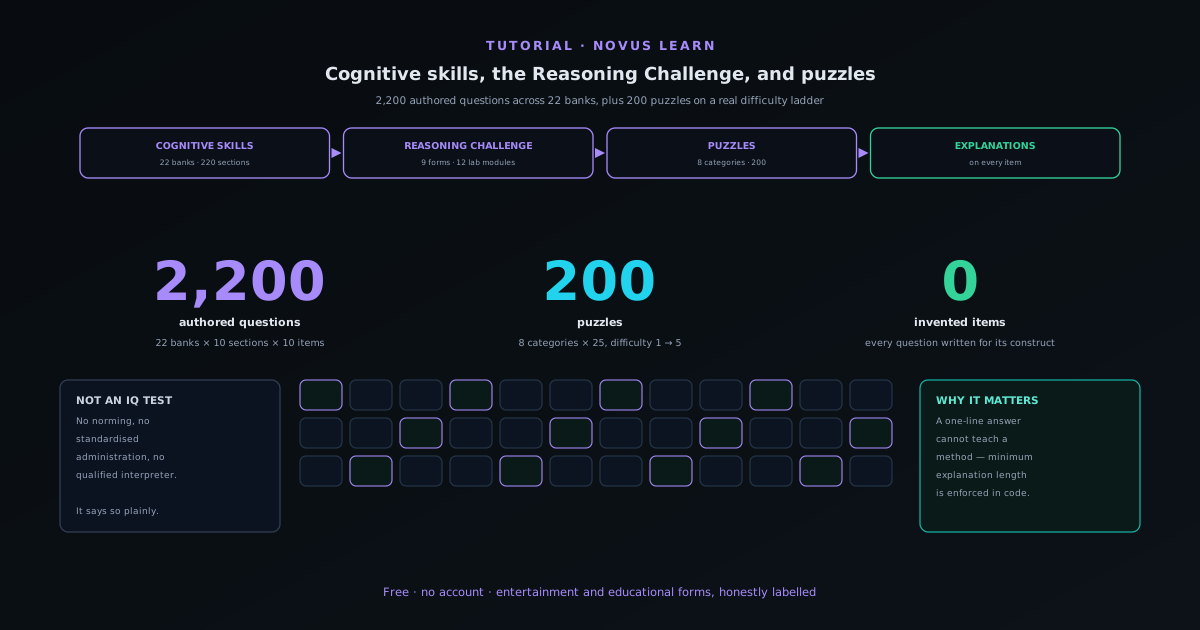
The assessment hub at /assessments holds three things that are easy to confuse and worth keeping separate: cognitive-skill practice organised by construct, the Novus Reasoning Challenge, and a puzzle catalogue. Together they carry 2,200 authored questions across 22 banks and 200 puzzles across 8 categories, all free, accountless, and stored on your device.
What makes this layer usable is a refusal rather than a feature. The Reasoning Challenge is not called an IQ test anywhere in its name, its copy, or its results, because a browser tool cannot deliver a standardised, normed, professionally interpreted score and implying otherwise would borrow authority it has not earned. This tutorial covers what each surface is for and how to read what it gives you.
Contents
Two ways to finish
Practise a construct
Work a named cognitive skill with worked explanations and printable packs.
Take a challenge or a puzzle
Sit a Reasoning Challenge form, or work the puzzle ladder for method rather than score.
- 1
1. Start at the assessment hub
Open learn.novusstreamsolutions.com/assessments. The hub is the map for three distinct surfaces: aptitude preparation aimed at hiring assessments, cognitive-skills practice organised around named constructs, and the Reasoning Challenge. Knowing which one you want first saves you from reading a puzzle score as though it were a diagnostic.
If you have a specific employer test in front of you, the aptitude surface is the right door and has its own walkthrough. If you want general reasoning practice, or you want to work on one specific mental skill, the cognitive-skills and puzzle surfaces are where to go.
- 2
2. Practise a cognitive construct properly
The cognitive-skills section at /cognitive-skills is built as 22 banks, each covering one construct, each with 10 sections of 10 items, 2,200 authored questions in total, every one written for its own construct rather than pulled from a general pool and relabelled. Working through a bank means practising a single, named mental skill rather than sampling a mixture and learning little from either.
A minimum explanation length is enforced in code, for a specific reason: a one-line answer cannot teach a method. You are meant to finish an item knowing why the answer is what it is, not merely whether you got it. Progress is kept per section at /cognitive-skills/progress, and printable packs live at /cognitive-skills/downloads for method work away from the clock.
- 22 construct banks · 220 sections · 2,200 authored items.
- Every item carries a worked explanation, not just a mark.
- Progress and printable packs have their own pages.
- 3
3. Understand what the Reasoning Challenge is, and is not
The Novus Reasoning Challenge at /iq-challenge offers 9 forms plus a 12-module practice lab, and publishes /iq-challenge/methodology, /iq-challenge/how-it-works, /iq-challenge/accessibility, and /iq-challenge/privacy. It describes itself as entertainment and educational, and that is a deliberate, load-bearing statement rather than legal hedging.
A real IQ instrument requires standardisation, norming against a representative population, controlled administration, and interpretation by someone qualified to do it. None of those are available to a web page, so a browser tool that presents a number as an IQ is making a claim it cannot support. Read the methodology page before you take a form; it tells you exactly what the score is a score of, which is the only thing that makes any score meaningful.
- 9 forms, a 12-module practice lab, and published methodology.
- Explicitly not an IQ test: no norming, no standardised administration.
- Accessibility and privacy pages are part of the surface, not buried.
- 4
4. Work the puzzle catalogue for method, not score
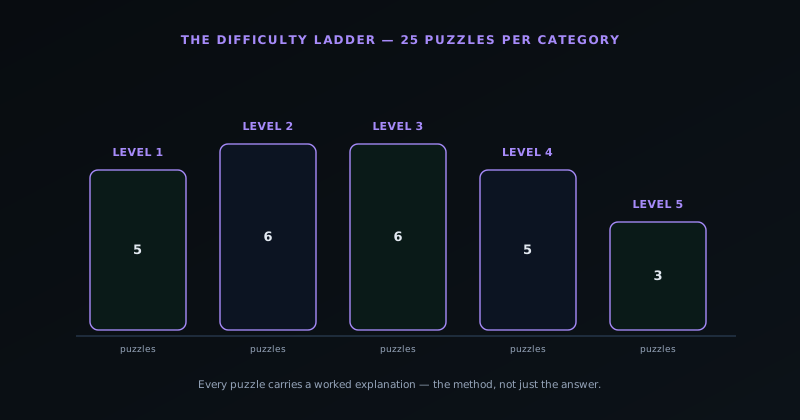
The puzzles at /puzzles hold 200 items across 8 categories, 25 per category, arranged on a deliberate difficulty ladder rather than shuffled. Each category ramps from level 1 to level 5 in a fixed distribution, so the numbering means something: the same position in any category is the same rung, and working a category top to bottom is a genuine progression rather than a random walk.
Puzzles are the right surface when you want to build a technique rather than measure yourself. There is no score to defend and no construct being estimated, just a problem, an attempt, and an explanation long enough to teach the method that solves the next one. That makes them the least anxious way into the reasoning material and often the most useful.
The ladder is fixed, so the same position in any category is the same rung, progression you can trust. - 5
5. Read your own results without over-reading them
Three habits keep this material useful. First, do not treat a point estimate as precise: a few points between two of your own section scores is very often noise, and reading it as a real strength difference is overreading the instrument. Look for large, consistent gaps across repeated attempts before concluding anything.
Second, avoid the labelling trap. A result that names you sticks far longer than a result that describes a performance, and labels are self-fulfilling: somebody told they are not a numbers person avoids numerical work, gets no practice, and confirms it. Third, keep the scope tight: material built to measure one narrow thing should not be deciding whether you change career or drop a subject.
- Small score gaps are usually noise, not a profile.
- Prefer descriptions of what happened over labels for what you are.
- The further a decision sits from what was measured, the less the score is worth.
- 6
6. Keep it local, and keep it free
The whole assessment layer is free and accountless, with progress kept on your device. That is not incidental. Assessment results are inferences about a person's abilities, which makes them unusually sensitive, and the common arrangement (trade an email address for a score, store it on a server, decide later what it is for) is a poor deal for whoever took the test.
It also has a quiet practical benefit. When nothing is recorded anywhere you cannot see, there is no reason to answer strategically, which means the result is about you rather than about the version of you that you thought was being observed.
Read the explanation, not the score
Every surface here is built so the explanation is the product and the number is a by-product. Work one construct at a time, read why the right answer is right and why yours was tempting, use the puzzle ladder when you want method without measurement, and treat the Reasoning Challenge as what it says it is, an educational and entertaining exercise with a published methodology, not a clinical instrument.
Frequently asked questions
Quick answers to common questions about this topic.
Is the Novus Reasoning Challenge an IQ test?
No, and it says so plainly. A genuine IQ instrument requires standardisation, norming against a representative population, controlled administration, and qualified interpretation, none of which a web page can provide. It publishes its methodology and describes itself as entertainment and educational.
How many cognitive practice questions are there?
2,200 authored questions across 22 construct banks, each bank holding 10 sections of 10 items. Every question is written for its own named construct, and a minimum explanation length is enforced so no item can ship with an answer too short to teach the method.
How is the puzzle catalogue organised?
200 puzzles across 8 categories, 25 per category, on a fixed difficulty ladder that ramps from level 1 to level 5. The ladder is identical in every category, so the same position always means the same rung.
Where are my results stored?
On your own device. The assessment layer is free and accountless, so nothing is uploaded to a profile, which also means there is no reason to answer strategically.
Related workflow
From a source you can cite to a study pack you can hand out
Read from the source rather than a summary of it, then turn what you verified into a document someone else can use.
- Find the source and check the claim against itNovus Learn: The study material is extractive, not generative: what you get back is what the source says, which is the only kind you can safely cite.
- Assemble and finish the packNovus PDF Studio: Merge the pieces, add the fields a learner fills in, and sign it locally, so unpublished material stays unpublished.
Related troubleshooting
Was this page helpful?
Your answer stays in this browser, it is not sent anywhere and no account or cookie is involved.