2026 · Novus StrikerAbout 14 min readNovus Stream Solutions
How a Novus Striker match resolves: the contest, the charge, and a keeper that parries
Arcade sports games usually hide their arithmetic. Novus Striker publishes it. This is a walk through the systems that decide a contested moment in the browser build (the tackle contest and its three outcomes, the four charge tiers, the six-gesture skill stick, the two-stage Power Strike that replaced a dice roll, and a keeper that either holds the ball or parries it back into play), plus an honest list of what the build still does not have.
Contents
- 1.Overview
- 2.The tackle is a contest, not a proximity check
- 3.Three outcomes, and why the middle one is wide
- 4.Four charge tiers, and a one-timer you cannot press
- 5.The skill stick: six gestures, and the input that cannot draw them all
- 6.Power Strike: two locks, and the dice roll that got deleted
- 7.The keeper holds it or parries it, and the rebound is live
- 8.Hazards belong to the arena, not to the rulebook
- 9.What the build does not have
- 10.Why the mechanics are published as data
- 11.Where to start
Overview
Most arcade sports games keep their arithmetic private. You press a button, something happens, and whether it happened because of what you did or because of a number you never see is left ambiguous on purpose: ambiguity reads as excitement. Novus Striker takes the opposite position, partly by temperament and partly because it is an early-access build in the browser where a player who cannot tell skill from noise simply closes the tab.
This article is a walk through the systems that actually decide a contested moment in the build you can load today. Almost every one of them replaced an earlier version that felt arbitrary, and the replacements are more interesting than the originals, because knowing what a rule is fixing tells you what to do with it. The game is in active development and this is not a claim that it is finished; it is a claim that the parts described here exist and behave this way, which is a much smaller and much more checkable claim.
The tackle is a contest, not a proximity check
The original tackle was a distance test. Any tap inside a steal radius against an opposing carrier took the ball outright: no contest, no timing window, no counterplay. Worse, that steal radius was larger than both the ability's own reach and the AI's tackle range, so any defender who got close enough stole the ball unconditionally. Defending was a positioning chore and being tackled felt like weather.
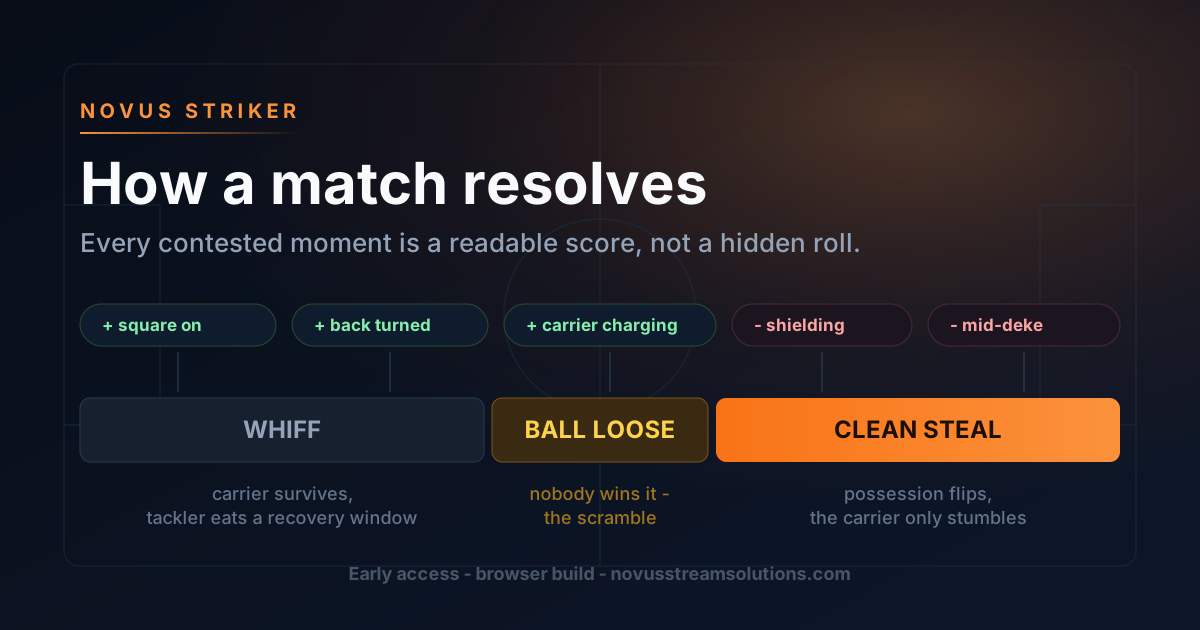
It is now resolved as a score, and the score is a sum of readable contributions rather than a tuned black box. The stat matchup between the tackler's defense and the carrier's technique sets the baseline, so the roster matters. Facing counts, because tackling square-on should beat swiping sideways at someone as they pass. A sprinting carrier is harder to dispossess than a walking one. Coming at a carrier whose back is turned is rewarded, because reading which way somebody is looking is a different skill from chasing them. A carrier who is winding up a charged action is committed and vulnerable, which is the risk that makes charging in traffic a genuine gamble. A carrier who is shielding has answered the pressure and is harder to take. And a carrier who is mid-deke beats the tap outright: the deke is the designed counter to a tackle, so it is not a modifier, it is a defeat.
A random roll is still involved. The honest description is not "there is no luck" but "the luck is measured against something you built". Every term in that sum answers the question "what did the player do?", not "how far apart were they?", which the range check already settled. Two players who make different decisions in the same geometry get different odds, and that is the whole point.
- Defence against technique: the stat matchup, so team choice shows up in defending too.
- Facing: square on beats side on, which makes approach angle a skill.
- Carrier speed: a sprinting carrier is harder to take off.
- Carrier charging: committed and vulnerable, the cost of holding the button in traffic.
- Carrier shielding: the carrier's deliberate answer, at the price of top speed.
- Back turned: rewards reading the carrier rather than following them.
- Carrier mid-deke: an outright defeat for the tackler, because the deke is the counter.
Three outcomes, and why the middle one is wide
The contest does not answer "did you get it, yes or no". It answers with one of three results. A clean steal flips possession immediately and leaves the dispossessed striker with a brief stumble. A whiff means the carrier survived and the tackler eats a recovery window, which exists so that spamming the tap is not strictly optimal: without a cost for losing, the correct strategy is to press the button constantly. And in the band around the middle, neither side wins it: the ball pops loose at a readable speed and both players stumble, which is the scramble.
That middle band is deliberately wide. A contest that always resolves cleanly one way or the other reads to a player as a coin flip, because the only information they get back is a binary. A scramble is a third state that both teams can still act in, and it converts a lost duel into a live situation rather than a verdict. It is also where a lot of the game's best moments come from, for the same reason a deflection is more interesting than a clean interception.
Four charge tiers, and a one-timer you cannot press
Passing and shooting are the same verb held for different lengths of time, and the hold has four outcomes: quick, charged, perfect and overcharged. A tap is fast and safe. A full hold is fast and loud. Perfect is a narrow window near the top of the charge. Overcharged is what happens if you sit past that window, and it costs you the ball, so the meter is not a power slider you fill to maximum; it is a timing decision with a failure state at the top.
The interesting interaction is with the tackle contest above. Charging tilts a contest toward the tackler, which means a full hold with a defender arriving is a real bet rather than a free upgrade. You are choosing between a weaker action taken now and a stronger one that leaves you exposed for the wind-up, and that choice is made in the open, because a charge draws an arc in the world, on the pitch, rather than hiding the state in a HUD meter. The defender arriving can read your commitment as clearly as you can, which is what makes the interaction between the two systems a read rather than a hidden roll.
First-time finishes work differently again: they are geometry rather than a special move. If your striker is already swinging when the ball arrives on a workable angle, the shot resolves as a one-timer. There is no dedicated button and nothing to press at the moment of contact. That is a design choice with a clear trade-off: a dedicated one-timer button would turn it into a reaction test, which rewards twitch; making it a property of where the ball and the striker actually are turns it into a positioning problem, which rewards reading the play a second earlier. Striker took the second option, and the cost is that a new player will produce one by accident before they produce one on purpose.
The skill stick: six gestures, and the input that cannot draw them all
Skill moves are gestures rather than buttons, driven by a recogniser that asks "what did the player draw?" separately from a table that asks "what does that mean?". Six gestures are recognised. A flick is the everyday sidestep: cheap, fast, low reward. A double tap is a committed straight-line burst, because the same direction twice reads as "go that way". A quarter-circle is a wider cut. A half-circle and a full rotation are the turn-away and the spin, the two moves that beat a committed defender, and the two that cost the most to input. Holding the stick is a shield, which is a sustained state rather than a one-shot move.
Effort and payoff are lined up on purpose: a full rotation is genuinely harder to draw under pressure than a flick, so the spin is worth more than the cut. If that relationship inverts, players stop using the harder input and the vocabulary collapses to one gesture.
The part worth stating plainly is the input asymmetry, because most games would quietly flatten it. A controller's right stick and the on-screen SKILL pad run the identical recogniser with identical thresholds: the touch pad is not a simplified version. A held right-mouse drag runs the same recogniser too, but a mouse flick cannot reliably express a quarter-circle or a double tap, so keyboard and mouse reaches three of the six rather than all of them. The game's own feature table carries a per-gesture availability column for exactly this reason instead of claiming "all inputs" and letting a player discover the gap by failing.
- Cut: flick. Available on keyboard and mouse, controller and touch.
- Swerve: quarter-circle. Controller and touch.
- Turn away: half-circle. Available everywhere.
- Spin: full circle. Available everywhere.
- Burst: double tap. Controller and touch.
- Shield: hold. Controller and touch, and a held state rather than a move.
Power Strike: two locks, and the dice roll that got deleted
The signature shot used to be a lie, and the team says so in the source. It resolved goal against save with a random draw and then faked the result: a "goal" was aimed at the net and a "save" was deliberately skewed wide. The timing mini-game the player had just performed only nudged the odds. The keeper was a spectator in its own penalty area, and no amount of skill beat a bad number.
It now runs as two timing locks. Time slows, a bar sweeps, and you lock power first and accuracy second. The ball then launches with the velocity and the aim error those two locks produced, and from that point it is an ordinary ball: the goal line and the keeper decide what happens, exactly as they do for every other shot in the match. A perfect Power Strike is not a guaranteed goal. It is a very hard one to stop, and that is a different feeling, which is the entire argument for the change.
Three rules keep it fair. The two stages compound (a good power lock widens the accuracy window), so the sequence has an arc instead of being two consecutive raffles. The striker is untouchable from activation to release, so no contest can dispossess you mid-strike; the answer to a Power Strike is to prevent it or to save it, not to interrupt it. And activation refuses without consuming the meter when the state is invalid, so a mistimed press does not silently burn a resource you spent a match building. The meter itself is per team and fills slowly from good play: completed passes, tackles and steals, dribbling, and shots.
The keeper holds it or parries it, and the rebound is live
Keepers used to be exempt from the catch-speed limit entirely, which meant any contact was a clean catch. A strike hit as hard as the engine allows was held as easily as a rolling back-pass, so there was no relationship between how hard you hit the ball and what happened next, which is most of why keeper outcomes felt arbitrary. It also removed rebounds from the game completely, and rebounds are where scrambles, second chances and a lot of the best goals come from.
The keeper now either holds the ball or parries it, and the split depends on speed. Below a low threshold the ball is comfortably held whatever else is true, because a weak shot squirming loose reads as a blunder rather than as difficulty. Above a high threshold even a good keeper only gets a hand to it. Between the two the chance is drawn from the ball's speed and the keeper's technique (which is what carries handling, so keeper choice matters in goal the way outfield stats matter outfield), and it is clamped away from certainty at both ends on purpose. A keeper who always holds deletes rebounds again; a keeper who never holds is farcical.
The parry itself is aimed. A ball deflected straight back down the shooting lane to the striker's feet is not a save, it is a delay, so a parry goes away from goal and to a side, and it carries roughly a third of the shot's pace: far enough to be genuinely contestable, not so far that the danger simply evaporates. That is why the rebound belongs to whoever reacted rather than to whoever shot.
Hazards belong to the arena, not to the rulebook
Some pitches are hostile. Electrified perimeter fences knock a striker down on contact, and toxic patches punish standing still. Both are per-stadium options rather than global rules, which means hazards are not on every pitch and you can learn the game without them before you meet them.
That split is worth noticing because it is the cheap way to get variety without fragmenting the game. The rules you learned (the contest, the charge tiers, the gesture vocabulary) are the same on every pitch. The arena changes what the space is worth: a fence turns the touchline into a threat, and a toxic patch turns standing and waiting into a cost. Nothing you learned stops being true; the map just stops being neutral.
What the build does not have
This is an early-access game and the gaps are large enough that listing them is not humility, it is information. The most conspicuous one: there is no sound. Not thin sound: no crowd, no impact, no music, because audio has not been authored yet. There is also no online multiplayer. Two players means two controllers on one machine joining local co-op, sharing the pitch and the same set of moves. There are no accounts and no save server, so settings live in your own browser and clearing site data clears them. And there is nothing to buy: no currency, no season pass, no cosmetics store.
The game also publishes its own defect list, which is the part worth copying. Choosing Quit from the pause menu freezes the game, because Quit calls the desktop shutdown path, which does nothing at all in a browser, so the game stops accepting input while waiting for an exit that never comes. Reloading the page fixes it and your settings survive. Fullscreen looks softer rather than sharper, because the canvas renders at a fixed size and is then stretched to your display instead of being redrawn at its pixel density; a maximised window is currently the sharper option. The Power Strike prompt can collide with other on-screen text, because that one HUD is still drawn by an older immediate-mode UI that does not obey the scaling the rest of the interface uses.
Career progression and tournaments are not in the build you can play. They are named on the roadmap, in the phase after the match itself is right, and the honest version of that sentence has no date attached to it.
- No audio of any kind: it has not been authored yet.
- No online multiplayer. Two players means two pads on one machine.
- No account and no save server; settings live in your browser.
- Quit from the pause menu freezes the game. Reload the page.
- Fullscreen is upscaled from a fixed canvas size, so it looks soft.
- Career and tournaments are roadmap, not shipped.
Why the mechanics are published as data
All of the above is readable because the game's own site keeps its mechanics, its known issues and its roadmap in one module that several pages render, rather than as prose typed separately onto each page. The rule its feature table is written under is a good one to steal: if a row cannot be performed in the release the site is currently serving, it does not belong on the page. That is a stronger constraint than "is this true?", because it fails a claim that is true of the source tree but not of the build a visitor can load, which is the most common way a game site ends up lying without anyone deciding to.
The same instinct shows up in the patch notes, where every entry corresponds to a build that actually shipped and no entry is padded to make the feed look busier. It shows up in the status page, which states in its own copy that it is maintained by hand and prints the date it was last reviewed, because a status page that looks automated and is not converts a stale value into a confident claim. And it showed up in a fix worth mentioning: the download size was once overstated in four separate places at once, and the correction was not to retype the right number but to sum it from the release manifest at build time so it cannot drift again. That is the general lesson: a figure that a human retypes is a figure that will eventually be wrong.
Where to start
Open the game and play a few minutes with the contest in mind. Try taking the ball square-on against a carrier who is charging a shot, then try the same tackle against one who is shielding, and notice that the two feel different because they are different. Deke past a tap deliberately at least once, so you know the counter exists. Save a Power Strike for a clear sight of goal and pay attention to the second lock, since that is the one that decides whether the keeper gets a hand to it.
Then send feedback, and be specific. "It feels bad" cannot be acted on; "the rebound from a parry keeps landing behind me" can. Move and gesture tables live at /features against the release being served; /releases is one entry per shipped WebGL build; /status lists known issues and the date the page was last reviewed. The hub keeps the documentation at Novus Striker, the current surface map at Tool maps, and a first-match walkthrough at Getting started with Novus Striker: first arcade match. Novus Striker is live, free, and unfinished, in that order.
Frequently asked questions
Quick answers to common questions about this topic.
Does a tackle just come down to luck?
There is a random element, but it is measured against a score built from what both players did: the defense-versus-technique matchup, your approach angle, how fast the carrier is moving, whether they are charging an action, shielding, or turned away from you. A carrier who is mid-deke beats a tap outright. Two players in identical geometry making different choices get different odds, which is the difference between a contest and a coin flip.
What actually happens when I hold the shoot button too long?
You overcharge and lose the ball. The four charge tiers are quick, charged, perfect and overcharged, and perfect is a narrow window near the top of the charge rather than the maximum of a slider. Holding past it is a failure state, not a bonus, which is what makes charging in traffic a decision instead of a free upgrade.
Why do I only get three skill moves on keyboard and mouse?
Six gestures are recognised, and a controller's right stick and the touch SKILL pad run the identical recogniser with identical thresholds. A held right-mouse drag runs the same recogniser but cannot reliably express a quarter-circle or a double tap, so the cut, the turn-away and the spin are available on mouse and the swerve, the burst and the shield are not. The game states that per gesture rather than claiming every move works on every input.
Is a perfect Power Strike a guaranteed goal?
No, and that is deliberate. The two timing locks set the shot's power and its aim error, and after release the ball is an ordinary ball that the goal line and the keeper resolve like any other shot. An earlier version drew goal-versus-save at random and then faked a trajectory to match; replacing that with a real ball means a perfect strike is very hard to stop rather than impossible to stop.
What is missing from the current build?
Sound, entirely: no crowd, no impact, no music, because audio has not been authored. Online multiplayer, so two players means two controllers on one machine. Accounts and a save server, so settings live in your browser. Career progression and tournaments, which are roadmap rather than shipped. Quit from the pause menu also freezes the game and needs a page reload, and fullscreen is upscaled from a fixed canvas so it looks soft.
Related workflow
A Striker match to a highlight clip worth posting
Capture the goal, tidy the capture, and hand each platform the format it wants.
- Play a match worth clippingNovus Striker: Browser play with no install means the capture is a plain screen recording, with nothing proprietary to export first.
- Trim and upscale the captureNSS Background Remover: Screen recordings are long and soft; the video utilities cut them down and sharpen them before encoding.
- Encode for each destinationNovus Convert: Compression with a measured result size, so the clip lands under the upload cap on the first attempt.
Related troubleshooting
Was this page helpful?
Your answer stays in this browser, it is not sent anywhere and no account or cookie is involved.