2026 · Novus StrikerAbout 13 min readNovus Stream Solutions
Building a game in the open
Most games arrive as a finished store page after months of silence. Novus Striker is doing the opposite: shipping a playable arcade soccer build in the browser while it is still in major development, and letting real matches shape what comes next. This is a look at what building in the open actually means, what is playable today, what is still expanding, and why the browser is the right venue for a game you can improve on a loop.
Contents
- 1.Overview
- 2.What building in the open actually means
- 3.Why the browser is the right venue for it
- 4.What is playable today
- 5.What is still expanding
- 6.The loop: ship, play, feedback, tune
- 7.Feedback is a first-class input, not a suggestion box
- 8.Shipping honestly beats shipping perfectly
- 9.Keeping an arcade game feeling instant
- 10.Designing for the highlight
- 11.Why a game lives in a portfolio of free apps
- 12.What to expect as it grows, and how to help
Overview
Most games reach you as a finished store page after a long stretch of silence: a trailer, a release date, and a download that arrives fully formed or not at all. Novus Striker is being made the other way around. It is an arcade soccer game you play in the browser (pick a team, chain combos, and bury a last-second screamer in an over-the-top match), and it is live today while it is still in major development. That combination is deliberate. The build is playable enough to be worth your time and honest enough to admit what it is not yet, and both halves of that sentence matter equally.
Building in the open is not a marketing pose here; it is the actual development method. Instead of guessing for months at what an arcade soccer game should feel like and unveiling the answer all at once, Striker ships a real build, watches how matches actually play, and tunes from there. This post is a walk through what that means in practice: what is playable right now, what is still expanding, why the browser is the right venue for a game you improve on a loop, and how the ship, play, feedback, tune cycle turns an unfinished game into a steadily better one. Nothing here is a promise about a distant version. It is a description of how the current one is being grown.
What building in the open actually means
The phrase gets used loosely, so it is worth being precise. Building in the open does not mean posting concept art and a wishlist button. It means the thing you can touch today is the real product, not a demo carved off from a hidden master build, and the roadmap is visible in the game rather than hidden behind an embargo. When you play Striker you are playing the same build the work is happening on, and when it changes you feel the change directly. There is no separate finished version being kept in a vault while you get a slice.
The tradeoff is honest and worth stating plainly. You are playing an unfinished game, which means some corners are rougher than a polished release and some things you might expect are still being built. In exchange, you get to influence the game while it is still soft enough to move, and you get improvements on a short cycle instead of one far-off launch. A silent pre-launch optimizes for a clean reveal; building in the open optimizes for a good game, because the fastest way to learn whether a match feels right is to let people play it and listen to what they say. Striker takes the second bet on purpose.
Why the browser is the right venue for it
A game you intend to improve on a weekly loop needs a delivery channel that can keep up, and the browser is exactly that channel. There is no launcher to update, no store review to clear, and no install for a player to perform before a fix can reach them. The build streams and caches the way any modern web app does, so the newest version simply loads on your next visit. That single property (updates that land without anyone downloading anything) is what makes shipping in the open practical rather than exhausting. The distance between fixing something and a player feeling the fix is a page reload.
It also lowers the cost of trying the game to almost nothing, which matters enormously for feedback. A player who has to find a store, create an account, and wait for an install is a player you have already lost most of before the first kick. A link that opens straight into a playable match keeps that friction near zero, so more people actually play, and more play means more of the honest, specific feedback that building in the open depends on. The browser is not a compromise venue for Striker; it is the venue that makes the whole method work, because it collapses distribution down to sharing a URL.
What is playable today
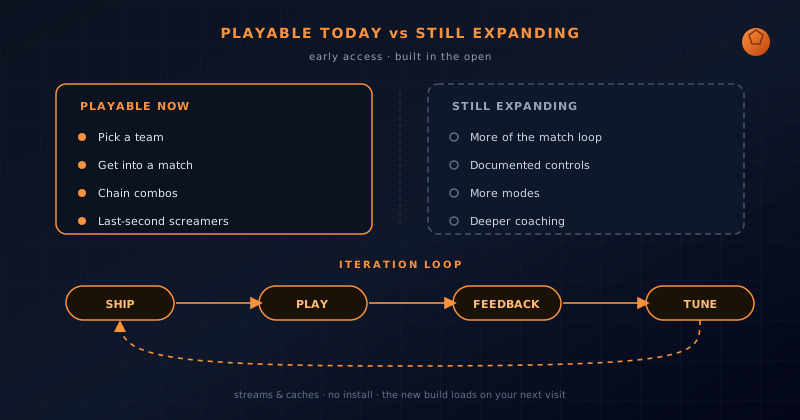
The current build is a real arcade soccer match, not a menu with a coming-soon banner. You pick a team, drop into a game, and play in the fast, exaggerated style the game is aiming for: chain combos together, work the ball into a chance, and go for the kind of last-second screamer that arcade soccer lives on. The loop that matters (get in, play a match, chase a highlight moment) is there to be experienced now. It is the core the rest of the game is being built around, and it is deliberately the first thing made playable so that everything after it is tuned against something real.
That focus is a choice about where to spend early effort. Rather than spreading thin across a long feature list that mostly sits behind locked doors, the build concentrates on making the moment-to-moment match feel good, because that feel is the thing no amount of surrounding structure can rescue if it is wrong. If picking a team and scoring a ridiculous goal is fun, the game has a foundation worth expanding. If it is not, no menu system or mode count would save it. So the playable core is small on purpose and central on purpose, and it is exactly the part your feedback is most useful on right now.
What is still expanding
Being built in the open means being specific about what is not finished, so here is the honest side of the ledger. More of the match loop is still being fleshed out around the core. The controls deserve clearer, documented explanation rather than being learned by feel alone. More modes are on the way beyond the current way to play. And the guidance that helps a new player understand the arcade style quickly (the onboarding and in-game coaching) is thinner than it will be. None of these are secrets being withheld; they are simply the parts of the game that have not been built yet, named out loud instead of implied by their absence.
Stating the gaps plainly is not an apology, it is part of the method. An early-access label only means something if it comes with an honest account of what early access covers, otherwise it is just a shield against criticism. By pointing directly at what is still expanding, the game sets accurate expectations (you know going in that you are playing a strong core inside an unfinished shell), and it turns the gaps into an agenda. Every item on the still-expanding list is a place where playing now and saying what you think has the most leverage, because those parts are still being decided.
The loop: ship, play, feedback, tune
The engine underneath building in the open is a short, repeatable cycle: ship a build, watch it get played, gather what players say, tune the game, and ship again. Each pass is small on purpose. Rather than accumulating a huge batch of changes and releasing them as an event, the loop favours frequent, modest adjustments that each answer a specific thing learned from real matches. Small steps are easier to attribute (when one variable moves and the game feels different, you know why), and they keep the distance between a problem and its fix measured in days rather than quarters. The browser delivery is what lets the loop run this tight.
What makes the loop trustworthy is that every stage is visible and none of it is theatre. Shipping means the live build actually changes. Play means real people take real matches, not a scripted internal demo. Feedback means specific reactions from those matches, not a satisfaction score. Tune means a concrete adjustment you can feel next time you play. When those four stages connect cleanly, the game gets better in a direction players can see, and the improvement compounds: each round starts from a slightly better base and a slightly clearer picture of what the game wants to be. That compounding is the entire payoff of developing this way.
Feedback is a first-class input, not a suggestion box
In a game built in the open, player feedback is not a courtesy inbox that gets skimmed occasionally; it is a primary source of direction. Use the Send feedback path on the live game while you play, and tell the truth about the match: what felt satisfying, what felt frustrating, what you expected to happen and did not, and what you wish existed. Early feedback on an in-development build carries far more weight than feedback on a finished one, because the game is still soft enough to change in response. You are not filing a complaint against a fixed object; you are voting on a direction while the vote still counts.
The specific is worth much more than the general, and the difference is enormous. A comment that a particular kind of shot feels unrewarding, or that a combo is hard to trigger on purpose, points straight at something tunable. A verdict that the game is good or bad, however sincerely meant, gives the loop nothing to act on. Building in the open asks players to be collaborators rather than reviewers, and the way to collaborate is to describe the moment (the shot, the combo, the scramble in front of goal) precisely enough that the next tuning pass can find it. The feedback loop is only as good as the detail people put into it.
Shipping honestly beats shipping perfectly
There is a temptation, with any game, to hide until it is flawless. Striker refuses that on principle. A perfect silent launch is a bet that you guessed right about fun without ever testing the guess, and fun is notoriously hard to guess. Shipping honestly (a genuinely playable core with a clearly marked unfinished edge) trades the clean reveal for something more valuable: contact with reality early enough to matter. The early-access framing is not a way to lower the bar. It is a promise that what you play is real and what is missing is named, so that nothing about the game's state is a surprise.
That honesty is also how a small operation earns trust. Overpromising a finished experience and delivering a rough one burns credibility fast; underpromising by shipping quietly wastes the very feedback that would make the game better. Saying exactly where the line is (this part is ready, this part is still being built) lets players calibrate their expectations correctly and judge the game on what it actually claims to be. It is the same posture the rest of the Novus Stream Solutions portfolio takes with its apps: be useful now, be honest about the edges, and keep improving in public rather than behind a curtain.
Keeping an arcade game feeling instant
Arcade soccer only works if it feels immediate, and that sets a hard constraint that shapes every decision. The game has to open quickly, respond the instant you act, and never make you wait through a loading wall between wanting to play and playing. Running in the browser helps here, because the same streaming-and-caching delivery that makes updates painless also means a returning player loads into a match fast. The goal is that the gap between clicking the link and controlling the ball stays short enough that the game feels like something you drop into, not something you launch and manage.
Responsiveness is also a feature that has to survive every change the loop makes. It would be easy to add depth and accidentally add lag, so the still-expanding work is measured against the arcade feel it must not break. A more elaborate match loop or an extra mode is only worth adding if the core stays crisp underneath it. Building in the open helps enforce that, because players notice sluggishness immediately and say so, and the feedback loop turns that complaint into a priority. The instant feel is not a launch-day property to be captured once; it is a standard the game has to keep clearing as it grows.
Designing for the highlight
Arcade soccer is not a simulation, and Striker leans into that difference on purpose. The game is built around the highlight (the improbable combo, the ball worked into a chance out of nothing, the screamer that goes in at the last second) because those moments are what make an arcade match memorable rather than merely competent. Design that chases realism spreads attention across a hundred systems; design that chases the highlight concentrates it on making the exciting moment reachable and satisfying. Every tuning decision can be checked against a simple question: does this make the great moment more likely to happen and better to pull off?
That north star is what keeps the game coherent while it is still being built. A feature that produces more highlights earns its place; a feature that dilutes them, however sophisticated, probably does not belong in an arcade game. This is also where player feedback is most pointed, because players know a highlight when they feel one, and they know when a moment that should have been thrilling landed flat instead. Steering by the highlight gives the ship, play, feedback, tune loop a clear target to aim at, so the game grows in a single direction (more and better moments) rather than sprawling into a checklist of features that never quite add up to fun.
Why a game lives in a portfolio of free apps
Novus Striker sits in the Novus Stream Solutions portfolio alongside tools like the Background Remover, the visualizers, the PDF and Convert utilities, and the reference apps, and at first glance a soccer game looks like the odd one out. It is not. The whole portfolio is built on the same premises: free to use, no barrier between you and the thing itself, delivered in the browser, and made with modern tooling by a small operation shipping fast. Striker is the games-and-fun corner of that ecosystem, and it follows the same rules the utilities do: open the link and it works, with no signup wall standing between you and a match.
Building the game in the open is the natural extension of how the rest of the apps are built, too. The utilities ship, get used, gather feedback, and improve on a loop; Striker does the same thing with a match instead of a task. Keeping a game in the portfolio also keeps the operation honest about range: the same approach that makes a free browser tool feel good has to make a free browser game feel good, and the game is a harder test of feel than most tools. If the ship, play, feedback, tune method can grow an arcade game that people actually enjoy, it validates the method for everything else in the ecosystem as well.
What to expect as it grows, and how to help
The honest forecast is the still-expanding list becoming the playable list, one loop at a time. Expect more of the match to fill in around the core, controls to get proper documentation instead of being learned by feel, more ways to play to arrive, and the onboarding that teaches the arcade style to get richer. None of that comes with a fixed date, because building in the open means shipping when a change is ready rather than holding it for a release event. The reliable promise is not a calendar; it is that improvements will keep landing on your next visit, and that the direction will keep being shaped by how the game actually plays.
The most useful thing you can do is the simplest: play it and tell us what breaks. Open Novus Striker in the browser, take a match, chain a combo, chase a screamer, and then use the feedback path to say what felt right and what did not. Read the early-access story for the fuller picture of why the game shipped now, and the getting-started tutorial to get oriented in the current build. A game built in the open is only as good as the loop feeding it, and the loop only runs if people play and speak up. That is the whole invitation: come play the unfinished thing, and help decide what it becomes.
Frequently asked questions
Quick answers to common questions about this topic.
Can I actually play Novus Striker right now, or is it just a teaser?
You can play it right now. Novus Striker is a real playable build, not a trailer or a waitlist. Open striker.novusstreamsolutions.com in a browser, pick a team, and start a match. It is in early access and still in major development, so it is honest about being unfinished, but the part that exists is genuinely there to be played rather than previewed.
Do I need to download or install anything?
No. Striker runs in the browser with no launcher, no store page, and no install step. The game streams and caches the way any web app does, so there is nothing to update by hand; the next build simply loads on your next visit. That is a large part of why building it in the open is practical at all.
What does "building in the open" mean for a game?
It means shipping something playable before it is finished and letting real matches steer what gets built next, instead of developing in silence for months and unveiling a finished product. The tradeoff is that you play an unfinished game; the payoff is that your feedback shapes it, and improvements arrive on a tight ship, play, feedback, tune loop rather than in one distant release.
How do I send feedback that actually changes the game?
Use the Send feedback path on striker.novusstreamsolutions.com while you play. Early player feedback is a first-class input in an in-development build: what feels good, what feels off, and what you wish existed all feed directly into the next round of tuning. Building in the open only works if the feedback loop is real, so it is treated as one.
Related workflow
A Striker match to a highlight clip worth posting
Capture the goal, tidy the capture, and hand each platform the format it wants.
- Play a match worth clippingNovus Striker: Browser play with no install means the capture is a plain screen recording, with nothing proprietary to export first.
- Trim and upscale the captureNSS Background Remover: Screen recordings are long and soft; the video utilities cut them down and sharpen them before encoding.
- Encode for each destinationNovus Convert: Compression with a measured result size, so the clip lands under the upload cap on the first attempt.
Related troubleshooting
Was this page helpful?
Your answer stays in this browser, it is not sent anywhere and no account or cookie is involved.