2026 · Novus Stream Solutions (hub)About 12 min readNovus Stream Solutions
Customer support that doesn't eat your whole week
For a one- or two-person business, support is the work that quietly expands to fill every hour. Here is how a tiny team handles it well (answering the questions before they are asked, templating the rest, and setting boundaries) without drowning or hiring.
Contents
- 1.Overview
- 2.Prevent the ticket before it happens
- 3.Build a help center that answers for you
- 4.Template the answers you still have to give
- 5.Set expectations and boundaries that hold
- 6.Support is your best product feedback channel
- 7.How you say no matters more than what you say
- 8.Batch support instead of being always-on
- 9.Turn standout support into word of mouth
- 10.Know which questions deserve your personal time
Overview
In a tiny business, customer support has a way of quietly becoming the job. When you are the founder, the maker, the marketer, and the shipping department all at once, you are also the support desk, and the questions do not arrive on a schedule: they trickle in all day, interrupting deep work, accumulating overnight, and expanding to fill whatever time you give them. Left unmanaged, support becomes the thing that swallows your week: not because any single question is hard, but because the volume and the interruption add up until you are spending your best hours answering the same things over and over instead of building the business. The goal of this guide is to make support good for customers without letting it consume the founder, and the path there is not working harder at it but designing it so most of the work never reaches you.
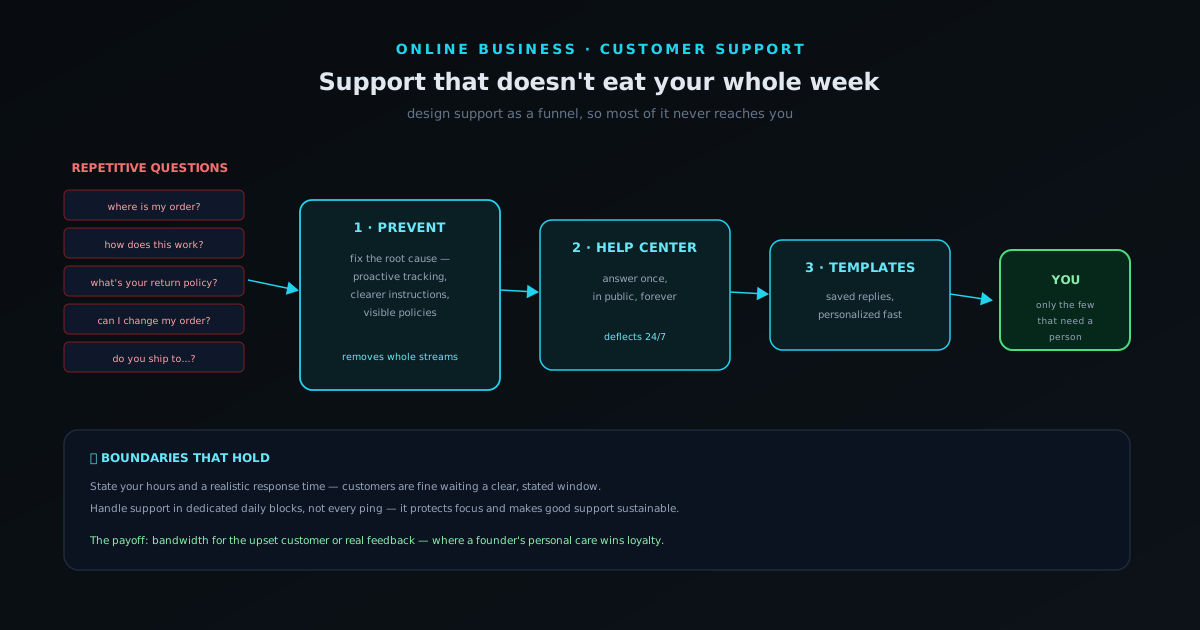
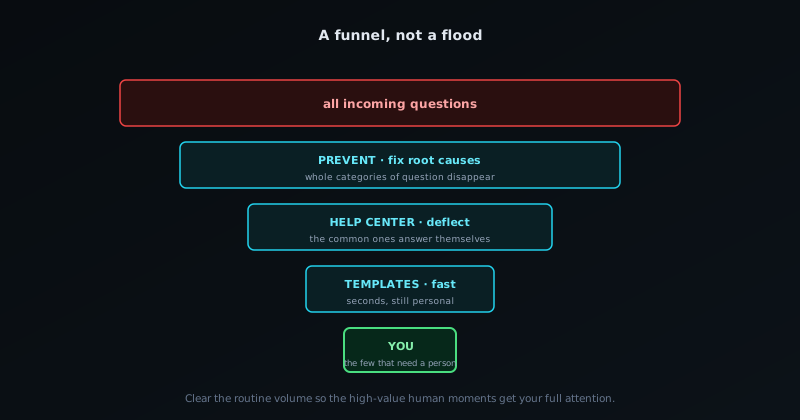
The reframe that unlocks everything is to stop treating support as a stream of individual questions to answer one at a time and start treating it as a system to design. Most support volume for a small business is not unique problems requiring your personal judgment; it is the same handful of questions asked repeatedly by different people, plus a smaller number of genuine one-offs that actually need you. Once you see that structure, the strategy is obvious: prevent the repetitive questions from being asked at all, template the answers to the ones that still come, and reserve your personal attention for the few that genuinely require it. That is how a one- or two-person team delivers support that customers find responsive and helpful while spending a fraction of the time a reactive, answer-everything approach would cost.
Prevent the ticket before it happens
The cheapest support question to handle is the one that never gets asked, and the single highest-leverage move in small-team support is preventing repetitive questions at their source. Every question a customer asks is a signal that something was unclear, missing, or broken somewhere in their experience, and the same questions recurring is a map of exactly where. If many people ask where their order is, your shipping communication is too quiet; if many ask how something works, your product or instructions are unclear; if many ask about returns, your policy is hard to find. Each recurring question points at a fixable root cause, and fixing the cause eliminates the whole future stream of that question rather than answering it one more time.
This turns support from a treadmill into a feedback loop that shrinks itself. Instead of just answering "where is my order?" for the hundredth time, you add proactive shipping notifications and tracking so customers know without asking; instead of re-explaining a confusing step, you fix the instructions or the product so the confusion stops; instead of fielding the same policy question, you make the policy obvious on the page where it matters. The discipline is to treat a recurring question as a bug report against your customer experience and fix the experience, so the question stops coming. Done consistently, this is what keeps support volume from growing with your customer count: each fix removes a category of question permanently, which is the only way a tiny team keeps support sustainable as it grows. The broader version of this operational thinking is in The boring operations that keep a small store alive.
Build a help center that answers for you
For the questions you cannot design away entirely, the next line of defense is a self-service help center: a FAQ or knowledge base where customers find answers themselves, any time, without waiting for you. A good help center is built directly from your actual support history: the questions you get asked most become the articles, written once, clearly, so that the next person with that question finds the answer instead of messaging you. This is leverage in its purest form: you answer the common questions a single time, in public, and that one answer serves everyone who has the question from then on, around the clock, including while you sleep. The help center is the part of your support that scales infinitely without your time.
The key to a help center that actually deflects questions rather than decorating the site is that it must be easy to find and genuinely useful: linked where people look for help, searchable, written in plain language that answers the real question rather than corporate hedging, and kept current as your product and policies change. A buried or out-of-date FAQ deflects nothing; a prominent, accurate one absorbs a large share of your volume. Build it incrementally (every time you answer a question that you suspect others will ask, turn that answer into a help-center article), and over time it grows to cover the bulk of what people need, leaving only the genuine exceptions for you. Pairing the help center with light automation, so customers are pointed to relevant answers before reaching a human, extends the deflection further without making it feel cold, which is the balance covered in Support automation that stays human: macros, AI drafts, and escalation paths.
Template the answers you still have to give
Even with prevention and a help center, some repetitive questions will still reach you directly, and the way to keep those from eating time is to template the answers. For any question you find yourself typing a response to more than a few times, save the response (a saved reply, a snippet, a canned answer), so that the next time, you insert the prepared text and personalize a touch rather than composing from scratch. This collapses the time per repetitive question from minutes of writing to seconds of selecting and tweaking, which across a day of support is the difference between support being a background task and being the whole day. Templates are how you handle volume without either rushing customers or burning hours.
The fear with templates is that they make support feel robotic, but done well they do the opposite: because the boilerplate is already written and correct, you have the time and attention to personalize the parts that matter (using the customer's name, acknowledging their specific situation, adjusting the tone) rather than spending all your energy reconstructing the same factual answer. A template is a starting point you adapt, not a wall you hide behind, and customers cannot tell the difference between a thoughtfully personalized templated reply and a fully hand-written one, because the parts they care about are personal either way. The result is responses that are fast for you and feel personal to them, which is exactly the combination a tiny team needs. Build the template library the same way as the help center (from your real, recurring questions), and the two together handle the overwhelming majority of your support load.
Set expectations and boundaries that hold
A tiny team cannot offer instant, around-the-clock support, and the mistake is pretending otherwise and then burning out trying to live up to an unstated promise of immediacy. The healthier and more honest approach is to set clear expectations: state when you respond (your support hours and a realistic response time), so customers know what to expect and are not left wondering, and so you are not implicitly on call every waking hour. Customers are generally fine waiting a reasonable, stated time; what frustrates them is uncertainty and silence, not a clear "we respond within one business day." Setting and meeting a realistic expectation satisfies customers better than an unrealistic promise you cannot keep, and it protects your time and sanity.
Boundaries also mean batching and structure rather than reacting to every message the instant it arrives. Constant context-switching to answer each ping as it comes destroys your ability to do focused work and makes support feel like an endless interruption; handling support in dedicated blocks (a couple of defined times a day) lets you process the queue efficiently and protects the rest of your day for the work that actually grows the business. This is not neglecting customers; it is serving them within a sustainable rhythm, which is what lets a one-person operation keep doing it well over the long run instead of collapsing into reactive exhaustion. The boundary is what makes good support repeatable. A founder who answers instantly at all hours feels responsive for a month and resentful by the third; one who answers reliably within a stated window does it indefinitely.
Support is your best product feedback channel
The most valuable thing a tiny team can extract from support is not goodwill but information, because every ticket is a data point about where the product or the messaging is failing. A question asked repeatedly is not just a support load to template away; it is the product telling you something is confusing, missing, or broken, and the highest-leverage response is often to fix the underlying cause so the question stops being asked. Treating support as a feedback channel rather than a cost centre turns the burden into the cheapest user research you will ever get.
The practical habit is to notice patterns rather than handle each ticket in isolation: when the same confusion recurs, that is a signal to change the product, the onboarding, or the copy, not just to answer faster. A tiny team has an advantage here that large companies lose: the person answering support is often the person who can change the product, so the loop from complaint to fix is short. Closing that loop, fixing the causes of the most common tickets, is what keeps support volume from growing in lockstep with the user base, which is the only way a tiny team survives growth.
How you say no matters more than what you say
A tiny team cannot say yes to everything, so a lot of support is, in effect, saying no (no refund outside the policy, no, that feature does not exist, no, we cannot do that), and the difference between a no that loses a customer and one that keeps them is almost entirely in the tone. A curt, policy-citing no reads as a wall; the same no delivered with genuine acknowledgement of the person frustration, a clear reason, and where possible an alternative reads as a human doing their honest best. The decision is often the same; the relationship outcome is not.
This is the one place where being small is a genuine advantage worth leaning into. A real person who clearly read the message, responds with warmth, and treats the customer as a person rather than a ticket number delivers an experience large support operations struggle to match, and it costs nothing but attention. Even when the answer is unwelcome, customers remember being treated decently, and that memory is disproportionately valuable for a small brand that lives on reputation. The content of support can be templated; the tone has to be human, and that is the part a tiny team can do better than anyone.
Batch support instead of being always-on
A trap that burns out small teams is treating support as an interrupt (answering every message the moment it arrives), which destroys the focus needed for the deeper work only you can do. The healthier pattern is to batch support into defined windows: handle it once or twice a day in a focused block rather than letting it fragment every hour. Most support is not as urgent as the unread badge makes it feel, and customers are well served by a thoughtful reply within a reasonable window rather than an instant but distracted one.
Batching also makes the work itself faster, because you stay in the support mindset and tools for a concentrated stretch rather than paying the context-switching cost dozens of times a day. Setting expectations openly (telling customers when they can expect a reply) is what makes batching possible without anxiety, because a known response window removes the pressure to be instantly available. Protecting your focus this way is not neglecting customers; it is the only way a tiny team can both support people well and still build the product that makes support worth giving.
Turn standout support into word of mouth
For a small brand, an exceptional support moment is not just damage control; it is marketing, because people talk about being treated unexpectedly well far more than about a transaction that merely worked. The rare ticket where you go beyond what was expected (solving a problem that was not strictly your fault, responding with real care to someone having a bad day) can create an advocate who tells others, and word of mouth from a delighted customer is worth more than any ad a tiny budget can buy. The moments that feel like a cost are sometimes the best investment available.
This does not mean over-serving every ticket, which a tiny team cannot afford; it means recognising the moments where a little extra effort buys disproportionate goodwill and spending it there deliberately. The earlier discipline of preventing, deflecting, and templating the routine tickets is what frees the time to be genuinely excellent on the ones that matter. Support handled this way becomes part of the brand rather than a drag on it: the routine load minimised by systems, and the human attention concentrated where it turns a customer into someone who recommends you.
Know which questions deserve your personal time
The whole point of preventing, deflecting, templating, and boundary-setting is to clear away the repetitive volume so that the few interactions that genuinely deserve your personal attention actually get it. Not every support contact is equal: a routine "what is my tracking number" is best handled by automation or a template, but an upset customer with a real problem, a thoughtful piece of product feedback, or a situation that could become a great story or a bad review is exactly where a founder's personal, human attention creates disproportionate value. The goal is not to minimize all support contact; it is to minimize the low-value repetitive contact so you have the time and energy for the high-value human moments.
This is where a tiny team actually has an advantage over a big company, if it manages its time well. A large support operation answers everything with scripted distance; a founder who has cleared the routine volume can give a struggling customer real, personal care, the kind that turns a complaint into loyalty and a bad moment into a five-star review and a story the customer tells others. That personal touch is a genuine competitive edge, but only if you have preserved the bandwidth for it by handling everything else efficiently. The sensitive situations most worth that personal attention (refunds, guarantees, things going wrong) are also the ones most worth having a clear policy for in advance, covered in Refunds, guarantees, and chargebacks: policy design that protects margin and trust. Designed this way, support stops being the thing that eats your week and becomes a manageable system that mostly runs itself, surfacing to you only the moments where you, specifically, can make the difference.
Frequently asked questions
Quick answers to common questions about this topic.
How does a one- or two-person business keep support from eating all its time?
By treating support as a system to design rather than a stream of questions to answer. Prevent repetitive questions by fixing their root causes, deflect common ones with a self-service help center, template the answers you still give, set clear response-time expectations, and reserve personal time for the few interactions that genuinely need it.
How do I reduce the number of support questions I get?
Treat each recurring question as a bug report on your customer experience and fix the cause. Lots of "where is my order?" means add proactive shipping updates and tracking; repeated how-to questions mean clearer instructions; policy questions mean making the policy obvious. Fixing the cause removes the whole future stream of that question.
Do templated support replies feel impersonal to customers?
Not when used well. Because the factual boilerplate is already written, you have the time to personalize the parts customers actually care about: their name, their specific situation, the tone. A thoughtfully personalized templated reply is indistinguishable from a hand-written one to the customer, and far faster for you.
Is it okay not to offer instant, 24/7 support as a tiny team?
Yes, and pretending otherwise leads to burnout. Set clear support hours and a realistic response time so customers know what to expect; they are generally fine waiting a stated, reasonable window. Handle support in dedicated daily blocks rather than reacting to every ping, which protects focus and makes good support sustainable long-term.
Related troubleshooting
Was this page helpful?
Your answer stays in this browser, it is not sent anywhere and no account or cookie is involved.