2026 · Novus Stream SolutionsAbout 12 min readNovus Stream Solutions
The boring operations that keep a small store alive
New sellers obsess over products and marketing and neglect the unglamorous operations that actually decide whether a store survives: fulfillment, inventory, service, and the weekly numbers. Here is what to get right.
Contents
- 1.Overview
- 2.Operations are the business; the product is the excuse
- 3.Fulfillment: the promise you actually keep
- 4.Inventory: the cost of getting it wrong in both directions
- 5.Customer service as retention, not cost
- 6.The numbers you check every week
- 7.Returns, refunds, and the trust they protect
- 8.Systematize the repetitive, not the rare
- 9.One source of truth keeps it from unraveling
- 10.Why boring is the moat
Overview
New sellers spend almost all of their attention on the exciting parts (the product, the branding, the marketing) and almost none on the operations, which is exactly backwards from what determines survival. A store does not usually die because its product was bad or its marketing was weak; it dies because orders did not ship on time, inventory ran out or piled up, customers could not get help, and the owner never looked at the numbers until it was too late. The unglamorous operational work is the actual business, and the product is, in a sense, just the excuse to do it. This is a field guide to the boring operations that keep a small store alive, because those are the parts that quietly decide whether it does.
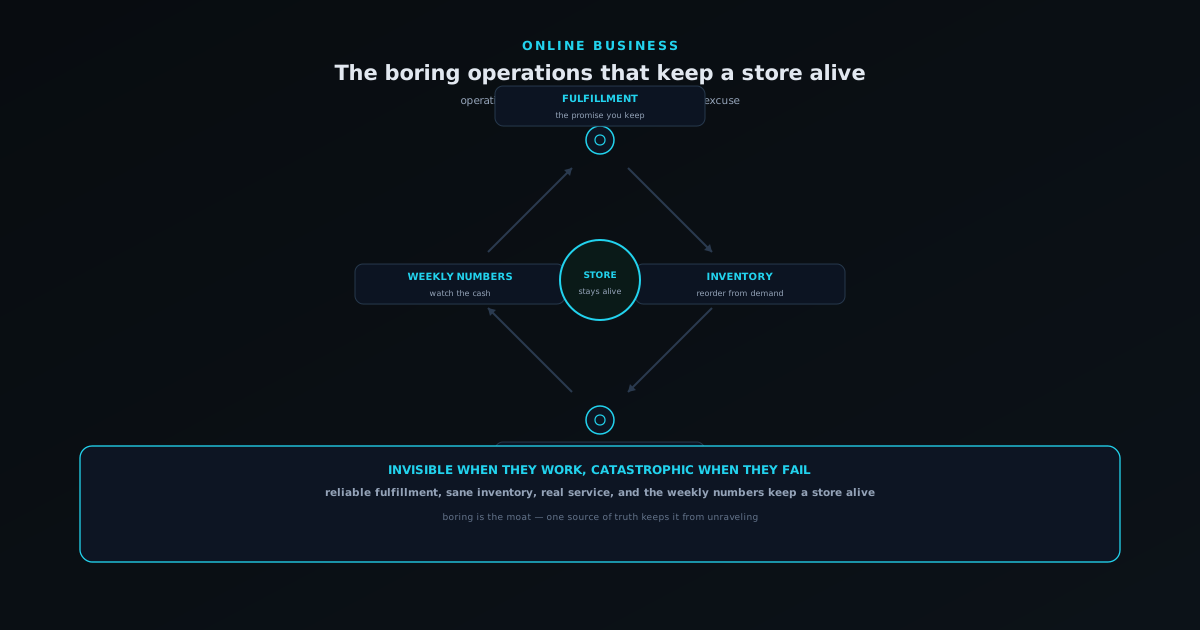
The reason operations get neglected is that they are invisible when they work and only noticed when they fail, which makes them feel optional right up until they are catastrophic. A smooth fulfillment process generates no excitement; a broken one generates refunds, bad reviews, and chargebacks. Good inventory management is unremarkable; bad inventory management is either stockouts that lose sales or dead stock that ties up cash. The whole category of operational work is like this (it earns no applause for being done well and inflicts real damage when done badly), which is precisely why disciplined sellers treat it as the core of the business rather than an afterthought.
Operations are the business; the product is the excuse
It helps to reframe what a store actually is. From the customer's side, your store is not really the product; it is the experience of ordering the product and receiving it as promised. A customer who orders and gets exactly what they expected, when they expected it, with easy help if something goes wrong, has had a good experience regardless of how clever your product page was. A customer who orders and then waits too long, receives the wrong thing, or cannot reach anyone has had a bad experience even if the product itself is excellent. The operations are the experience, and the experience is what people remember, review, and return for.
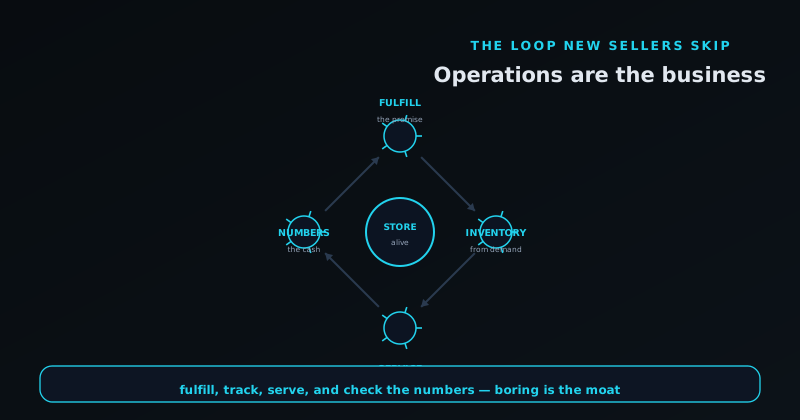
This reframe matters because it reorders your priorities correctly. If operations are the business, then reliable fulfillment, accurate inventory, and responsive service are not back-office chores to minimize but the core product to perfect. The most successful small stores are often not the ones with the most exciting products but the ones that execute the boring parts flawlessly: the order always arrives, the help is always there, the experience is always consistent. Treating operations as the real product rather than a cost to be cut is the mindset shift that separates stores that survive from stores that quietly disappear after their initial marketing push fades.
Fulfillment: the promise you actually keep
Fulfillment is where your marketing promise becomes a kept or broken commitment, and it is the operation customers judge most directly. When someone buys, they have been promised a thing by a certain time, and fulfillment is the process of actually delivering on that: picking, packing, shipping, and getting it to them in the condition and timeframe they expected. Every step has failure points: the wrong item, damage in transit, a delay, a lost package. The store that keeps its fulfillment promise reliably builds trust with every order; the store that breaks it erodes trust just as steadily, and erosion is expensive because a customer burned once rarely comes back.
For a small store, the goal is not a sophisticated fulfillment operation but a reliable one, and the two are different. You do not need same-day shipping or a warehouse; you need a process that consistently delivers what was promised, even if that process is partly manual at first. Whether you fulfill yourself or through a service, the key is that the promise on the product page matches what actually happens, and that you do not promise faster or more than you can reliably deliver. Underpromising and reliably keeping it beats overpromising and frequently missing, because reliability is what builds the trust that turns a first order into a repeat customer. Get fulfillment dependable before you get it fancy.
Inventory: the cost of getting it wrong in both directions
Inventory is a balancing act with a real cost on each side, and small stores often discover both the hard way. Run out of stock and you lose sales you had already earned through marketing, frustrate customers who were ready to buy, and on some channels damage your standing. Carry too much and you tie up cash in product that is not selling, take on storage costs, and risk being stuck with goods that go out of season or out of style. Neither error is forgiving: stockouts waste demand you paid to create, and overstock freezes the cash a small business most needs to stay flexible. Inventory management is the discipline of staying in the narrow band between those two costly mistakes.
The practical approach for a small store is to track what is actually selling, reorder based on real demand rather than optimism, and resist the temptation to over-order for a discount that locks up cash you cannot spare. Forecasting does not have to be sophisticated, but it has to be honest, based on what has actually sold, not on what you hope will sell. Starting conservative and reordering as demand proves itself protects the cash flow that keeps a small store alive, even if it occasionally means a brief stockout on a winner. Tying up your limited capital in inventory you guessed at is one of the fastest ways a small store runs out of room to operate, so the boring discipline of matching stock to real demand is genuinely existential.
Customer service as retention, not cost
Customer service is usually framed as a cost to minimize, which is a mistake that quietly kills small stores. Service is where you save the relationships that operational hiccups would otherwise lose: an order goes wrong, a customer has a question, something does not fit, and how you respond determines whether that customer leaves angry and warns others, or stays loyal because you handled it well. Good service turns a problem into a reason to trust you more, because a customer who sees you make things right has more confidence than one who never had a problem at all. Treating service as retention rather than overhead reframes it as one of the highest-leverage operations you have.
For a small store, the advantage in service is that you can be genuinely responsive and human in a way large operations struggle to match. A real, prompt, helpful reply from someone who clearly cares is a competitive advantage, and it costs mostly attention rather than money. The point is not to build an elaborate support system but to make sure customers can reach you and that you respond in a way that resolves the issue and protects the relationship. The stores that retain customers are often the ones whose service made people feel taken care of, and that feeling is built in exactly the moments (a complaint, a confusion, a mistake) that a store treating service as a cost would handle carelessly.
The numbers you check every week
A store stays alive partly because its owner actually looks at it, and looking means a small, regular set of numbers rather than a vague sense of how things are going. The weekly numbers that matter for a small store are the basic vital signs: what sold, what it cost, what came in versus what went out, what is running low, and whether cash is growing or shrinking. None of this requires sophisticated analytics; it requires the discipline to look at the real figures regularly so that problems are caught while they are small. The owner who checks weekly notices a slipping margin or a building inventory problem in time to act; the one who never looks finds out when the cash runs out.
The cash position especially is the number a small store cannot afford to ignore, because cash flow, not profit on paper, is what keeps the doors open. A store can be profitable on paper and still die because its cash is tied up in inventory or stuck in delayed payouts while bills come due. Watching the actual flow of money (in from sales, out for inventory and costs) week by week is what keeps a small operation from being blindsided. The weekly review is boring precisely because most weeks nothing alarming shows up, but it is exactly that habit of looking when nothing is wrong that lets you catch the week when something is. Skipping it because it is dull is how owners get surprised by problems that were visible for months.
Returns, refunds, and the trust they protect
Returns and refunds feel like pure loss, but how you handle them is an operation that protects the trust your whole store runs on. A clear, fair returns process reassures customers enough to buy in the first place (people are more willing to purchase when they know they can return something that does not work out), and handling returns gracefully turns a potential negative into evidence that you are trustworthy. A store that fights returns, hides its policy, or makes refunds painful saves a little money per case and loses far more in the trust and repeat business that a fair process would have preserved. The returns operation is part of the buying experience, not separate from it.
The discipline is to make the policy clear up front and honor it without friction, treating returns as a cost of doing business honestly rather than a battle to win. There is also a feedback loop hiding in your returns: a pattern of returns for a particular reason (wrong sizing, mismatched expectations, a quality issue) is operational data telling you something about your product pages, your sourcing, or your descriptions. Stores that listen to why things come back can fix the upstream cause and reduce future returns, while stores that just grumble about returns keep paying for the same preventable problem. Handled well, the returns operation both protects trust in the moment and improves the store over time.
Systematize the repetitive, not the rare
As a store grows, the instinct is to systematize and automate everything, but the right discipline is to systematize the repetitive and leave the rare alone. The operations you do many times a day (processing orders, updating inventory, answering the same few questions) are where systems and automation pay off, because the time saved compounds and the consistency reduces errors. The operations you do rarely, or that vary every time, are usually not worth the effort of systematizing, because you will spend more building the system than you ever save using it. Over-systematizing rare tasks is a common way small operators waste the time they meant to save.
The honest rule is to do things manually until the manual version genuinely hurts, then systematize the specific part that hurts, and no more. Premature systems are a form of procrastination that feels productive: building infrastructure for a volume you do not have, or automating a process you have not even stabilized. Let the repetition reveal what is worth automating: the task you find yourself dreading because you do it twenty times a day is the one to systematize, while the odd exception that comes up once a month can stay manual. This keeps your operations lean, focuses your effort where it compounds, and avoids the trap of building an elaborate operational machine for a store that has not earned it yet.
One source of truth keeps it from unraveling
As soon as a store sells in more than one place or tracks information in more than one spot, the risk of things diverging appears, and divergence is where operational chaos comes from. If inventory lives in two systems that disagree, you will oversell or undersell; if pricing differs between channels, you will confuse customers and yourself; if order information is scattered, something will fall through the gaps. The defense is a single source of truth (one canonical record of products, prices, inventory, and orders that everything else reflects), so that there is never a question of which version is correct. The boring discipline of keeping one authoritative record prevents a whole category of expensive mistakes.
This does not require expensive software for a small store; it requires the discipline to designate one place as authoritative and to update it rather than letting parallel copies drift. The moment you have two records that can disagree, you have created work (reconciliation) and risk (acting on the wrong one). Keeping a single source of truth, and treating every channel and view as a reflection of it rather than an independent copy, is what lets a small operation stay consistent as it grows. It is unglamorous infrastructure, but it is exactly the kind of boring operational discipline that keeps a store from slowly unraveling into a tangle of conflicting numbers nobody trusts.
Why boring is the moat
The reason all of this is worth taking seriously is that operational excellence is a genuine competitive advantage precisely because it is boring and most competitors neglect it. Anyone can copy your product or your marketing, but consistently reliable operations (orders that always arrive, service that is always there, a store that simply works every time) are built through sustained, unglamorous discipline that is hard to fake and hard to match. A small store that executes the boring parts flawlessly will quietly outlast flashier competitors who let their operations slip, because customers reward reliability with repeat business and trust. The boring work compounds into a reputation, and reputation is a moat.
This is the encouraging part of an otherwise unglamorous truth: the operations that feel like a grind are exactly where a small, careful operator can win against larger or better-funded competitors. You cannot outspend them on marketing, but you can out-care them on the details: the order that ships correctly every time, the question answered promptly, the return handled gracefully. Those details are where small stores earn the loyalty that keeps them alive, and they are available to anyone willing to take the boring work seriously. The product gets the attention, but the operations keep the store alive, and treating the boring parts as the real business is the quiet discipline behind the stores that last.
- Fulfillment: deliver exactly what was promised, on time, reliably before fancily.
- Inventory: reorder from real demand; avoid both stockouts and cash-trapping overstock.
- Service: treat it as retention; be responsive and human, especially when something goes wrong.
- Weekly numbers: check sales, costs, low stock, and cash even when nothing looks wrong.
- Returns: clear, fair, frictionless, and read them as data about upstream problems.
- One source of truth: keep a single canonical record so channels never drift apart.
Frequently asked questions
Quick answers to common questions about this topic.
What operations actually keep a small store running?
The unglamorous ones: reliable fulfillment, fast support, accurate inventory, and basic bookkeeping. Marketing gets attention, but consistent operations are what keep customers and the business alive.
Why do boring operations matter more than they seem?
Because failures there (a late order, a wrong charge, an oversell) directly destroy trust and create refunds and churn. Doing the basics reliably is a competitive advantage most stores neglect.
How do I keep operations consistent as a solo owner?
Document them as lightweight SOPs and automate the repetitive parts. See SOPs for a tiny team: documenting the business so it survives you taking a week off.
Related troubleshooting
Was this page helpful?
Your answer stays in this browser, it is not sent anywhere and no account or cookie is involved.