2026 · Novus Stream Solutions (hub)About 12 min readNovus Stream Solutions
Terms, privacy, and refund policies without a lawyer
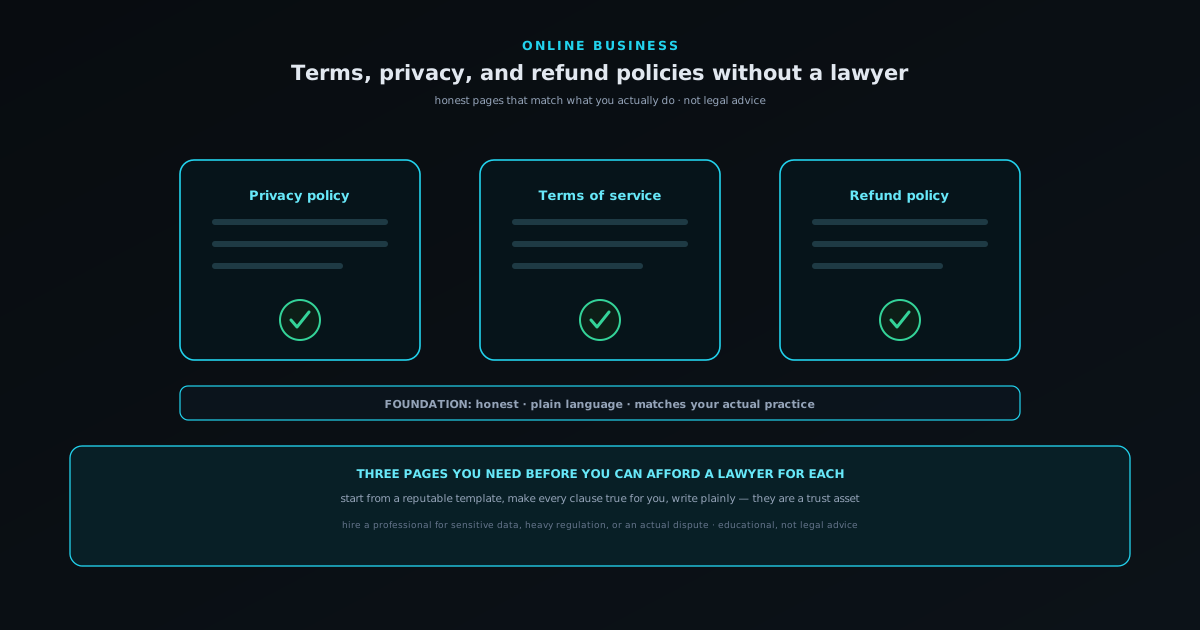
A privacy policy, terms of service, and a clear refund policy are table stakes for an online business, and you usually need them before you can justify paying a lawyer for each. This is how to write honest, useful versions yourself: what each is for, how to use templates safely, and where doing it yourself stops being wise.
Contents
- 1.Overview
- 2.These pages are a trust asset, not just compliance
- 3.The three documents and what each is for
- 4.Start from a reputable template, not a blank page
- 5.The privacy policy must describe what you actually do
- 6.Terms of service: setting expectations and limits
- 7.A refund policy that prevents disputes
- 8.Plain language beats legalese for trust
- 9.Where you genuinely need a lawyer
- 10.Keep them current and easy to find
- 11.Honest policies are worth the effort
Overview
A necessary disclaimer up front, and it is the whole spirit of this piece rather than a formality: this is general information about the policy pages a small online business typically needs, not legal advice, and laws differ by where you and your customers are. The aim here is to help you produce honest, useful first versions of these documents yourself, and to recognise the specific moments when you should stop doing it yourself and pay for real advice. With that said, the practical reality most small operators face is simple: you need a privacy policy, terms of service, and a refund policy from roughly day one, and you usually cannot justify a lawyer’s fee for each of them at that stage.
That gap (needing the documents before you can afford bespoke legal work on them) is where a lot of small businesses either freeze or paper over the problem with something they never read. Neither is good. The better path is to understand what each document is actually for, produce a clear and honest version from a reputable starting point, make sure it matches what your business genuinely does, and budget real legal help for the parts and the moments that truly warrant it. Done this way, your policies stop being scary boilerplate you copied and forgot, and become what they should be: a clear, trustworthy account of how you handle data, what you promise, and what happens when something goes wrong.
These pages are a trust asset, not just compliance
It is tempting to treat policy pages as pure compliance (a box to tick so nobody sues you) but that framing leads to bad, ignored documents. The more useful view is that these pages are a trust asset, read by exactly the kind of careful customer you most want: the person deciding whether to hand you their money or their data, who clicks "privacy policy" or "refund policy" precisely because they are taking you seriously. What they find there shapes whether they proceed, and a clear, honest, human-readable policy reassures them in a way that dense boilerplate or, worse, a missing page never will.
This reframing changes how you write them. A compliance mindset produces the longest, most defensive document possible and hides it in the footer; a trust mindset produces a clear document that genuinely answers the questions a cautious customer is asking and makes it easy to find. The second is both better for the customer and, in practice, better protection for you, because a policy that accurately and plainly describes what you do is more defensible than a vague template that contradicts your actual practice. The pages do double duty (they meet a real obligation and they earn confidence) and writing them as if a real person will read them is how you get both.
The three documents and what each is for
Before writing anything, it helps to be clear on the distinct job each document does, because they are often lumped together and they are not interchangeable. Each answers a different question for a different reason, and conflating them produces a muddle that serves none of their purposes. The three that nearly every consumer-facing online business needs, and what each one is actually for:
Understanding these as three separate jobs is what keeps each one focused and honest, rather than a single sprawling page that tries to do everything and communicates nothing.
- Privacy policy: tells visitors what personal data you collect, why, how you use and protect it, and what choices they have, driven by data-protection law and by basic trust.
- Terms of service: sets the rules for using your site or product: acceptable use, your and the user’s responsibilities, disclaimers, and limits on liability.
- Refund / returns policy: states plainly what a customer can expect if they want their money back or need to return something: the conditions, the window, and the process.
Start from a reputable template, not a blank page
Writing these from scratch is a mistake in the other direction: you are not going to out-draft decades of accumulated legal convention, and trying to invent the structure yourself is how you omit something important. The sensible starting point is a reputable template appropriate to your type of business and your jurisdiction, used as a skeleton you then make true rather than a finished document you paste in unread. Good templates encode the structure and the standard clauses you would not think to include; their weakness is that they are generic, and a generic policy that does not match your actual business is both useless to the reader and potentially worse than nothing legally.
So the template is the beginning of the work, not the end of it. The real task is going through it clause by clause and making each statement accurately describe your business: deleting the parts that do not apply, filling in the parts that do with what is actually true for you, and flagging anything you do not understand for later professional review rather than leaving boilerplate you cannot explain. A template you have read, understood, and adapted to your reality is a legitimate document; a template you pasted in with the placeholder company name still in it is a liability that signals you did not take the page seriously, which is exactly the opposite of the trust the page is supposed to build.
The privacy policy must describe what you actually do
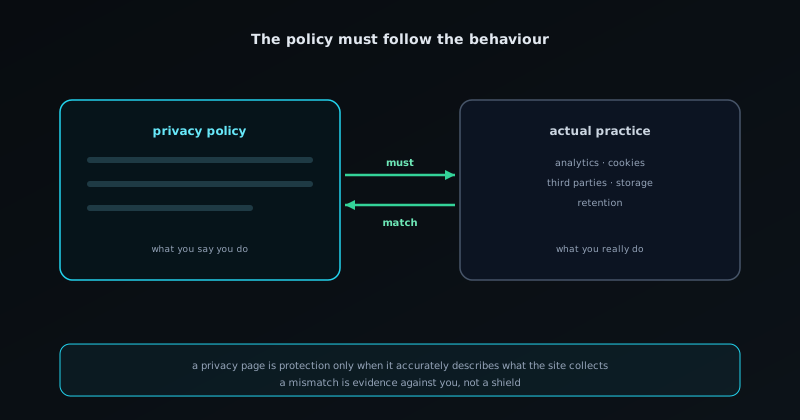
The single most important property of a privacy policy is that it accurately describes your real data practices, because a privacy policy that says one thing while your site does another is not protection, it is evidence against you. This means the document has to be written from an honest inventory of what data you actually collect and what actually happens to it: the analytics you run, the third-party services that receive data, the cookies you set, what you store, and for how long. You cannot write a true privacy policy without first knowing your own data flows, which is why the writing often usefully forces you to map them, a valuable exercise in itself.
For a privacy-first product the policy is also where you get to substantiate your central claim, which raises the stakes of getting it right. If your pitch is that a tool runs entirely on the visitor’s device and never uploads their files, the privacy policy is where a careful reader checks whether that is really true, and a policy that quietly contradicts the marketing destroys the trust the marketing built. The discipline is the same either way: the policy follows the behaviour, never the other way around. Map what you actually do with data, describe it plainly, and keep the document in sync as your practices change, because the moment the words and the reality diverge, the document has become a problem rather than a protection.
Terms of service: setting expectations and limits
Terms of service do a different job: they set the rules of engagement between you and the people using your site or product, and their value is mostly in preventing disputes by making expectations explicit before anything goes wrong. A workable terms document covers what people may and may not do with your service, what you are and are not responsible for, the disclaimers appropriate to what you offer, and reasonable limits on your liability. For a free tool the terms can be relatively light; for anything involving payment, accounts, or user-generated content, they need to be more careful, because there is more that can go wrong between you and the user.
The trap with terms is over-reaching in a way that is both off-putting and unenforceable. Terms that claim sweeping rights, disclaim every conceivable responsibility, or impose obviously unfair conditions read as hostile and may not hold up anyway, since many jurisdictions simply ignore unconscionable clauses. Sensible, proportionate terms that a reasonable person would accept are both more trustworthy to read and more likely to actually do their job. The goal is clarity about a fair arrangement, not a one-sided wish list, and writing them as the rules of a relationship you actually want with your users, rather than as a fortress against them, produces a document that serves you better in practice.
A refund policy that prevents disputes
For anything you sell, the refund or returns policy is the document customers are most likely to actually read, usually at the worst moment, when they are unhappy and deciding whether to ask for their money back or simply dispute the charge. A clear, generous-where-you-can-be, easy-to-find refund policy is one of the best dispute-prevention tools you have, because most refund conflicts come from mismatched expectations rather than genuine bad faith. If the policy plainly states the window, the conditions, and the process, a customer who qualifies gets a smooth resolution and a customer who does not at least understood the terms before they bought.
The operational depth behind this (how refunds, guarantees, and chargebacks actually interact, and why a chargeback is far more costly than a refund) is its own subject, covered in Refunds, guarantees, and chargebacks: policy design that protects margin and trust. For the policy document itself, the principles are to be specific rather than vague, to be as generous as your margins allow because goodwill is cheaper than disputes, and to make the policy trivial to find rather than buried, since a hidden refund policy reads as a trap. A customer who can see exactly what to expect, before and after they buy, is far less likely to escalate, and the policy that creates that clarity pays for the small writing effort many times over in disputes that never happen.
Plain language beats legalese for trust
There is a persistent myth that policy documents must be written in dense legal language to be valid, and it leads small businesses to produce intimidating walls of text that nobody (including the author) actually understands. In reality, plain language is not only allowed in most consumer contexts, it is increasingly encouraged and sometimes required, and it is unambiguously better for the trust these pages are meant to build. A privacy policy a normal person can read and understand reassures them; one written in impenetrable legalese makes them suspect you are hiding something, which for the cautious reader who sought the page out is exactly the wrong impression.
Writing plainly also protects you from a subtler risk: you cannot stand behind a document you do not understand. If your policy is full of clauses you copied without grasping, you have no idea what you have actually committed to, and you cannot answer a customer’s question about it honestly. A policy written in clear language that you fully understand is one you can explain, defend, and keep accurate as your business changes. The combination of plain language and genuine comprehension is worth more than borrowed sophistication, because the whole point of these documents is to communicate a true arrangement clearly, and clarity, not complexity, is what does that.
Where you genuinely need a lawyer
Doing the first versions yourself is reasonable; pretending you never need professional help is not, and being honest about the boundary is part of doing this responsibly. There are situations where the stakes and the complexity justify real legal advice, and recognising them is more important than any template. Handling sensitive categories of personal data, operating in or selling to heavily regulated jurisdictions, taking on significant financial or contractual exposure, dealing with children’s data, or facing an actual dispute or regulator inquiry are all moments to stop self-serving and get advice from someone qualified in the relevant law. The cost of professional help in these cases is small next to the cost of getting them wrong.
The sensible posture is therefore staged rather than all-or-nothing: produce honest, clear first versions yourself to meet your immediate needs and build trust, and budget for a professional review as the business grows or whenever you hit one of those higher-stakes situations. A lawyer reviewing and refining a thoughtful draft you have already prepared is far cheaper and more productive than one starting from nothing, so the DIY work is not wasted even when you do eventually get help: it is the input that makes the help efficient. Knowing where your competence ends is not a failure of the do-it-yourself approach; it is what makes the do-it-yourself approach safe.
Keep them current and easy to find
A policy is only as good as its accuracy, and accuracy decays as your business changes. Add a new analytics tool, start taking payments a new way, change your data retention, expand to new markets: each of these can make a previously-true policy false, and a false policy is worse than none because it actively misrepresents what you do. So the documents need an owner and a habit: whenever something material about your data handling, your terms, or your refunds changes, the relevant policy gets updated to match, ideally as part of shipping the change rather than as a someday task. The same "the words follow the behaviour" discipline that governs writing them governs maintaining them.
Findability is the other half. Policies hidden behind obscure links or absent from the moments they matter (the checkout, the signup, the data-collection point) fail the trust test and sometimes the legal one, since some obligations require the terms to be presented at the right time. The standard, sensible pattern is a persistent footer link to each policy plus a clear reference at the points where they are relevant, so a customer who wants to check can always find them in two seconds. A current, accurate, easy-to-find set of policies is a quiet but real signal that a business is legitimate and takes its customers seriously, which is exactly the impression a small online business most needs to make.
Honest policies are worth the effort
The throughline of all of this is that the best policy documents are the honest ones: pages that accurately and plainly describe what your business actually does, what it promises, and what happens when things go wrong. That honesty is simultaneously the best protection (a true document is the most defensible one), the best trust signal (a clear document reassures the careful customer), and the easiest to maintain (you only have to keep it matching reality, not remember a fiction). Approached this way, writing your own first versions is not a risky shortcut; it is a forcing function that makes you understand your own data flows, promises, and processes well enough to describe them truthfully.
So the realistic path for a small online business is neither to freeze for lack of a lawyer nor to paste in boilerplate it never reads, but to produce honest, clear, well-structured policies from reputable starting points, keep them matched to reality, make them easy to find, and bring in professional help for the high-stakes parts and moments. Do that and your privacy policy, terms, and refund policy stop being a source of low-grade anxiety and become what they were always meant to be: a straightforward, trustworthy account of how you operate that protects you and reassures the people deciding to trust you. None of this is legal advice for your specific situation; it is the practical shape of getting these pages to a responsible first version yourself.
Frequently asked questions
Quick answers to common questions about this topic.
Can I write my own privacy policy, terms, and refund policy?
You can write honest, useful first versions yourself, starting from reputable templates and adapting each clause to accurately describe your real business, and you usually need to, because you need these pages before you can justify a lawyer for each. But this is general information, not legal advice, and you should get professional help for higher-stakes situations like sensitive data, heavy regulation, or an actual dispute.
Is it safe to just use a policy template?
A reputable template is a good skeleton, not a finished document. Its weakness is that it is generic, and a policy that does not match your actual business is useless to readers and potentially worse than nothing. Go through it clause by clause, delete what does not apply, fill in what does with what is actually true for you, and flag anything you do not understand for professional review rather than leaving boilerplate you cannot explain.
What is the most important thing about a privacy policy?
That it accurately describes what you actually do with data. A policy that claims one thing while your site does another is evidence against you, not protection. Write it from an honest inventory of what you collect and where it goes, describe it plainly, and keep it in sync as your practices change: the document must follow the behaviour, never the reverse.
Do policy pages have to be written in dense legal language?
No. In most consumer contexts plain language is allowed, often encouraged, and far better for trust. A policy a normal person can understand reassures them, while impenetrable legalese makes them suspect you are hiding something. Plain language also protects you, because you can only stand behind and accurately explain a document you actually understand.
When should I stop and hire a lawyer?
When the stakes or complexity warrant it: handling sensitive personal data or children’s data, operating in heavily regulated jurisdictions, taking on significant financial or contractual exposure, or facing a real dispute or regulator inquiry. Produce honest first drafts yourself and budget for professional review at those moments: a lawyer refining your thoughtful draft is far cheaper than one starting from scratch.
Related troubleshooting
Was this page helpful?
Your answer stays in this browser, it is not sent anywhere and no account or cookie is involved.