2026 · Novus Stream SolutionsAbout 13 min readNovus Stream Solutions
How to write an About page people actually trust
The About page is one of your most-visited and most-wasted pages. Most are vague, self-focused, and forgettable. Here is how to write one that answers the real question every visitor is asking: can I trust you?
Contents
- 1.Overview
- 2.Why the About page matters more than you think
- 3.The core mistake: making it about you instead of them
- 4.Lead with what you do and who it is for
- 5.Earn trust with specifics, not adjectives
- 6.Show the people, or be honest that it is just you
- 7.Tell the origin story: briefly, and only the relevant part
- 8.Address the unspoken question directly
- 9.Be honest about what you are not
- 10.Refresh it as the business changes
- 11.A simple structure that works
Overview
The About page is one of the most-visited pages on almost any site and one of the most consistently wasted. People click it for a specific reason (they are deciding whether to trust you), and most About pages answer with a wall of vague, self-congratulatory language that addresses none of what the visitor actually wants to know. "We are passionate about quality and committed to excellence" tells a reader nothing they can act on, builds no trust, and is interchangeable with a thousand other About pages. The page gets traffic from people in a deciding frame of mind and squanders it on adjectives. This is a guide to writing an About page that does the job it is actually visited for: earning trust.
The reframe that fixes most About pages is understanding why people visit them. A reader on your About page is rarely there out of idle curiosity about your company history; they are there because they are weighing whether to buy from you, work with you, or rely on you, and they are looking for reasons to feel safe doing so. The unspoken question behind every About-page visit is some version of "can I trust these people?" Once you write to answer that question (with specifics, honesty, and a clear sense of who you serve), the page stops being a formality and starts being one of the most persuasive pages you have.
Why the About page matters more than you think
The About page punches above its weight because of who reads it and when. The casual visitor skimming your product does not click About; the serious one who is close to a decision and wants reassurance does. That means the page is read disproportionately by people with high intent (exactly the visitors most worth converting) at the precise moment they are deciding whether you are trustworthy. A page read by your most ready-to-act audience at their most decisive moment is not a low-stakes page; it is one of the highest-leverage pages on the site, and treating it as a throwaway is leaving conversions on the table.
It also does work no other page does. Product pages make the case for the product; the About page makes the case for you, the entity behind the product, which is a different and often decisive question. People do not just buy products; they buy from someone, and for a small or unfamiliar business especially, the question of whether the someone is trustworthy can be the deciding factor. The About page is where that question gets answered, which is why a vague one quietly costs you the customers who needed reassurance and did not find it, and a strong one quietly closes the ones who were almost there.
The core mistake: making it about you instead of them
The most common About-page mistake is taking the name too literally and making the page entirely about you (your history, your passion, your mission statement) when what the reader needs is to understand what you do for them and why they can trust you to do it. A reader does not actually care about your founding story for its own sake; they care about it only insofar as it tells them something relevant to their decision. An About page that is a self-focused monologue, however heartfelt, misses that the reader is asking "what does this mean for me?" and answers a question they did not ask. The page is named About You, but it has to be written about Them.
This does not mean the page contains no information about you (it necessarily does) but that everything about you should be framed in terms of what it means for the reader. Your experience matters because it means you can be trusted to deliver; your story matters because it explains why you do this well; your values matter because they predict how you will treat the customer. The shift is from "here are facts about us" to "here is why these facts about us should matter to you," and it is the single change that turns a forgettable About page into a persuasive one. Write every line asking what the reader gains from knowing it.
Lead with what you do and who it is for
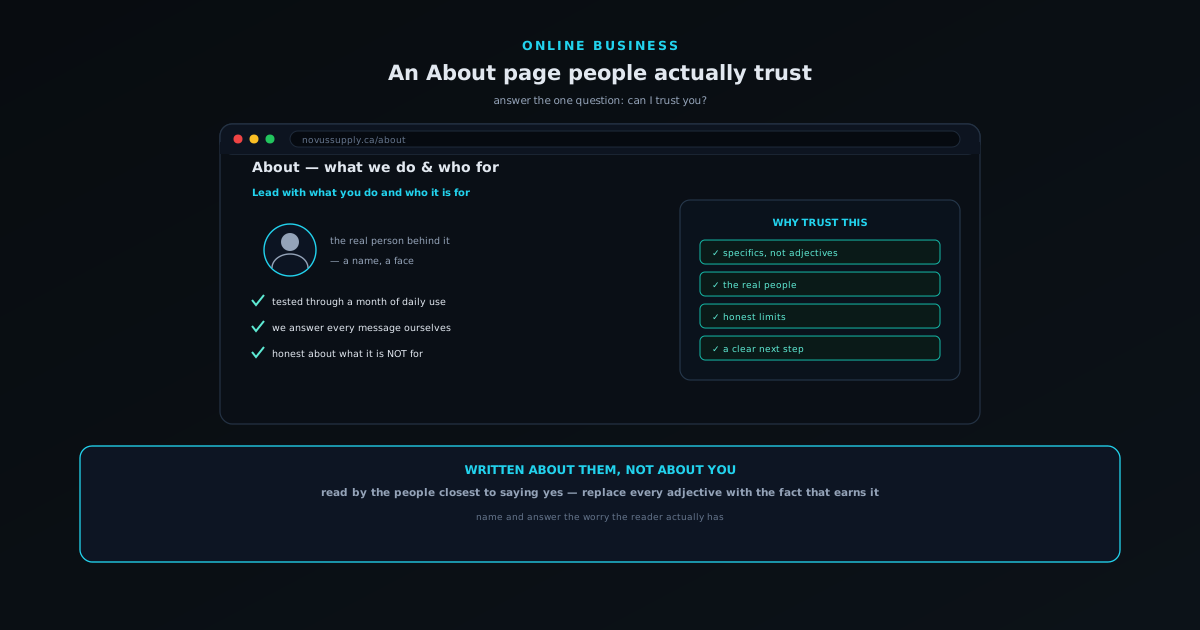
The top of the About page should answer, immediately and plainly, what you do and who you do it for, because that is the orienting information every reader needs before anything else can land. A visitor who has to scroll through your origin story to figure out what you actually offer is being made to work for the most basic fact, and many will not bother. Open with a clear statement (this is what we make, this is who it is for, this is the problem it solves), so that the reader is oriented from the first line and everything after it has context. Clarity up front is itself a trust signal, because it shows you know exactly what you do and for whom.
This clarity is also where knowing your niche pays off directly. A business that has clearly identified who it serves can write an opening that makes the right reader feel immediately seen ("this is for people like me") while a business hedging to appeal to everyone produces an opening so generic it lands with no one. Specificity about your audience is not exclusionary; it is magnetic to the people you actually serve. Leading with a concrete statement of what you do and for whom does more to build trust than paragraphs of mission language, because it lets the right reader recognize themselves and conclude, correctly, that you understand their situation.
Earn trust with specifics, not adjectives
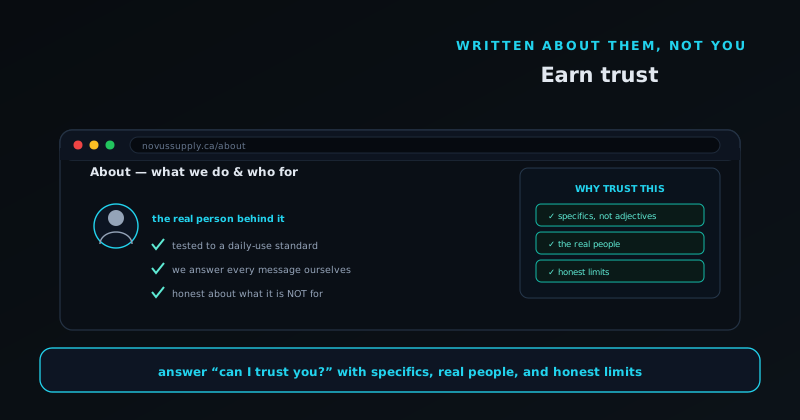
The fastest way to build trust on an About page is to replace adjectives with specifics, because adjectives are claims anyone can make and specifics are evidence only you can provide. "High quality" is an adjective every competitor also uses; "we test every product through a month of daily use before we stock it" is a specific that demonstrates the quality rather than asserting it. "Passionate about customer service" is empty; "we answer every message ourselves, usually within a few hours" is a concrete commitment a reader can evaluate. Specifics are persuasive precisely because they are checkable and particular, while adjectives wash over a reader who has seen the same words on every site.
The discipline is to go through your About page and, for every adjective or value claim, either replace it with the specific fact that earns it or cut it. If you cannot back up "high quality" with a concrete practice, the phrase is doing no work and should go; if you can, the concrete practice is far more convincing than the label. This is harder than writing adjectives, which is exactly why most About pages are full of them: specifics require you to actually have something real to point to. But that difficulty is the point: the specifics that are hard to write are hard precisely because they are real, and realness is what builds trust.
Show the people, or be honest that it is just you
People trust people more than they trust faceless brands, so showing the human beings behind the operation is one of the most effective trust-builders an About page has. A real name, a real face, a real voice tells the reader that there is someone accountable behind the business, someone who can be reached and who has staked their name on it. For a small operation this is an advantage, not a limitation: the personal, human scale that a large company cannot convincingly fake is exactly what makes a small business feel trustworthy and approachable. Letting the reader see who they are dealing with turns an abstract entity into someone they can have a relationship with.
And if the operation really is just you, say so plainly rather than hiding behind a corporate "we" that implies a team you do not have. Honesty about being a one-person operation is far more trust-building than a false impression of size, because the reader who later discovers the truth feels misled, while the reader who knew from the start appreciates the candor and often roots for you. "I am one person who builds these tools and answers every email myself" is a stronger trust signal than a vague institutional voice, because it is specific, honest, and human. Whether you are a team or a solo operator, the trust comes from letting the reader see the real people, at the real scale, behind the work.
Tell the origin story: briefly, and only the relevant part
There is a place for an origin story on the About page, but its job is narrow: to explain why you do this and why you do it well, not to recount your entire history. The relevant origin story is the part that builds trust: the problem you experienced that led you to build the solution, the expertise you accumulated that means you know what you are doing, the reason you care about getting this right. Told briefly and in service of the reader's trust, that story is powerful, because it explains the "why" behind the business in a way that makes the quality believable. Told at length and for its own sake, it becomes the self-focused monologue that loses readers.
The test for what to include is whether a given piece of the story changes how much the reader trusts you. The fact that you struggled with the exact problem your product solves is relevant, because it explains why your solution fits the real problem; the year you were founded or the unrelated jobs you held usually are not, unless they establish credibility. Keep the origin story tight, lead with the parts that build trust, and cut the parts that are just history. A short, relevant origin story that makes the reader think "ah, that is why they are good at this" does more than a long one that makes them think "why am I reading this?"
Address the unspoken question directly
Every About-page visitor is silently asking some version of "can I trust you with my money, my data, my problem?" The strongest About pages address that question directly instead of dancing around it. This means anticipating the specific worries your particular reader has and answering them: if you handle sensitive data, say plainly how you protect it; if you are new and unproven, acknowledge it and offer what reassurance you can; if people might worry you will disappear, show the signs of a stable, ongoing operation. Naming and answering the reader's real concern is disarming precisely because most businesses avoid it, and the candor itself builds the trust the reader was looking for.
The willingness to address concerns directly also signals confidence and honesty, which are themselves trust-building. A business that pretends its customers have no worries comes across as either naive or evasive, while one that says "here is the concern you probably have, and here is our honest answer to it" comes across as trustworthy because it is engaging with reality. You do not have to manufacture concerns, but you should know the real ones your audience has and meet them head-on. An About page that answers the question the reader was actually asking (can I trust you) does the one job the page exists for, and does it better than any amount of polished but evasive copy.
Be honest about what you are not
Counterintuitively, stating clearly what you are not and who you are not for builds more trust than claiming to be everything for everyone. A business that admits its product is not the right fit for certain needs comes across as honest and self-aware, and it helps the right customers self-select while sparing the wrong ones a bad experience. "This is built for X, not Y" reassures the X customer that the product is genuinely focused on them, and it prevents the Y customer from buying something that will disappoint them and generate a return or a bad review. Honesty about your limits is a gift to both the reader and yourself.
This honesty is also a powerful differentiator because so few businesses do it. The default is to claim universal applicability (good for everyone, perfect for every use), which readers have learned to discount because it is obviously not true. A business that says plainly what it is not for stands out as credible precisely because it is willing to turn away the wrong fit, which paradoxically makes its claims about the right fit more believable. Stating your limits is not weakness; it is the kind of confidence that comes from knowing exactly what you are good at, and readers trust that confidence far more than they trust a claim to be all things to all people.
Refresh it as the business changes
An About page is not a write-once artifact; it is a living page that should evolve as the business does, because a stale About page quietly undermines the trust it is supposed to build. If the page describes a smaller operation than you now are, or omits products and capabilities you have since added, or tells a story that no longer quite fits, a reader who senses the mismatch trusts you less rather than more. The page is read by people deciding whether you are a real, current, trustworthy operation, and an obviously out-of-date page signals neglect, which is exactly the opposite of the impression the About page exists to create. Keeping it current is part of keeping it trustworthy.
The practical habit is to revisit the About page whenever the business meaningfully changes (a new product, a new direction, a new scale) and update it to reflect reality, rather than letting it drift. This does not mean constant rewriting; it means treating the page as something that should always honestly describe the current operation, and refreshing it when reality moves. Because the About page is one of your highest-trust, highest-intent pages, the small effort of keeping it current pays off in the trust it preserves. A page that accurately reflects who you are today, every time someone reads it, keeps doing its job; a page frozen at who you were a year ago slowly stops being true, and a reader who notices that is a reader you have lost rather than won.
A simple structure that works
Pulling it together, a trustworthy About page tends to follow a simple arc. Open with a clear statement of what you do and who it is for, so the reader is oriented immediately. Follow with the specifics that earn trust: the concrete practices, the real numbers, the actual commitments behind your claims. Show the people behind the operation, at their real scale, and tell the brief, relevant slice of origin story that explains why you do this well. Address the reader's real concern directly, be honest about what you are not, and close with a clear next step for the reader who is now ready to act. Each part serves the single goal of moving the reader from "who are these people?" to "I can trust these people."
None of this requires you to be a great writer; it requires you to be specific, honest, and focused on the reader rather than yourself. The most common reason About pages fail is not bad prose but a failure to understand what the page is for, and once you write it to answer "can I trust you," with real specifics and honest framing, even plainly written copy does the job. Revisit your About page and ask, line by line, whether each sentence helps a deciding reader trust you more; cut what does not, sharpen what does, and the page will quietly become one of the better-converting pages you have. The About page is read by the people closest to saying yes, and writing it to earn their trust is one of the highest-return pieces of copy you will ever write.
Frequently asked questions
Quick answers to common questions about this topic.
What makes an About page trustworthy?
Specifics: who you are, what you actually do, real history, and honest detail instead of vague slogans. Concrete facts and a human voice build trust where generic mission statements do not.
What should an About page include?
Who is behind the business, why it exists, what it sells or makes, and how to reach a real person. Trust signals (real names, contact, and genuine story) matter more than polish.
Does the About page affect sales and SEO?
Yes. It is a key trust and E-E-A-T signal that reassures buyers and search engines alike. A credible About page supports conversion and is often visited before a purchase.
Related troubleshooting
Was this page helpful?
Your answer stays in this browser, it is not sent anywhere and no account or cookie is involved.