2026 · Novus Stream SolutionsAbout 13 min readNovus Stream Solutions
Refunds, guarantees, and chargebacks: policy design that protects margin and trust
Your refund policy is not legal boilerplate: it is a pricing decision, a marketing asset, and your first line of defense against chargebacks. Here is how to design one that protects both your margin and your reputation.
Contents
- 1.Overview
- 2.The core math: a refund is the cheap outcome
- 3.What a chargeback actually is, mechanically
- 4.Write the policy a human can read in one minute
- 5.Guarantees: when promising more makes you more
- 6.The refund conversation is a retention moment
- 7.Digital products, physical goods, and services age differently
- 8.Telling fraud apart from honest regret
- 9.The numbers that tell you the policy is working
- 10.A working checklist
- 11.The policy as a statement of confidence
Overview
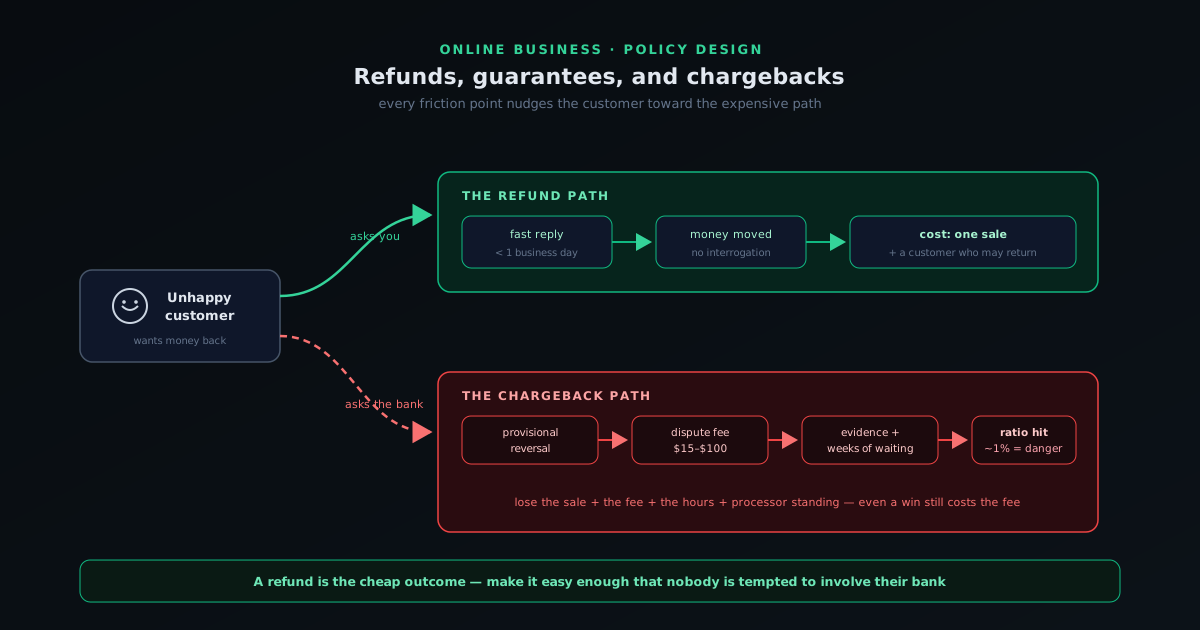
Most small online businesses treat their refund policy as an afterthought, a block of borrowed legalese pasted into the footer on launch day and never read again, least of all by the owner. That is a mistake, because the refund policy is quietly one of the most economically active documents in the business. It influences whether a hesitant first-time visitor buys at all, it determines how much an unhappy customer costs you, and it is the difference between a disappointed buyer asking you for their money back and a disappointed buyer asking their bank instead. The first path costs you one sale. The second costs you the sale, a dispute fee, hours of evidence-gathering, and a mark against your payment processor account that you cannot easily erase.
This guide treats refund and guarantee design as what it actually is: an operating decision with measurable consequences on both sides. Set the policy too strict and you suppress conversion, generate chargebacks, and burn goodwill one incident at a time. Set it too loose without guardrails and a small percentage of buyers will treat it as a free rental program. The good news is that the workable middle is wide, the math mostly favors generosity, and the whole thing can be designed deliberately in an afternoon instead of inherited accidentally from a template.
The core math: a refund is the cheap outcome
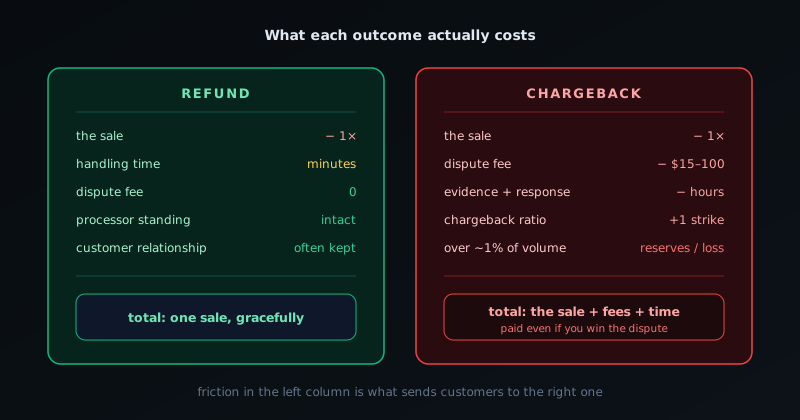
Start with the comparison that should anchor every decision in this area: what a refund costs versus what a chargeback costs. A refund costs you the revenue from one sale, minus whatever the product cost you to deliver, plus a few minutes of handling. A chargeback costs you the same revenue, plus a dispute fee that is typically somewhere between fifteen and a hundred dollars depending on the processor, plus the time to assemble evidence and respond, plus (and this is the part that compounds) a hit to your chargeback ratio. Payment processors track the percentage of your transactions that get disputed, and when that ratio crosses their threshold, often somewhere near one percent, you face monitoring programs, higher fees, rolling reserves where they hold a slice of your revenue, or outright account termination.
Once you internalize that asymmetry, a lot of policy decisions resolve themselves. Every friction point you put between an unhappy customer and a refund (hidden contact forms, restocking fees that feel punitive, multi-day response times, arguing about edge cases) is a nudge toward the chargeback path, where you lose more and lose it with interest. The strategically correct posture for most small businesses is to make refunds easy enough that nobody who wants their money back is ever tempted to involve their bank. You are not being soft; you are buying down the expensive outcome with the cheap one. The customer who got a fast, gracious refund is also far more likely to come back or to say something neutral-to-kind about you than the one who had to fight, which means the refund is partly a marketing expense too.
What a chargeback actually is, mechanically
It helps to understand the mechanics, because chargebacks are widely misunderstood as a sort of customer-service escalation when they are actually a banking process you barely participate in. A cardholder calls their bank and disputes a charge: they did not receive the item, the item was not as described, they do not recognize the transaction, or they claim it was unauthorized. The bank provisionally reverses the charge immediately, debiting you, and assigns the dispute a reason code. You then get a window, usually a few weeks, to submit evidence: proof of delivery, the product description as the buyer saw it, your refund policy as displayed at checkout, correspondence with the customer. A bank employee who has never heard of your business reviews the file and decides. Even when you win, you typically still pay the dispute fee, and the dispute still counts against your ratio.
The reason codes matter because they tell you what is actually going wrong upstream. A pattern of item-not-received disputes points at shipping or delivery-confirmation problems. Not-as-described disputes point at product pages that oversell. Do-not-recognize disputes very often mean your billing descriptor (the text that appears on the customer's card statement) does not match your storefront name, so honest customers genuinely cannot tell what the charge was. That last one is the cheapest fix in the entire chargeback universe: make the statement descriptor obviously yours, and a whole category of disputes evaporates. Treat every chargeback as a diagnostic, not an insult, and trace the reason code back to the operational gap that produced it.
Write the policy a human can read in one minute
The policy document itself should be written for the customer who is deciding whether to trust you, not for an imaginary courtroom. That means plain language, short sentences, concrete numbers, and a structure that answers the four questions every buyer actually has: how long do I have, what condition does the thing need to be in, how do I start a return, and when do I get my money. If a nervous first-time visitor can read your policy in under a minute and come away knowing exactly what happens if the purchase disappoints them, the policy is doing its conversion job. If it takes a paragraph of defined terms before anything is promised, it is doing the opposite: vague or hostile policies read as a warning, and the visitor who reads one quietly closes the tab.
Plain language also protects you operationally, because ambiguity in a refund policy is always resolved against you in practice. A customer who can argue that the policy was unclear will argue exactly that, to you or to their bank, and the bank tends to sympathize. Specifics close those gaps: thirty days from delivery rather than a reasonable period, unused and in original packaging rather than acceptable condition, refund to the original payment method within five business days of receiving the return rather than promptly. Put the policy where it can be seen before purchase (linked at checkout, not buried) both because that visibility lifts conversion and because policy displayed at checkout is exactly the evidence a processor wants when you contest an illegitimate dispute.
Guarantees: when promising more makes you more
A guarantee is a refund policy promoted from the footer to the sales page, and the promotion changes its economics. The policy version exists to handle failure; the guarantee version exists to remove the perceived risk of buying from someone the customer has never heard of, which is the single biggest conversion obstacle a small independent business has. A clear, confident guarantee (thirty days, money back, no interrogation) converts hesitant browsers into buyers at the margin, and for most products the additional revenue from that lift comfortably exceeds the cost of the additional refunds it generates. People who design guarantees for a living keep relearning the same result: the businesses afraid of generous guarantees are usually losing more to hesitation than they would ever lose to refunds.
The discipline is to only guarantee what you genuinely control and to state it without weasel words. A guarantee with visible escape hatches is worse than no guarantee, because the customer reads the escape hatches as your actual intent. If you sell digital products, accept that a refund means the buyer keeps the bits: that is the nature of the medium, and pricing should absorb it rather than the policy pretending otherwise. If you sell physical goods, decide deliberately who pays return shipping and say so plainly, because surprise costs at return time produce exactly the resentment that turns refunds into disputes. And track the guarantee's actual cost rather than assuming it: in most honest businesses the refund rate under a generous guarantee settles in the low single digits, which is a small and very predictable marketing expense.
The refund conversation is a retention moment
How you handle the request matters as much as what the policy says, because the refund conversation is one of the few moments a customer experiences your business under mild stress, and people remember how businesses behave under stress far more vividly than how they behave when everything goes well. The mechanics of a good refund interaction are simple: respond fast, skip the interrogation, process the money quickly, and end on a note that leaves the door open. A one-question follow-up (was it the product, the expectation, or something else) asked after the refund is granted rather than as a condition of it, gets honest answers precisely because nothing is riding on them anymore, and those answers are some of the cheapest product research you will ever collect.
What you should not do is defend the sale. The instinct to rescue the transaction (offering troubleshooting the customer did not ask for, suggesting they did not use the thing correctly, counter-offering store credit before honoring the actual request) reads as resistance, and resistance is what converts a mildly disappointed customer into an actively hostile one. Save the rescue attempt for the cases where the customer explicitly signals they want the product to work. Everyone else gets the money back gracefully, because the realistic prize in that interaction is not saving this sale; it is the customer's next purchase, their review, and what they say when a friend asks if you are legitimate. A surprising number of repeat customers are people whose first transaction ended in a refund handled well.
Digital products, physical goods, and services age differently
The same policy framework lands differently across product types, and copying terms across that boundary is how businesses end up with policies that make no sense. Physical goods have the cleanest logic: the item can come back, condition can be assessed, and the policy mostly needs to be specific about windows, condition, and who pays return shipping. Digital products cannot come back, so the policy is really a satisfaction promise backed by your refund-rate math, which argues for a defined window and graceful acceptance that some refunds are the cost of removing purchase risk. Watch the refund pattern per product rather than per customer: a digital product with an unusually high refund rate is almost always a product-page honesty problem, not a customer honesty problem.
Services and subscriptions add a time dimension. For services, the fair unit is work performed: refund fully before work begins, proportionally during, and rely on clear milestone communication so the proportion is never a surprise. For subscriptions, the highest-leverage policy decisions are not refund terms at all: they are cancellation friction and renewal notice. Make cancellation self-service and instant, and send a plain reminder before any annual renewal. Both feel like revenue leaks and are actually dispute prevention: forgotten renewals and un-cancellable subscriptions are two of the most common chargeback sources in the entire industry, and the disputes they generate are nearly impossible to win because the customer's story (I tried to cancel and could not) is one banks find instantly credible.
Telling fraud apart from honest regret
Generosity needs one guardrail: the ability to distinguish the honest majority from the small minority who exploit return policies as a free rental service or dispute charges they recognize perfectly well. The distinction is visible in patterns, not in individual requests. An honest customer refunds occasionally, across time, with ordinary reasons. The exploiter refunds repeatedly, often at the end of the return window, often with escalating stories, and the pattern is obvious the moment you look at refund history per customer rather than treating each request as an isolated event. Your policy can stay generous in general while you quietly decline to keep serving the handful of accounts whose history makes the pattern clear: generosity is a default, not a suicide pact.
For card fraud (stolen cards, account takeovers) the defense is upstream of policy entirely. Use your payment processor's built-in fraud screening, require the card security code, and pay attention to the classic mismatch signals: shipping address far from billing address, rush orders of unusually large size, multiple failed attempts before a success. For digital goods, where fraud means a stolen card buying something instantly delivered, faster notification matters more than anything: the sooner you refund a transaction the cardholder reports as unauthorized, the more likely you avoid the dispute entirely. None of this requires paranoia. It requires noticing that fraud prevention and refund policy are different layers (one filters who can transact, the other governs how transactions end) and not letting fear about the first make the second hostile for everyone else.
The numbers that tell you the policy is working
A policy you do not measure is a policy you are guessing about, and the measurement here is light. Four numbers cover it. Refund rate: refunds as a percentage of orders, watched per product, because a portfolio-wide average hides the one product that is quietly disappointing everyone. Chargeback ratio: disputes as a percentage of transactions, which you want comfortably under half a percent and your processor needs under roughly one. Refund reason distribution: even informal tagging of requests into not-as-described, changed-mind, delivery-problem, and other reveals which upstream system is generating the refunds. And time-to-resolution: how long between a customer asking and the money moving, because that interval is the strongest lever you have over whether requests stay requests or become disputes.
Read these numbers for trends, not events. A single bad week means nothing; a refund rate that doubles after a product-page rewrite means the rewrite oversells. The healthy pattern for a small business with honest pages and a generous policy is remarkably stable: low-single-digit refund rates, a chargeback ratio near zero, and reasons dominated by changed-mind rather than not-as-described. When the numbers sit there, stop tightening the policy: you have nothing left to win and conversion to lose. When they drift, the reason distribution almost always points at the fix, and the fix is almost never the policy itself: it is the product page, the shipping partner, the billing descriptor, or the response time.
A working checklist
Everything above compresses into a short list you can audit your own store against in an hour. Most of the items cost nothing to implement, and the ones that cost something (eating a few more refunds, paying return shipping on your own mistakes) are buying down outcomes that cost more. If you only do one thing today, fix the statement descriptor and put a plain-language policy link at checkout; those two changes prevent more disputes per minute of effort than anything else on the list.
- Policy readable in under a minute, answering: window, condition, process, and when the money arrives.
- Policy linked visibly at checkout: for conversion now, and as dispute evidence later.
- Billing descriptor matches your storefront name so customers recognize the charge.
- Refund requests answered within one business day; money moved within five.
- No interrogation as a condition of refund; one optional feedback question after.
- Subscriptions: self-service cancellation and advance notice before renewals.
- Per-product refund rates and chargeback reason codes reviewed monthly.
- A quiet per-customer history check so serial exploiters lose access without the policy tightening for everyone.
The policy as a statement of confidence
Step back from the mechanics and the refund policy is making a statement on your behalf: this is how confident we are that you will want to keep what we sold you. A strict policy says the business expects disputes and is bracing for them. A generous one says the business expects satisfaction and can afford to be wrong occasionally. Customers read that signal even when they never consciously read the policy, because it leaks into everything around it: the tone of the FAQ, the checkout copy, the speed of support. Designing the policy deliberately is partly about the direct economics and partly about deciding which of those two statements your business makes.
The encouraging part is how small the real cost of the confident posture turns out to be. Honest businesses with accurate product pages discover that almost nobody abuses a generous policy, that the refund rate is a stable low-single-digit cost they can price in, and that the chargebacks which used to feel like random lightning strikes were mostly preventable artifacts of friction they have now removed. The policy stops being a document you dread and becomes what it should have been from the start: a quiet piece of infrastructure that converts strangers, defuses disappointment, and keeps the expensive failure mode rare. That is a lot of work for one page in the footer to do, which is exactly why it deserves a real afternoon of design instead of a pasted template.
Frequently asked questions
Quick answers to common questions about this topic.
How do I write a refund policy that protects margin?
Make the terms clear and easy to find, set sensible windows and conditions, and state who pays return shipping. Clarity reduces disputes; a vague policy invites both abuse and chargebacks.
How do I prevent chargebacks?
Keep evidence (order details, tracking, delivery confirmation, and customer messages) and resolve complaints before they escalate to the bank. A fast, fair refund is usually cheaper than a chargeback.
Does a generous guarantee actually help?
Often yes: a clear guarantee lowers purchase hesitation and signals confidence, and most customers do not abuse it. The cost of the occasional refund is usually less than the sales a strong guarantee unlocks.
Related troubleshooting
Was this page helpful?
Your answer stays in this browser, it is not sent anywhere and no account or cookie is involved.