Category
Stack & engineering
The locked, opinionated stack behind the Novus ecosystem and how it is built: code-as-content architecture, type-safe content, edge rendering, and the AI-assisted engineering workflow that ships it solo.
26 articles
About the Stack & engineering thread
The technical record of how this ecosystem is built. The stack is deliberately locked and narrow (one framework, one styling approach, content as typed code rather than a CMS) because a solo operation cannot afford the tax of maintaining variety across nine apps.
Content-as-code is the decision with the longest reach, and several articles work through its consequences. When every article, tutorial, and app statistic is a typed TypeScript object, a broken internal link, a missing image, or a renamed app becomes a compile error rather than a support ticket. The cost is that content edits go through a build; the benefit is that content cannot silently rot.
The AI-assisted engineering material is written from production experience rather than demos: where frontier models genuinely compress the work, where the review burden eats the gain, and what has to be true of a codebase before either is possible.
What this topic covers
- The locked stack, and why narrow beats flexible for a small team
- Content-as-code: typed registries, build-time validation, and what it prevents
- Edge rendering, caching strategy, and static generation choices
- Shipping production work with frontier AI: where it helps and where it costs
- Testing and release discipline for a small operation, including zero-downtime content deploys
Who it's for
Engineers building content-heavy sites, solo developers maintaining several products, and anyone weighing AI-assisted development honestly.
26 articles in this thread, newest first. Every one is free to read with no signup.
26 articles in this thread
Stack & engineering · Aug 1, 2026
When your docs drift from your product
How a documentation audit across eight apps found the same statistics re-typed and quietly wrong, and the pattern that keeps them honest.
Field notes
Stack & engineering · Jul 28, 2026
Frontier AI in 2026: Sol, Fable / Opus 5, and Gemini in the race
A builder’s field guide to what “frontier” means in 2026 and how to evaluate Sol, Fable / Opus 5, and Gemini without hype or fake benchmarks.
Field notes
Stack & engineering · Jul 25, 2026
Why Playwright ships its own Chromium instead of using your Chrome
What the bundled Chromium build actually is, how it differs from branded Chrome, and why GPU-accelerated features are the hardest thing to put under test.
Novus Stream Solutions
Stack & engineering · Jun 29, 2026
Feature flags without a platform
A three-rung ladder for shipping behind flags on a small product (env vars, a typed flag module, hash-based percentage rollouts) plus the cleanup rules that stop flag debt.
Novus Stream Solutions (hub)
Stack & engineering · Jun 28, 2026
The case for boring technology
Why a small operation should spend its innovation tokens on the one thing that differentiates it and choose deliberately boring technology everywhere money, data, and login are involved.
Novus Stream Solutions (hub)
Stack & engineering · Jun 27, 2026
Documenting decisions: the ten-line ADR that saves future you
A ten-line architecture decision record scaled to a team of one: the template, the threshold for writing one, and the case for keeping the files in the repo instead of a wiki.
Novus Stream Solutions (hub)
Stack & engineering · Jun 26, 2026
Error budgets for tiny teams: reliability without an SRE org
Scaling the error-budget idea down to a one- or two-person operation: the arithmetic of nines at small revenue, a written not-fixing list, six-line incident notes, and spending unused budget on shipping speed instead of hoarding it.
Novus Stream Solutions (hub)
Stack & engineering · Jun 16, 2026
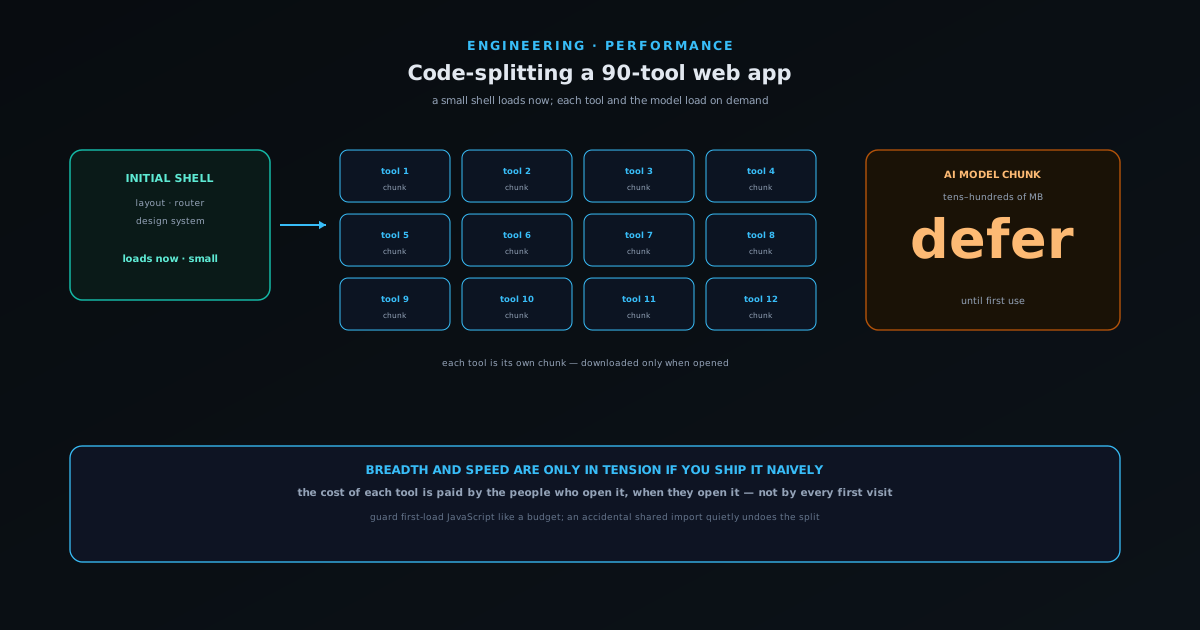
Code-splitting a large web app: how lazy routes keep it fast
How the NSS Background Remover stays fast to open despite many tools: route-level code-splitting so each tool is its own chunk, lazy boundaries that defer the heavy parts, deferring multi-megabyte AI models until a tool actually needs them, and the measurements that tell you whether any of it worked.
NSS Background Remover
Stack & engineering · Jun 10, 2026
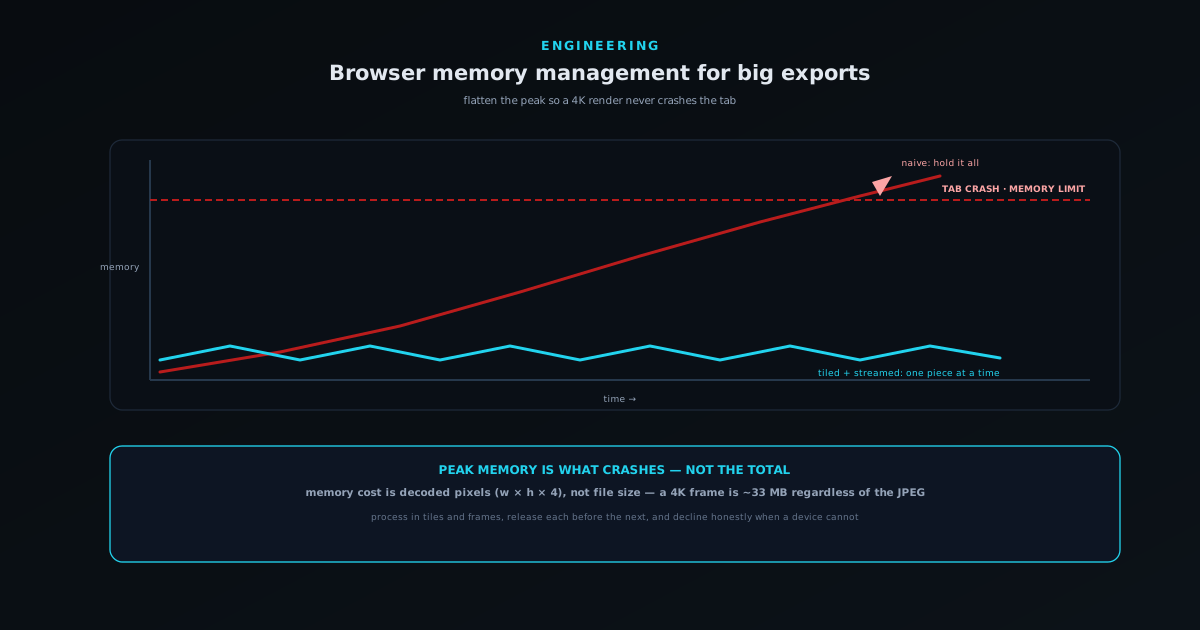
Browser memory management: not crashing the tab on a 4K export
How to keep a heavy in-browser export from crashing the tab: where the memory actually goes (decoded pixels, not file size), why peak usage is what kills you, tiling and streaming so you never hold the whole thing at once, releasing buffers and bitmaps explicitly, and degrading honestly when a device cannot do the job.
Novus Visualizers