2026 · Novus VisualizersAbout 10 min readNovus Stream Solutions
Music promotion as a micro-business: a zero-budget content engine for independent artists
An independent artist is a one-person company whether they like it or not. Here is the operator's approach to music promotion: owned channels, repeatable assets, and a release pipeline where the visuals cost nothing but a browser tab.
Contents
Overview
Most independent musicians run a business and refuse to admit it. There is a product line (the catalog), a release calendar, distribution channels, marketing, customer relationships, and a profit-and-loss statement that mostly reads as losses: everything a small company has except the willingness to operate like one. The refusal is understandable, since nobody picks up a guitar to become a content operations manager. But the artists who break through at the independent level are, with remarkable consistency, the ones who made peace with the company they accidentally founded: they ship on a schedule, they build assets instead of posts, and they own their audience instead of renting it from an algorithm.
This article applies the operator playbook this series has been building (unit thinking, repeatable systems, owned channels, compounding assets) to music promotion specifically, with a content engine that costs nothing to run. The visual half of that engine is built on Novus Visualizers, our free in-browser tool for turning a track into beat-synced video, so the bias is disclosed upfront. The strategy, though, is tool-agnostic: it is about what an artist with zero budget and finite hours should actually produce, and why.
The post mindset versus the asset mindset
The defining mistake of DIY music marketing is treating promotion as a stream of disposable posts: record a clip, caption it, feed it to the algorithm, watch it decay to zero within forty-eight hours, repeat until burnout. Each post is labor that evaporates. The operator alternative is the asset mindset: every piece of promotion should either be durable (continuing to work after you stop pushing it) or be a cheap derivative of something durable. A music video on your channel accrues views for years. A visualizer video for a catalog track is searchable forever. An email list is a permanent asset. A trending-sound clip is none of these things, which does not make it worthless; it makes it the garnish, not the meal.
The asset mindset changes the economics of effort in the same way a content library changes a blog's. Catalog is the word the music industry uses for the compounding machine: every released song with its full visual kit is a surface the world can discover, and discovery of any one song advertises all the others. An artist five years in with sixty well-packaged tracks has sixty doors into their world, each feeding the rest, which is the exact compounding structure described elsewhere in this series, with songs in place of articles. The practical implication is unglamorous: consistent releases of well-packaged work beat sporadic releases of heavily promoted work, because the machine is built from accumulation, and accumulation rewards cadence.
One song is a family of assets
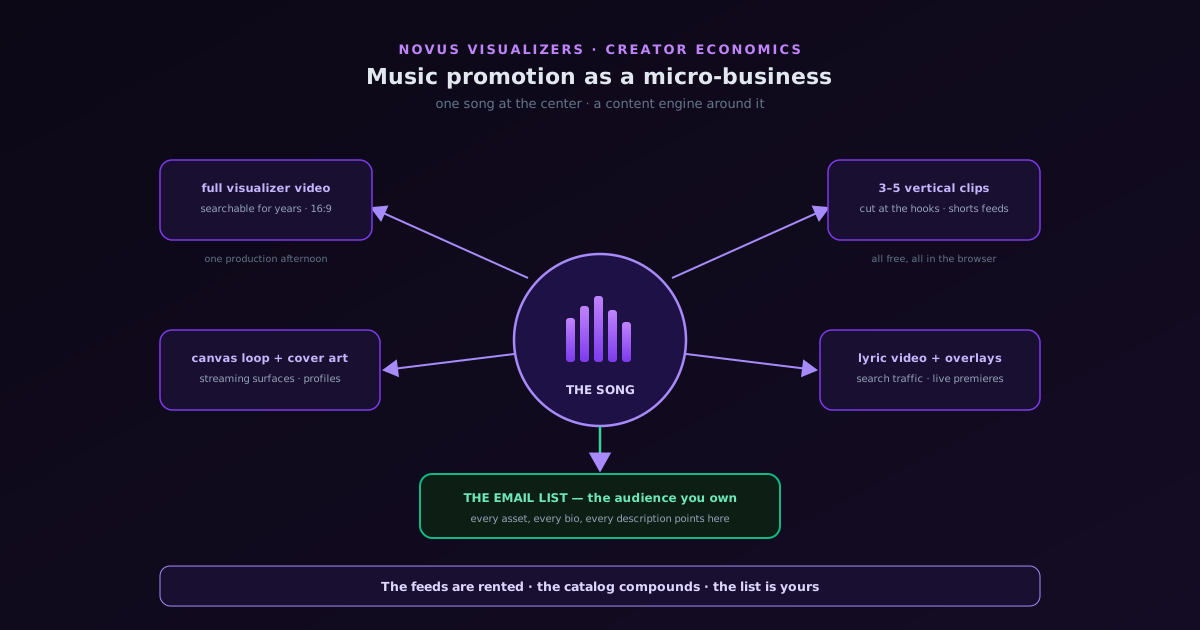
The unit of production, then, is not "a post" but the asset family a single song generates. A finished track should ship with, at minimum: a full-length visualizer video for the long-form platforms, where a song with moving visuals is searchable and embeddable in ways raw audio never is; a set of vertical clips (fifteen to sixty seconds, cut at the hooks) for the short-form feeds; a looping canvas for the streaming platforms that support one; cover art and its derivative formats for every profile and playlist pitch; and a lyric video if the words carry the song, because lyric content captures search traffic from people who heard a line and went looking. Done traditionally, that family costs hundreds of dollars per song in editing and design. Done with the current generation of free in-browser tools, it costs an afternoon.
This is the workflow Novus Visualizers was built around. Upload the track in the editor at visualizers.novusstreamsolutions.com/editor, pick a template, and the engine reads the audio directly: bass, mids, and treble each driving different visual elements, so the result moves with the song rather than near it. The editor exports release-ready video entirely in the browser: full-length sixteen-by-nine for the video platforms, vertical crops for shorts, short seamless loops for canvases. The companion tools cover the rest of the family: the album art editor at visualizers.novusstreamsolutions.com/albums, the lyric video creator at visualizers.novusstreamsolutions.com/lyric-videos, and audio-reactive stream overlays for artists who perform live online. Nothing uploads to a server, nothing requires an account to try, and nothing costs money; the production half of the music-promotion business, which used to be the budget line that excluded independents, now runs in a tab.
The release pipeline, run like an operator
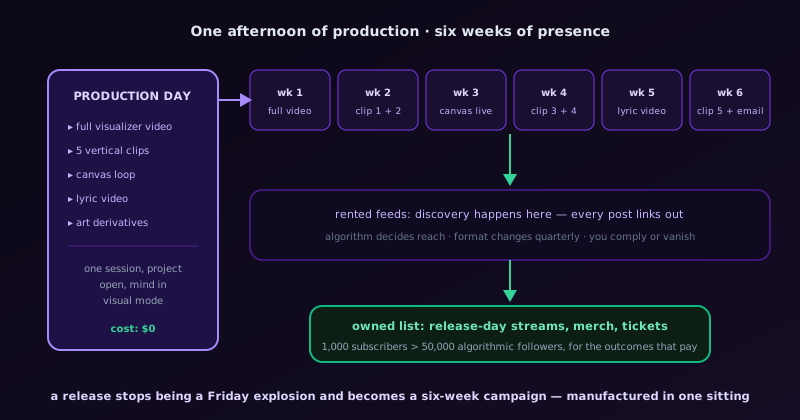
With the asset family defined, promotion becomes a pipeline rather than a panic, and the pipeline is the difference between artists who sustain and artists who cycle through enthusiasm and silence. The operator pattern is batching with a calendar: production day generates the whole asset family while the project is open and the mind is in visual mode; the calendar then drips the derivatives across the weeks after release, with the full video at launch, clips staggered through the following month, and the canvas and lyric video filling the gaps. A release stops being a single Friday explosion followed by silence and becomes four to six weeks of steady presence, all manufactured in one sitting.
The pipeline also imposes the discipline feeds are designed to destroy: working from a plan instead of from the dopamine console. An artist who opens the platforms only to post and respond (rather than to graze) reclaims the hours that make the next song possible, which matters because in this business the product and the marketing compete for the same creative energy. The companion discipline is measurement on an operator's cadence: not refreshing view counts hourly, but a monthly half-hour reviewing which songs, which clip styles, and which platforms actually moved listeners toward the places that matter (follows, saves, list signups), and adjusting the next cycle accordingly. Everything else this series says about calm analytics applies doubly to artists, for whom the numbers are unusually entangled with self-worth.
Own the audience; rent the feeds
The strategic spine under all of this is the distinction between owned and rented audiences, and no industry has been burned by it more often than music. Every platform cycle (the social network that mattered five years ago, the one that matters now) has minted artists with enormous follower counts who discovered, after an algorithm change or a platform decline, that those followers were never theirs. The feed decides who sees a post, the platform owns the relationship, and the artist rents reach month to month at the price of compliance with whatever the format demands this quarter. Rented reach is genuinely valuable (it is where discovery happens), but building a career on it alone is building on a landlord's patience.
The owned assets are the email list and, increasingly, the artist's own site and community spaces. A thousand email subscribers who chose to hear from you outperform fifty thousand algorithmic followers for the outcomes that pay (release-day streams, merch, tickets, crowdfunding) because delivery is certain and intent is high. The operator move is to make every rented channel funnel toward an owned one: the link under every video, the call-to-action in every bio, the download or early-access offered for an address. Visual content plays a specific role in this funnel, because it is the only kind that works natively in every feed while carrying the song: the visualizer clip is the advertisement, the email list is the store, and the catalog is the inventory. Artists who structure it that way stop fearing algorithm changes, which is the most operator-like feeling available in music.
What to measure, and what to deliberately ignore
The metrics discipline from elsewhere in this series needs translation for artists, because music platforms drown creators in numbers and almost all of them are noise. Views and streams are the loudest and least useful: they fluctuate with algorithmic weather, they reward content that interrupts rather than content that connects, and they correlate weakly with everything that pays. The numbers that matter are the conversion chain: of the people a clip reached, how many followed or saved; of the followers, how many joined the list; of the list, how many showed up on release day. Saves and playlist adds beat raw streams because they predict repeat listening, which the platform algorithms themselves treat as the quality signal. List signups beat everything, because they are the only metric measured in owned relationships rather than rented impressions. An artist tracking just three numbers monthly (saves per release, list growth, release-day engagement from the list) has a more honest dashboard than one drowning in platform analytics.
The ignore list matters as much as the watch list, and it is mostly psychological protection. Ignore per-post view counts within the first day; short-form distribution is bursty and delayed, and the post that "flopped" at noon routinely finds its audience on Thursday. Ignore follower counts on rented platforms as a goal: they are a means to list growth, not an end. Ignore comparison artists entirely; their visible numbers are inflated by survivorship and say nothing about their economics. And resist the analytics refresh as a dopamine pattern: the data changes meaningfully on a monthly rhythm, which is exactly why this playbook prescribes a monthly half-hour rather than a daily vigil. The artist who checks numbers thirty times a day is not measuring the business; they are letting the business measure them, and the creative work that feeds the whole engine pays the bill.
A monthly operating rhythm for one artist
Condensed into a runnable system, the music micro-business fits into a rhythm a working artist can sustain alongside actually making music, which is the entire point. The hands-on clip-cutting step lives in the walkthrough at Making a vertical visualizer for TikTok, Reels & Shorts.
- One release (or re-promoted catalog track) per cycle, on a cadence you can hold for years: monthly beats quarterly-with-gaps.
- One production afternoon per release: full visualizer video, three to five vertical clips, canvas loop, art derivatives, the whole family in one session.
- A drip calendar spacing the derivatives across the following four to six weeks, written down, not improvised.
- Every asset, every bio, every description pointing at one owned destination, usually the email list.
- One email to the list per cycle: the release, the story behind it, one ask.
- A monthly thirty-minute review: what moved saves, follows, and signups; what to do more and less of next cycle.
- Catalog maintenance quarterly: older tracks re-clipped in current formats; the back catalog is free inventory most artists never restock.
The company you accidentally founded
None of this asks an artist to become a marketer in spirit. It asks for the opposite: to build a machine boring enough that the marketing stops consuming the identity. The artists who burn out on promotion are almost never doing too much of it; they are doing it without structure, improvising every post, re-deciding every week what the strategy is, and paying the full cognitive price of an unsystematized business on top of the creative price of the work itself. The pipeline, the asset families, the owned-audience funnel: these are how the company runs on a few hours a week, so the rest of the week can belong to the music.
And the economics have never tilted further toward the independent. The expensive layers of music promotion (video production, design, distribution) have collapsed into free tools, leaving cadence and judgment as the real differentiators, and those are free too. A catalog of well-packaged songs, compounding quietly across platforms, funneling listeners toward a list nobody can algorithm away: that is a durable small business by any definition this series uses, and it is buildable by one person with a laptop, a browser tab, and the willingness to operate the company they already own. The guitar was always the easy part to pick up. The operator's mindset is the instrument that keeps it heard.
And the machine has compounding effects on the music itself that artists rarely anticipate. A sustainable promotion system removes the boom-bust emotional cycle (the exhausted silence after an over-promoted release, the guilt spiral that delays the next one) and replaces it with a cadence the creative work can actually live inside. Catalog thinking changes what gets finished: the half-songs that never fit a big-launch narrative become viable releases inside a monthly rhythm, and more finished work means faster craft improvement, which is its own flywheel. Even the visual pipeline feeds back into the art: artists who watch their music move through a visualizer week after week consistently report it changing how they hear their own arrangements, the way seeing a waveform changes how an engineer hears a mix. The operator's machine, built to protect the music from the marketing, ends up serving the music directly. That is the version of "treating it like a business" worth wanting: not the music industrialized, but the noise around it systematized until only the music is left to think about.
Frequently asked questions
Quick answers to common questions about this topic.
How can an independent artist promote music with no budget?
Turn each release into a steady stream of content (visualizers, vertical clips, lyric videos, and covers) from free tools, and post consistently. Volume and consistency, not ad spend, drive zero-budget discovery.
What content should artists make from one song?
A full visualizer, vertical cuts for TikTok/Reels, a lyric video, an album-art image, and short teasers, all derivable from one track using Novus Visualizers at https://visualizers.novusstreamsolutions.com.
How is treating promotion like a business different?
You build a repeatable system (capture, produce, schedule, measure) instead of posting sporadically. The micro-business framing makes promotion consistent and improvable rather than random.
Related workflow
A track to a release-ready visualizer, per platform
Render the visual once, then produce the platform masters from it, instead of re-rendering the whole video for every aspect ratio.
- Render the beat-synced videoNovus Visualizers: Pick the engine and mode against your actual track; the analysis is done on your audio, not on a preset preview.
- Trim or upscale the exportNSS Background Remover: The video utilities handle the tidy-up pass so the render does not have to be repeated to fix ten seconds of it.
- Produce the per-platform mastersNovus Convert: Each destination wants a different container and bitrate; converting the finished render is far cheaper than re-rendering it.
Related troubleshooting
Was this page helpful?
Your answer stays in this browser, it is not sent anywhere and no account or cookie is involved.