2026 · Novus Stream SolutionsAbout 11 min readNovus Stream Solutions
Compound interest for operators: the one formula that runs your portfolio and your business
Compounding is the rare piece of financial math that applies equally to an index fund and to a small business. Here is how it actually works, why the early years feel broken, and where operators already use it without noticing.
Contents
- 1.Overview
- 2.The mechanics, without the mystique
- 3.Why the early years feel broken
- 4.Time in the market, not timing the market
- 5.Compounding works against you at exactly the same power
- 6.Where your business is already a compounding machine
- 7.When the compounding story lies to you
- 8.Making the math work for you: a short checklist
- 9.The quiet conclusion
Overview
If you run a business, you already believe in compounding; you just may not have named it. Every time you reinvest profit into inventory that sells through faster, publish an article that keeps earning search traffic next year, or keep a customer whose repeat orders cost you nothing to acquire, you are exploiting the same mechanism that makes a retirement portfolio grow: returns that themselves generate returns. The math is identical whether the asset is an index fund or a catalog of products, and operators who understand it in one domain make noticeably better decisions in the other. This article is the bridge between the two.
One framing note before the numbers: this is education, not personalized financial advice. Nothing here knows your situation, your obligations, or your jurisdiction, and none of it should be read as a recommendation to buy any particular investment. What it can do is make the underlying machinery legible, because compounding is one of those ideas that is trivial to state, genuinely hard to feel, and expensive to misunderstand: most of the damage people do to their own finances comes from acting against compounding without realizing that is what they are doing.
The mechanics, without the mystique
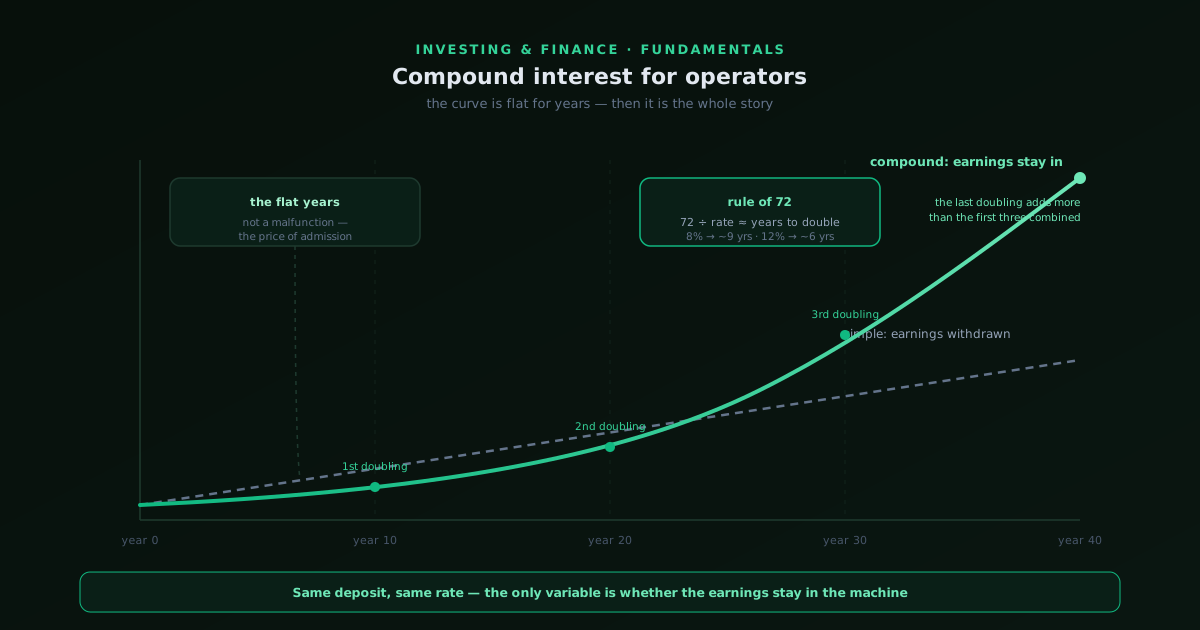
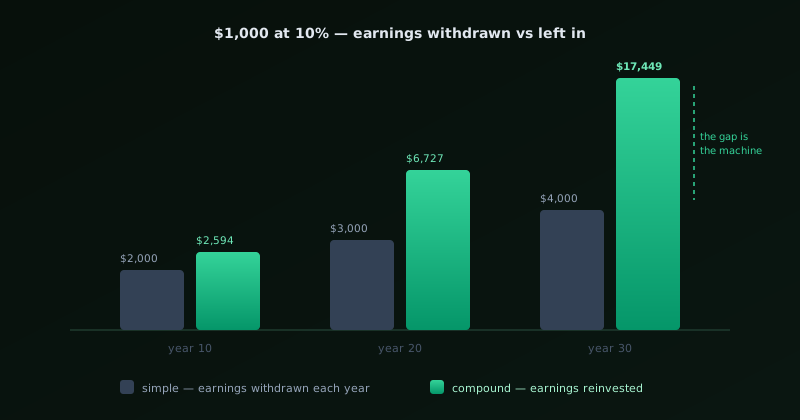
Simple interest pays you on your original amount, forever. Put in a thousand dollars at ten percent simple interest and you collect a hundred dollars a year, every year, in a straight line. Compound interest pays you on the original amount plus everything it has already earned. The same thousand dollars at ten percent compounded becomes eleven hundred after year one, and year two pays ten percent of eleven hundred, not a thousand. The difference between the two starts as a rounding error: ten dollars in year two, a few more in year three. Almost nobody would notice. After thirty years, the simple-interest account holds four thousand dollars and the compounding one holds more than seventeen thousand. Same deposit, same rate, wildly different destination, and the only variable that changed is whether the earnings were left in the machine.
The most useful piece of mental arithmetic in this whole subject is the rule of 72: divide 72 by your annual growth rate and you get, roughly, the number of years it takes money to double. At eight percent, money doubles about every nine years. At twelve percent, every six. The rule works in reverse, too, and that direction is where it gets motivating for an operator: if your repeat-customer revenue is growing twenty percent a year, that line of your business doubles roughly every three and a half years without a single new marketing idea. Doubling is also how you should think about long horizons, because a forty-year saving career at eight percent is not "forty years of growth"; it is about four and a half doublings, and the last doubling alone adds more than the first three combined.
Why the early years feel broken
The emotional problem with compounding is that the curve is indistinguishable from a flat line for years. In year three of saving, the compounding portion of your balance is tiny compared to what you deposited yourself; the account looks like a jar you put money into, not a machine that makes any. This is exactly the period when most people conclude that investing "does nothing" and either quit contributing or start chasing something faster. The math says the opposite: the flat years are not a malfunction, they are the price of admission. Every doubling requires the previous one, and the only way to reach the steep part of the curve is to be unremarkably present for the boring part.
Operators live this same shape in their businesses and tend to handle it better there, which is worth noticing. Nobody publishes thirty articles and expects a traffic explosion in week two; you expect the library to take a year to start carrying its weight, because each piece reinforces the others: internal links accumulate, topical authority builds, old posts feed new ones. A products business feels it as the slow grind from the first hundred customers to the first thousand, where every cohort of repeat buyers makes the next launch cheaper. If you can hold your nerve through the flat years of a content library or a customer base, you already have the exact temperament compounding asks of an investor. The discipline transfers one-to-one; only the account statement looks different.
Time in the market, not timing the market
Because compounding is driven by doublings, the scarcest input is not brilliance; it is time. A dollar invested at twenty-five and left alone until sixty-five passes through roughly five doublings at historical-ish equity rates; the same dollar invested at forty-five gets two. That asymmetry is why starting early with small amounts so reliably beats starting late with large ones, and why the standard advice to begin before you feel ready is not a platitude but arithmetic. It is also why interruptions are so expensive. Pulling money out for three years in the middle of a forty-year run does not cost you three years of returns; it costs you the compounding of everything those returns would have earned for the remaining decades.
This is the honest argument against market timing, and it has nothing to do with whether crashes are predictable. Even a timer who is right about a downturn has to be right twice (out near the top and back in near the bottom) and the historical record is brutal about the second half: a large share of the market's long-term return arrives in a small number of explosive recovery days that cluster immediately after the worst ones, precisely when a timer is still hiding in cash waiting for things to feel safe. Miss a handful of those days across a few decades and your terminal wealth drops by a startling fraction. The operator translation: you would never shut down your store for a quarter because you had a feeling the market was about to soften, because you know the cost of being closed during the rebound. The portfolio works the same way.
Compounding works against you at exactly the same power
Everything that makes compounding magical in your favor makes it merciless against you, and the against-you versions hide in small numbers. A one percent annual fee sounds like nothing: it is one penny per dollar. But the fee does not just remove one percent of one year's return; it removes that slice every year, and with it every future doubling that slice would have produced. Over a forty-year horizon, the difference between a fund charging 0.05 percent and a fund charging one percent compounds into a terminal balance gap of twenty percent or more. The fee did not take a bite of your money; it took a bite of your machine. The same logic applies to recurring costs in a business: a software subscription that quietly skims margin every month is not a line item, it is a permanent reduction in your reinvestment rate.
Debt is the other direction the same math runs. A credit card at twenty-two percent is compounding too (someone else's asset, your liability) and at that rate the rule of 72 says the balance doubles in just over three years if untouched. This is why paying down high-interest debt is, mathematically, a guaranteed return at the debt's interest rate, an investment opportunity that the market almost never beats reliably. For a business, the equivalent trap is financing inventory or growth at rates higher than the return the inventory actually generates; the spreadsheet can hide that mismatch for a surprisingly long time, because revenue grows while the compounding cost grows faster underneath it. Whenever two compounding rates point in opposite directions in your life, the spread between them is silently deciding your outcome.
Where your business is already a compounding machine
It is worth being explicit about the business-side assets that compound, because once you see them as compounding machines rather than expenses, you fund them differently. Content is the cleanest example: an article published once keeps generating visits, links, and customers for years, and each new article raises the value of the existing ones through internal links and topical depth. Repeat customers compound because retention multiplies: a customer base with ninety percent annual retention and steady acquisition does not grow linearly, it stacks cohorts on top of cohorts. Brand and reviews compound because every satisfied customer lowers the trust barrier for the next one. Even skills compound: an operator who gets five percent better at copywriting every quarter is on a doubling schedule most portfolios would envy.
The shared trait of all of these is that they require reinvestment to keep compounding, which is exactly the simple-versus-compound distinction from the first section. The store owner who takes every dollar of profit out of the business is collecting simple interest on the asset they built. The one who routes some profit back into the things that compound (more inventory depth in proven products, more content in proven topics, better retention infrastructure) is letting the earnings earn. Neither choice is automatically right, and the next article in this series deals with that allocation decision directly. But the framing matters: when you decide what to do with a profitable month, you are choosing a point on the simple-to-compound spectrum, whether or not you think of it that way.
When the compounding story lies to you
A concept this powerful attracts abuse, so it is worth knowing the three standard ways compounding gets misused in a pitch. The first is extrapolating an unsustainable rate: a fund, a stock, or a business line that grew forty percent last year gets projected forward at forty percent for a decade, producing a number that justifies any price. Real compounding engines slow as they scale: markets saturate, competition arrives, and the law of large numbers grinds every growth rate toward something ordinary. The second is ignoring volatility: an investment that alternates between gaining fifty percent and losing forty percent has a positive average return and still loses money, because a forty percent loss requires a sixty-seven percent gain just to break even. Smooth eight percent and volatile eight percent are not the same eight percent.
The third lie is survivorship: every compounding success story you hear is drawn from the set of things that survived long enough to compound, and the graveyard does not give interviews. This is where small-business analogies need honesty too: content libraries compound only if the content was good enough to rank, customer bases compound only if the product earns retention, and plenty of businesses reinvest faithfully into assets that never reach the steep part of the curve. Compounding is a multiplier on something that works; it cannot make something broken work. The test before trusting any compounding story, including your own plans, is to ask what the underlying engine is, why its rate is sustainable, and what evidence exists that the early flat years are an on-ramp rather than the whole road.
Making the math work for you: a short checklist
None of this requires sophistication to apply. The whole edge is structural: get the compounding forces pointed in your favor, remove the ones pointed against you, and then refuse to interrupt the machine. In practice that reduces to a short list, and almost every item on it is a one-time decision rather than an ongoing skill.
- Start before it feels worthwhile: the flat years are the admission price for the steep ones.
- Automate contributions so that staying invested never depends on how the market feels this month.
- Treat every recurring fee as a permanent tax on your compounding rate, and minimize the ones that buy nothing.
- Kill high-interest debt first; it is a guaranteed return at the card's rate.
- In the business, identify the two or three assets that genuinely compound (content, retention, inventory depth in winners) and fund them before funding anything novel.
- Distrust any projection that extrapolates an exceptional growth rate more than a few years out, including your own.
- Measure in doublings, not percentages: ask "how many doublings does this horizon hold?" before judging any rate.
The quiet conclusion
Compound interest does not feel like a secret because the formula is hidden (it is taught to teenagers) but because the experience of it is so badly mismatched to human time preference. The machine does almost all of its visible work at the end, after years of looking inert, and every instinct you have about effort and reward argues that something which looks inert is broken. The people who end up wealthy on ordinary incomes, and the small businesses that end up unkillable on ordinary products, are mostly the ones who stopped negotiating with that instinct: they set the contributions, funded the compounding assets, and let an unremarkable rate run for an unreasonable amount of time.
The operator advantage is real here. You already know what it feels like to tend something through its flat years: a content library nobody reads yet, a product with forty reviews on its way to four hundred. You already budget for assets that pay off on a multi-year horizon, and you already understand that interrupting an engine to feel safe usually costs more than the danger did. Investing asks for exactly that temperament and nothing more exotic. The same patience you spend on the business, pointed at a boring diversified portfolio and left alone, is the entire strategy, and the rest of this series is about the specific decisions that hang off it.
Frequently asked questions
Quick answers to common questions about this topic.
What is compound interest in simple terms?
It is growth on your growth: each period's gains are added to the base, so the next period's return is calculated on a larger amount. Over time that creates an accelerating curve rather than a straight line.
How does compounding apply to a business, not just investing?
Reinvested profit, retained customers, and compounding content or audience all behave like compound interest: small consistent gains stacked over time. The same formula that grows a portfolio describes a business that reinvests its returns.
Is this financial advice?
No. This is general educational material about how compounding works, not personalized investment or financial advice. Decisions about your own money should account for your situation and, where appropriate, a qualified advisor.
Related troubleshooting
Was this page helpful?
Your answer stays in this browser, it is not sent anywhere and no account or cookie is involved.