2026 · Novus Stream SolutionsAbout 11 min readNovus Stream Solutions
Reinvest or pay yourself? A profit allocation framework for small business owners
Every profitable month asks the same question: does the money go back into the business, into your pocket, or into reserves? Most owners answer by vibe. Here is a framework for answering it on purpose.
Contents
Overview
Profit creates a decision that nobody warns first-time owners about. The month closes, the numbers are good, and several thousand dollars sit in the business account with no assigned job. Reinvest it and the business might grow faster; the inventory could be deeper, the ads could run wider, the freelancer could take two tasks off your plate. Pay it out and your household breathes easier, your savings grow, and the years of underpaid bootstrapping start getting repaid. Hold it as cash and you sleep better but feel vaguely guilty about idle money. Most owners resolve this by mood (aggressive after good months, hoarding after scares) which means their most consequential recurring financial decision is being made by whoever they happen to be that week.
This article builds the deliberate version: a framework for splitting profit between reinvestment, owner pay, reserves, and outside wealth, decided once and adjusted on a schedule rather than renegotiated every month. The framing is educational rather than prescriptive: tax treatment of owner compensation varies wildly by country and entity type, and a real accountant should bless the mechanics of whatever you implement. The strategic logic, though, is universal, and it starts by understanding why the two pure strategies both fail.
Why "reinvest everything" fails
The reinvest-everything owner has the better story: every dollar plowed back, the machine compounding at full throttle, deferred gratification as identity. The failure is that the strategy assumes reinvestment returns stay high, and they do not. Every business has a marginal return curve: the first thousand dollars of monthly ad spend might return three to one, the fifth thousand barely breaks even, because audiences saturate, keywords cap out, and shelf space in your customers' attention is finite. Inventory deepens past its sell-through rate and becomes storage fees. A second product line launches before the first is solid and divides your attention instead of multiplying your revenue. Owners who reinvest by default rarely measure where they are on this curve; they fund the tenth-best idea at the same rate as the first-best and call the average "growth."
The deeper failure is personal. An owner who pays themselves nothing for years is borrowing from their household to subsidize the business, and the loan comes due in ways spreadsheets miss: thin personal savings that turn every business wobble into a family crisis, resentment that corrodes the motivation the whole project runs on, and a balance sheet where one illiquid asset is everything, the exact concentration problem covered elsewhere in this series. There is also a strategic cost: a business that only survives because its labor is free has not actually proven its model. If the economics require an unpaid owner, the economics are the problem, and reinvesting harder into unproven economics just makes the eventual reckoning larger.
Why "drain everything" also fails
The opposite strategy (treat the business as a paycheck, extract every profitable dollar) fails more slowly and just as surely. A business stripped of retained cash operates with no shock absorber: the supplier price hike, the platform fee change, the slow season all arrive eventually, and the drained business meets them with borrowed money or panic. Opportunities suffer the same fate as emergencies (the inventory discount that needs cash this week, the competitor's customer base suddenly up for grabs) because opportunity, like crisis, is bought with liquidity. And underinvestment compounds in reverse: the store that never refreshed its product photos, never improved its tooling, never funded the redesign, drifts from leader to laggard one skipped reinvestment at a time.
Drained businesses also carry a subtler tell: the owner's personal finances and the company's finances end up fused. When all profit flows out immediately, business reserves and household savings become one pool, and money flows backward into the company whenever it stumbles, which means the household is the reserve, involuntarily. Owners in this pattern often believe they are being financially conservative because their personal account looks healthy, while in reality they are running an unbuffered operation whose risks they have personally guaranteed. The fix in both failure directions is the same: stop treating allocation as a single dial between "business" and "me," and start treating it as a system with four distinct jobs.
First, pay yourself like an employee
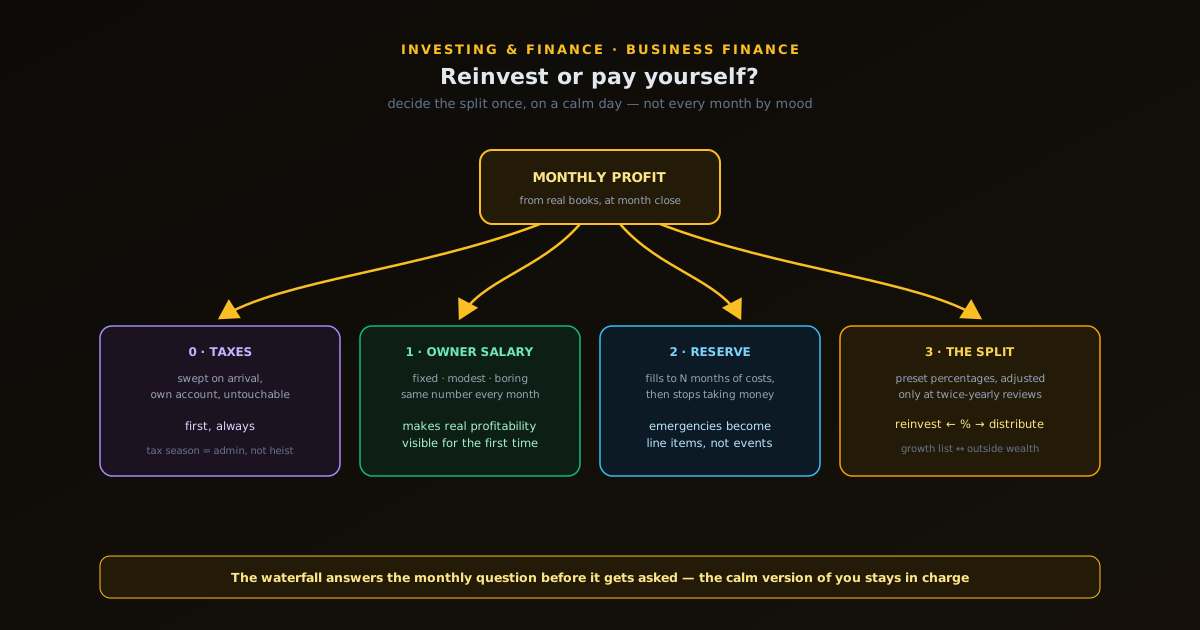
The cornerstone of the system is a fixed, boring, modest owner salary: the same amount every month, sized to cover your real household baseline, paid before any other allocation decision happens. This single move fixes more problems than anything else in the framework. It makes the business's true profitability visible for the first time, because labor is finally on the books at a real cost; a business that cannot afford its owner's salary is unprofitable, and it is better to know. It decouples your household from the company's monthly volatility, which makes both sides calmer. And it converts the emotional question "what do I deserve this month?" into an administrative one, which is exactly what you want your compensation to be.
Sizing it is less delicate than owners fear. Start from your actual personal baseline (housing, food, obligations, a margin for being human) not from your title or your revenue. Set the salary there, even if it is unimpressively small, and resist the urge to ratchet it with every good quarter; raises should follow sustained profitability, reviewed maybe twice a year, like any employee's. The remainder of profit above this salary is what the rest of the framework allocates, and the psychological shift is that everything beyond the salary now feels like the system's money rather than yours, which makes the discipline of the next three channels dramatically easier to maintain. Owners who skip the salary step and allocate "whatever is left after I take what I need" discover that what they need mysteriously expands to fit whatever exists.
The four-channel waterfall
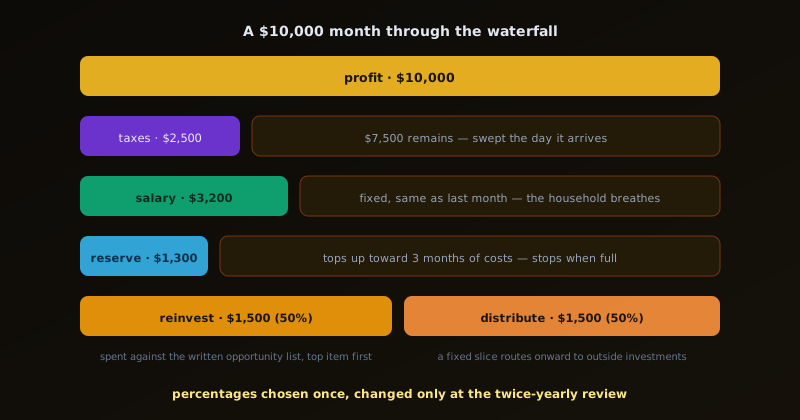
With the salary paid, remaining profit flows through a waterfall of four channels, each with a defined job and a defined fill rule. Channel one is the operating reserve: business cash sufficient to run the company for a fixed number of months (two or three for a lean digital business, more for one carrying inventory) held in the business, boring by design. Until this reserve is full, it takes the largest share of profit, because it is the cheapest insurance you can buy: it converts future emergencies from existential events into line items. Once full, it stops taking money; reserves beyond the target are just dead capital wearing a safety costume.
Channels two through four split everything past the reserve, by fixed percentages you choose in advance. Reinvestment funds growth experiments and capacity, but only against a written list of opportunities with expected returns, which forces the marginal-return honesty that default-reinvestors skip. Owner distribution is profit paid out beyond your salary: the bootstrap years getting repaid, the household savings growing, with a slice routed onward into the outside investments that diversify your net worth. The tax channel (strictly speaking channel zero) is whatever fraction of profit your jurisdiction will eventually claim, swept to its own account on arrival so that tax season is an administrative event rather than a heist. Typical post-reserve splits land somewhere near half to reinvestment and half to distribution for a growth-phase business, drifting toward distribution as the business matures, but the specific numbers matter less than their existence and their stability.
Reading the marginal return on reinvestment
The reinvestment channel deserves its own discipline, because "growth spending" is where allocation systems quietly rot. The standard is simple to state: reinvested dollars must clear the bar of what they would earn elsewhere (roughly, the boring eight-ish percent of a diversified portfolio) adjusted for the very real chance the project returns nothing. In practice that means maintaining a short written list of reinvestment candidates, each with a sentence on the expected mechanism ("deeper stock of the two best sellers eliminates stockout weeks, worth roughly X in recovered sales") and a review date. Money flows to the top of the list, not to whatever idea arrived most recently or feels most exciting.
Two patterns indicate the curve is flattening and distribution should take a bigger share. First, recycled experiments: the reinvestment list keeps funding variations of things that already plateaued: the fourth ad channel after three broke even, the product-line extension nobody requested. Second, capacity without demand: spending that adds ability to serve customers who do not currently exist, justified by hope rather than waitlists. Neither means the business is failing; it means the business is mature at its current size, which is a respectable thing to be. The waterfall handles this gracefully (you adjust the percentages at your scheduled review, shifting weight from reinvestment to distribution) and the owner who built outside savings during the growth years now owns both a stable business and a portfolio, which was the point all along.
How the system fails, when it fails
Allocation systems do not usually collapse; they erode, through a small set of predictable moves that deserve to be named so you can catch yourself mid-move. The salary ratchet is the most common: a strong quarter becomes a raise, the raise becomes the new baseline, and two years later the owner's fixed draw has quietly absorbed the entire reinvestment channel, each step individually defensible, the sum a starved business. The reserve raid is its cousin: the operating reserve gets borrowed against for an "exceptional" opportunity, the exception becomes precedent, and the buffer that was supposed to make emergencies boring is itself an emergency by the time one arrives. And the tax account borrow is the cardinal sin, common enough among first-time owners to deserve italics: that money was never yours, the borrowing always feels temporary, and the eventual reckoning arrives with penalties attached and trust in your own system destroyed.
The defenses are structural rather than moral, because willpower is exactly what the system exists to replace. Separate accounts at the bank level (not categories in a spreadsheet) make raids visible and deliberate instead of frictionless. The twice-yearly review is the only legitimate venue for changing any number, and writing that rule down converts mid-month temptation into an agenda item for a calmer meeting. And a one-line log of every deviation (what was moved, why, when it gets restored) turns the occasional genuine exception into a documented loan instead of a silent erosion. Owners who run the waterfall with these guardrails report something close to the opposite of deprivation: because every dollar has a named job, spending from the right channel feels guiltless in a way that spending from an undifferentiated pile never did. The discipline is not the cost of the system. It is the product.
Running the system
The whole framework operationalizes into a monthly ritual that takes less than an hour once the accounts exist. The discipline is in the schedule, not the math.
- On month close, compute real profit from real books; the waterfall runs on accurate numbers or not at all.
- Sweep the tax fraction to its own account first, every month, untouchable.
- Pay the fixed owner salary, the same number as last month, boring on purpose.
- Fill the operating reserve toward its target months-of-expenses; stop when full.
- Split the remainder by your preset percentages: reinvestment fund and owner distribution.
- Spend reinvestment only against the written opportunity list, top item first.
- Route a fixed slice of distributions onward to outside investments before it reaches the household account.
- Twice a year, review the percentages, the salary, and the reserve target; change them only at these reviews.
The decision you stop making
The quiet genius of allocating by system is that it removes the decision from the months and gives it to the reviews. In the months, you are just an administrator executing percentages: no willpower consumed, no negotiation with yourself, no aggressive April undoing a cautious March. At the reviews, you are a strategist with six months of clean data, adjusting a machine. This separation matters because the monthly version of you is the least qualified allocator available: flush with recency, spooked by the last surprise, and structurally incapable of seeing the marginal return curve from inside a single data point. The system is how the calm version of you stays in charge.
And the system answers the question this article opened with in the only honest way: it depends, but it should depend on rules rather than weather. Early businesses with steep return curves should tilt hard toward reinvestment, after the salary, after the reserve. Maturing businesses should let distribution grow and the outside portfolio with it. Every business, at every stage, should pay its owner something real, hold a buffer, and respect the tax account. Owners who run this way for a few years report the same surprising outcome: the business grows about as fast as it was going to anyway, but the owner gets steadily richer, calmer, and harder to bankrupt, which, it turns out, is what the profit was for.
Frequently asked questions
Quick answers to common questions about this topic.
Should I reinvest profit or pay myself?
Most owners split profit across a few buckets (owner pay, taxes, a cash reserve, and reinvestment) rather than choosing one. The right mix depends on how much return reinvestment can earn versus your need for income and safety.
How much should go to a cash reserve?
A common approach is to hold enough to cover several months of expenses before aggressively reinvesting, so a slow month does not threaten the business. The exact buffer depends on how lumpy your revenue is.
Is there a simple framework for allocating profit?
Yes: set fixed percentages for taxes, owner pay, reserve, and reinvestment, and run every profit through them. This is general education, not personalized financial or tax advice.
Related troubleshooting
Was this page helpful?
Your answer stays in this browser, it is not sent anywhere and no account or cookie is involved.