2026 · Novus Stream SolutionsAbout 11 min readNovus Stream Solutions
Diversifying when your business is your biggest asset
Most diversification advice assumes your wealth lives in a brokerage account. For an owner-operator it lives in the business: illiquid, concentrated, and correlated with your paycheck. Here is how to think about the rest of the balance sheet around it.
Contents
- 1.Overview
- 2.See the whole position first
- 3.What concentration actually costs
- 4.The diversified side has one job
- 5.De-risking without betraying the business
- 6.Diversifying inside the business counts too
- 7.A working sequence
- 8.Taking chips off the table: the partial exit
- 9.Concentration builds wealth; diversification keeps it
Overview
Open any beginner investing guide and diversification is rule one: do not put all your eggs in one basket, own many assets, let no single failure sink you. Then look at the actual balance sheet of a typical small business owner and notice that the advice has already been violated beyond repair. The business is usually the largest asset they own (often larger than their home) and it is the same asset that produces their salary, occupies their working hours, and houses most of their accumulated skill. By textbook standards this is a portfolio on fire. By entrepreneurial standards it is just Tuesday, and it is also how most real wealth gets built in the first place.
This article does not argue that owning a concentrated business is a mistake; concentration is how operators earn returns that diversified investors cannot. It argues something narrower and more useful: that once the business exists, every other financial decision you make should be shaped by the concentration you already carry, and that the standard advice, written for people whose wealth lives in accounts, needs translation before it fits a life where wealth lives in a company. As always in this series, what follows is education and a way of thinking, not personalized financial advice; the right specific moves depend on facts about you that no article can know.
See the whole position first
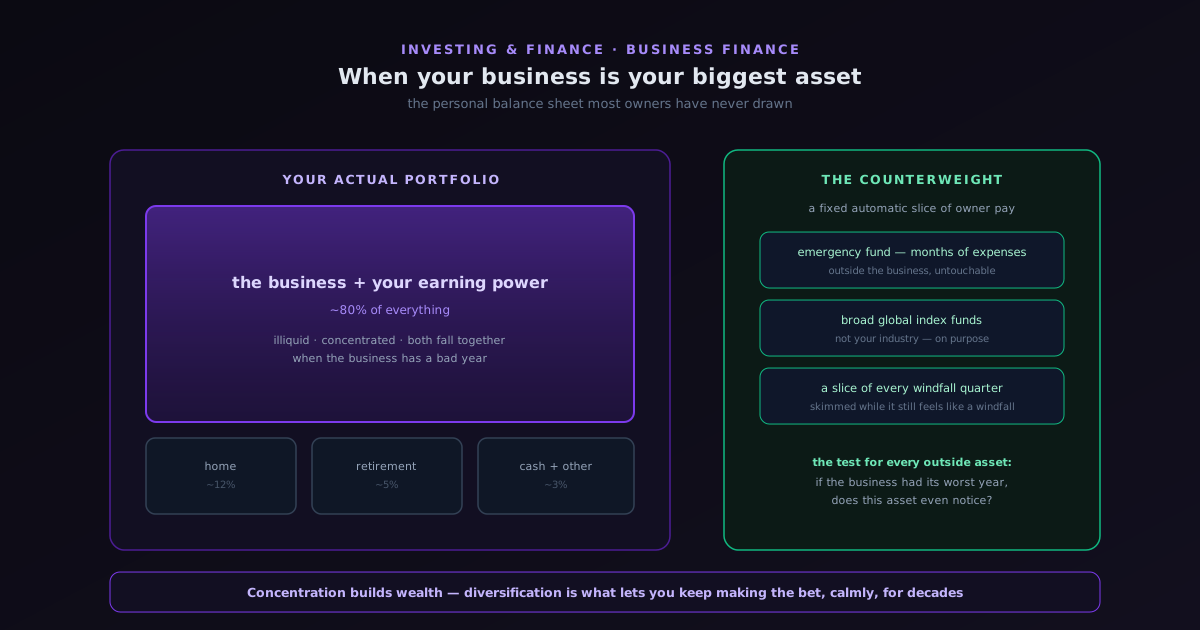
The starting exercise is to draw your personal balance sheet honestly, and the honesty is in counting things that never appear in a brokerary statement. List the business at a defensible value, not the number you hope an acquirer pays someday, but something anchored to what small businesses like yours actually sell for. Add your home, retirement accounts, taxable investments, and cash. Then, on a separate line, acknowledge the asset accountants ignore: your future earning power, which for most working people is the largest asset they have, and which for an owner-operator is fused to the same business that already dominates the asset column. When the company has a bad year, your equity and your paycheck fall together.
For most operators this drawing produces an uncomfortable picture: the business plus business-dependent earning power is seventy, eighty, ninety percent of everything. The point of the exercise is not shame; it is that you cannot manage what you have not measured, and most owners have genuinely never seen their concentration stated as a number. It also reframes what your "portfolio" is. You do not have a small portfolio of index funds doing fine; you have a large portfolio that is overwhelmingly long one private, illiquid small-cap stock, with a thin diversified sliver around it. Every dollar you move from the business side to the diversified side is not a small act inside a small account. It is a meaningful shift in the shape of the whole structure.
What concentration actually costs
Concentration risk is easy to nod along to and hard to feel, so it is worth being concrete about the failure modes, none of which require you to do anything wrong. Platforms change rules: a ranking update, a marketplace policy shift, an ad-account suspension, an API deprecation, and revenue that took five years to build halves in a quarter. Markets move: the niche cools, a funded competitor arrives, input costs spike. Health intervenes: a solo operator who cannot work for six months discovers exactly how much of the company's value was actually their own labor in a trench coat. And small businesses simply fail at high base rates, even well-run ones; that is what the return premium for running them is paying you for.
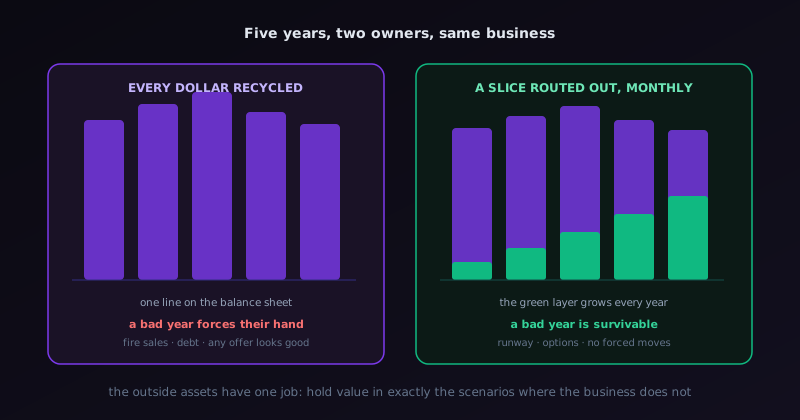
The compounding insult is that these blows land on the income and the asset simultaneously. A laid-off employee with index funds loses their paycheck while their portfolio keeps working; the two systems fail independently. An owner whose business stumbles loses salary, asset value, and often confidence in the same season, and if the household's emergency fund was thin because "the business is doing great," the stumble forces exactly the wrong moves at the wrong time: selling inventory at fire-sale prices, taking expensive debt, or accepting any acquisition offer that appears. Diversification, for an operator, is not about optimizing returns. It is about making sure no single bad season can force your hand.
The diversified side has one job
Once the picture is drawn, the design principle for everything outside the business becomes clear: the outside assets exist to be uncorrelated with the inside one. Their job is not to be exciting, and it is certainly not to express your industry insight; it is to hold value in exactly the scenarios where the business does not. That argues for broad, boring, liquid holdings: global index funds across many sectors and countries, some bonds or cash according to your nerve, an emergency fund sized in months of household expenses. Every property the business lacks (liquidity, diversification, indifference to your niche, zero demands on your time) is a property the outside portfolio should maximize.
The same principle generates a short list of anti-patterns that owners fall into constantly. Holding your liquid wealth in stocks from your own industry recreates the correlation you were trying to escape. Keeping the emergency fund inside the business checking account means it will quietly become working capital the next time inventory looks cheap. Lending the business money from retirement savings, or personally guaranteeing its debts beyond what is unavoidable, welds the two sides of the balance sheet back together precisely where you had managed to separate them. The test for any asset on the outside ledger is brutal and simple: if the business had its worst plausible year, does this asset notice? If yes, it is not diversification. It is the same bet wearing different clothes.
De-risking without betraying the business
The emotional obstacle deserves naming, because it stops more owners than the math does: taking money out of the business feels like disloyalty. Every dollar moved to an index fund is a dollar not spent on inventory, marketing, or the next hire, and the inside-view return on those always looks higher than eight percent. Sometimes it genuinely is: early on, reinvestment usually wins, which is why this series treats the reinvest-or-pay-yourself decision as its own article. But the inside-view comparison omits risk: the business return is a possible return on a fragile asset, while the diversified return is a probable return on an unkillable one. A rational allocator pays something for that difference. Owners who refuse to ever pay it are not being ambitious; they are letting the asset that already owns their days also own their downside.
The practical resolution is to make diversification a small, automatic, boring tax on success rather than a periodic agonizing decision. Pick a fixed share of owner pay or distributions (the exact number matters less than its existence) and route it to the outside portfolio on a schedule, the same way you route sales tax to the tax account without debating it monthly. When the business has a windfall quarter, skim a defined slice of the windfall too. The psychology of the rule is the entire trick: by deciding once, you stop renegotiating with yourself during exactly the seasons (booms and panics) when your judgment about the business is least objective. Over a few years the outside sliver stops being a sliver, and you will notice the difference not in spreadsheets but in posture: decisions about the business get calmer when the business is no longer the only thing keeping you safe.
Diversifying inside the business counts too
Balance-sheet diversification is the main event, but the same logic applies one level down, inside the company, and for owners who cannot yet extract much cash, it is the diversification they can actually afford. Revenue concentration is the obvious target: a business where one customer, one product, or one channel produces most of the revenue is concentrated in exactly the way a one-stock portfolio is. Adding a second meaningful traffic source, a second product family, or a second sales channel does not show up in any investment account, but it changes the survival math of the asset that dominates your net worth, which amounts to the same thing.
Platform dependence is the version most online businesses underestimate. If your revenue exists at the pleasure of a single algorithm (one marketplace, one social feed, one search engine, one app store) then a policy bot can do to you what a market crash does to an undiversified investor, except with no recovery rally afterward. The hedges are unglamorous and effective: an email list you own, a direct-sales channel beside the marketplace, documentation and content on a domain you control, customer relationships that survive a platform ban. None of this is new advice as business strategy. The reframe is to see it as portfolio management: every reduction in single-point-of-failure risk inside the business is a direct improvement to the riskiest line on your personal balance sheet.
A working sequence
Pulling the threads together, the path from fully concentrated to sensibly structured is a sequence, not a leap, and each step is worth doing even if you never take the next one.
- Draw the personal balance sheet, including the business at a defensible value, and compute your actual concentration percentage.
- Build a household emergency fund outside the business: months of personal expenses, in cash, untouchable by inventory temptations.
- Set a fixed, automatic slice of owner pay or distributions that flows to broad index funds on a schedule.
- Skim a defined share of windfall quarters to the outside portfolio while they still feel like windfalls.
- Keep the outside portfolio free of your own industry and of anything correlated with the business's failure modes.
- Attack revenue concentration inside the business: second channel, second product family, owned audience.
- Revisit the balance sheet yearly; the goal is a concentration number that trends down as the business matures.
Taking chips off the table: the partial exit
There is a more aggressive de-risking tool that small business owners rarely consider because they assume it belongs to the venture-capital world: selling a slice of the business itself. Partial exits at small-business scale take humbler forms than equity rounds, but they exist and they work. Selling a single product line or a secondary site lets you convert a piece of the concentrated asset into liquid capital while keeping the core. Bringing in a minority partner (an operator who buys twenty or thirty percent and shares the work) simultaneously diversifies your balance sheet and reduces the key-person risk that was depressing the asset's value anyway. Even seller financing on a full exit, where you carry a note paid from the business's future profits, is a form of staged de-risking: the asset converts to an income stream whose risk declines with every payment. None of these are admissions of doubt about the business. They are the recognition that the difference between eighty percent of your net worth in one asset and fifty percent is enormous, while the difference in your daily life is often barely noticeable.
The standard objection is timing: the business is growing, so selling any of it now means selling cheap. Sometimes that is even true. But notice that the argument proves too much: it argues against ever diversifying anything that is going well, which is exactly the logic that keeps owners fully concentrated until the platform change or the health event makes the decision for them, at the worst possible price. The honest framing is that a partial exit trades some expected value for a large reduction in variance, and that trade gets more attractive as the business becomes a larger share of everything you own. A founder whose company is forty percent of their net worth can rationally let it ride. A founder at ninety percent is not being bold by refusing to sell a slice; they are being undiversified with extra steps, and the market for small businesses (unlike the market for startup equity) will actually let them fix it.
Concentration builds wealth; diversification keeps it
The old market saying holds up: concentration is how wealth gets built, diversification is how it gets kept. Operators live the first half by default: the business is the concentrated swing, and nothing in this article asks you to swing softer. The failure mode is forgetting the second half until it is urgent: running a decade of profitable years with every dollar recycled into the company, then meeting the platform change, the health event, or the market turn with a balance sheet that has exactly one line on it. The owners who end up durably wealthy are rarely the ones who avoided that storm. They are the ones for whom the storm was survivable because, years earlier, they started quietly building the boring side.
There is also a payoff that arrives long before any crisis: optionality changes how you operate. An owner with two years of household runway and a real outside portfolio negotiates differently, prices differently, says no to bad customers, and declines desperate pivots, because the business has stopped being a hostage situation. Paradoxically, de-risking your life often improves the risky asset, since fear is a terrible product manager. That is the real argument for diversifying around the thing you built: not abandoning the bet, but becoming the kind of owner who can keep making it freely, year after year, with hands that do not shake.
Frequently asked questions
Quick answers to common questions about this topic.
Why is having most of your wealth in your business risky?
Because your income, your savings, and your net worth all depend on the same single outcome. If the business struggles, several parts of your financial life are hit at once; that concentration is the risk diversification addresses.
How do owners diversify without starving the business?
Commonly by gradually moving some profit into assets outside the business as it generates surplus, rather than pulling capital it needs to grow. The balance between reinvesting and diversifying is the judgment call.
Is this advice for my situation?
No. It is general education about concentration risk, not personalized financial advice. Your own balance depends on your circumstances and is worth discussing with a qualified advisor.
Related troubleshooting
Was this page helpful?
Your answer stays in this browser, it is not sent anywhere and no account or cookie is involved.