2026 · Novus Stream SolutionsAbout 13 min readNovus Stream Solutions
How small online businesses are valued: SDE, multiples, and what moves them
Small online businesses sell for a multiple of their owner earnings, and the multiple is a scorecard of how transferable, durable, and owner-independent the business is. Understanding the formula makes you a better operator even if you never sell.
Contents
- 1.Overview
- 2.SDE: the number buyers actually price
- 3.The multiple is a grade for risk
- 4.What pushes a multiple up
- 5.What drags a multiple down
- 6.Valuation as an operating lens
- 7.Where the numbers come from, and why asking prices lie
- 8.A self-valuation walkthrough
- 9.How the deal is actually structured
- 10.The number is a mirror
Overview
Every small business owner carries a private number: what they reckon the business would fetch if they ever sold. The number is usually wrong, and not by a little. Owners anchor on revenue, on years of effort invested, or on a half-remembered headline about a startup acquired for ten times sales, while actual buyers of small online businesses price them with a formula so consistent you can write it on one line: a multiple of owner earnings, where the multiple is a grade for risk. Learning how that formula works is worth an afternoon even if selling is the furthest thing from your mind, because the formula doubles as the most honest checklist of business quality you will find anywhere.
This article covers how the sub-million-dollar end of the market actually prices things: the world of marketplaces, brokers, and individual buyers acquiring content sites, e-commerce stores, SaaS products, and service books. As with everything in this series, it is education rather than advice: real transactions involve accountants, lawyers, and facts specific to your situation. But the mechanics below are the shared vocabulary the entire market negotiates in, and operators who do not speak it are negotiating blind.
SDE: the number buyers actually price
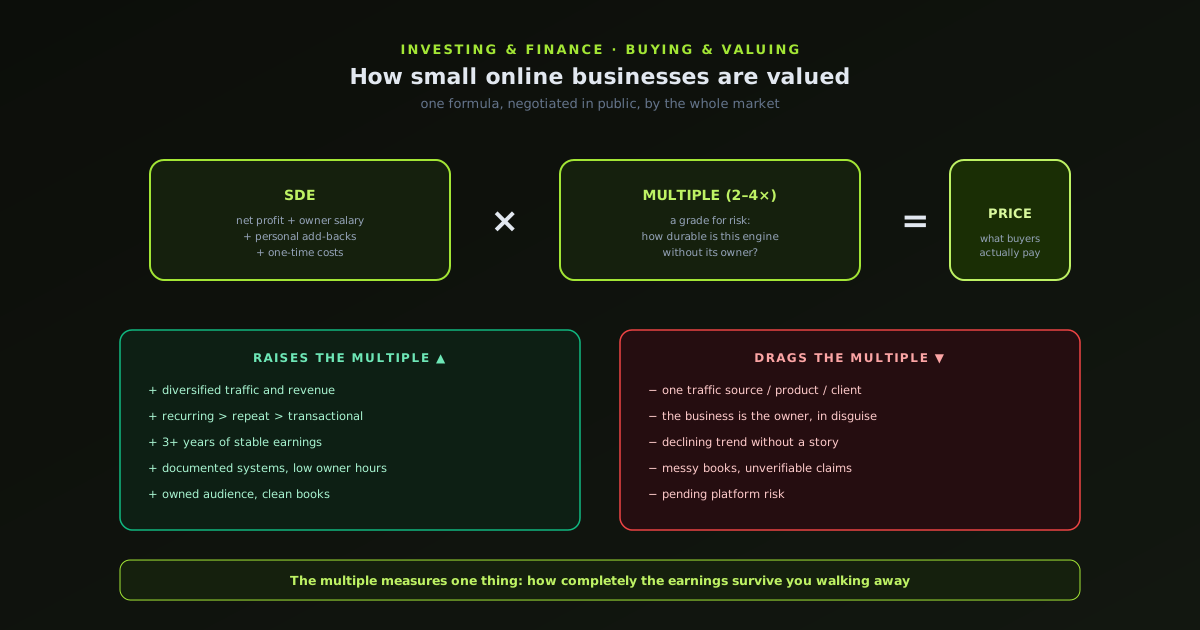
The earnings figure that small-business buyers care about is not net profit as your accountant reports it, and it is not revenue. It is seller's discretionary earnings, or SDE, which asks a specific question: if a single owner-operator ran this business, how much total economic benefit would flow to them in a year? You build it by starting with net profit and adding back everything that was really owner benefit or owner choice in disguise: the salary you paid yourself, personal expenses routed through the business, one-time costs that will not recur, interest and depreciation that reflect financing decisions rather than operations. What remains is the cash engine a new owner is actually buying.
Two consequences follow immediately. First, clean books are worth real money: every legitimate add-back you can document raises the priced number dollar-for-dollar, and every murky personal expense entangled with business spending forces a buyer to either trust you or discount you, and buyers do not trust you. Second, SDE explains why revenue brags mean nothing to acquirers. A store doing a million in revenue at four percent margin produces less SDE than a content site doing a hundred and fifty thousand at seventy percent, and it will sell for less, full stop. Larger businesses (typically beyond several hundred thousand in earnings) graduate to a cousin metric called EBITDA, which assumes a hired manager replaces the owner and subtracts that manager's market salary first. For the micro end of the market, SDE is the lingua franca.
The multiple is a grade for risk
The second half of the formula is the multiple, and the cleanest way to understand it is as an inverted interest rate. A business selling for three times SDE pays its buyer back in roughly three years if earnings hold, about a thirty-three percent annual yield. Why would any market hand out thirty-three percent yields when index funds pay eight? Because the earnings frequently do not hold. Small businesses are fragile in all the ways this series keeps cataloguing (platform dependence, key-person dependence, niche decay) and the fat yield is compensation for the meaningful chance that the engine sputters within the payback window. The multiple, in other words, is the market's estimate of durability: riskier earnings command a shorter payback demand, safer earnings stretch to a longer one.
In practice, most small online businesses trade in a band between roughly two and four times SDE, with the band's edges telling the story. Content and ad-revenue sites have historically clustered near the low-to-middle of the range, reflecting their exposure to search algorithms. E-commerce sits in the middle, with inventory and supplier risk pulling one way and brand strength pulling the other. Small SaaS products command the top of the band and sometimes break above it, because contractual recurring revenue is the most durable earnings stream the micro market sells. These bands drift with the broader economy (cheap money stretches them, tight money compresses them) but the ordering between business types is stable, because it reflects structural risk rather than fashion.
What pushes a multiple up
Within the band, specific attributes move individual businesses toward the top, and the unifying theme is transferability: how completely the earnings survive the owner walking away. Diversified traffic and revenue lead the list: a site earning from search, email, direct visits, and social, monetized through ads plus affiliates plus products, is structurally harder to kill than one fed by a single algorithm and a single income stream. Age and trend matter next: three-plus years of stable or gently growing earnings reads as durability, while a spectacular eighteen-month spike reads as a fad with a countdown timer. Documented systems (SOPs, documented supplier relationships, a content process a stranger could run) convert the owner's private knowledge into an asset that conveys with the sale.
The quieter premium factors are structural. Recurring revenue beats repeat revenue, which beats transactional revenue, because each step up makes next month's income more predictable. An owned audience (email list, customer accounts, a community) adds value no rented channel can. Low owner hours raise the multiple directly: a business producing its SDE on five hours a week is buying the new owner an income and a life, while one demanding sixty hours is buying them a job, and jobs price lower. Even boring hygiene compounds here: clean financials, separated accounts, and tidy analytics do not just speed due diligence; they signal an operator whose claims about everything else can be believed, and credibility itself is priced.
What drags a multiple down
The discount list is the same theme inverted, and the heaviest weight on it is concentration in any form. One traffic source supplying most visits, one product supplying most revenue, one customer supplying most income, one supplier with no alternative: each is a single point of failure a buyer must price as if it will eventually fail, because sometimes it does. Key-person dependence is the most common and most underestimated drag for small operations: if the business is a personal brand, if customers come for the owner by name, if the content voice or client relationships are inseparable from one human, then a meaningful share of the "business" cannot be sold at all, and the multiple quietly prices only the part that can.
The remaining discounts are self-inflicted more often than structural. Messy books that blend personal and business spending force buyers to reconstruct reality and assume the worst about whatever resists reconstruction. Declining earnings trends demand either a story with evidence or a steep haircut; buyers pay for trajectory, not nostalgia. Unverifiable claims about traffic or revenue, even true ones, price as if false. Pending platform risk (a site that has not been migrated off a deprecated stack, a store built on a policy gray area) transfers as a liability with the asset. The pattern across all of it: buyers discount uncertainty itself, independent of the underlying facts, which means an owner can lose six figures of sale price purely through poor record-keeping on a perfectly healthy business.
Valuation as an operating lens
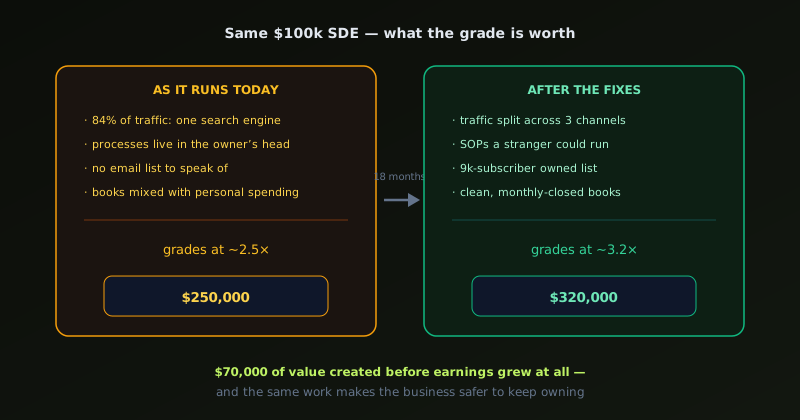
Here is the practical payoff for owners with no intention of selling: the valuation formula is a to-do list. Every factor that raises a multiple is also a factor that makes the business safer and saner to own, and the formula prices each improvement with unusual clarity. Suppose your business produces a hundred thousand in SDE and would realistically grade at 2.5× today. Diversifying off a single traffic source, documenting your processes, and growing the email list might plausibly move the grade to 3.2× over eighteen months. That is seventy thousand dollars of created value before earnings grow at all, and unlike a revenue push, the same work simultaneously reduces the odds of the catastrophic scenarios that haunt concentrated businesses.
This lens also sharpens everyday tradeoffs. A dollar of recurring revenue is worth more than a dollar of one-off revenue; the formula says how much more, so weight your roadmap accordingly. An hour spent writing the SOP nobody asked for is an hour converting your private knowledge into sellable property. Cutting your own operating hours is not laziness; it is multiple expansion. Owners who internalize this stop treating "exit prep" as a frantic season before a sale and recognize it as ordinary good operating that happens to be denominated in enterprise value. The businesses that sell well are simply well-run businesses whose owners kept receipts; the market pays for the overlap.
Where the numbers come from, and why asking prices lie
A fair question about everything above: where do the multiples actually come from, and how would an owner check them? The honest answer is that the small-business market publishes its prices unusually openly. The major acquisition marketplaces list hundreds of businesses at any moment with revenue, earnings, and asking multiples visible; several brokers publish annual reports aggregating their closed transactions by business type and size; and the listing archives themselves, browsed patiently, teach the going rate for your category faster than any formula. An owner who spends two evenings a year reading listings for businesses resembling theirs maintains a working sense of their own multiple at a cost of zero, which is more market awareness than most owners of houses have, let alone businesses.
The critical correction when reading this data: asking prices are not prices. Sellers anchor high, listings sit unsold for months at fantasy multiples, and the gap between asked and closed is widest exactly where the seller's documentation is weakest, which means the visible market systematically overstates what businesses fetch. Closed-transaction data, where brokers publish it, runs reliably below the asking-price impression, and the spread itself is informative: it is the market pricing the difference between a story and a verified one. The practical takeaways for a self-valuing owner are two. First, calibrate against closed data and discount listing prices by a healthy margin when only listings are available. Second, notice that everything separating an asking price from a closing price (verifiable numbers, clean books, documented transferability) is in your control years before any sale, which returns to this article's central point: the valuation gap is mostly a preparation gap, and preparation is just operating well with receipts.
A self-valuation walkthrough
You can grade your own business in an evening, and the exercise is worth repeating yearly. The output is approximate (real prices are set by real negotiations) but the direction and the gaps it reveals are reliable.
- Compute SDE: last twelve months' net profit, plus owner salary, personal expenses run through the business, and genuine one-time costs.
- Identify your business type's rough band (content, e-commerce, SaaS, service) and start at its midpoint.
- Grade transferability honestly: would the earnings survive your disappearance? Each "only I can do this" subtracts.
- Count concentrations: any traffic source, product, customer, or supplier above half of its category is a discount.
- Credit durability: years of stable earnings, recurring revenue share, owned-audience size, documented processes.
- Multiply, then stress-test: would you pay that price for this business, knowing everything you know? The wince is information.
- Write down the three cheapest fixes that would raise the grade, and treat them as roadmap items with dollar values attached.
How the deal is actually structured
The headline number (SDE times a multiple) is where most valuation conversations stop, but the structure of how that number gets paid often matters as much as its size, and an owner who understands deal mechanics negotiates a stronger outcome than one fixated solely on the price. Few small businesses sell for the full figure in cash on closing day. Buyers, sensibly wary that the earnings might not survive the transfer, push to tie part of the price to the business actually performing after they take over, and the instruments they use to do so are worth knowing before you are sitting across from one. An all-cash offer at a slightly lower number can genuinely beat a higher headline price loaded with contingencies, and the seller who cannot tell the difference is negotiating on the one term that is easiest to inflate cheaply.
Three structures recur at the small-business end of the market. An earn-out pays a portion of the price over the following year or two, contingent on the business hitting agreed revenue or profit targets, which protects the buyer and transfers real risk to the seller, since a post-sale stumble (sometimes caused by the buyer's own missteps) can erase money you thought you had earned. Seller financing has the seller carry a promissory note for part of the price, paid from the business's future cash flow with interest; it widens the buyer pool and signals confidence, but it means you are effectively lending the buyer money secured by the business you no longer control. A holdback parks a slice of the proceeds in escrow against post-closing surprises in the books or the claims you made. Each shifts risk onto the seller, and each should be priced: a dollar promised contingently is worth less than a dollar paid at closing, and the discount is the seller's to demand in the headline number.
The practical lesson loops back to everything earlier in this article. The cleaner and more transferable the business, the more leverage the seller has to insist on cash and to resist contingent structures, because a buyer staring at diversified revenue, documented systems, and verified books has far less reason to fear the earnings will evaporate, and far less justification for tying up the price. Owner dependence, concentration, and messy records do not merely lower the multiple; they hand the buyer the argument for structuring the deal in their own favor, stretching payment out and conditioning it on performance the seller can no longer guarantee. So the same disciplines that raise the number also improve its terms, twice rewarding the operator who built well. Preparing a business to sell on its own terms, for cash, is indistinguishable from simply running it well enough that nobody needs to hedge against it.
The number is a mirror
Valuation gets treated as exit arcana, something to learn in the final year before a sale. The better posture is to treat the formula as a standing mirror: SDE measures whether the machine actually produces owner wealth, and the multiple measures whether the machine is built well: diversified, documented, durable, and bigger than the person who built it. Owners who check the mirror annually catch their fragilities while they are cheap to fix. Owners who avoid it tend to discover, at the worst possible moment, that what they built was a well-paying job with inventory.
And if you do someday sell, the preparation turns out to have been the operating itself. The diversified traffic you built for safety becomes the multiple you are paid. The SOPs you wrote to take a vacation become transferability a buyer funds. The clean books you kept for your own sanity become a due diligence that closes instead of collapsing. There is a satisfying honesty in how this market prices things: it pays, almost exactly, for the discipline. The owners who get surprised by their valuation (in either direction) are the ones who never looked at the formula while there was still time to change what it measured.
Frequently asked questions
Quick answers to common questions about this topic.
How is a small online business valued?
Most small online businesses are valued as a multiple of SDE (seller's discretionary earnings), annual profit plus the owner's add-backs. The multiple reflects risk, growth, and how transferable the business is.
What makes a business worth a higher multiple?
Stable, diversified revenue, low owner dependence, clean books, growth, and durable traffic or customer relationships. Anything that makes future earnings more certain and more transferable raises the multiple.
What lowers a valuation?
Heavy reliance on one channel, customer, or the owner; declining or volatile revenue; and messy financials. Buyers discount for risk and for work they will have to do to de-risk the business.
Related troubleshooting
Was this page helpful?
Your answer stays in this browser, it is not sent anywhere and no account or cookie is involved.