2026 · Novus Stream SolutionsAbout 11 min readNovus Stream Solutions
Buying a small online business: where micro-acquisitions happen and how not to overpay
You can skip the zero-to-one years by buying a business that already works, if you can tell the difference between a durable asset and a dressed-up listing. A field guide to micro-acquisitions and the due diligence that separates them.
Contents
- 1.Overview
- 2.The case for buying, and the honest case against
- 3.Where the deals actually are
- 4.Due diligence: verify everything, trust nothing
- 5.Structuring the deal like an adult
- 6.The first ninety days: do not break the machine
- 7.Where the bargains actually hide
- 8.The buyer's checklist
- 9.Skipping the desert, not the work
Overview
There are two ways to own a small online business. The famous one is building: the zero-to-one years of publishing into silence, launching to nobody, and surviving long enough for compounding to notice you. The quieter one is buying: paying a few months' or years' worth of profit for something that already has traffic, customers, and revenue, skipping directly to the operating phase, where effort converts to results at rates the zero-to-one years never offer. Micro-acquisitions, from four-figure content sites to six-figure stores and small software products, have become a genuine asset class with marketplaces, brokers, and a steady population of buyers and sellers.
It is also an asset class with a structural information problem: every listing is written by someone whose incentive is to sell, describing an asset whose risks are mostly invisible from outside, to buyers who are often shopping with more enthusiasm than method. The result is predictable: most first-time buyer mistakes are overpayment for fragility that ten hours of verification would have revealed. This guide is those ten hours, organized. As with everything in this series: education, not advice; real acquisitions deserve real professionals at the document stage.
The case for buying, and the honest case against
The buy case is time arbitrage. The hardest, least rewarding phase of any online business is the beginning, when content has no authority, stores have no reviews, and products have no users: a desert that consumes one to three years and kills most attempts. Buying purchases someone else's completed desert crossing: an aged domain with rankings, a customer base with repeat behavior, a product with paying subscribers. For an operator with skills but no asset (someone who can write, market, or build but does not want to wait two years for soil to become fertile) acquisition is often the rational entry, and the math from the valuation article in this series shows why: at typical multiples of two to four times annual profit, even modest improvement of an existing engine repays the price quickly.
The case against is equally structural. You are buying the risks along with the asset, including the ones the seller does not mention and the ones the seller does not know. Small online businesses are concentrated creatures (one traffic source, one supplier, one platform's policy) and a buyer inherits every concentration at full strength on day one, minus the founder's accumulated instincts for managing them. You are also, unavoidably, answering a question the seller has already answered: why is this person selling a machine that prints money at a thirty-percent yield? Sometimes the reason is benign: fatigue, a new project, a life change. Sometimes the seller sees a cliff you cannot: a ranking decay underway, a platform change announced, a competitor scaling. Due diligence is the discipline of refusing to proceed until you know which.
Where the deals actually are
The market has three tiers, distinguished mostly by deal size and how much verification infrastructure surrounds you. Marketplaces (the listing platforms where sellers post businesses with summary financials) dominate the small end, from four-figure starter sites to mid-six-figure businesses; they offer selection and some standardized data, but vetting depth varies enormously and the platform's incentive is transaction volume, not your outcome. Brokers occupy the middle and upper-middle, packaging businesses with prepared financials and managing the process for a commission paid by the seller, which buys you cleaner information and a smoother transaction, alongside the structural fact that the broker works for the other side. Direct outreach (finding an unlisted business you admire and asking the owner) is the smallest channel and frequently the best one, because unlisted sellers have not optimized their story, competition is absent, and prices reflect conversation rather than auction.
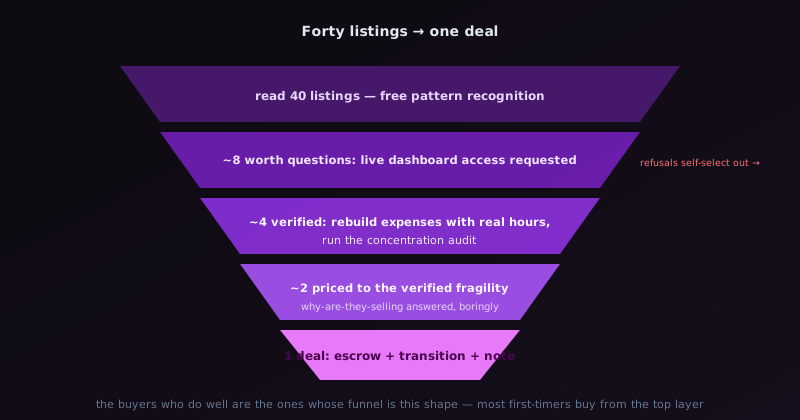
Whichever channel, the working posture is the same: deal flow is a funnel, and the buyers who do well look at dozens of listings for every letter of intent, building pattern recognition the way a hiring manager builds it: by volume. The first ten listings you read will all look plausible; by the fortieth, the patterns of dressing-up announce themselves from the summary alone: the revenue spike conveniently inside the trailing twelve months, the "passive, four hours a week" claim attached to a content operation publishing daily, the traffic chart that starts exactly where an earlier collapse would have been visible. Reading listings is free education in market prices and seller psychology, which is why the standard advice is to spend your first month buying nothing.
Due diligence: verify everything, trust nothing
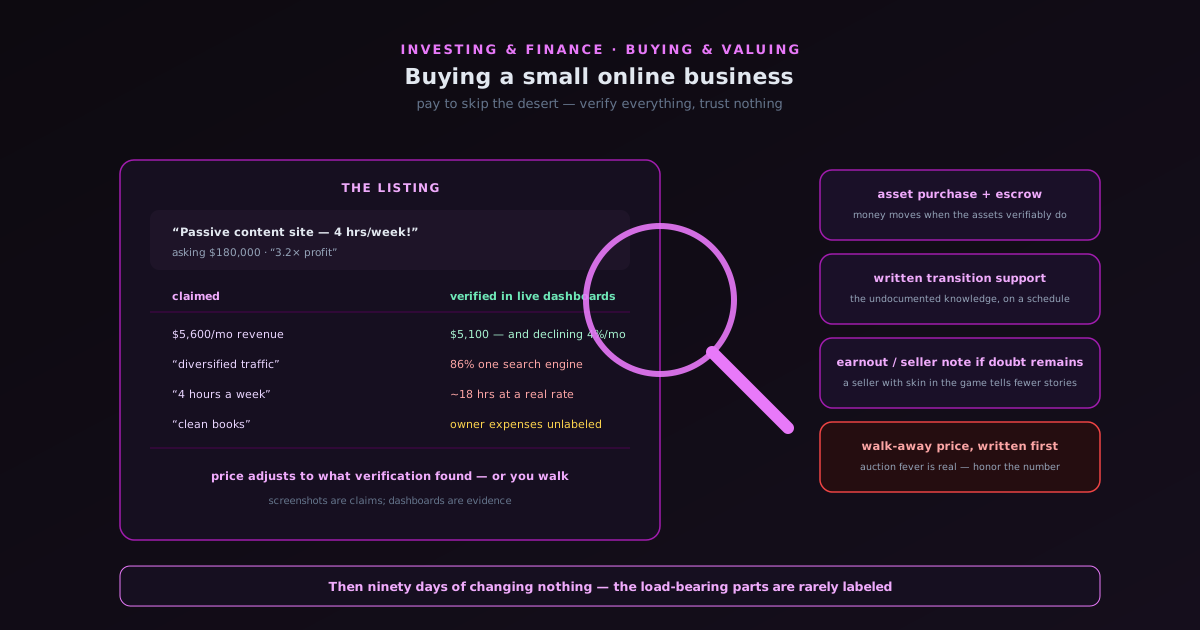
Diligence on a micro-acquisition is not a formality scaled down from big deals; it is the entire game, because at this end of the market there are no audited statements, only claims and the evidence you demand. The prime directive: verify from primary sources, never from screenshots. Revenue gets confirmed by read-only access to the actual payment processor, ad network, and marketplace dashboards: screenshots are trivially forged, and the request for live access is itself a test, since legitimate sellers grant it and evasive ones evaporate. Traffic gets confirmed inside the analytics platform directly, checked for the composition that matters: which pages earn it, from which sources, with what trend at monthly resolution, because annual averages are where traffic collapses go to hide.
Then the expense reality: small-business sellers systematically understate costs, especially their own labor. Rebuild the P&L from the verified numbers, inserting the real hours the operation needs at a real rate: the "four hours a week" listing that actually requires twenty is overpriced by exactly the difference, and you will be the one paying it. Finally, the concentration audit from the valuation article, run as a buyer: what fraction of traffic depends on one search engine's current opinion; what fraction of revenue on one product, customer, or affiliate program; what single supplier, plugin, or platform policy could halve the business by email. None of these are necessarily deal-killers; they are price adjusters, and the entire negotiation is making the price reflect the verified fragility rather than the listed story.
Structuring the deal like an adult
Deal structure is the buyer's second line of defense, after price. The instruments are simple at this scale. An asset purchase (buying the site, the customer list, the product, not the seller's legal entity) is standard, leaving the entity's unknown liabilities behind. Escrow through a reputable third party protects the transfer in both directions: money releases when the assets (domain, accounts, code, supplier relationships) verifiably move. A transition period, written into the agreement, obligates the seller to a defined number of support hours across the first weeks, because an enormous amount of how a small business actually runs lives undocumented in the founder's head. And a non-compete with sensible scope keeps the seller from rebuilding the same business next quarter with the audience relationships they did not sell you.
For larger or riskier deals, earnouts and seller financing align incentives better than any promise: a seller holding a note paid from future profits, or an earnout tied to revenue holding above a threshold, is a seller with a financial stake in the truth of their own claims, and a seller who refuses any skin in the game after diligence raised questions is answering those questions. Two final disciplines belong in every deal regardless of size. First, the walk-away price gets written down before negotiation begins, because auction psychology is real and micro-acquisition bidding produces the same overpayment fevers as house-hunting. Second, the professionals get hired for the documents (a lawyer for the purchase agreement, an accountant for anything with inventory or taxes) at costs that are rounding errors against what they prevent.
The first ninety days: do not break the machine
The risk that no diligence catches is the transition itself, and it follows a known script: the new owner arrives energized, sees ten obvious improvements, implements them in month one, and discovers by month three that several of them were not improvements: the redesign cratered the conversion rate the old ugly page had quietly earned, the content "upgrade" disturbed rankings, the pricing change churned the regulars. Small businesses are ecosystems whose load-bearing elements are rarely labeled. The standard prescription is humility on a timer: for the first sixty to ninety days, change nothing material. Run the machine exactly as bought, learn where the revenue actually comes from, talk to customers, and keep a list of improvement hypotheses that you deliberately do not act on yet.
The ranked list at day ninety is reliably different from the one at day five, and the difference is the tuition you paid for by waiting instead of by breaking things. From there, the operating playbooks elsewhere in this series take over: the boring monthly close, the concentration-reduction roadmap, the reinvest-or-distribute waterfall. One acquisition-specific addendum: keep the seller relationship warm if the transition allowed it. The founder who built the asset remains the single highest-context consultant on earth for it, and a respectful buyer who asks a good question twice a year usually gets answers worth far more than the goodwill costs. Most sellers, it turns out, want the thing they built to keep working.
Where the bargains actually hide
Since most buyers shop the same marketplaces with the same filters, it is worth saying where the genuinely good deals tend to live, and it is rarely the polished listings. Tired-owner businesses are the classic category: a fundamentally sound asset run by someone who checked out a year ago, visible in the tells of deferred maintenance (stale content, unanswered reviews, a design from two redesign cycles ago) atop traffic and revenue that have merely sagged rather than collapsed. These price off their tired recent numbers, and a buyer with energy is purchasing the gap between what the asset does and what it would do if anyone cared again. Mismatched-owner businesses are the second category: a content site owned by someone who hates writing, a product brand owned by someone who hates marketing; these are sound machines run by the wrong operator, sold at the price of their mediocre execution rather than their mechanism.
The third category is the unlisted business, reached by direct approach, and it deserves more respect than its conversion rate suggests. Most owners of small digital businesses have never seriously considered selling, have no idea what the asset is worth, and have also, in some fraction of cases, quietly fantasized about being done. A short, respectful, specific message (what you admire about the business, that you are a real buyer with real funds, an invitation to a conversation with no pressure) costs nothing and occasionally opens negotiations with no competing bidders, no broker framing, and a seller whose price anchors on their own surprise rather than on a marketplace's comparables. The discipline in all three categories is the same as everywhere in this article: the discount is compensation for something (effort, neglect, illiquidity) and the buyer's job is to verify that the something is fixable by them, specifically, rather than romantic in general. Cheap and broken is just expensive with a delay.
The buyer's checklist
The whole discipline, compressed for the moment a listing catches your eye:
- Read forty listings before bidding on one; pattern recognition is the cheapest diligence there is.
- Verify revenue and traffic in live dashboards, never screenshots; treat refusal as the answer.
- Rebuild the expense line with the real hours at a real rate: yours.
- Audit concentration: traffic sources, revenue mix, suppliers, platform policies. Adjust price, not enthusiasm.
- Ask why they are selling until the answer is boring and consistent.
- Structure: asset purchase, escrow, written transition support, sensible non-compete; earnout or seller note where doubt remains.
- Write the walk-away price before negotiating. Honor it.
- Then: ninety days of changing nothing, learning everything.
Skipping the desert, not the work
Buying a business is best understood as paying to skip the desert, not the work. What the purchase price buys is the asset's accumulated time: the rankings, the reviews, the customer trust that only calendar months can mint. What it cannot buy is the operating judgment the founder accumulated alongside it, which means every acquisition has a private second price: the months of learning curve during which the new owner is objectively worse at running the business than the person who sold it. Buyers who respect that second price (verifying hard, structuring carefully, then sitting on their hands for a quarter) consistently report that micro-acquisition was the best financial decision they made. Buyers who pay only the listed price tend to fund the cautionary tales.
For readers of this series, the deeper connection is to the valuation mirror from the seller's side: everything that makes a business worth buying (diversified traffic, documented systems, transferable operations, clean books) is exactly what the operating playbooks here keep telling you to build. The market for small businesses prices discipline, in both directions. Build with it and you will someday sell well; buy with it and you will rarely overpay. Either way, the formula is symmetric, public, and patient, which is more than can be said for almost any other market where ordinary operators are allowed to play.
Frequently asked questions
Quick answers to common questions about this topic.
Where do people buy small online businesses?
On marketplaces and brokerages for websites, content sites, and small SaaS, as well as through direct outreach. Listings typically show revenue, profit, and an asking multiple of earnings.
How do I avoid overpaying for an online business?
Verify the numbers (traffic, revenue, and profit from primary sources, not screenshots), understand how dependent the business is on the owner or one channel, and price the risk into the multiple. Concentration and unverifiable claims should lower what you pay.
What due diligence matters most?
Traffic sources and stability, revenue verification, owner involvement, and transferability of key assets and accounts. See how valuations are set at How small online businesses are valued: SDE, multiples, and what moves them.
Related troubleshooting
Was this page helpful?
Your answer stays in this browser, it is not sent anywhere and no account or cookie is involved.