2026 · Novus Stream SolutionsAbout 12 min readNovus Stream Solutions
Reading a P&L for non-accountants: what each line is trying to tell you
The profit and loss statement is the business equivalent of a medical chart, and most owners squint at the bottom line and skip the diagnosis. Here is how to read each line as the question it answers.
Contents
- 1.Overview
- 2.The shape of the page: a controlled descent
- 3.Revenue: bigger is not the question
- 4.COGS and gross profit: the engine gauge
- 5.Operating expenses: the cost of existing
- 6.The bottom line, and why cash disagrees with it
- 7.Three one-paragraph case studies
- 8.Common-size the statement: reading in percentages
- 9.A ten-minute monthly reading ritual
- 10.From scoreboard to instrument panel
Overview
Most small business owners interact with their profit and loss statement the way most people interact with a medical chart: they look at one number (the bottom line, the pulse) and hand the rest to a professional, hoping silence means health. That works until it does not. The P&L is the most information-dense page the business produces, and nearly every slow-motion failure in small business (margin erosion, cost creep, a product line quietly subsidizing another) announces itself on that page months or years before it becomes a crisis. The announcements are just written in a dialect nobody taught the owner to read.
This article is the dialect lesson. No accounting training is assumed, no journal entries appear, and the goal is not to replace your accountant; it is to make you the kind of owner who reads the monthly statement in ten minutes and comes away knowing which question to ask next. The frame that makes everything click: each line of the P&L is the answer to one specific question about the business, and reading the statement is just asking the questions in order, from the top.
The shape of the page: a controlled descent
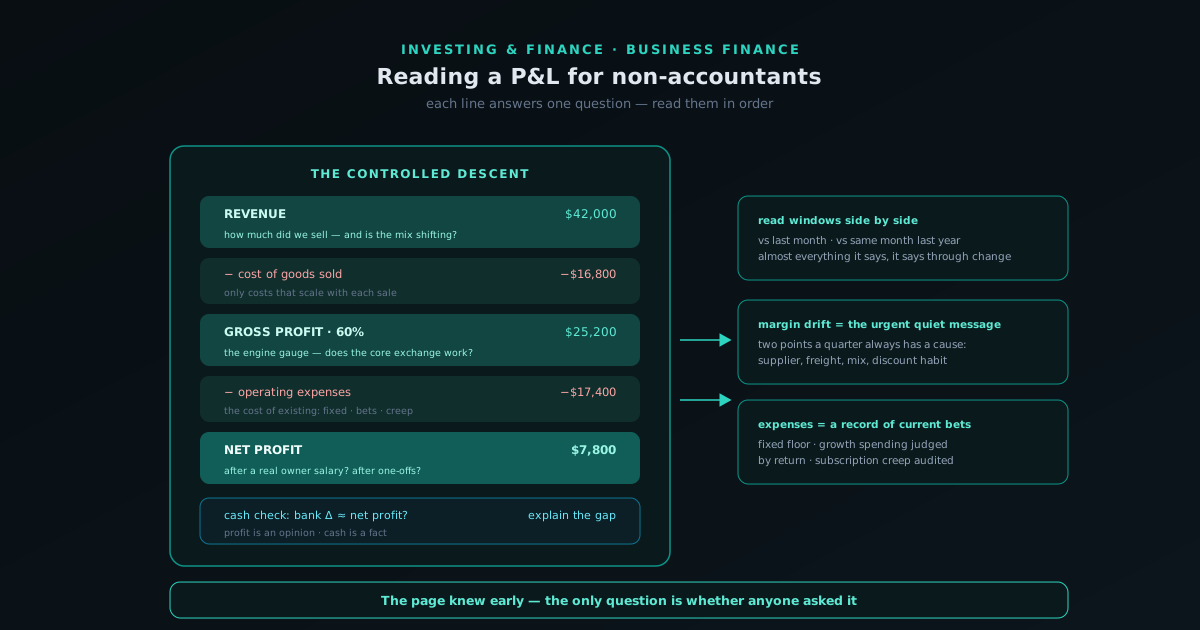
Every P&L, whatever the software that printed it, has the same architecture: it starts with all the money that came in, then subtracts costs in deliberate stages, arriving at what remains. The stages are the entire point. A statement that lumped every cost together would only tell you whether you made money; the staged descent tells you where money is made and lost, because each stage isolates one layer of the business. Revenue at the top answers "how much did we sell?" Cost of goods sold answers "what did delivering those sales directly cost?" Their difference, gross profit, answers "does the core exchange work?" Operating expenses answer "what does it cost to exist as a business?" And the remainder, net profit, answers "after everything, did this enterprise create money?"
The period matters as much as the shape. A P&L describes a window of time (a month, a quarter, a year) and the single most common reading error is treating one window as a verdict. Any month can be weird: a big order lands a day early or late, an annual insurance bill hits, a refund cluster arrives. The statement becomes diagnostic when windows are compared: this month against last month, against the same month last year, against the trailing average. Owners who set their accounting software to show three or four periods side by side have done half the work already, because almost everything the P&L has to say, it says through change.
Revenue: bigger is not the question
The top line gets the most attention and deserves the least naive reading. Revenue is recognized when it is earned, not necessarily when cash arrives, a distinction that surprises owners whose bank balance disagrees with their statement. The useful questions about revenue are rarely about its size. Composition: which products, channels, or clients produced it, and is the mix shifting? A business whose revenue is flat while its mix moves from high-margin to low-margin products is shrinking in disguise, and only the composition view shows it. Concentration: how much of the top line depends on one customer or one channel, the risk theme this series returns to constantly, surfacing here as a revenue footnote most owners never compute.
Quality is the third question: how much of this revenue will recur without being re-won? A thousand dollars of subscription renewal, a thousand dollars from a repeat customer, and a thousand dollars from a one-off promotional spike are identical on the statement and completely different as facts about the future. The P&L cannot make these distinctions for you (it reports the sum) which is why operators who care maintain a one-line supplement: revenue split into recurring, repeat, and new. That single split converts the top line from a vanity number into a forecast, and it costs five minutes a month to maintain.
COGS and gross profit: the engine gauge
Cost of goods sold collects the expenses that scale directly with each sale: the wholesale cost of products, inbound freight, payment processing, fulfillment, the contractor hours billed to client work. The discipline is the word "directly": rent and software subscriptions do not belong here, because they exist whether or not a sale happens. Kept clean, COGS enables the most important calculation on the page: gross profit, and its percentage cousin gross margin. Gross margin is the engine gauge of the business: the fraction of every sales dollar that survives the act of delivering, available to fund everything else. A retail operation might run thirty-five percent; an agency sixty; a software product eighty-five. The absolute number mostly reflects your business model. The trend is where the news is.
A gross margin drifting downward two points a quarter is the P&L's most urgent quiet message, and it always has a specific cause worth hunting: a supplier raised prices and the price list did not respond; freight crept; the product mix shifted toward the thin-margin item; discounting became a habit; a client engagement is consuming more delivery hours than was priced. Per-product or per-service-line gross margin (which decent software produces if items are categorized properly) is the magnifying glass: blended margin hides the one product whose economics broke last spring. The general rule for small operators: problems above the gross profit line are pricing and delivery-cost problems, they compound with every sale, and no amount of expense discipline below the line can outrun them.
Operating expenses: the cost of existing
Below gross profit live the operating expenses: rent, salaries, software, marketing, insurance, the accountant, everything the business pays to exist independent of any particular sale. The reading skill here is categorization into three mental buckets. Fixed commitments (rent, insurance, core payroll) define your survival floor: gross profit must clear them or the business is losing money structurally. Discretionary growth spending (marketing, contractors for new projects) is investment wearing an expense costume, and it should be judged by what it returns, not by its size. And the creep category (subscriptions, fees, the small recurring charges nobody owns) is where unattended businesses leak. Software subscriptions in particular metastasize: each is trivial, the stack is not, and an annual one-hour audit of every recurring charge reliably pays for itself many times over.
Marketing deserves its own sentence, because the P&L is precisely where it stops being a faith expense. Marketing spend divided into the new revenue (or better, new gross profit) it plausibly produced is the crudest acquisition-cost math available, and even crude, it answers the question owners avoid: is growth being bought at a price the margins can afford? A business spending thirty percent of revenue on marketing at forty percent gross margin is paying most of its engine output for fuel: sustainable only as a deliberate, time-boxed launch strategy, and lethal as an unexamined habit. The expense block, read this way, is not a list of costs; it is a record of every bet the business is currently making, in dollars.
The bottom line, and why cash disagrees with it
Net profit, what survives the full descent, is the headline, and it needs two corrections before it deserves your feelings. First, owner compensation: a sole proprietor who pays themselves through draws rather than salary will see a net profit line that overstates reality, because the owner's labor cost is missing from the expenses. Mentally subtracting a market salary for yourself is the honesty adjustment that makes small-business P&Ls comparable to anything. Second, one-time events: a statement bloated by an annual payment or flattered by a one-off windfall is describing an event, not a trend, and the reading habit of asking "what in this month will not repeat?" filters most of the noise.
Then the deeper correction: profit is an accounting opinion, while cash is a fact, and the two routinely disagree. A profitable month can drain the bank account (inventory purchased, customer invoices not yet collected) and a losing month can fill it. Inventory is the classic gap: cash spent on stock does not appear as cost until the stock sells, so a heavy buying month looks profitable and feels broke. This is why the P&L has a sibling, the cash flow picture, and why "profitable businesses die of cash" is a cliché with a body count. The practical habit for a small operator is the two-number close: read net profit and the change in bank balance together, every month, and chase any large disagreement until you can explain it in one sentence. The explanation is almost always inventory, receivables, or a liability, and knowing which is half of financial literacy.
Three one-paragraph case studies
The reading skills above land better as miniatures. Case one, the margin drift: a small store's revenue grows gently all year while gross margin slides from forty-one to thirty-six percent, and the owner, watching only the top and bottom lines, sees "growth" and a bottom line that is merely flat and blames overhead. The per-product view shows one bestseller's supplier raised prices in February while its retail price never moved; five points of margin spent subsidizing the company's own most popular product, recoverable with one repricing email. Case two, the profitable drought: a consultancy books its best quarter ever, and the bank account falls: the P&L says triumph, the cash says crisis, and the reconciliation is a single client invoice, large and sixty days overdue, that revenue recognition counted and the bank never saw. The fix is not financial but procedural: deposit terms and a Friday receivables nudge, both invisible on the statement that revealed the problem.
Case three, the marketing mirage: an online business doubles ad spend in March, and revenue obligingly rises, so the owner reads confirmation and doubles again. The expense block read against new revenue tells the other story: the incremental sales carry thin margins after acquisition cost, the blended number is healthy only because the old organic base subsidizes it, and the second doubling is a plan to scale a loss. Each miniature has the same shape, which is the point of the whole article: the statement contained the answer months before the symptom became a crisis, the answer lived one level deeper than the headline number, and the question that surfaced it was one of the standard six, asked on schedule by an owner with no accounting training whatsoever.
Common-size the statement: reading in percentages
There is one analytical move that upgrades a P&L reader from competent to genuinely fluent, and it costs nothing but a column: express every line as a percentage of revenue rather than as a dollar figure. Accountants call this a common-size statement, and the trick is that it strips away the distortion of growth. A business whose revenue doubled will show every dollar figure rising, which tells you nothing about whether the business got healthier or just bigger. Convert the lines to percentages (cost of goods as a share of sales, each expense category as a share of sales, net profit as a share of sales) and the structure of the business stands revealed independent of its size. Suddenly a marketing line that grew in dollars but shrank as a percentage reads as efficiency, while a fixed cost that crept upward as a percentage reads as a warning the dollar view buried.
The percentage view is also what makes comparison across time and against the wider world meaningful. Two years of a growing business look like two different companies in dollars and like the same company, evolving, in percentages, and the percentage drift is the story. Did cost of goods rise from thirty-four to thirty-eight percent of sales? That is four points of margin gone, visible instantly in the common-size column and easy to miss among rising dollar figures. The percentages also let you benchmark: industry norms for gross margin, marketing spend, and net margin are published as percentages precisely because they are the only comparable unit, and a business whose net margin sits at half its industry's typical figure has a diagnosis to chase that no absolute number would have flagged.
A practical caution keeps the technique honest. Percentages can mislead at small scale or in unusual months, because a single large one-off cost can blow a category's percentage out of all proportion to its real significance, which is why the common-size column belongs beside the dollar column, not instead of it. Read them together: the dollars tell you the magnitude, the percentages tell you the shape, and the gap between what the two are saying is often where the real insight lives. An owner who adds this one column to their monthly statement, alongside the comparison periods already recommended, has built a diagnostic instrument that the dollar-only reader simply does not possess, for the price of a formula copied down a spreadsheet.
A ten-minute monthly reading ritual
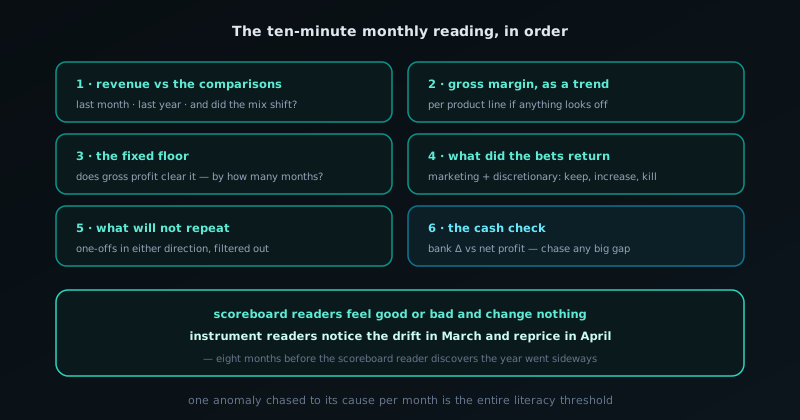
Compressed into practice, P&L literacy is a short monthly ritual: the same six questions, in order, with comparison columns on:
- Revenue: how does it compare to last month and the same month last year, and did the mix shift?
- Gross margin: what is the percentage, and is it trending, per product line if anything looks off?
- Fixed floor: does gross profit comfortably clear the fixed expenses, and by how many months of cushion?
- Bets: what did marketing and discretionary spending return, and should you keep, increase, or kill?
- One-offs: what in this statement will not repeat next month, in either direction?
- Cash check: does the bank balance change roughly agree with net profit, and if not, what explains the gap?
From scoreboard to instrument panel
The migration this article is selling is from treating the P&L as a scoreboard (a verdict on whether you won the month) to treating it as an instrument panel that tells you which control to adjust. Scoreboard readers feel good or bad and change nothing. Instrument readers notice the margin drift in March, find the freight increase behind it, and reprice in April, eight months before the scoreboard reader discovers the year went sideways. Every example in this article reduces to that pattern: the page knew early, and the question was whether anyone asked it.
The encouraging truth is that the literacy threshold is low. You do not need to produce financial statements, reconcile anything, or know what accrual means in conversation. You need the staged-descent map, the six monthly questions, and the stubbornness to chase one anomaly per month to its cause. Owners who do that for two quarters report the same shift: the business stops feeling like weather that happens to them and starts feeling like a machine with legible gauges. The accountant still files the taxes. But the owner reads the chart, and in a small business, the owner who reads the chart is the difference between diagnosis and autopsy.
Frequently asked questions
Quick answers to common questions about this topic.
What is a P&L statement?
A profit and loss (or income) statement summarizes revenue, costs, and profit over a period. It walks from sales at the top down through cost of goods, operating expenses, and finally net profit at the bottom.
What is the difference between gross and net profit?
Gross profit is revenue minus the direct cost of what you sold. Net profit is what is left after all other operating expenses, taxes, and overhead. Gross tells you about the product; net tells you about the whole business.
Which P&L line should I watch most?
Beyond net profit, watch gross margin (gross profit ÷ revenue), because it shows whether the core economics work before overhead. A shrinking gross margin is an early warning even when net profit still looks fine.
Related troubleshooting
Was this page helpful?
Your answer stays in this browser, it is not sent anywhere and no account or cookie is involved.