2026 · Novus Stream SolutionsAbout 12 min readNovus Stream Solutions
Bookkeeping before you need an accountant: minimum viable books for a small business
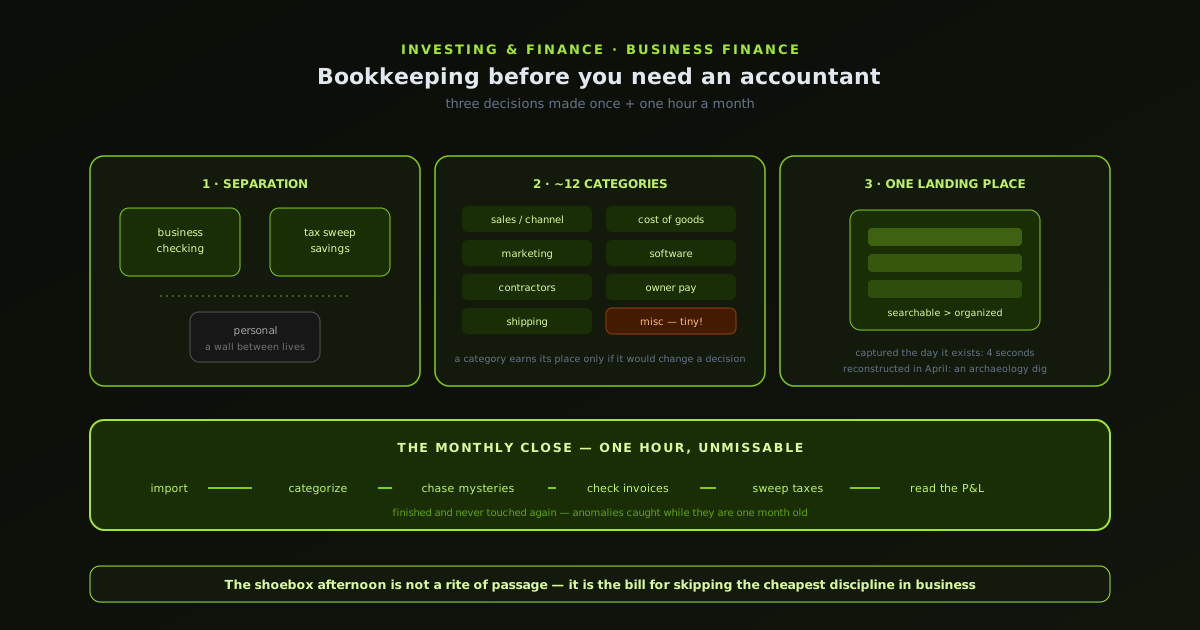
You do not need an accountant in month one. You need separation, categories, and a monthly close ritual that takes an hour. Here is the minimum viable bookkeeping system, and the messes it prevents.
Contents
- 1.Overview
- 2.Separation: the one non-negotiable
- 3.Categories: enough resolution to decide with
- 4.Receipts and the paper trail, minimally
- 5.The monthly close: one hour that keeps everything boring
- 6.Tools: the spreadsheet is not embarrassing
- 7.The traps the system quietly prevents
- 8.Cash versus accrual, in plain language
- 9.The starter checklist
- 10.Boring on purpose
Overview
There is a specific afternoon in the life of almost every small business, usually in its second spring, when the owner sits down with a tax deadline, a shoebox of receipts, literal or digital, and twelve months of bank statements in which groceries, inventory, software subscriptions, and a dentist appointment swim together in one undifferentiated stream. The afternoon becomes a weekend. The weekend becomes an expensive emergency engagement with an accountant who bills by the hour to perform archaeology. None of it taught the owner anything about their business; all of it was preventable with about one hour a month, started early.
This article is the prevention. Not accounting, but bookkeeping, the humbler discipline of recording what happened, in categories, on time. The minimum viable version requires no software expertise, no debits and credits, and no accountant until the business genuinely needs one; what it requires is three structural decisions made once and one small ritual repeated monthly. As ever, tax specifics vary by country and entity type, and a real professional should answer jurisdictional questions. The system below is the part that is universal.
Separation: the one non-negotiable
If you adopt a single practice from this article, adopt this one: a separate bank account for the business, from the first dollar, with every business transaction flowing through it and nothing else. Separation is not primarily a legal formality, though for incorporated entities, commingling funds can genuinely undermine the liability protection the entity exists to provide. It is an information architecture decision. A dedicated account means the raw record of your business already exists, complete and uncontaminated, in the bank's own statement. Every downstream task (categorizing, tax preparation, reading your own P&L) becomes filtering a clean stream instead of panning a muddy one.
The practical setup is modest: a business checking account, a card attached to it, and (the upgrade that pays for itself immediately) a second savings account where a fixed fraction of every revenue deposit is swept for taxes the day it arrives. Self-employment income arrives gross, with no employer quietly withholding on your behalf, and the difference between businesses that sail through tax season and businesses that take on debt for it is almost always whether the sweep habit existed. Pay yourself from the business account to your personal account in deliberate, labeled transfers (the owner-pay discipline covered elsewhere in this series) and the wall between the two financial lives stays intact. When the wall is intact, every question about the business has an answer that takes minutes; when it is not, every question is a project.
Categories: enough resolution to decide with
The second structural decision is the category scheme: the buckets every transaction falls into. The twin failure modes are too few and too many. Too few ("income" and "expenses") produces books that are technically complete and diagnostically useless: you cannot see margin, cannot find cost creep, cannot answer a single question from the P&L-reading playbook. Too many (the forty-category taxonomy built in a burst of enthusiasm) collapses under its own decision fatigue: when categorizing a transaction requires judgment, the categorizing stops happening. The working principle: a category earns its existence only if it would change a decision. You track software subscriptions separately because that creep needs an annual audit; you do not need "office supplies" split from "shipping supplies" unless those numbers would ever be read separately.
For most small online businesses, a dozen-ish categories cover everything: sales (split by major channel if you have more than one), cost of goods or direct delivery costs, payment processing fees, marketing, software and subscriptions, contractors, shipping, equipment, professional services, owner pay, taxes, and a deliberately small miscellaneous. The deliberate smallness of the last one is a health metric in itself: a miscellaneous category absorbing more than a few percent of spending means the scheme is failing and transactions are being dumped rather than recorded. Match your categories loosely to your jurisdiction's tax form lines where you can; it makes year-end translation nearly mechanical. And resist renovating the scheme mid-year: consistency across periods is worth more than elegance, because the entire diagnostic value of books is comparison.
Receipts and the paper trail, minimally
The receipts habit has a reputation for tedium it no longer deserves. The modern minimum: a single designated place where every receipt lands the day it is generated (a folder in your email for digital receipts, plus a phone photo into a synced folder for the rare paper ones), searchable, dated, and never organized beyond that. You are not building a filing system to admire; you are building a pile that can answer questions, and a searchable pile answers them fine. The discipline that matters is immediacy: a receipt captured the day it exists costs four seconds, while the same receipt reconstructed in April costs an email to a vendor and a small piece of your patience.
Two records deserve slightly more ceremony. Invoices you issue, if your business bills clients, need their own numbered sequence and a simple status view of what is outstanding, because unpaid invoices are the most common place small service businesses silently lose money: not to theft, to forgetting. And anything unusual (equipment purchases, a loan to or from the owner, a refund cluster, the deposit that was actually a customer prepayment) earns a one-line note in a running memo file, written when it happens. The note is a gift to two future readers: the accountant you eventually hire, who will otherwise bill you to investigate, and yourself in eleven months, who will otherwise stare at a transaction with no memory of it whatsoever.
The monthly close: one hour that keeps everything boring
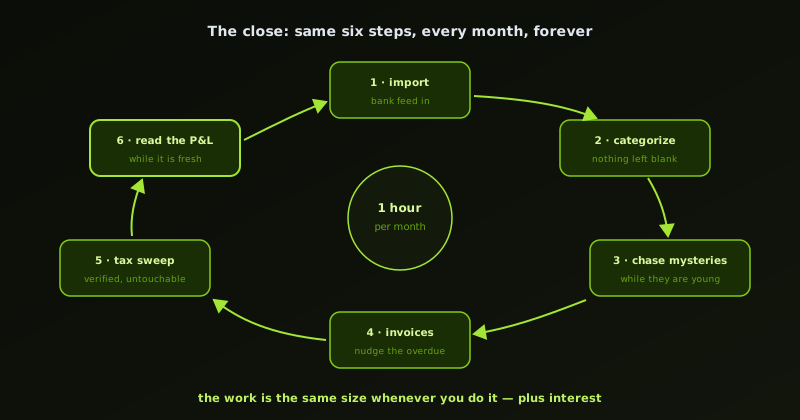
The ritual that holds the system together is the monthly close: a fixed appointment, ideally the first few days of the new month, where the books for the previous month are finished and never touched again. The agenda never changes: pull every transaction from the business accounts into your ledger (software that imports bank feeds makes this nearly automatic, but a spreadsheet works at small volume); categorize everything, letting no transaction stay uncategorized; chase the mysteries while they are young, because the unrecognizable charge is solvable in week two and archaeology in month eleven; check invoices outstanding and nudge the overdue; verify the tax sweep happened; and read the result (the six-question P&L review from this series) while the month is fresh enough to learn from.
The close is also where the books earn their keep as an early-warning system rather than a compliance chore. Because you touch every transaction monthly, you notice the subscription that doubled, the processing fees that crept, the channel whose sales quietly slid, each while it is one month old and cheap to address. Owners who batch their bookkeeping annually do not just suffer in April; they operate blind all year, making pricing and spending decisions on vibes while the answers sit unread in a bank feed. An hour a month is the entire price of operating sighted. There is no version of this discipline that gets cheaper by deferral; the work is the same size whenever you do it, plus interest.
Tools: the spreadsheet is not embarrassing
Tool choice matters far less than the habits above, and the honest hierarchy runs by transaction volume. Under a few dozen transactions a month, a well-structured spreadsheet (one row per transaction, columns for date, amount, category, channel, and note) is a complete bookkeeping system, costs nothing, and teaches you more about your numbers than software that hides them behind automation. As volume grows, entry-level accounting software earns its monthly fee through bank-feed imports and automatic categorization rules: the hour-long close shrinks toward twenty minutes, and the software produces a proper P&L on demand. What no tool provides is the ritual itself; software with eleven months of unreviewed automated imports is the shoebox afternoon wearing a subscription fee.
The accountant question resolves on the same gradient. You likely do not need one to start: you need the system above, plus an hour of paid consultation at setup if your entity type or jurisdiction has wrinkles, which is money disproportionately well spent. You graduate to a real engagement when specific triggers arrive: incorporation, employees, sales tax across borders, inventory accounting at scale, or simply when your hourly value clearly exceeds what delegating the close costs. Arriving at that engagement with clean, categorized, monthly-closed books changes its entire economics: the professional spends their billed hours on judgment and tax strategy instead of archaeology, which is what you actually wanted to buy.
The traps the system quietly prevents
It is worth cataloguing what this modest machinery actually protects you from, because the protection is invisible precisely when it works. Commingling drift is the slowest trap: the personal card used for one business purchase "just this once," the business account covering one grocery run, each instance trivial and the accumulated result a financial record that costs hundreds of dollars of professional hours to untangle, and that, for incorporated owners, quietly weakens the liability wall the corporation existed to build. The forgotten-invoice leak is the most expensive per incident: service businesses without a status view routinely discover invoices that were never sent, sent and never followed, or disputed and never resolved, and the money lost this way dwarfs anything stolen from small businesses by outsiders. The numbered sequence and the monthly check are the entire defense, and they cost minutes.
Then there are the traps that arrive wearing official envelopes. The April panic is the famous one, but its quieter sibling is the estimated-payment spiral, where a self-employed owner misses quarterly prepayments their jurisdiction expects, meets a year-end bill swollen with penalties, pays it out of operating cash, and thereby starts the next year already behind. The tax sweep account dissolves this entire failure category: the money exists before it is owed, by construction. Last is the audit lottery: unlikely for any given small business, expensive for the unprepared one. An audit against clean books with a searchable receipt pile is an afternoon of exports; the same audit against a shoebox is weeks of reconstruction performed under deadline for an unsympathetic audience. None of these traps requires bad faith to fall into; they are the default outcomes of running a business on memory. The system is just the decision to stop being the default.
Cash versus accrual, in plain language
One distinction trips up self-taught bookkeepers more than any other, and it is worth ten minutes to settle: the difference between recording money when it moves and recording it when it is earned or owed. Cash-basis bookkeeping logs a sale the day the payment lands and an expense the day you pay it: simple, intuitive, and what a separate bank account hands you almost for free. Accrual-basis records a sale the moment you deliver the work or ship the goods and an expense the moment you incur the obligation, regardless of when cash changes hands. For most very small businesses, cash basis is the sensible starting point: it is easier to maintain, it matches the bank feed, and many jurisdictions permit it below certain revenue thresholds. Confirm what yours requires, because the choice has tax consequences a professional should bless.
The reason to understand both, even while running on cash basis, is that cash basis can quietly mislead you in exactly two situations a small business hits constantly. The first is invoicing: if you bill clients and wait weeks to be paid, a cash-basis ledger shows a lean month that was actually a strong one, because the work was done but the money has not arrived. The second is inventory and prepaid costs: a big stock purchase or an annual software bill lands as one brutal expense in a single month under cash basis, making a healthy month look like a loss. Knowing these blind spots is the whole defense. You can keep the simpler cash-basis books while mentally adjusting for outstanding invoices and lumpy one-time costs when you read them, which is precisely the reconciliation habit the monthly close already builds.
For the owner who eventually outgrows cash basis, the transition is not dramatic, and the minimum-viable system above makes it nearly painless. Clean, categorized, separated books convert to accrual reporting mechanically, because the raw record of what was billed and when, what was bought and when, already exists; accrual accounting is mostly a matter of timing entries the records already contain. The businesses that suffer the conversion are the ones whose books were a shoebox to begin with: they are reconstructing reality and changing its timing rules simultaneously. This is one more quiet payoff of the discipline: the system that keeps tax season boring also keeps the eventual accounting upgrade boring, because both are just queries against records you kept honestly the first time.
The starter checklist
The whole system, as a setup-day list, most of it done in an afternoon, once:
- Open a dedicated business checking account and card; route everything business through it, nothing personal.
- Open a second savings account; sweep a fixed tax fraction from every revenue deposit on arrival.
- Write a category list of roughly a dozen buckets, loosely matched to your tax form, with a deliberately tiny miscellaneous.
- Designate one searchable landing place for all receipts; capture them the day they exist.
- Number your invoices and keep a status view of what is outstanding.
- Keep a running memo file for anything unusual, noted when it happens.
- Book a recurring monthly close appointment, and treat it as unmissable as a client meeting.
- Buy one hour with a professional at setup if entity or jurisdiction questions exist; defer the ongoing engagement until a real trigger.
Boring on purpose
Bookkeeping is the rare business discipline whose highest achievement is being unremarkable. Books in good order generate no stories: tax season is a quiet afternoon, the accountant's bill is small, the loan application's document list is an export, the acquirer's due diligence finds nothing to discount, and the monthly numbers arrive with the dependable dullness of a utility. Every dramatic bookkeeping story (the panicked spring weekend, the amended returns, the deal that died in diligence) is the absence of an hour a month, compounded.
And the quiet system pays a dividend beyond prevention: it is the substrate every other financial practice in this series runs on. The P&L you can read, the profit you can allocate, the valuation you can defend, the diversification you can fund: all of them assume numbers that are real, current, and categorized, which is to say, all of them assume the books. Start the system the week the business starts, or failing that, this week. The shoebox afternoon is not a rite of passage. It is just the bill for skipping the cheapest discipline in business, and it is the one bill you can simply decide never to receive.
Frequently asked questions
Quick answers to common questions about this topic.
What is the simplest bookkeeping system for a small business?
Track every dollar in and out in one place, keep a separate business account, and save receipts. A single spreadsheet or basic app that records date, amount, category, and source covers the essentials before you need anything fancier.
When do I actually need an accountant?
Usually when complexity rises: payroll, multi-state or cross-border tax, an audit, or a sale. Until then, clean minimum-viable books let an accountant (or tax software) take over without untangling a mess.
Is this tax advice?
No. It is general education on keeping basic books; tax rules vary by jurisdiction and situation, so confirm specifics with a qualified professional.
Related troubleshooting
Was this page helpful?
Your answer stays in this browser, it is not sent anywhere and no account or cookie is involved.