2026 · Novus Stream SolutionsAbout 11 min readNovus Stream Solutions
Index funds vs stock picking when your day job is already a concentrated bet
A founder's working hours are already one giant undiversified position. That changes the index-fund-versus-stock-picking debate in a way most investing advice never mentions. Here is the version of the argument written for operators.
Contents
- 1.Overview
- 2.What each approach actually is
- 3.What the scoreboard says
- 4.The founder's twist: you already run an active position
- 5.Why operator edge does not transfer
- 6.The honest case for a small picking allocation
- 7.What this looks like in practice
- 8.The boring mechanics that decide the outcome
- 9.The decision behind the decision
Overview
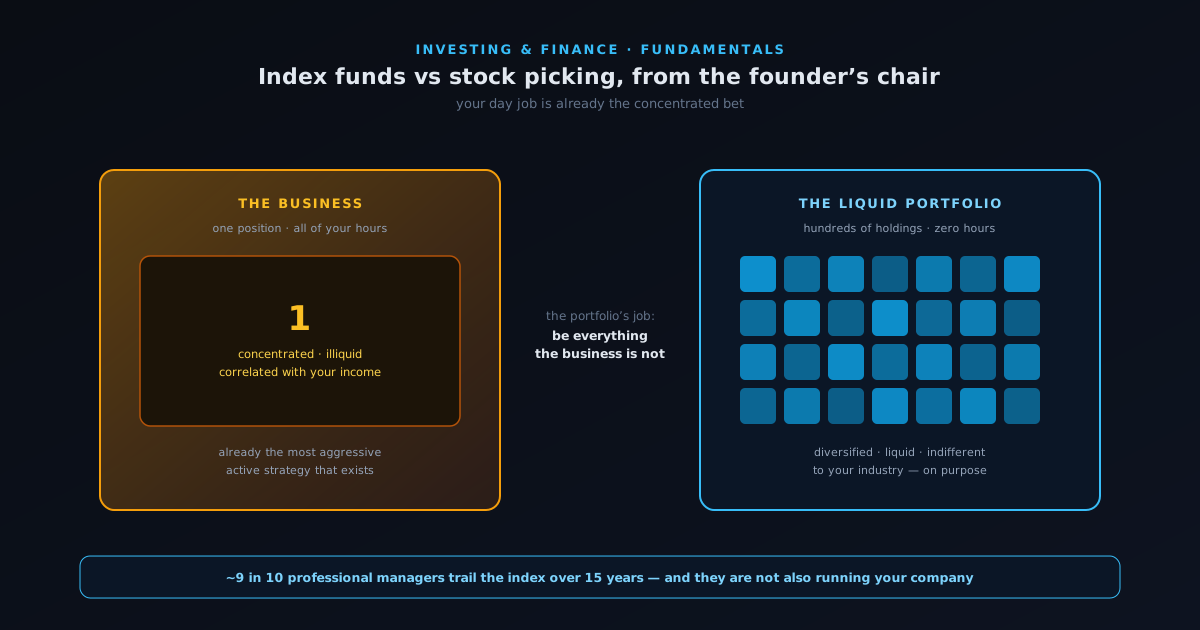
The standard active-versus-passive debate is written for people with salaries: should the money you save from a predictable paycheck go into broad index funds, or should you try to beat the market by choosing individual companies? Founders and operators read that debate from a different seat, because their financial life already contains an enormous active position: the business itself. Your working hours, your reputation, and usually a large share of your net worth are concentrated in a single small company whose fate you influence directly. That existing bet should change how you think about every investment dollar that sits outside it, and it almost never appears in the standard advice.
The usual disclaimer applies with full force here: this is education about how two approaches work and what the evidence says about them, not a recommendation tailored to you. Tax treatment, account types, and sensible choices vary by country and by situation. What does not vary is the underlying logic, and the logic is what this article is after, because once you see the founder version of the argument clearly, the decision that looks hard from the salaried seat becomes surprisingly easy from yours.
What each approach actually is
An index fund is a basket that owns the market, or a defined slice of it, automatically. A total-market or S&P 500 fund holds hundreds of companies in proportion to their size, charges a few hundredths of a percent in fees, and does no analysis whatsoever: when a company grows, the fund owns more of it by definition; when a company dies, it falls out of the basket on its own. You are not betting on anyone's judgment. You are betting that the aggregate of all businesses, over decades, produces the growth it has historically produced, and you are collecting that result minus almost no costs. The strategy's entire content is a refusal to play the selection game.
Stock picking is the selection game: choosing individual companies in the belief that some are mispriced and your judgment can identify which. It is worth saying plainly that this is not a foolish belief on its face: prices are set by humans, humans misjudge, and somebody's buying does move prices toward reality. The problem is competitive, not conceptual. When you buy a stock because you think it is underpriced, the person selling it to you usually believes the opposite, and that person is statistically likely to be a professional with a research team, faster information, and a decade of practice. Picking stocks is not analysis in a vacuum; it is a zero-sum contest against the most heavily resourced participants in any market on earth, played for stakes that come out of your retirement.
What the scoreboard says
This contest has a public scoreboard, and it has been telling the same story for fifty years. The SPIVA reports (a long-running scorecard comparing actively managed funds against their benchmark indexes) find, year after year, that the large majority of professional fund managers underperform a plain index over any period long enough to matter. Over fifteen-year windows, the share of large-cap funds beating the S&P 500 has repeatedly landed in the single digits or low teens. These are full-time professionals with analysts, models, and management fees justifying their existence, and roughly nine in ten of them would have served their investors better by buying the index and going home. The few who do win rarely repeat: persistence studies find that a top-quartile fund in one period is about as likely as any other fund to be top-quartile in the next.
The mechanism behind the scoreboard matters more than the scoreboard itself, because it explains why the result keeps happening. Markets are unforgiving aggregators: the index return is, by definition, the average of all participants before costs. For every dollar that beats the market, a dollar must lose to it, and then costs (fees, spreads, taxes from turnover) drag the average active participant below the index with mathematical certainty. This is Sharpe's old arithmetic of active management, and no amount of skill in the population can repeal it; skill only determines which active players take money from which. Meanwhile the return distribution of individual stocks is brutally skewed: most stocks underperform treasury bills over their lifetimes, and the market's entire long-term gain comes from a small minority of extreme winners. Miss those few (and concentrated pickers usually do) and you trail badly.
The founder's twist: you already run an active position
Now add the piece the standard debate leaves out. A founder's net worth is typically dominated by a single private, illiquid, undiversifiable position: the business. Its value is correlated with your income (both collapse together if it fails), it cannot be sold quickly or cheaply, and its risk dwarfs anything inside a brokerage account. In portfolio terms, you are already running the most concentrated active strategy that exists: one asset, full leverage of your time, no diversification at all. The relevant question is not "can I beat the market with my stock picks?" It is "given that half or more of my balance sheet is one aggressive bet I cannot exit, what should the rest of it do?"
Framed that way, the answer mostly writes itself. The job of the liquid portfolio is to be everything the business is not: diversified where the business is concentrated, liquid where the business is frozen, indifferent to your industry where the business lives or dies by it, and demanding zero hours where the business takes all of them. An index portfolio fits that job description almost perfectly. A hand-picked stock portfolio fails it on several counts at once: it re-concentrates what you needed diversified, and it competes for the scarcest resource you have. Every hour spent researching a company you might put two thousand dollars into is an hour not spent on the company you own outright, where your effort converts to value at a rate no public-market position can match.
Why operator edge does not transfer
The most seductive argument for founder stock picking is the edge argument: you are a sophisticated operator, you understand products and markets from the inside, surely that insight should beat the average investor's. The problem is that public markets do not pay for understanding a business; they pay for knowing something the price does not already contain. You may genuinely understand why a company's product is excellent, but that excellence is public information, discussed in fifty research notes, and it is in the price. Your inside-view skill as an operator works because in your own business you control execution. In a public stock you control nothing; you are betting on other people's execution at a price that already reflects the consensus view of it.
There is also a sharper version of this trap: the industry you know best is the industry your business already depends on. A software founder who loads up on software stocks has not diversified at all: they have doubled down on the exact macro forces (rates, tech spending, platform shifts) that already determine their livelihood. The familiarity feels like safety and is precisely the opposite. If anything, the textbook logic says your liquid portfolio should be tilted away from your own sector, which is an uncomfortable, unintuitive idea, and a useful litmus test. If your stock picks cluster in the field you work in, you are not investing on edge; you are investing on comfort, and paying concentration risk for the feeling.
The honest case for a small picking allocation
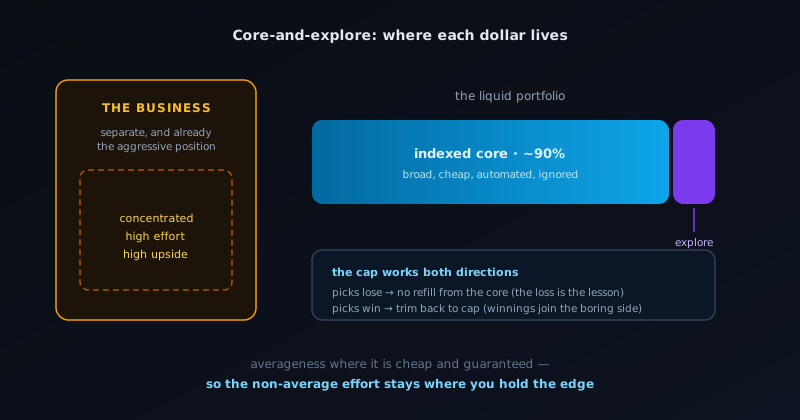
None of this means picking stocks is morally wrong or that curiosity about companies is wasted. There are defensible reasons to hold individual stocks that have nothing to do with beating the market: keeping yourself financially literate, staying close to how public companies report and communicate, or simply enjoying the game enough that the cost is worth it as entertainment. The evidence-respecting way to do that is the core-and-explore structure: the overwhelming majority of liquid investments in broad, cheap index funds, and a small, capped slice (five or ten percent) in whatever active ideas you like, treated explicitly as tuition and hobby rather than strategy.
The cap is the entire discipline, and it has to be enforced in both directions. If the picks lose, you do not refill the slice from the core; the loss is the lesson. If the picks win big, you trim them back to the cap and let the winnings join the boring side, because a winning streak is exactly when the inner narrative about your special insight gets loudest and least reliable. What the cap really buys is psychological containment: it gives the part of you that wants to play an arena whose worst case is annoying instead of catastrophic, and it protects the compounding core from the single greatest threat to any long-term plan, which is an owner who has recently been right and feels ready to get aggressive.
What this looks like in practice
For an operator who buys the argument, implementation is almost anticlimactic, and that is the point: the strategy's value comes precisely from how little ongoing judgment it demands. The working pieces fit on an index card.
- Treat the business as the concentrated, active, high-effort position in your total portfolio, because it is.
- Give liquid savings the opposite job: broad index funds across global stocks, with whatever bond or cash allocation your sleep requires.
- Prefer funds with expense ratios measured in hundredths of a percent; fees are a permanent leak in the compounding machine.
- Automate contributions on a schedule so investing never competes with your attention or your mood.
- If you want to pick stocks, cap the hobby at a fixed slice and rebalance it back to the cap in both directions.
- Avoid loading the liquid portfolio with your own industry; you are already maximally exposed to it.
- Re-read the SPIVA scorecard any time you feel the itch to go active with the core. The data updates; the conclusion has not.
The boring mechanics that decide the outcome
Once the strategic question is settled, a handful of unglamorous implementation details determine most of the realized result, and they deserve more attention than the strategy debate that usually monopolizes it. Account structure comes first: most jurisdictions offer tax-advantaged investment accounts (retirement wrappers, tax-free growth accounts, self-employed pension equivalents) and the difference between growing at eight percent taxed annually and eight percent sheltered compounds into a gap worth more than nearly any security-selection decision a founder could make. The self-employed routinely under-use these because no employer enrolls them automatically; the hour spent with a local professional mapping which accounts apply to your situation is plausibly the highest-return hour in this entire subject. Fund selection, by contrast, deserves less agonizing than it gets: among broad index funds tracking comparable markets, the deciding variable is the expense ratio, and the gap between a fund charging five hundredths of a percent and one charging half a percent is, over thirty years, a five-figure difference on ordinary contribution levels.
The behavioral mechanics matter just as much as the financial ones. Set the contribution to leave your account the day after income arrives, because money that waits for a manual decision waits forever during busy quarters, and founder quarters are all busy. Turn off the portfolio news. Check balances on a calendar (quarterly is generous) rather than on impulse, because every glance is an invitation to act and the indexed core's entire advantage is that it never asks you to. And write down, once, a single paragraph describing what you own and why, so that the future version of you (richer, more confident, freshly stung or freshly emboldened by something the business did) has to argue with the calm version before changing anything. Operators build systems precisely so the business does not depend on their daily moods. The portfolio deserves the same engineering, and needs about one page of it.
The decision behind the decision
Strip away the finance vocabulary and the choice is about where you believe your effort converts to value. A salaried investor picking stocks is at least playing the only active game available to them. A founder picking stocks is choosing to fight professionals in their arena, with money that could compound untouched, using hours stolen from the one arena where the founder is the professional. The index fund is not a surrender to mediocrity; it is a deliberate routing decision: averageness exactly where averageness is cheap and guaranteed to work, so that all of your nonaverage effort can stay concentrated where you actually hold the advantage.
There is a quiet confidence in that arrangement that the stock-picking founder never gets to enjoy. The indexed core asks nothing, panics about nothing, and needs no opinion from you during earnings season. The business gets your full attention, which is the highest-return allocation available to anyone who owns one. And the two halves hedge each other emotionally as well as financially: when the business has a brutal quarter, the portfolio is quietly compounding; when markets fall thirty percent, your livelihood does not depend on them recovering this year. That is what a balance sheet built on purpose feels like, and the entire price of admission is admitting that, in one specific arena, you are not special. You have a better arena.
Frequently asked questions
Quick answers to common questions about this topic.
Are index funds better than picking stocks?
For most people, broad index funds offer diversification and low cost without requiring the time and skill stock picking demands. Whether they are "better" depends on goals and risk tolerance; this is educational, not personalized advice.
Why might a founder lean toward index funds?
Because a founder's business is already a large, concentrated bet on one outcome. Adding more concentrated risk through individual stock picking increases exposure to the same kind of risk, where a broad index spreads it.
Does this account for my situation?
No. It is general education about a common tradeoff, not advice tailored to your finances. Consider your own circumstances and a qualified advisor before making investment decisions.
Related troubleshooting
Was this page helpful?
Your answer stays in this browser, it is not sent anywhere and no account or cookie is involved.