2026 · Novus Stream SolutionsAbout 10 min readNovus Stream Solutions
Asset allocation for the self-employed: building a portfolio around lumpy income
Standard allocation advice assumes a paycheck. Self-employment replaces it with feast-and-famine cash flow, no employer plan, and a business that already owns most of your risk budget. Here is how allocation thinking changes.
Contents
- 1.Overview
- 2.Capacity versus tolerance: the distinction that does the work
- 3.Layer one: cash is an asset class when income is lumpy
- 4.Layer two and three: the portfolio above the buffer
- 5.Contributing when income refuses a schedule
- 6.The other direction: drawing income from the layers
- 7.Maintenance: the annual hour
- 8.The portfolio as the quiet half
Overview
Open a standard guide to asset allocation and notice the silent assumption under every rule of thumb: the reader has a salary. The percentages-by-age formulas, the "invest aggressively while young" advice, the automatic monthly contributions: all of it presumes income that arrives in identical installments with taxes withheld and an employer plan humming in the background. Self-employment voids the assumption on every count. Income arrives in lumps separated by droughts. Nobody withholds anything. There is no employer match, no default plan, no autopilot, and looming over the whole exercise, a business that already represents a concentrated, illiquid bet occupying most of the risk budget the formulas were planning to spend.
This article rebuilds allocation thinking from the operator's actual situation. The standard concepts survive (diversification, time horizons, the discipline of staying invested) but their application changes shape, sometimes drastically. The usual disclaimer applies with extra force here, because account types, tax treatment of retirement savings, and entity questions are deeply jurisdiction-specific: this is the strategic logic, not a prescription, and the specifics deserve a professional who knows your country and your facts.
Capacity versus tolerance: the distinction that does the work
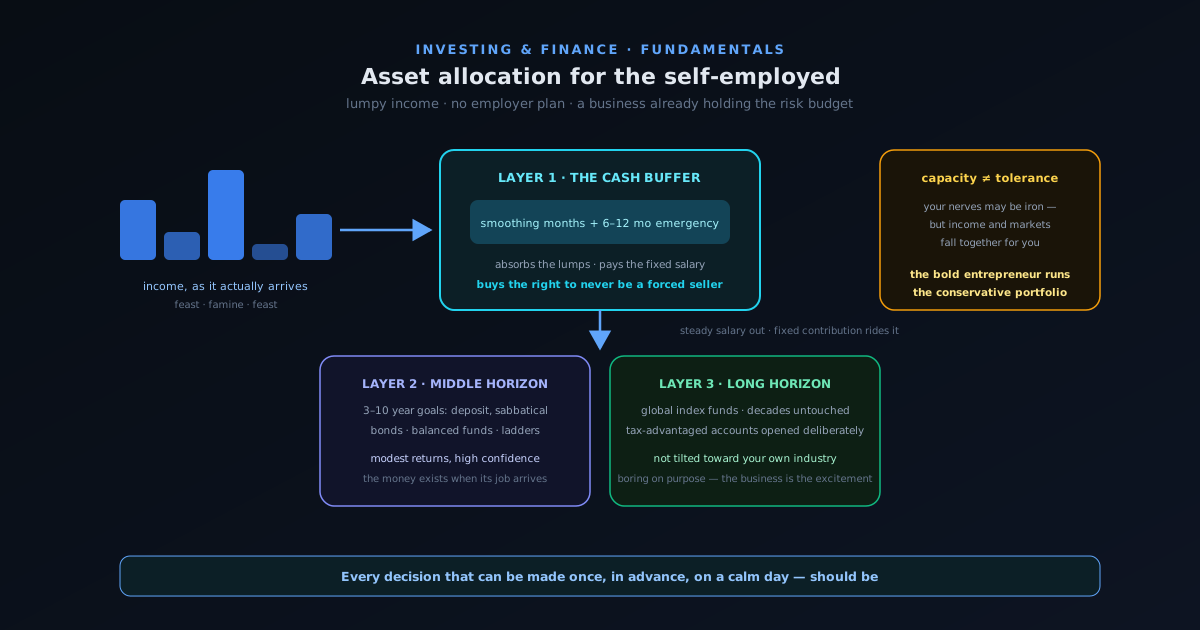
The most useful concept in all of allocation theory, and the one self-employment bends hardest, is the difference between risk tolerance and risk capacity. Tolerance is psychological: how much volatility you can watch without panic-selling. Capacity is structural: how much volatility your actual life can absorb without forcing you to sell at the wrong moment. A salaried engineer with stable income and an emergency fund has high capacity almost regardless of feelings; their paycheck does not care what markets do. A self-employed operator may have iron nerves (entrepreneurs usually do) and still have low capacity, because the scenarios that crater their portfolio are correlated with the scenarios that crater their income: recessions hit small-business revenue and equity markets together, which means the moment they might need to sell investments is precisely the moment those investments are marked down.
This correlation is the structural fact the whole allocation must be designed around, and it generates a conclusion that sounds paradoxical until it does not: the bold entrepreneur should usually run a more conservative liquid portfolio than their salaried twin. The business is the aggressive position: concentrated, illiquid, high-expected-return. The portfolio's job, as the diversification article in this series argues, is to be the counterweight: liquid when the business is frozen, stable when the business is volatile, boring when the business is anything but. Operators who instead express their temperament in both places (aggressive business, aggressive portfolio) have built a financial life with no shock absorber anywhere, and the absence stays invisible until the one year everything correlates.
Layer one: cash is an asset class when income is lumpy
For the self-employed, the foundation layer is bigger than convention suggests and earns its size daily: cash, in two distinct jobs. The first is the income-smoothing buffer: enough liquid months of personal baseline expenses to convert feast-and-famine cash flow into a steady self-paid salary, as the profit-allocation article describes. The second is the genuine emergency fund stacked beyond it, sized for the operator's reality: where a salaried person might hold three to six months, six to twelve is the working range for someone whose income and assets share failure modes, on the logic that their "emergency" is likelier to be longer and correlated with everything else going wrong. Together these layers are not idle money failing to be invested; they are the asset class that purchases the single most valuable thing in a self-employed financial life, the ability to never be a forced seller of anything: investments in a crash, business assets in a drought, or your own judgment under duress.
It is worth saying plainly why this guards returns rather than dragging them. The classic destruction pattern for self-employed investors is buying through good years, then liquidating at market lows during an income drought, a pattern that converts ordinary volatility into permanent loss and reliably underperforms a smaller portfolio that never had to sell. The oversized cash layer is what breaks the pattern. Its measurable cost (a few points of foregone return on a slice of the whole) is the premium on an insurance policy that pays out in exactly the years everything else fails. High-yield savings accounts and short-term instruments keep the layer from being entirely sterile, but optimizing its yield is decoration; the layer's return is paid in survival.
Layer two and three: the portfolio above the buffer
Above the cash foundation, allocation becomes refreshingly conventional, because the buffer has already absorbed the unconventional risks. The long-horizon layer (retirement money, untouchable for decades) goes into the boring global diversification this series keeps recommending: broad index funds across world equities, with whatever bond fraction matches your honest tolerance, at fees measured in hundredths of a percent. Self-employment's wrinkle here is administrative rather than strategic: with no employer plan, the tax-advantaged accounts available to the self-employed in your jurisdiction must be opened deliberately, and they are routinely the highest-return paperwork an operator ever files: the tax treatment differences compound over decades into sums that dwarf any investment cleverness. This is the one place where an hour with a local professional is almost universally worth it.
Between cash and forever sits the often-forgotten middle layer, the money for the three-to-ten-year horizon: the house deposit, the planned sabbatical, the future business expansion. The temptation is to let this money pick a side, either sitting in cash being eroded or riding in equities pretending the timeline is infinite. The middle deserves middle instruments (bond funds, conservative balanced allocations, term deposits laddered to the timeline) accepting modest returns for high confidence the money exists when its job arrives. One business-specific note for the whole stack: avoid over-weighting your portfolio toward your own sector and its correlates, the familiarity trap covered in the index-funds article. The software founder loaded with tech funds and the retailer heavy in consumer stocks have both quietly un-diversified the only diversification they had.
Contributing when income refuses a schedule
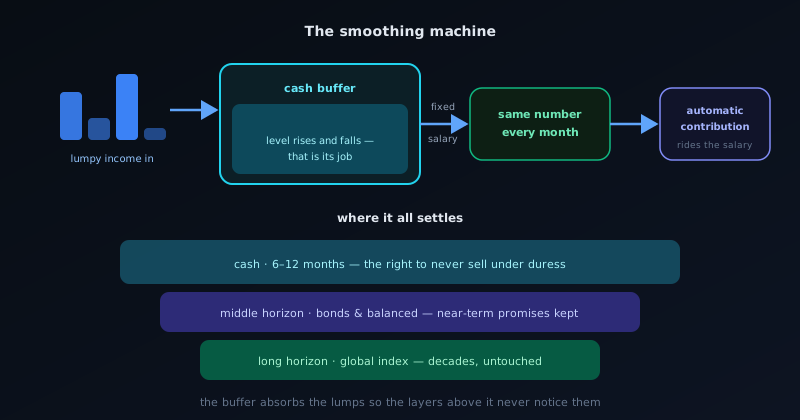
The dollar-cost-averaging machinery from earlier in this series assumes a contribution schedule, and lumpy income seems to break it. The fix is to put the smoothing upstream: income lumps land in the business or buffer accounts, the fixed owner salary flows from there on schedule, and a fixed contribution rides the salary, identical every month, automated, exactly as the DCA playbook prescribes. The lumps fill and drain the buffer; the contributions never notice. This is the quiet payoff of the salary discipline advocated throughout this series: it does not just stabilize the household, it manufactures the steady substrate that automatic investing requires.
Windfall months get a standing rule of their own, decided in advance: after the buffer is full and taxes are swept, a fixed percentage of any surplus goes to investments immediately, not "when things feel certain," which is never, and not after a research project into whether the market is currently high, which is timing wearing a thoughtful expression. Lump-sum arrivals into a long-horizon portfolio are statistically fine, as the DCA article's honest caveat explained; if the behavioral insurance of spreading a large windfall over a few months buys you sleep, pay it knowingly and keep the spread short. The principle underneath both rules is the same one that runs the whole system: every decision that can be made once, in advance, on a calm day, should be, because the self-employed get more than enough mandatory decisions in the other parts of their week.
The other direction: drawing income from the layers
The same three-layer structure that absorbs lumpy income going in also smooths it coming out, which matters because self-employed financial life includes seasons when the business cannot pay the full salary: the slow stretch, the deliberate sabbatical, the pivot year, eventually retirement itself. The withdrawal logic mirrors the contribution logic in reverse: the buffer pays the steady salary first, uninterrupted, which is precisely what it accumulated for; the middle layer refills the buffer if the drought outlasts it; and the long-horizon layer is touched last and ideally not at all, because every untouched year is another compounding doubling left intact. An operator who has run the system for some years discovers that a six-month revenue drought, the event that bankrupts the unbuffered competitor, registers in their household as nothing at all: the salary arrives on the first of the month from a buffer doing its job, while the owner fixes the business without a gun to their head.
The discipline that makes withdrawal seasons safe is sequencing, and it is worth pre-writing just like the contribution rules. Decide in advance what triggers a buffer draw (the salary, automatically), what triggers a middle-layer refill (buffer below a stated floor), and what would have to be true before long-horizon assets get sold (a written list, deliberately short and dire). The pre-writing matters because withdrawal decisions arrive bundled with stress, and stressed owners liquidate in exactly the wrong order, selling depressed equities to protect a cash buffer that existed to protect the equities. There is also a quiet tax dimension: drawing from different account types in different orders produces meaningfully different lifetime tax bills in most jurisdictions, which is the second place in this article where an hour of local professional advice repays itself absurdly. The system's promise, fully assembled, is symmetry: money enters calmly regardless of how income behaves, and it leaves calmly regardless of what life requests.
Maintenance: the annual hour
A structure this deliberate maintains itself on remarkably little attention, which is the design goal, not a happy accident. The maintenance loop is annual, plus triggers:
- Once a year, recheck the buffer targets against current personal and business burn; both drift upward quietly.
- Rebalance the long-horizon layer back to its target weights if anything has drifted past a tolerance band; this mechanically sells high and buys low without requiring opinions.
- Confirm the contribution rate still matches income reality, and ratchet it with any sustained step-up in owner salary.
- Re-run the concentration check: has the portfolio drifted toward your own industry, or a single position, or last year's winner?
- Revisit the middle layer's timelines: goals that moved closer should get more conservative holdings, mechanically.
- On triggers only (a business sale, a windfall, a household change) redo the whole personal balance sheet from the diversification article.
- Ignore everything else: market commentary, forecasts, and the performance of other people's portfolios are weather for a trip you are not taking.
The portfolio as the quiet half
Assembled, the self-employed allocation has a shape worth seeing whole: a deep cash foundation purchasing immunity from forced sales; a conventional, boring, globally diversified growth engine above it; a modest middle layer keeping near-term promises; contributions automated off a self-paid salary that the buffer keeps steady; and the whole thing deliberately uncorrelated with the business that dominates the rest of the balance sheet. Nothing in the structure is clever. Everything in it is positioned: each layer placed where the operator's specific risks, the lumpy income and the correlated downside, can do the least harm.
The emotional payoff mirrors the financial one, and operators who build the structure report it consistently: business decisions improve when the household is not riding on this quarter. Pricing gets braver, bad clients get fired, desperate pivots get declined: the de-risking dividend described throughout this series, paid here through the specific machinery of buckets and buffers. The business remains the exciting half of the balance sheet, the place where concentrated effort earns concentrated returns. The portfolio's job is to be the other half: the quiet, boring, unkillable counterweight that lets the exciting half take its swings. Build it once, automate it, review it annually, and then give it the highest compliment a self-employed investor can give their allocation: forgetting about it for months at a time.
One adjacent layer belongs in the same conversation, because for the self-employed it is allocation by another name: insurance. An employee's disability coverage, liability protection, and often health coverage arrive bundled with the job; an operator's arrive only if deliberately purchased, and their absence is a silent short position against the household's largest asset: the owner's ability to work. Disability insurance in particular deserves the same priority as the emergency fund, since a working-age operator is statistically far more likely to face a long disability than a death, and a six-month buffer does not answer a six-year problem. Professional liability and business liability coverage protect the balance sheet from the lawsuit-shaped risks no diversification touches. None of this is investment advice or insurance advice in the specific (products and needs vary enormously) but the structural point stands: the layered portfolio above protects against market risk and income lumpiness, and it assumes the operator keeps operating. The policies are what defend that assumption, and a allocation plan that ignores them is a fortress with an unlocked door.
Frequently asked questions
Quick answers to common questions about this topic.
How should the self-employed think about asset allocation?
Start with a larger cash buffer than an employee would, because income is irregular, then allocate the rest across diversified investments per your goals and risk tolerance. The buffer is what lets you avoid selling investments in a slow month.
How big should a self-employed emergency fund be?
Commonly larger than the standard advice (enough to cover several months of lumpy income and expenses) precisely because revenue is unpredictable. The exact size depends on how variable your income is.
Is this financial advice?
No. It is a general framework for thinking about allocation with irregular income, not personalized advice. Your situation may warrant a qualified advisor.
Related troubleshooting
Was this page helpful?
Your answer stays in this browser, it is not sent anywhere and no account or cookie is involved.