2026 · Novus Stream SolutionsAbout 11 min readNovus Stream Solutions
Dollar-cost averaging and why timing the market keeps failing ordinary investors
The most reliable investing technique ever devised is also the least impressive: buy the same amount, on the same day, every month, forever. Here is the mechanism, the math, and why it beats the smarter-sounding alternative.
Contents
Overview
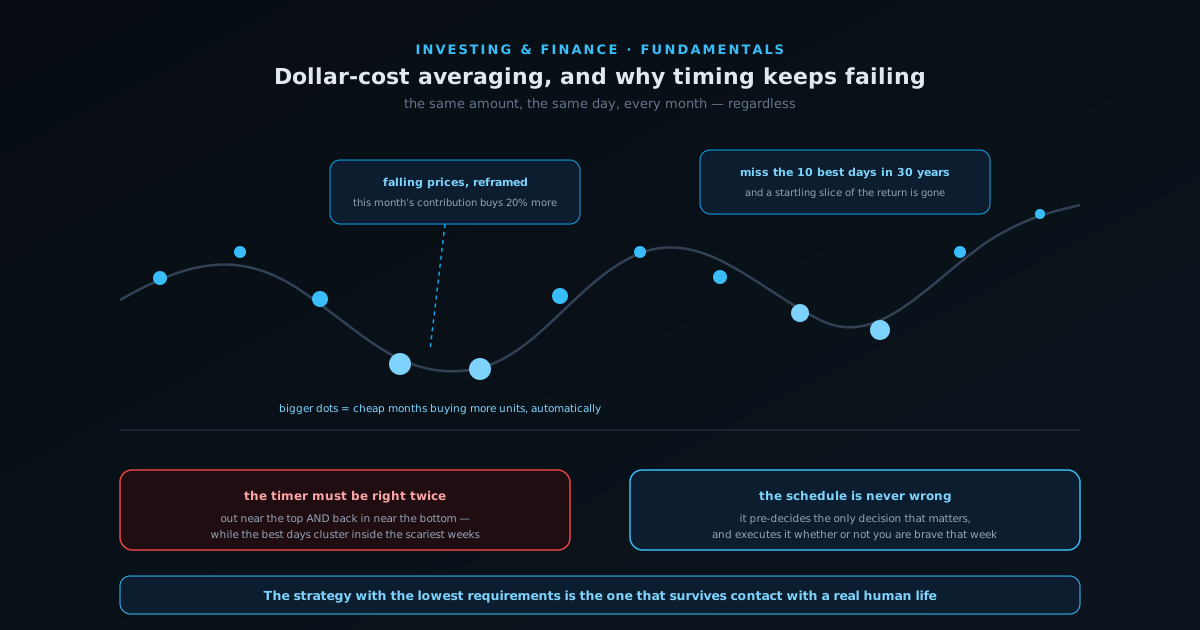
Investment techniques usually sell themselves on cleverness: a screen, a signal, an edge. Dollar-cost averaging sells itself on the opposite: invest the same fixed amount, on the same day, every month, into the same broad holdings, regardless of headlines, prices, or how you feel. No analysis, no decisions after the first one, no skill. And yet this aggressively unimpressive procedure has probably created more durable wealth for ordinary people than every clever technique combined, not because it squeezes out maximum returns, but because it is the only approach most humans can actually execute for thirty consecutive years. The technique's real subject is not markets. It is you.
This article explains the mechanism honestly, including the part most advocates skip, which is that DCA is not mathematically optimal and does not need to be. As always in this series: education, not personalized advice. The arithmetic and the behavioral evidence are general; what you should do with your specific money, in your specific tax situation, is a question for someone who knows your facts. What the general material can do is dissolve the illusion that keeps savers on the sidelines: the belief that successful investing requires knowing when to act.
The honest caveat: lump sums usually win on paper
Intellectual honesty requires the caveat that DCA marketing omits: if you already have a large sum to invest, spreading it deliberately over months is not mathematically optimal. Markets rise more often than they fall, so money invested sooner is in the market longer, and studies comparing immediate lump-sum investment against spreading the same sum over a year find the lump sum winning roughly two times out of three. The expected cost of waiting exceeds the expected benefit of averaging. If a windfall lands and pure expected value is the only criterion, the math says invest it now.
So why does DCA deserve its reputation anyway? Two reasons. First, most people do not have lump sums: they have income, arriving monthly, and investing a slice of each paycheck as it arrives simply is dollar-cost averaging; the technique is not a choice but the natural shape of saving from earnings. Second, for those who do face the windfall decision, the paper-optimal answer carries a behavioral trap the studies also document: the investor who puts everything in at once and meets a crash in month two is at high risk of panic-selling at the bottom, converting a temporary drawdown into a permanent loss that no expected-value calculation survives. A spread-out entry that forfeits a little expected return to guarantee the investor stays invested is not irrational; it is paying an insurance premium against one's own worst moment. The right frame is not "DCA versus lump sum" but "which approach will this specific human actually hold through the first storm?"
Why timing fails: the evidence
The alternative to scheduled investing (waiting for the right moment, stepping out when things look dangerous) fails for ordinary investors with a consistency the research community finds almost boring to keep documenting. The structural problem appeared earlier in this series: a timer must be right twice, on the exit and the re-entry, and the re-entry is psychologically near-impossible because the best buying days cluster inside the scariest periods, when every instinct and every headline screams to stay out. Miss a handful of the market's best single days over a few decades (the standard studies count them on two hands) and a large fraction of the total return evaporates. The market does not distribute its gains evenly; it pays in rare, violent bursts that punish absence.
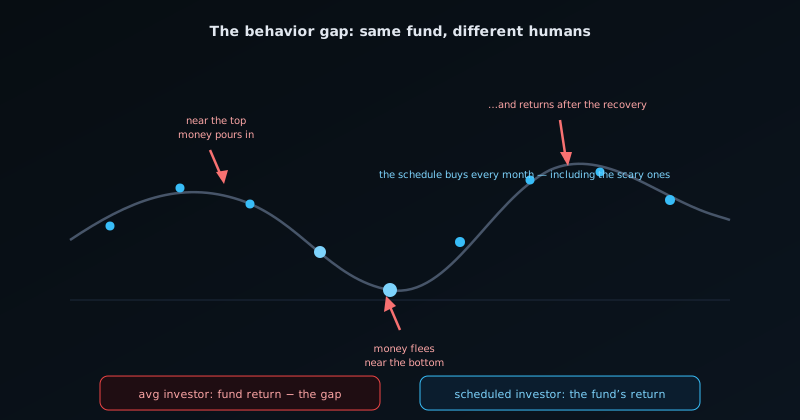
The behavioral data adds the human postscript: study after study of actual investor returns (what people earned, versus what the funds they held earned) finds a persistent gap, with the average investor underperforming their own investments by meaningful percentages per year. The gap has one cause: flows. Money pours in after markets have risen and flees after they have fallen, which is timing, practiced unconsciously, in exactly the wrong direction. This is the precise failure DCA exists to prevent: not a math failure but a behavior failure. The schedule is a commitment device: it pre-decides the only decision that matters, removes the daily invitation to act on feelings, and converts investing from a stream of emotional judgment calls into a standing instruction the bank executes whether or not you are brave that week.
Running the system: automation is the whole trick
Implementation is almost embarrassingly simple, and the simplicity is load-bearing: every manual step you remove is a place willpower can no longer fail. The standing order goes out the day after income arrives (pay the portfolio first, before spending has opinions) into the same broad, low-cost holdings every time. The amount should be ambitious enough to matter and conservative enough to survive your worst expected month, because the system's entire value is unbroken continuity; a contribution rate you must pause twice a year teaches you that pausing is normal. Increases ride automatic triggers where possible (a fixed share of every raise, a sweep of windfalls) so the rate ratchets upward without requiring an annual act of virtue.
Then comes the hard part, which is doing nothing. The schedule will carry you into months where contributing feels absurd: markets falling, commentary apocalyptic, the balance lower than the deposits that built it. Those are, mechanically, the highest-value contributions of the entire program, and the system's job is to make them happen without consulting you. The supporting habits are deliberately anti-engagement: check the portfolio on a calendar (quarterly is plenty), not on a mood; never log in during dramatic weeks; treat financial news as weather reporting for a trip you are not taking. For operators, the parallel earlier in this series holds: you would not let a scary sales week shut down your store's ordinary operations; the portfolio's ordinary operation is the monthly buy, and it deserves the same protection from your moods.
Variations, and why plain beats clever
Once the basic schedule is running, a small literature of refinements presents itself, and most deserve a polite decline. Value averaging (adjusting each contribution so the portfolio hits a predetermined growth path, investing more after bad months and less after good ones) genuinely improves average purchase prices in backtests, and fails in practice for a human reason the backtests omit: it demands the largest contributions in the scariest months and sometimes demands selling in euphoric ones, replacing a system that removes decisions with one that schedules the hardest decisions imaginable. Contribution timing tweaks (buying on dips within the month, splitting the monthly amount weekly) produce differences measured in hundredths of a percent, which is to say they are entertainment wearing a strategy costume. The honest summary of the variations research: nothing reliably beats the plain schedule by enough to pay for the complexity it adds, and complexity is itself a risk, because every added rule is another place the system can be second-guessed mid-storm.
The one refinement that does earn its keep is rebalancing, because it extends the DCA principle to the portfolio's shape. A simple annual rebalance back to target weights (selling a slice of whatever grew beyond its allocation, buying whatever shrank) mechanically sells high and buys low without requiring a single opinion about markets, which makes it the only form of contrarian trading available to people who should not trade. Paired with a contribution schedule, it completes a system with a pleasing property: every action the investor ever takes is prescribed in advance by rules set on a calm day, and the market's only role is to be whatever it is. That is the real answer to the variations question. The plain machine is not the beginner version of something more sophisticated. It is the sophisticated version: sophistication, in a domain ruled by behavior, means removing opportunities to be clever at the worst possible moment.
Where DCA does not apply
A technique this good at its job gets over-applied, so the boundaries deserve a list of their own:
- Individual stocks: averaging into a single company is discipline applied to concentration; the schedule cannot fix the vehicle. DCA assumes broad holdings that cannot go to zero without civilization-level problems.
- Money with a near-term job: a house deposit needed in two years does not belong in markets on any schedule; time horizons under several years are savings problems, not investing problems.
- High-interest debt: a guaranteed twenty-percent return from paying down a card beats the expected return of any contribution schedule. Kill the debt first.
- No emergency fund: contributions you may be forced to sell in a bad month at a bad price are not investments; they are volatility with extra steps. The buffer comes first.
- As a market-timing opinion in disguise: deliberately stretching a windfall over three years because the market "feels high" is timing wearing DCA's clothes. Pick a modest spread period for behavioral insurance, or invest it now, but be honest about which decision you are making.
The discipline is the asset
Step back far enough and dollar-cost averaging stops looking like an investment technique and starts looking like what it actually is: a system for protecting a multi-decade compounding machine from its single largest threat, which is the machine's owner. Every component (the fixed amount, the fixed date, the automation, the deliberate ignorance of headlines) exists to keep one promise: the contributions continue, through every season, until the flat early years bend into the steep later ones. The market provides the returns; the schedule's only job is to ensure you are present for them, and presence, as the timing evidence shows, is where ordinary investors actually win or lose.
Operators should recognize the shape, because it is the same one running through this whole series: systems beat intentions, pre-made decisions beat in-the-moment judgment, and the boring repeated action (the monthly close, the weekly publish, the standing transfer) outperforms the brilliant sporadic one over any horizon long enough to matter. DCA is simply that principle, pointed at a brokerage account. It asks nothing impressive of you, ever, which is exactly why it works: the strategy with the lowest requirements is the one that survives contact with a real human life. Set the schedule, automate the transfer, and go build something; the machine runs fine without your attention. In fact, it runs best that way.
For the self-employed readers of this series, one adaptation note before the machinery feels out of reach: lumpy income does not break the system, it just relocates the smoothing. The schedule attaches to the fixed owner salary this series keeps prescribing: the same contribution rides the same salary out of the buffer account, while the feast-and-famine deposits land upstream where the buffer absorbs them. The windfall quarter gets its own standing rule: a fixed slice to investments after the buffer and the tax sweep, decided in advance, executed without a market opinion. Operators sometimes object that their income is too irregular for automatic investing, and the objection has it backwards: irregular income is precisely why the automation matters, because the alternative is a human deciding monthly whether this is a good month to invest, and that human's judgment is contaminated by exactly the business anxieties the portfolio exists to counterbalance. The fuller treatment of buckets and buffers is its own article in this series; the headline is that the schedule survives self-employment intact, one account upstream.
Frequently asked questions
Quick answers to common questions about this topic.
What is dollar-cost averaging?
It is investing a fixed amount on a regular schedule regardless of price, so you buy more shares when prices are low and fewer when high. It removes the need to guess the right moment to invest.
Why does trying to time the market usually fail?
Because consistently predicting tops and bottoms is extremely hard, and missing a handful of the best days badly hurts long-term returns. Investing on a schedule sidesteps the temptation to guess.
Is dollar-cost averaging always better than investing a lump sum?
Not always. Historically lump-sum investing often comes out ahead on average, but DCA reduces regret and risk if the timing is unlucky. This is general education, not personalized financial advice.
Related troubleshooting
Was this page helpful?
Your answer stays in this browser, it is not sent anywhere and no account or cookie is involved.