2026 · Novus Stream SolutionsAbout 11 min readNovus Stream Solutions
Starting a service business with no capital: the zero-inventory on-ramp to working for yourself
Service is the only business model where you can be profitable in week one with nothing but a skill and a way to be contacted. Here is how to scope a first offer, price it without flinching, and land the first five clients.
Contents
- 1.Overview
- 2.Pick a service the market already buys
- 3.Scope one narrow offer
- 4.Price from value and capacity, not from fear
- 5.The first five clients come from warm ground
- 6.Deliver like a business, not a freelancer with luck
- 7.Handling the price objection without folding
- 8.The week-by-week shape of a launch
- 9.The on-ramp, not the destination
Overview
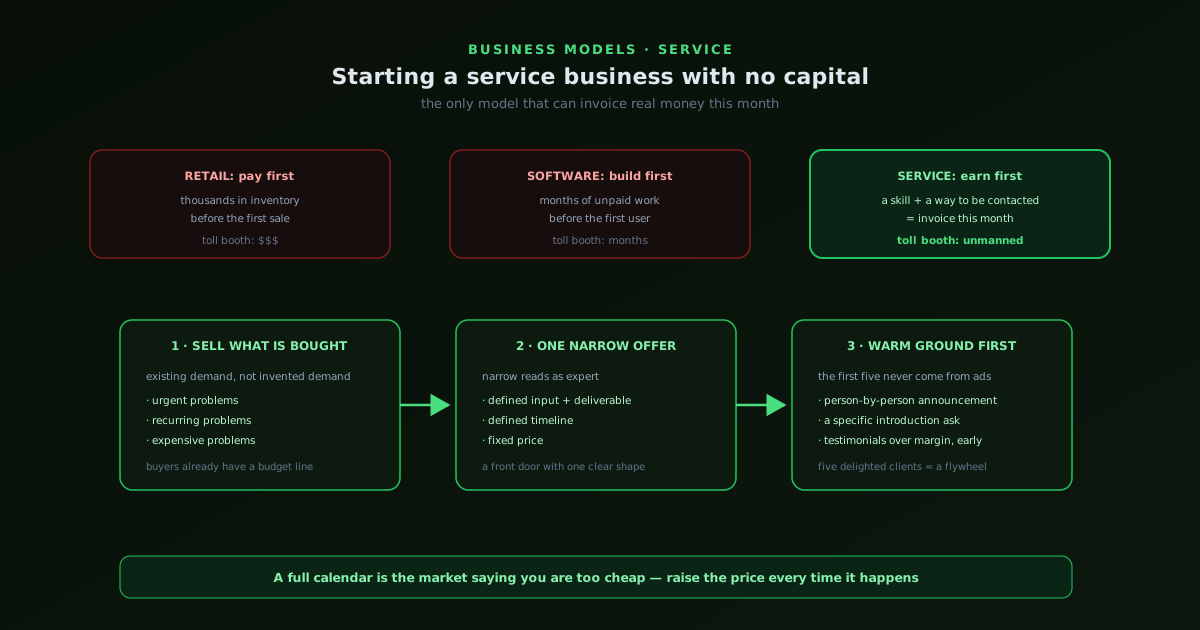
Every other path into business ownership has a toll booth at the entrance. Retail wants thousands of dollars of inventory before the first sale. Software wants months of unpaid building before the first user. Content wants a year of publishing before the first meaningful check. Service stands alone: if you have a skill someone will pay for and a way to be contacted, you can invoice real money this month, with startup costs that round to zero. That is not a motivational exaggeration; it is a structural fact about the model, and it is why service businesses are how a huge share of all successful owners got their start, including plenty who later built the stores and software products that service income funded.
The catch is that "low barrier" describes the entrance, not the path. Most new service businesses stall not because the founder lacked skill but because they sold the skill badly: offers too broad to be credible, prices set by fear, and marketing aimed at strangers when every early client was always going to come from somewhere warmer. This guide is about doing those three things deliberately (scoping, pricing, and the first five clients) because they are nearly the whole game at the start.
Pick a service the market already buys
The first discipline is to sell something people already purchase, rather than something you wish they purchased. Aspiring founders consistently invert this: they inventory their most interesting skills and try to manufacture demand for them, which means spending the hardest months of the business simultaneously learning to sell and educating a market. The faster route is to look at what businesses around you visibly pay for today: bookkeeping, web fixes, product photography (the kind a free tool like bgremover.novusstreamsolutions.com/background-remover can make you fast at), ad management, copywriting, cleaning, repairs, onboarding help for common software. Then find the overlap with what you can do excellently. Existing demand means buyers already have a budget line and a vocabulary for the problem; you compete for the spend rather than conjuring it.
Within that overlap, optimize for problems that are urgent, recurring, or expensive, ideally more than one. Urgent problems (the site is down, the books are a mess before tax season) short-circuit long sales cycles because the buyer is already in motion. Recurring problems (monthly bookkeeping, ongoing content) turn one sale into a revenue stream and transform the business's stability. Expensive problems (ones tied to revenue the client can count) let your price be compared against the client's upside rather than your hourly effort. The dreamy fourth quadrant, work that is interesting to you, is worth honoring only after the first three; plenty of service founders discover that delivering a slightly boring service to grateful, well-paying clients is far more interesting than delivering a fascinating one into indifference.
Scope one narrow offer
The next discipline is narrowness, and it is the one founders resist hardest. The instinct is to stay broad ("I do design") on the theory that a wider net catches more fish. In practice broad reads as junior, and narrow reads as expert. "I design landing pages for course creators" loses every client who wants a logo and wins a disproportionate share of clients who want exactly that page, at higher prices, because a specialist plausibly carries pattern knowledge a generalist cannot. Narrowness also compounds operationally: each project resembles the last, so you build templates, checklists, and judgment that make delivery faster and better simultaneously. The generalist starts every project from zero forever.
The practical form of narrowness is a scoped offer: a named piece of work with a defined input, a defined deliverable, a defined timeline, and a price. Not "web design services" but "a five-page site for your trade business, live in three weeks." Scoping does quiet, important work in every direction at once. The buyer can say yes without negotiating an ambiguous engagement. You can estimate effort honestly because the edges are defined. And scope creep (the silent margin killer of all custom work) now has a boundary to creep across, which makes it visible and chargeable instead of absorbed. You will still do custom work off the menu sometimes; the offer is the front door, not a prison. But the front door should be one clear shape, because confused visitors do not knock.
Price from value and capacity, not from fear
New service founders price by a ritual of self-harm: take the hourly rate of their last job, maybe add a little, quote it nervously, and discount at the first hesitation. Better to start from arithmetic. Your real capacity is perhaps twenty to twenty-five billable hours a week (the rest disappears into sales, admin, and the unpaid machinery of running a business) for maybe forty-five working weeks a year. Divide a modest target income plus business costs by those thousand-ish hours and most people discover their "comfortable" rate is roughly half what survival actually requires. That arithmetic, done once, permanently relocates the conversation about what is expensive.
Then move from defensible to advantageous: anchor price to the client's outcome wherever the work touches money. A landing page that lifts a course launch by a few percent is worth thousands regardless of the hours it takes; monthly books that save a business from tax-season chaos are worth a real retainer. Quote fixed prices for scoped offers rather than hourly rates wherever possible: fixed pricing rewards you for getting faster, while hourly pricing punishes your own improvement and invites the client to audit your minutes. And resist the universal beginner temptation to be the cheap option. Cheap attracts the clients who treat vendors as adversaries, churns the fastest, and traps you at full calendar with no profit. In services, price is also a signal: buyers genuinely cannot inspect quality before purchase, so they read it from your confidence, and the discount you offer to seem safe reads instead as doubt.
The first five clients come from warm ground
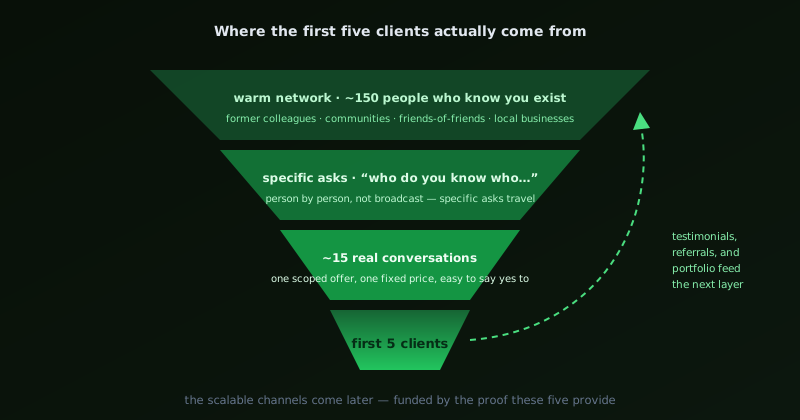
With an offer and a price, the remaining problem is the first clients, and here the honest news is also the convenient news: they will not come from ads, SEO, or any channel that scales. They will come from people who already know you exist: former employers and colleagues, the local business you already frequent, communities where you have history, friends-of-friends one introduction away. This embarrasses founders who wanted the business to feel like a machine from day one, but it should not: warm-ground acquisition is not a temporary hack, it is how trust-based purchases work at small scale, and services are maximally trust-based purchases.
The move is a direct, specific, low-pressure announcement, repeated person by person rather than broadcast once. Tell your network what you now do, for whom, and what the offer is, and ask not for their business but for the introduction: "who do you know who runs a small trades business and hates their website?" Specific asks travel; vague availability does not. Expect the first projects to be slightly underpriced and oversized in effort, and treat that deliberately as the cost of acquiring the real assets: testimonials, portfolio pieces, referral sources, and the pattern knowledge that sharpens the offer. Five delighted clients who each know two more prospects is a flywheel; it is also, at typical service prices, most of the way to replacing a salary.
Deliver like a business, not a freelancer with luck
What separates a service business from sporadic gig income is almost entirely procedural, and the procedures are cheap to install from client one. Use a simple agreement that states scope, price, timeline, and what happens when the client requests more; one page of plain language prevents most of the disputes that destroy small service relationships. Invoice promptly and take deposits on larger projects; a client's willingness to pay half upfront is also the cheapest qualification filter that exists. Communicate on a rhythm: a short weekly update beats a brilliant silence, because clients buying intangible work fill silence with anxiety. None of this is bureaucracy; it is the experience of professionalism, which is a large part of what your price purchases.
Behind the scenes, run the boring machinery this series keeps advocating: a separate bank account from day one, simple expense records, a fraction of every payment swept toward taxes immediately. Service income arrives without withholding, and the founder who spends gross revenue as if it were net is the founder who meets tax season as a crisis. Keep a simple pipeline list (every prospect, every conversation, every promised follow-up) because at small scale your memory is the CRM and your memory is worse than you think. An hour of Friday administration, every week without exception, is the entire back office a young service business needs.
Handling the price objection without folding
Every new service provider meets the same moment within the first month: a prospect says the price is too high, and everything in the founder's nervous system votes to discount. Resist the vote, because the response to a price objection is the single most identity-defining negotiation a young service business conducts, and the discount path compounds badly: the discounted client refers more discounted clients, the calendar fills at the wrong rate, and the business learns that its prices are opening bids rather than prices. The professional alternative is to adjust scope, never rate: if the budget is genuinely smaller, offer a genuinely smaller package (fewer pages, a narrower audit, a shorter engagement) so the price drops because the work drops. The client gets a real option, the rate survives intact, and the difference between the two postures is visible to everyone involved: one says my time is negotiable, the other says my offers come in sizes.
It also helps to hear objections accurately, because "too expensive" is rarely about the number. Sometimes it means the value was not made concrete: the prospect cannot picture what changes for them, which is a pitch problem you fix with specifics and proof rather than a price problem you fix with surrender. Sometimes it means the prospect is the wrong client, and the objection is the cheapest possible way to find out; the people who negotiate hardest at the gate are reliably the most expensive to serve once inside. And sometimes it simply means not now, in which case the graceful response is to stay warm rather than to chase; a meaningful share of declined proposals convert months later, at full rate, when the budget or the pain arrives. A young service business that holds its pricing through the first ten objections discovers something the discounting competitor never learns: the market contains enough clients who pay properly, and the fastest way to find them is to stop being available to the ones who do not.
The week-by-week shape of a launch
Compressed into a sequence, a credible zero-capital launch looks like this, and none of it requires permission, savings, or a logo.
- Week one: choose the intersection of what you do excellently and what businesses already pay for; draft one scoped offer with a fixed price.
- Week one: set up the minimum surface (a one-page description of the offer, a way to be paid, a separate bank account).
- Week two: announce person-by-person to your warm network with a specific ask for introductions, not business.
- Weeks two to four: take the first projects slightly under market in exchange for testimonials and referrals, delivered conspicuously well.
- Ongoing: invoice with deposits, communicate weekly, sweep a tax fraction from every payment, keep the pipeline list current.
- Month two onward: raise the price every time the calendar fills; a full calendar is the market saying you are too cheap.
- Month three onward: write down what repeats across projects; that document is the seed of the productized offer that comes next.
The on-ramp, not the destination
It is worth being clear-eyed about what this model gives and what it withholds. What it gives is unmatched: profitability measured in days, education in sales and delivery that no course teaches, and income that arrives while every other model is still consuming cash. What it withholds is leverage: the revenue stays chained to your hours until you deliberately break the chain, and the standard breaking tools are the subjects of their own playbooks: productized offers, retainers, raising prices until demand and capacity balance, and eventually hiring or building assets that earn without you. A service business run without those moves matures into a well-paid, fragile job. Run with them, it matures into a company.
But that critique belongs to year two, and this article is about week one. The under-told truth of small business is that an enormous number of durable companies (agencies, firms, brands, even software products) began as one person invoicing for a skill, because service income is the most accessible venture capital in existence: it funds the next thing while teaching you exactly what the next thing should be. If you have been waiting to start something until you have savings, inventory, or a product, the wait may be the only real obstacle. The toll booth at this entrance is unmanned. The skill you already have is the ticket.
Frequently asked questions
Quick answers to common questions about this topic.
Can you start a business with no money?
A service business is the most common way: you sell your skills and time rather than inventory, so startup cost is mainly your effort. The first sale funds the next step instead of upfront capital.
What is the fastest service business to start?
One based on a skill you already have, sold to people who already need it. Skip the website-and-logo phase: define a clear offer, reach a few likely clients directly, and deliver.
How do I get my first client with no track record?
Start narrow and specific, use your existing network, and offer a clear, fixed-scope result rather than vague "help." Early proof of delivery is what builds the track record that makes the next client easier.
Related troubleshooting
Was this page helpful?
Your answer stays in this browser, it is not sent anywhere and no account or cookie is involved.