2026 · Novus Stream SolutionsAbout 10 min readNovus Stream Solutions
Retail vs service vs software: what the margins actually look like and why it changes everything
A retail store, a service firm, and a software product can all report the same revenue and live in completely different financial universes. The difference is margin structure, and it quietly dictates pricing, hiring, marketing, and what growth even means.
Contents
- 1.Overview
- 2.A thirty-second margin vocabulary
- 3.Retail: the volume game played on thin ice
- 4.Service: high margins with a ceiling
- 5.Software: brutal until it is beautiful
- 6.Reading a business through its margin structure
- 7.Benchmarking your own structure
- 8.Why modern businesses blend the models
- 9.The structure is the strategy
Overview
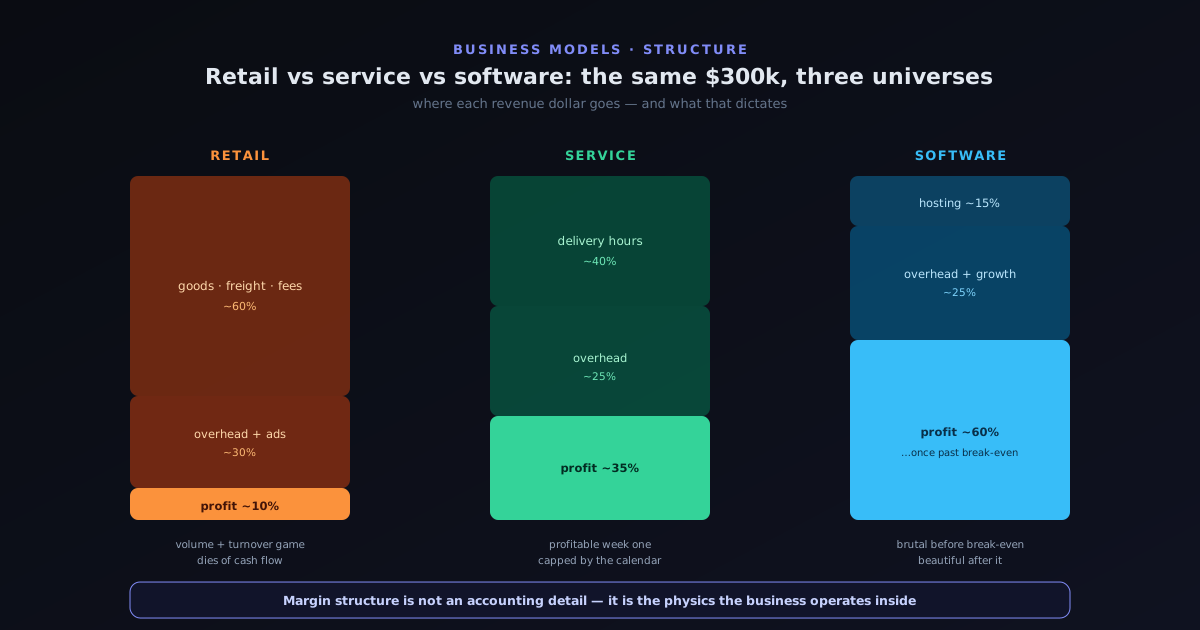
Imagine three businesses that each booked three hundred thousand dollars in revenue last year: a retail store selling socks, a two-person design agency, and a small software product. By the revenue line they are identical. By every line below it they are different species. The store keeps maybe thirty thousand after the goods, the shipping, the storage, and the ads are paid. The agency keeps a hundred thousand but cannot grow without hiring, and hiring eats the margin. The software product keeps a hundred and eighty thousand and could serve ten times the customers without spending much more, but it cost two years of unpaid development before earning its first dollar. Same revenue; three different universes.
The thing that separates the universes is margin structure: not just how much profit survives, but where in the income statement the costs live and how they behave when the business grows. Margin structure is destiny in a way that beginners consistently underrate: it dictates what pricing is possible, what marketing you can afford, whether hiring helps or hurts, and what "scaling" even means. This article walks through the three classic models side by side, because the comparison is the fastest way to understand any business you might start, buy, or currently run.
A thirty-second margin vocabulary
Two numbers carry the whole conversation. Gross margin is what remains of each revenue dollar after the direct costs of delivering the thing sold: the wholesale cost of the socks, the hours of the designer, the server cost of the software. It answers: how much does each additional sale actually contribute? Net margin is what remains after everything else too: rent, salaries, software subscriptions, marketing, the accountant. It answers: how much does the whole machine keep? The gap between the two is the overhead the business must clear before profit exists.
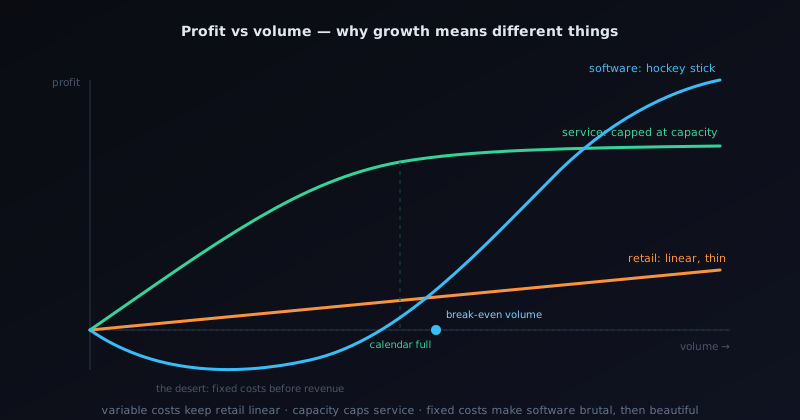
The behavioral distinction that matters even more than the percentages is fixed versus variable. Variable costs scale with each sale: every additional unit of socks costs you its wholesale price, forever. Fixed costs are paid regardless of volume: the development of a software feature costs the same whether ten people or ten thousand people use it. A business dominated by variable costs has margins that stay roughly constant as it grows. A business dominated by fixed costs has margins that transform with scale: terrible below the break-even volume, increasingly spectacular above it. Hold that distinction; it explains nearly everything that follows.
Retail: the volume game played on thin ice
Retail (physical products, whether on a shelf or an e-commerce site) runs on gross margins that typically land between thirty and fifty-five percent for independents, and net margins that survive in the single digits to low teens. The reason is that retail's costs are overwhelmingly variable and stubbornly physical: every sale carries its wholesale cost, inbound freight, packaging, outbound shipping, payment processing, returns, and a slice of storage. These costs do not negotiate and barely shrink with scale at small volumes. A retailer's entire profit lives in the gap between landed cost and what the market will pay, and that gap is under permanent pressure from competitors selling comparable goods.
The strategic consequences follow directly. Retail is a volume and turnover game: with thin slices per sale, the money is made by selling many units and by turning inventory fast, because stock sitting in storage is capital earning negative yield. Pricing power is the scarcest resource, which is why every durable retailer eventually invests in the things that create it (brand, exclusive products, owned audiences) rather than competing on price against whoever is willing to earn less. Cash flow runs backward: you pay for inventory months before customers pay you, so growth consumes cash even when profitable, and many retail deaths are profitable businesses that ran out of liquidity. And marketing budgets are mathematically capped: a business keeping eight cents per revenue dollar cannot outbid one keeping forty for the same click, which dictates where and how retail can afford to acquire customers.
Service: high margins with a ceiling
Service businesses (agencies, consultancies, freelancers, trades) invert the retail picture. Gross margins are high, often fifty to seventy percent even after counting delivery labor, and a lean solo operation can post net margins retail will never see, because the product is expertise and the cost of goods is mostly time. There is no inventory to finance, no freight, no warehouse. The startup capital is close to zero, which is why service is the historic on-ramp for first businesses: you can be profitable in week one, a feat structurally impossible in the other two models.
The catch is the ceiling. Service revenue is manufactured from hours, and hours do not scale: when the calendar is full, growth requires either raising prices or adding people, and people change the math. Each hire adds salary as a new quasi-fixed cost, needs management time that subtracts from billable time, and delivers somewhat less margin than the founder's own hours did. Agencies discover that doubling headcount roughly doubles revenue while less-than-doubling profit, and that the owner's job migrates from craft to management whether they wanted that career or not. The standard escapes (productized fixed-scope offers, retainers that smooth the revenue, and selling outcomes rather than hours) are all attempts to decouple revenue from the clock, and they work exactly to the degree the decoupling is real. Service is the best model for reaching profitability and the hardest for leaving your own calendar behind.
Software: brutal until it is beautiful
Software inverts the cost structure entirely: nearly everything is fixed, almost nothing is variable. Building the product costs heavily in time or salaries before revenue exists; serving one additional customer afterward costs cents of hosting and a sliver of support. The result is gross margins in the seventy-five to ninety percent range (the highest of any mainstream model) and a profit curve shaped like a hockey stick: deeply negative through development, crawling through early traction while fixed costs dwarf a small customer base, then expanding dramatically once revenue clears the fixed-cost line, because each marginal dollar arrives nearly clean.
This structure explains the entire culture of software economics. It is why software can spend so aggressively on customer acquisition: a subscriber worth thousands over their lifetime justifies hundreds to acquire, spending no retailer could survive. It is why recurring billing matters so much: subscriptions make the high-margin revenue predictable, which is what lets a software business spend its future income on growth today. It is also why the model is the riskiest at the start: the months or years of fixed cost are spent before learning whether anyone pays, and the graveyard of software products that never found a hundred customers is vast. The margin paradise is real, but it sits on the far side of a desert that retail and service businesses never have to cross: they earn from the first sale; software earns from the ten-thousandth.
Reading a business through its margin structure
Put the three models side by side and you can derive most strategy questions from the structure alone. Where does each additional revenue dollar go? In retail, mostly to suppliers and shippers; in service, to the calendar; in software, to profit, eventually. What does growth cost? Retail: cash for inventory ahead of sales. Service: hires and the margin they consume. Software: marketing, because the product itself barely costs more to serve. What kills each? Retail dies of cash flow and price competition; service dies of churn in key people and the owner's burnout; software dies of never reaching break-even volume. None of these answers required knowing anything about the specific company; the model structure dictated them.
This is also the lens for evaluating opportunities, including your own next move. When someone pitches a business (to join, to buy, to copy) ask the margin-structure questions before the vision questions. What is the gross margin, really, with all delivery costs counted? Which costs are fixed and which scale with sales? Where is break-even volume, and what does the desert before it look like? How does a dollar of growth get financed? Mediocre operators in a structurally great model routinely out-earn brilliant operators in a structurally punishing one, which is an uncomfortable but liberating fact: choosing the game well matters at least as much as playing it well.
Benchmarking your own structure
The comparison becomes personally useful the moment you place your own business inside it, and the placement exercise takes one evening with the books this series keeps insisting you maintain. Compute your actual gross margin (all delivery costs honestly counted, including the owner labor that small-business accounting loves to omit) and set it beside your model's typical band. A retail operation at twenty-five percent gross when the category norm is forty has a sourcing or pricing problem worth a quarter of focused work. A service business at eighty percent gross is probably not counting the founder's delivery hours, and the flattering number is hiding the capacity ceiling that will define its next two years. The bands are not grades; they are diagnostics, and deviation in either direction is information about where your particular machine differs from the standard design, sometimes as a flaw, occasionally as an edge worth protecting deliberately.
The second placement question is trajectory: which costs in your structure are genuinely fixed, which are variable, and which are quietly migrating between categories as you grow? A service business adding retainer clients is shifting revenue from re-won to recurring, software-like motion that deserves to be fed. A retailer whose ad spend has stopped scaling sales is watching a variable cost calcify into a fixed one, which is the margin structure announcing that a channel has saturated. An owner who re-runs this classification yearly gets something the income statement alone never provides: a picture of which business model they are actually becoming, as opposed to the one they started with. Plenty of companies drift across model boundaries without their owners noticing (the agency that is now mostly a software shop, the store that is now mostly a media property) and the drift is usually good news for whoever notices it first, because pricing, hiring, and strategy can finally be aligned with the machine that exists rather than the one in the founding story.
Why modern businesses blend the models
The sharpest operators increasingly refuse to pick just one structure, because the models patch each other's weaknesses. The classic combinations are everywhere once you look for them.
- Service funding software: agencies build internal tools on client revenue, then productize them; service's instant profitability subsidizes software's desert.
- Software wrapped in service: products add onboarding, migration, or done-for-you tiers, capturing customers who pay for outcomes, at service margins, on top of the subscription.
- Retail with software margins attached: physical brands add memberships, content, and digital products: a sock company whose subscription club revenue would carry near-software gross margin on top of the socks.
- Service productized into near-retail: fixed-scope, fixed-price offers sold from a page, service economics with retail's transactional simplicity.
- Content as a fourth column: media properties monetized by ads run software-like margins on library economics: high fixed cost to create, near-zero cost to serve the next reader.
The structure is the strategy
The takeaway worth keeping is that margin structure is not an accounting detail to delegate; it is the physics the business operates inside. Pricing, marketing budgets, hiring plans, funding needs, and the realistic shape of your next five years are all downstream of where the costs live and how they behave at scale. Owners who internalize their structure stop fighting it: the retailer stops envying software's ad budgets and invests in turnover and brand; the agency stops hiring toward a margin that hiring cannot produce and productizes instead; the software founder stops apologizing for the unprofitable year and measures the only thing that matters in the desert, which is progress toward break-even volume.
And if you are choosing a model rather than running one, the comparison offers an honest decision rule. Choose service to be profitable soonest and learn fastest, accepting the ceiling. Choose retail if you have an edge in products, brand, or sourcing, and the cash discipline the model demands. Choose software for the structurally best margins anywhere, if you can survive the desert and genuinely validate demand before building. Or sequence them, as a striking share of durable small companies do: service for income, then a productized offer, then the software or the brand the first two phases paid for. The models are not rivals so much as stages, and knowing their anatomy is what lets you move between them on purpose.
Frequently asked questions
Quick answers to common questions about this topic.
Which business model has the best margins?
Software typically has the highest gross margins because copies cost almost nothing, services sit in the middle (you sell time), and retail is lowest because every sale carries the cost of physical goods. But high margin comes with its own demands.
Why do margins change how you run a business?
Low-margin retail lives or dies on volume and operations; mid-margin services depend on utilization and pricing; high-margin software depends on acquisition and retention. The margin shape dictates where your attention has to go.
Can one business combine models?
Yes, and many do: a service that productizes into software, or a retailer that adds a subscription. Understanding each model's margin profile is what lets you combine them deliberately.
Related troubleshooting
Was this page helpful?
Your answer stays in this browser, it is not sent anywhere and no account or cookie is involved.