2026 · Novus Stream SolutionsAbout 11 min readNovus Stream Solutions
Productizing a service: from custom hours to fixed-scope offers people can just buy
The escape route from trading hours for money is not hiring; it is packaging. Productized services sell a defined outcome at a fixed price, and the transformation changes everything from your margins to your marketing.
Contents
- 1.Overview
- 2.Find the repeatable core
- 3.Design the package: scope, deliverable, timeline, exclusions
- 4.Price the outcome, not the hours
- 5.Build the delivery machine
- 6.Marketing gets easier when the offer is a thing
- 7.What happens to the custom work
- 8.The transition, without burning the boats
- 9.From selling time to owning a process
Overview
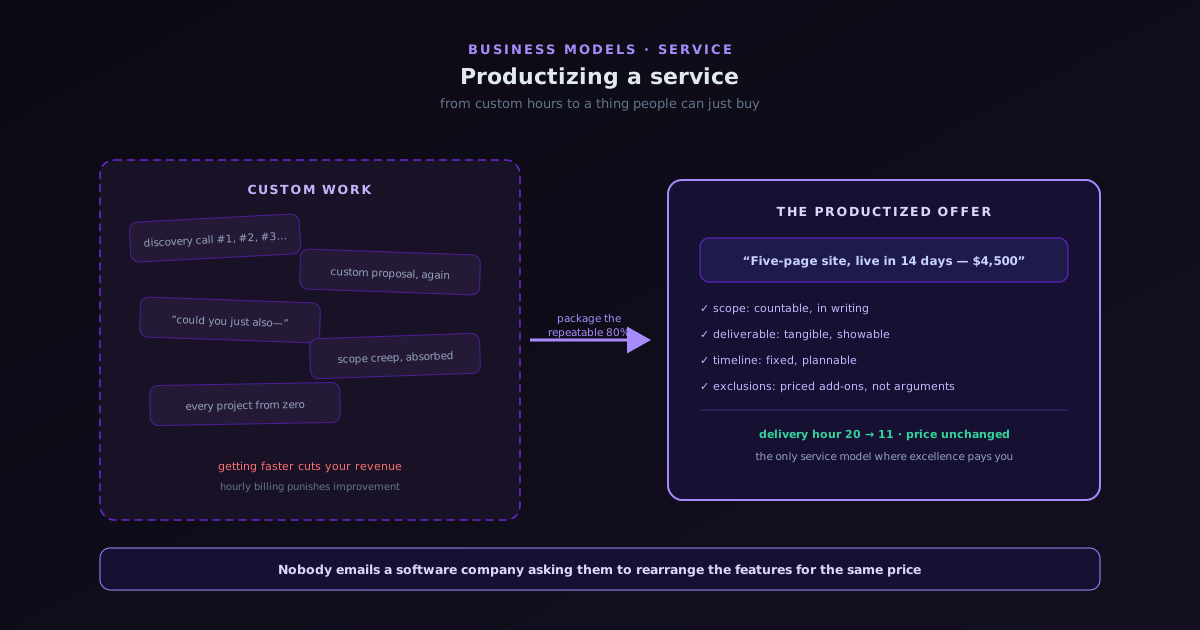
Every custom service provider eventually hits the same wall. The calendar is full, the clients are happy, and the business cannot grow by a single dollar without either working more hours or charging more per hour, and both levers have ceilings. The conventional escape is hiring, which trades the ceiling for a different set of problems and a thinner margin. The under-used escape is packaging: noticing that beneath the apparent uniqueness of every engagement, eighty percent of what you deliver is the same work in a different costume, and selling that eighty percent as a product: defined scope, defined deliverable, defined timeline, fixed price, buyable from a page without a single discovery call.
Productization is not a gimmick or a downmarket move; it is a structural migration. A custom service has the margins of consulting and the scalability of a calendar. A productized service inherits properties from genuine products: repeatable delivery that improves with every iteration, pricing decoupled from hours, marketing that can describe exactly what the buyer gets, and operations that someone other than the founder can eventually run. This article is the conversion manual: from finding the repeatable core to designing the boundaries that make the whole thing survivable.
Find the repeatable core
The raw material for productization is buried in your delivered projects, and the excavation method is straightforward: lay out the last ten engagements and list what you actually did in each, step by step, ignoring what the proposals claimed. Patterns surface immediately. The web designer discovers every project began with the same site audit and the same five questions. The marketing consultant finds that whatever the brief said, the first month was always an analytics cleanup and a channel review. The bookkeeper sees the same messy-to-clean migration over and over. That recurring spine (the work that appears in every project regardless of client) is the product hiding inside the service.
The selection criteria for which core to package first: it should be the work where your speed advantage is largest, because fixed pricing converts speed into margin; it should produce a deliverable the client can see and show to others, because tangible outcomes sell themselves in ways advice cannot; and it should sit early in the client journey, because an affordable, defined entry product is also the best qualification mechanism ever invented. Buyers of the small package become the warm pipeline for everything larger. Notice what this rules out: your most interesting, most bespoke, most senior work productizes worst and should stay custom. Productize the thing you could do half-asleep. The market does not pay for your boredom threshold; it pays for the outcome, and your boredom is the evidence of mastery.
Design the package: scope, deliverable, timeline, exclusions
A productized offer is defined by four edges, and the sharpness of the edges is the quality of the product. Scope says what is included, in concrete countable terms: a five-page website, a twelve-post content package, a complete books cleanup for up to two accounts. Deliverable says what the buyer holds at the end (files, a live site, a report, a working system) described so specifically that the buyer can imagine receiving it. Timeline says when, as a fixed duration the buyer can plan around: delivered in fourteen days, not "depends on our current load." And exclusions (the least loved, most important edge) say what is not included, in writing, in advance: revisions beyond two rounds, copywriting, ongoing maintenance, rush delivery. Each exclusion is either a boundary or a future upsell, and usually both.
The discipline that makes the design real is refusing the customization reflex. Every productized service faces a daily stream of "this is perfect, but could you just also…" and every yes erodes the model: the timeline slips, the margin leaks, and the delivery system stops being repeatable. The professional answers are a menu, not a negotiation: that addition is available as a fixed-price add-on; that requirement means you need the custom tier, which starts at a different number; or simply, this package does not do that. Buyers respect a defined product far more than service founders expect (nobody emails a software company asking them to rearrange the features for the same price) and the act of holding the boundary is itself a signal that the offer is a real product rather than a discount consulting engagement in a box.
Price the outcome, not the hours
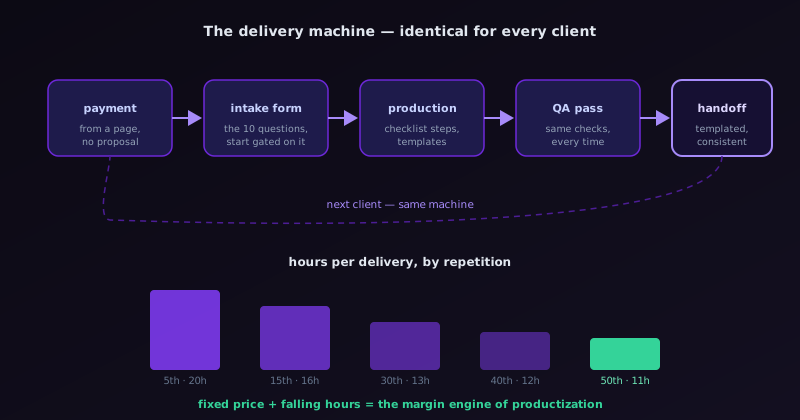
Productized pricing inverts the consulting logic. In custom work, price scales with effort, so clients interrogate effort. In productized work, price attaches to the defined outcome, and your effort becomes invisible and irrelevant, which is precisely the point, because the entire margin engine of productization is that delivery gets faster while the price stays fixed. The package that took you twenty hours in month one takes eleven hours by month six, with better quality, because the process has been run fifty times. Under hourly billing, that improvement would have cut your revenue by half. Under fixed pricing, it doubled your effective rate. Productization is the only service model in which becoming excellent pays you instead of penalizing you.
Set the initial price from three inputs: what the outcome is worth to the buyer (a converting landing page or clean books have estimable value), what adjacent alternatives cost (agencies above you, marketplaces below you; your defined-scope, known-timeline offer justifies sitting well above the low end), and your honest current delivery cost with margin on top. Then plan to raise it on a trigger rather than a feeling: every time the queue exceeds your comfortable capacity, the price moves up; a queue is the market reporting that you are underpriced. Tiering comes naturally later: a basic, standard, and premium version of the same core, differentiated by scope and speed rather than by vague quality promises, captures buyers at multiple budgets without re-fragmenting delivery into custom chaos.
Build the delivery machine
Once the same product sells repeatedly, delivery stops being a craft performance and becomes a process, and the process deserves the same design attention as the offer. Document the delivery as a checklist while you run it: every step from payment received to final handoff, in order, with the templates, questions, and quality checks each step uses. Standardize the inputs by replacing the discovery call with a structured intake form: the ten questions you always ask, answered asynchronously before work begins, with the start date gated on completion. Standardize the outputs with templates for the deliverable, the status updates, and the handoff, so the client experience is consistent at fifty units in a way no custom shop ever achieves.
This machinery is what converts productization from a pricing trick into an actual asset. A documented, repeatable delivery process is the thing that lets you eventually hand fulfillment to a contractor or hire while quality holds: the checklist is the training manual, the intake form is the brief, the templates are the standard. It is also what makes the business sellable, in the valuation language used elsewhere in this series: transferable process, recurring-ish demand, owner-optional delivery. And even if you never hire or sell, the machine pays daily dividends in cognitive load: the fiftieth delivery consumes a fraction of the decision energy of the fifth, which is the difference between a service business that exhausts its founder and one that quietly runs.
Marketing gets easier when the offer is a thing
A pleasant side effect of productization is that marketing transforms from selling yourself to describing a thing, and things are dramatically easier to market. The offer now has a name, a fixed price, a defined deliverable, and a timeline, which means the landing page writes itself, comparison against alternatives becomes concrete, and word-of-mouth finally has a handle to grab: "they do the fourteen-day website package" travels through a referral network in a way "they do good design work" never does. Publishing the price, which custom shops fear, works for you here: it pre-qualifies buyers, filters the negotiators, and signals the confidence of a real product.
The defined offer also unlocks marketing channels that custom services cannot use. Content marketing gets a precise target: every article answering a question your exact buyer asks before purchasing is now aimed at a specific conversion, not a vague brand impression. Past deliverables become a standardized portfolio where prospects see literally the thing they would receive. Even paid acquisition (economically impossible for most custom work because the sales cycle devours the margin) becomes plausible, because a fixed-price product with a known conversion rate and a known delivery cost has computable customer-acquisition math. The offer's edges, designed for operational sanity, turn out to be the same edges marketing needed all along.
What happens to the custom work
Productizing does not abolish custom work; it repositions it, and the repositioning is where a meaningful share of the model's profit hides. Once the packaged offer is the front door, custom engagements become the premium tier, explicitly framed that way, priced accordingly, and rationed deliberately. The framing matters: "custom" stops meaning "whatever the client asks for at whatever the negotiation produces" and starts meaning "engagements outside the package, starting at a number that reflects their true cost." That starting number should be uncomfortable, because custom work's true cost was always higher than custom shops admit: every bespoke project carries unpriced scoping, unpriced novelty risk, and the opportunity cost of the productized deliveries it displaces. Most providers discover that the honest custom price is two to three times their old instinct, and that demand survives the honesty far better than expected, because the clients who genuinely need bespoke work are precisely the ones who can pay for it.
The interplay between the tiers then becomes a quiet engine. The productized offer qualifies buyers cheaply: a client who has been through the package is a known quantity (responsive or not, decisive or not) before any large engagement begins, which de-risks exactly the projects that used to produce the horror stories. Custom work, in turn, feeds the product: the requests that keep recurring at the custom tier are the roadmap for the next package or the next add-on, surfaced by paying customers rather than by speculation. And the ratio between the tiers becomes a steering wheel. More custom when you want learning and reputation-building; more product when you want margin and calendar control; and if custom requests dry up entirely, the packages have probably drifted behind what the market now wants, a signal you would never receive if everything were custom and nothing were comparable. The two tiers are not a compromise between business models. They are one model with a sensor attached.
The transition, without burning the boats
Productizing does not require dramatic gestures; it layers onto a custom practice and grows by reallocation. The working sequence:
- Audit the last ten projects and identify the repeatable core you deliver fastest and most often.
- Design one package: countable scope, tangible deliverable, fixed timeline, written exclusions, one price.
- Build the minimum machine: an intake form, a delivery checklist, deliverable templates, a payment link.
- Offer it first to past clients and referrals as the new front door, while existing custom work continues.
- Hold the boundary: customization requests route to add-ons or the custom tier, never into silent scope growth.
- Raise the price whenever the queue exceeds comfortable capacity; add tiers only after the core package is boringly smooth.
- Shift the mix deliberately: let productized revenue grow toward dominance, keep custom only at prices that respect its true cost.
From selling time to owning a process
The deeper shift productization makes is in what the business actually owns. A custom service owns nothing but the founder's reputation and calendar; when the founder rests, the asset is idle. A productized service owns a process (a named offer, a documented delivery system, a pricing structure, a pipeline of buyers who arrive knowing what they want) and a process is property: improvable, delegable, marketable, and ultimately sellable. The same hours of expertise that used to evaporate into bespoke engagements now accrete into an asset that compounds, which connects this playbook to every other theme in this series: compounding requires a machine, and productization is how a service business builds one.
It is honest to say what is lost in the trade. Productized work is narrower than custom work; some of the intellectual variety that drew you into the craft gets exchanged for repetition, and the most interesting briefs may belong to the custom tier you now ration. But the exchange buys the things custom work could never offer: margins that grow as you improve, income decoupled from your hour count, a business that can include people other than you, and (for many founders the real prize) the recovery of evenings that used to belong to scope creep. The wall every service provider hits was never about effort. It was about structure, and packaging is how the structure changes.
Frequently asked questions
Quick answers to common questions about this topic.
What does it mean to productize a service?
It means packaging custom work into a fixed-scope, fixed-price offer with a clear deliverable, something a buyer can understand and purchase without a custom quote. The work becomes repeatable instead of bespoke every time.
Why productize instead of charging hourly?
Hourly work caps income at your available hours and requires selling each engagement from scratch. A productized offer is faster to sell, easier to deliver consistently, and can be improved and systematized over time.
How do I turn my service into a product?
Find the request you get most often, define its scope tightly, price it as a package, and standardize how you deliver it. Productizing the repeatable 80% frees you for the custom 20%.
Related troubleshooting
Was this page helpful?
Your answer stays in this browser, it is not sent anywhere and no account or cookie is involved.