2026 · Novus Stream SolutionsAbout 12 min readNovus Stream Solutions
Recurring revenue for non-software businesses: retainers, memberships, and subscriptions that actually hold
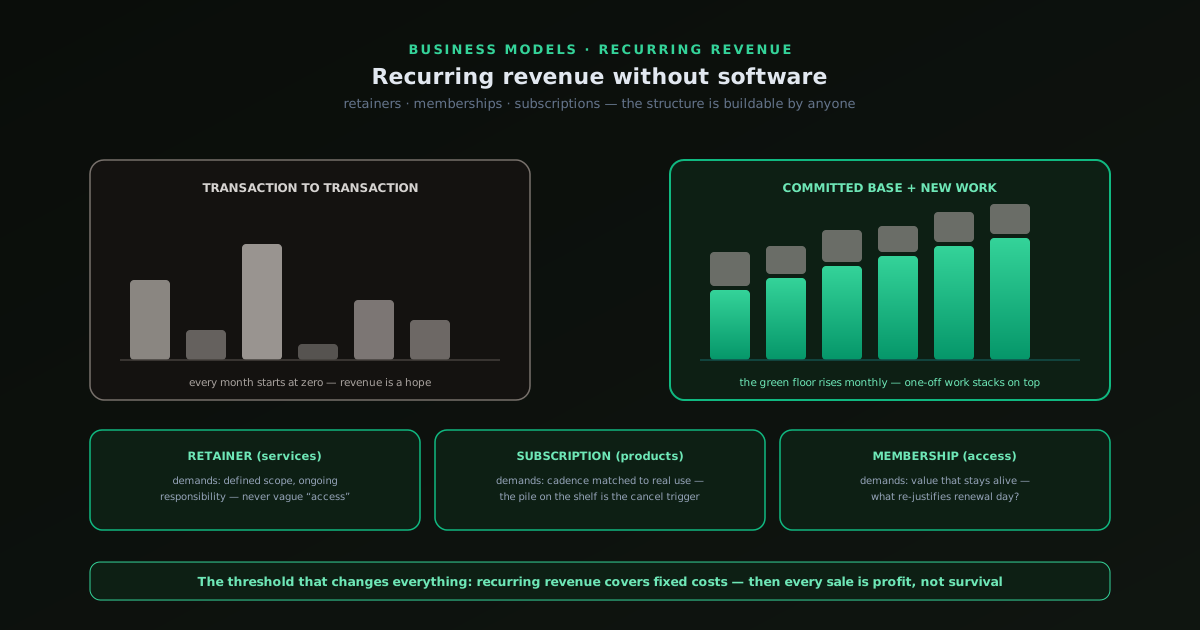
Recurring revenue is not a software privilege. Service retainers, memberships, and product subscriptions can give any business the predictability that changes everything, if the recurring promise is one you can actually keep.
Contents
- 1.Overview
- 2.What predictability is actually worth
- 3.Retainers: recurring revenue for services
- 4.Memberships and subscriptions: recurring revenue for products and communities
- 5.The retention lessons software paid for
- 6.Pricing the recurring offer
- 7.The hybrid model: recurring as the floor, one-offs on top
- 8.Converting an existing business, step by step
- 9.The floor that changes the business
Overview
The most envied number in business is not a margin or a growth rate; it is the percentage of next month's revenue that is already committed before the month begins. Software companies built an entire culture around that number, and the rest of the economy watched their valuations and concluded recurring revenue was a software thing, enabled by code that costs nothing to serve. The conclusion is wrong. Retainers predate software by a century; gyms, gardeners, accountants, and coffee roasters all run subscription models; and the underlying mechanism (converting a relationship into a standing arrangement) is available to almost any business that delivers ongoing value. What software actually contributed was the discipline: the metrics, the retention obsession, and the hard lessons about what makes recurring revenue hold versus quietly rot.
This article ports the model to everyone else: what predictability is genuinely worth, the three recurring structures available to service and product businesses, what each one demands operationally, and the failure pattern (recurring offers built on lock-in rather than ongoing value) that gives the model its bad name when it deserves one. The through-line from the rest of this series holds here too: the structures are simple; the discipline is the product.
What predictability is actually worth
Start with why the envied number deserves the envy, because the benefits run deeper than comfort. Planning transforms: a business that knows sixty percent of next quarter's revenue can hire, buy inventory, and commit to growth spending with a confidence the project-to-project business can never afford, which means recurring revenue does not just smooth income, it raises the rate at which the business can safely reinvest, the compounding lever this series opened with. Selling costs collapse on the committed base: the expensive machinery of acquisition (ads, proposals, launches) runs once per customer instead of once per transaction, and the margin difference between a re-won customer and a retained one flows straight to the bottom line.
Then the valuation effect, which the buying-and-selling articles in this series quantified: recurring revenue is the single most powerful multiple-raiser in the small-business market, because a buyer pricing committed revenue is pricing a machine while a buyer pricing pipeline is pricing a promise. A service business with most of its revenue on retainer, or a product brand with a thriving subscription base, sells at the top of its category band, and the same durability that buyers price is, in the meantime, what lets the owner sleep. The honest cost side: recurring revenue is a standing liability as well as a standing asset. Every subscriber holds a quiet option to leave, the business carries a permanent obligation to keep being worth it, and the operational demands, covered structure by structure below, are real. Predictability is purchased, not declared.
Retainers: recurring revenue for services
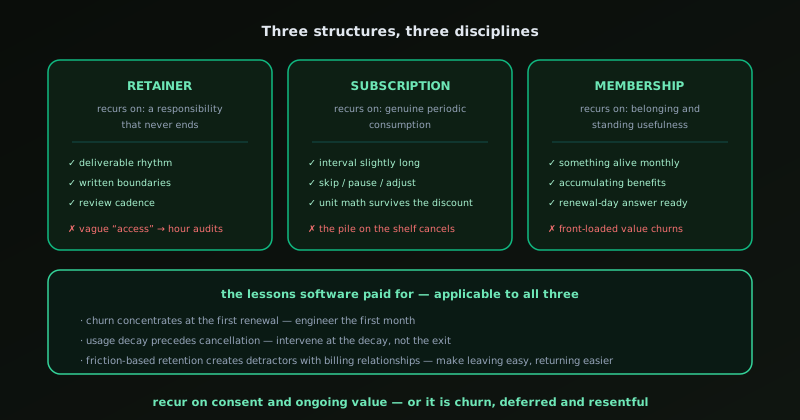
The retainer is the service business's native recurring structure: a client pays a fixed monthly amount for an ongoing scope: so much work, such-and-such availability, a defined set of responsibilities. Done well it is transformative for both sides; done vaguely it is a slow-motion dispute. The difference is the same scoping discipline the productization article demanded: a retainer needs a defined deliverable rhythm (the monthly reporting, the maintained site, the four posts), defined boundaries (what counts as in-scope, what triggers additional billing), and a defined review cadence where scope and price get revisited openly. The classic failure is the undefined "access" retainer that the client gradually reinterprets as unlimited service; eighteen months later the provider is earning less per hour than they did on projects, while the client feels nickeled at every boundary. Vagueness, as ever, resolves against the provider.
Two design choices separate retainers that hold from retainers that churn. First, recur on ongoing value, not on leftover hours: the strongest retainers attach to responsibilities that genuinely never end (maintenance, monitoring, advising, producing) where the client can see each month what the fee bought. Retainers structured as prepaid hour banks invite monthly audits of whether the hours were "used," which converts a relationship into an invoice argument; responsibility-based scopes get judged on outcomes instead. Second, anchor the price to what predictability is worth to you and discount accordingly with intention: a modest concession against project rates is rational payment for committed utilization, but the panic-discount retainer signed to smooth a slow quarter becomes the underpriced anchor every future negotiation drags against. Price it as the premium product it is (guaranteed attention is scarce) and let the occasional client decline it.
Memberships and subscriptions: recurring revenue for products and communities
Product businesses recur through two structures with different physics. The replenishment subscription (coffee monthly, socks quarterly, supplements on schedule) works where consumption is genuinely periodic, and its design centers on matching the cadence to real usage: intervals slightly too long beat intervals slightly too short, because the surplus pile on a customer's shelf is the most common cancellation trigger in the entire category. Flexibility is retention infrastructure here, not generosity: skip, pause, and interval controls keep the marginal subscriber subscribed, where a rigid schedule forces them to choose between waste and cancellation. The unit math also has to survive the model's standard incentives: subscription discounts and free shipping stack on top of the landed-cost waterfall from earlier in this series, and a subscription that only retains because it is underpriced is churn deferred, not avoided.
The membership (recurring payment for access, community, content, or standing benefits) fits businesses whose customers want belonging or ongoing usefulness rather than recurring boxes: the gym model, the trade association, the creator community, the local business's insiders club. Its design question is the renewal-day question: what does the member experience this month that re-justifies the charge? Memberships fail by front-loading (great onboarding, a static experience thereafter) because the value that recruited the member is not the value that retains them; something must be alive in the offer, whether fresh content, recurring events, ongoing access, or accumulating benefits. For both structures, the operational bill is the same: billing infrastructure that handles failed payments gracefully (involuntary churn from expired cards quietly claims a meaningful slice of subscribers if unmanaged), service capacity for the relationship the subscription implies, and the measurement discipline of the SaaS-metrics article (MRR, cohort retention, and churn reasons) which applies verbatim the moment any business starts recurring.
The retention lessons software paid for
Software's twenty years of subscription scar tissue compress into lessons any recurring business can borrow. Churn concentrates early: the first renewal is the dangerous one, which makes onboarding (the first delivery, the first month's visible value) disproportionately worth engineering. Usage decay precedes cancellation: the member who stops attending, the subscriber whose boxes pile up, the retainer client whose requests go quiet are all announcing a future churn event months in advance, and a simple "haven't seen you" intervention at the decay stage outperforms any save-offer at the cancellation stage. Exit interviews are cheap research: a one-question cancellation survey asking what changed sorts the fixable reasons (price, cadence, a service stumble) from the unfixable (moved away, business closed), and the fixable list is the retention roadmap.
The dark lesson matters most: friction-based retention destroys the asset it pretends to protect. Software's most-hated practitioners made cancellation a maze and discovered the consequences: chargebacks, regulatory attention, and a reputation that poisoned acquisition. The same physics govern a retainer with a punitive exit clause or a subscription with a buried cancel button: customers retained against their will become detractors with a billing relationship, and in the review-driven small-business world, detractors compound too. The strategic posture that wins is the inverse: make leaving easy and returning easier, let the offer's ongoing value do the retaining, and treat every cancellation as either feedback or a future re-subscription in waiting. Recurring revenue built on consent is an asset; built on friction, it is a liability wearing the asset's clothes.
Pricing the recurring offer
Recurring pricing has its own psychology, distinct from one-off pricing, and the distinctions are worth money. The anchor decision is monthly versus annual: monthly minimizes the commitment barrier and maximizes churn opportunities (twelve renewal decisions a year instead of one); annual improves cash flow, slashes involuntary churn from failed payments, and effectively prepays retention, which is why the standard offer is both, with the annual option discounted by roughly the equivalent of one to two months. The discount is not generosity; it is buying twelve months of certainty at a price below what the churn risk would have cost. The second decision is where to set the number relative to the one-off alternative, and the trap is pricing the retainer or subscription as a discount aggregation of individual purchases. Price it instead against the outcome of the standing relationship (the maintained site, the never-empty shelf, the always-current books) because the subscriber is buying the absence of a recurring problem, not a bulk rate on its recurring solution.
Two operational pricing rules complete the set. First, raise prices on new subscribers freely and on existing ones rarely and gently: grandfathering early supporters at their original rate costs little, buys disproportionate loyalty, and converts your earliest believers into the cohort least likely to ever churn; when an increase for existing members is genuinely necessary, long notice and a plain explanation of what improved keep it from reading as a squeeze. Second, resist the deep-discount acquisition trap: the three-dollar first month that fills the base with subscribers who never valued the offer at its real price and churn the moment it appears. Cohort math from the SaaS world is blunt on this: discounted-entry cohorts retain dramatically worse than full-price ones, which means the promotion buys impressive top-line numbers and a retention problem wearing them. The recurring offer's price is a filter as much as a fee, and the businesses that thrive on this model let it filter.
The hybrid model: recurring as the floor, one-offs on top
A misconception worth dismantling is that adopting recurring revenue means converting the entire business to subscriptions. The strongest small operations almost never do this; they run a hybrid, where the recurring base provides the floor and transactional sales provide the upside. A studio might keep a handful of maintenance retainers covering its fixed costs while still taking lucrative one-off projects; a product brand might run a subscription on its consumable hero item while selling everything else outright. The recurring layer is not there to capture every dollar; it is there to make the unpredictable dollars optional rather than existential. Trying to subscriptionize a business whose value is genuinely episodic, where customers buy when they need to and not on a cadence, forces an unnatural model the market quietly rejects through churn.
The hybrid structure also resolves the tension between predictability and the high-margin work that recurring scopes often exclude. Retainer clients become the warm pipeline for premium projects, because the standing relationship surfaces needs the provider is already positioned to win; subscription customers become the lowest-cost audience for one-off launches, because the billing relationship and the trust already exist. In this arrangement the recurring revenue does double duty: it stabilizes the base directly, and it lowers the acquisition cost of the transactional revenue stacked on top. The discipline is to keep the two streams legible (to know what share of next month is committed versus hoped-for) so the floor is never quietly mistaken for the whole building.
Choosing which slice of an existing business to make recurring is its own small decision, and the test is repetition of need rather than enthusiasm for the offer. The right candidate is the thing customers already come back for on a rhythm (the consumable they reorder, the maintenance they keep requesting, the access they renew by habit) because there the subscription merely formalizes existing behavior and the value is self-evident at every renewal. The wrong candidate is the showpiece the owner is proudest of but customers buy once: bolting a recurring charge onto an inherently one-time purchase manufactures churn and resentment in equal measure. Pick the boring repeated need over the exciting singular sale, and the recurring layer holds because it was discovered in the customer's habits rather than imposed on them.
Converting an existing business, step by step
For a business currently living transaction to transaction, the conversion path is incremental and starts with what already exists:
- Find the repeaters: the clients who return quarterly, the customers who rebuy on a rhythm. The recurring offer formalizes behavior they already have.
- Design one recurring offer around their pattern: a retainer scoped to what the repeat clients keep needing, a subscription matched to the real consumption interval.
- Price it as a premium with a modest commitment concession, not a desperation discount.
- Offer it personally to the best existing customers first; their objections are free product design.
- Install the machinery before scaling: billing with dunning for failed payments, easy pause and cancel, the metrics dashboard.
- Engineer the first month deliberately: onboarding is where renewal is won.
- Watch usage decay as the leading indicator, and intervene early and personally.
- Let the recurring base grow to where it covers fixed costs, the point where the business's entire risk posture changes.
The floor that changes the business
There is a specific threshold worth naming as the goal: the month when committed recurring revenue covers the business's fixed costs: rent, core payroll, the owner's baseline salary. Past that line, every project, every one-off sale, every busy season is profit rather than survival, and the psychological economy of the whole operation inverts. Pricing firms up, because no single deal is existential. Bad-fit customers get declined. The owner takes the vacation. This is the same de-risking dividend this series keeps finding in different costumes, whether the buffer, the diversified portfolio, or the second channel. Here it is built not from savings but from the structure of the revenue itself.
And the threshold is reachable at modest scale, which is the encouraging arithmetic. A service practice needs only a handful of well-scoped retainers; a product brand needs a few hundred genuine subscribers; a community business needs less than its founder fears. None of it requires software margins; it requires the discipline software learned in public: recur on real ongoing value, scope the promise you can keep, measure cohorts honestly, and never mistake friction for loyalty. Predictability is not a business model reserved for code. It is a structure, and structures are built one committed relationship at a time, by businesses that decided next month's revenue should be a plan rather than a hope.
Frequently asked questions
Quick answers to common questions about this topic.
Can a non-software business have recurring revenue?
Yes: retainers, memberships, subscription boxes, maintenance plans, and service contracts all create recurring revenue. The model is about ongoing value and billing, not about being software.
Why is recurring revenue worth pursuing?
It smooths out lumpy income, makes planning easier, and raises the sale value of the business because predictable revenue is worth more. Even a portion of revenue made recurring stabilizes the whole.
How do you keep a subscription from churning?
Deliver continuous, obvious value so canceling feels like a loss, and make the ongoing benefit visible. Recurring models hold when the customer keeps getting something, not just keeps getting billed.
Related troubleshooting
Was this page helpful?
Your answer stays in this browser, it is not sent anywhere and no account or cookie is involved.