2026 · Novus Stream SolutionsAbout 10 min readNovus Stream Solutions
Understanding SaaS metrics: MRR, churn, CAC, LTV, and how they interlock
Software businesses run on four interlocking numbers, and misreading any one of them quietly corrupts the other three. A plain-language tour of the recurring-revenue dashboard, including when small-sample metrics lie to you.
Contents
Overview
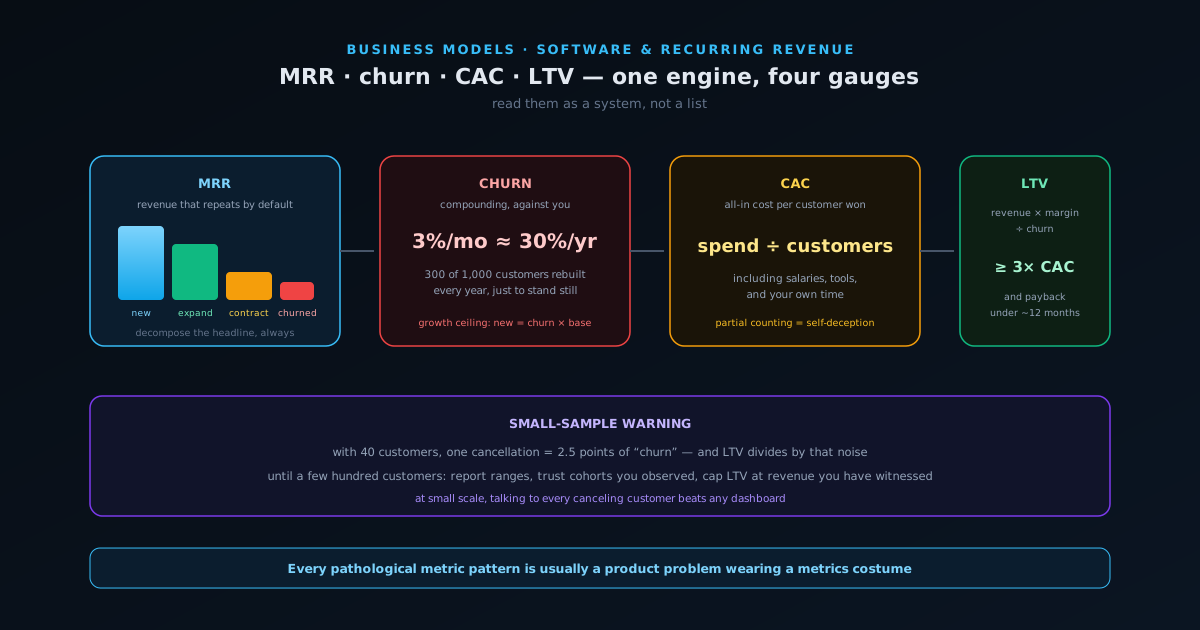
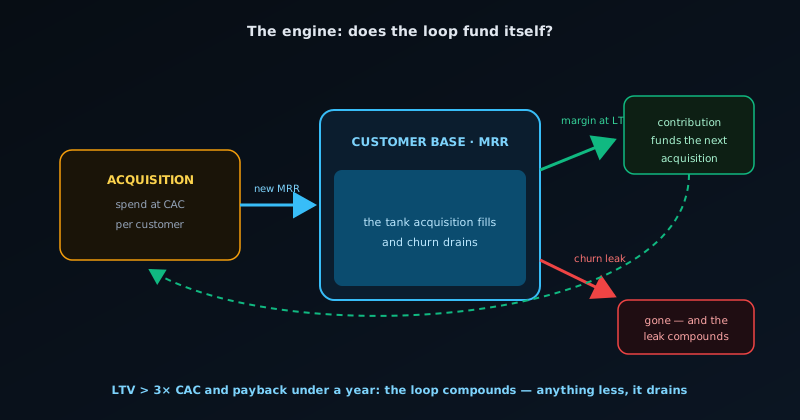
Recurring-revenue businesses get measured differently from everything else, and the difference confuses operators arriving from other models. A store asks "what did we sell this month?" A subscription business barely cares; this month's sales are a minor character next to the questions that actually determine its fate: how much revenue repeats automatically, how fast customers leak away, what a customer costs to acquire, and what one is worth over their whole relationship. Four numbers (MRR, churn, CAC, and LTV) form a closed system, an engine diagram where each gauge constrains the others, and reading them as a system rather than a list is most of what separates operators who understand their software business from operators who merely run one.
This guide is the plain-language tour: what each metric actually counts, the standard mistakes in computing each one, how they interlock into the engine equation, and (the section most guides omit) why these metrics routinely lie at small scale, when a business has forty customers and every percentage swings wildly on individual humans. No finance background assumed; the arithmetic never exceeds division.
MRR: the revenue that repeats by default
Monthly recurring revenue is the sum of what your active subscriptions bill per month, the revenue that arrives next month if nobody acts at all. The definition's power is in what it excludes: one-time setup fees, annual deals counted as lump sums, services revenue, anything that requires a new decision to recur. An annual subscription paid upfront contributes one-twelfth of its value to MRR each month, not its full amount in the month the cash landed, which is precisely the distinction between MRR and revenue: MRR measures the machine's current speed, while cash measures when money happens to arrive. Businesses that blur the two report exciting months followed by inexplicable ones, because they are reading the cash weather and calling it the climate.
The real diagnostic value appears when you decompose MRR's movement. Each month's change is the sum of four flows: new MRR from new customers, expansion MRR from existing customers upgrading, contraction MRR from downgrades, and churned MRR from cancellations. Two businesses with identical five percent growth can be in opposite conditions (one adding customers atop a stable base, the other pouring new signups into a leaking bucket) and only the decomposition tells them apart. The single most encouraging signal in the entire dashboard lives here too: when expansion from existing customers exceeds losses from churn and contraction, the business grows even with zero new sales, a condition called net negative revenue churn that makes everything downstream (fundraising, hiring, sleeping) dramatically easier.
Churn: compounding, running against you
Churn is the percentage of customers (or revenue; track both, they diverge) lost per month, and its tyranny comes from the same exponential math that makes compound interest miraculous, pointed the other way. Three percent monthly churn sounds survivable until you annualize it: losing three percent of customers every month compounds to losing roughly thirty percent of the base per year, meaning a business with a thousand customers must find three hundred new ones annually just to stand still. Five percent monthly churn (common among early products) means rebuilding nearly half the customer base every year before a single unit of growth registers. Churn is the gravity every other metric fights against, and small differences in it produce wildly different destinies at five-year horizons.
Churn also sets a hard ceiling that founders discover too late: at a given acquisition rate, a business stops growing exactly where new customers per month equals churn rate times the customer base; beyond that size, the leak outruns the faucet. This is why mature operators treat retention work as growth work, usually the highest-yield kind available. The diagnostic habit that makes churn actionable is cohort analysis: instead of one blended number, track what fraction of each month's signups survive to month two, month six, month twelve. Cohorts reveal what the blend conceals: whether churn concentrates in the first month (an onboarding or expectation problem), bleeds steadily (a value problem), or improves across newer cohorts (whatever you changed is working). A single churn percentage is a smoke alarm; cohorts are the floor plan showing where the fire is.
CAC and LTV: the engine equation
Customer acquisition cost is everything you spend to win customers (ads, content, tools, the humans doing the selling) divided by the customers won in the period. The standard self-deception is partial counting: founders divide ad spend by signups and ignore the salaries, the software, and their own time, producing a flattering number that evaporates under honest accounting. Lifetime value is the mirror metric: what a customer is worth across their whole relationship, computed in its simplest form as average revenue per customer per month, times gross margin, divided by monthly churn. The margin term matters (a customer paying thirty dollars on eighty percent margin is worth twenty-four dollars a month of actual contribution) and the churn term is where the equation interlocks: every churn improvement raises LTV mechanically, which is why retention is also an acquisition economics project.
Together they form the engine equation: LTV must exceed CAC by enough to run the business; the folk threshold of three-to-one exists because the gap has to fund overhead, product, and profit, not merely repay the marketing. But the ratio alone misses a constraint that kills profitable-on-paper companies: payback period, the months of margin needed to recoup CAC. A business spending three hundred dollars to acquire customers yielding twenty-five dollars of monthly margin has a fine ratio if they stay three years, and a twelve-month payback, meaning every burst of growth is a loan to the future and cash leaves long before it returns. Fast-growing subscription businesses can die of success precisely this way, which is why experienced operators watch payback as nervously as the ratio: under a year is comfortable for a bootstrapped product; much beyond it, growth itself becomes the cash-flow risk.
When small numbers lie
Every formula above silently assumes a sample size that early businesses do not have, and this is where metric literacy matters most for small operators. With forty customers, one cancellation is two and a half points of churn; your "churn rate" swings monthly on the private decisions of individual humans, and computing an LTV from it produces a number that is statistically fiction. Worse, the lifetime value formula divides by churn, so when churn is tiny and noisy, LTV explodes into fantasy: a couple of quiet months can imply customers worth thousands, a projection no sane person should spend against. The same trap inflates early CAC optimism: ten signups from a founder's personal network imply an acquisition cost of zero, and no scalable channel will ever match it.
The defenses are humility and medians. Until you have a few hundred customers, treat ratio metrics as wide ranges rather than numbers: report churn as "somewhere between two and six percent" and make only the decisions that survive the whole range. Prefer directly observable quantities (month-two retention of each cohort, actual revenue retained after twelve months) over derived projections like LTV, because observation cannot be fooled by a formula. Cap any LTV used for spending decisions at the revenue horizon you have actually witnessed: if the product is eight months old, no customer has yet demonstrated a ninth month, whatever the division says. The small-sample stage rewards a different posture entirely: talking to every canceling customer personally teaches more than any dashboard at that scale, and it is the only churn analysis that works on a sample of three.
Expansion: the quiet fifth metric
Hiding inside the MRR decomposition is the lever that separates good subscription businesses from great ones, and it deserves its own treatment: expansion revenue, the growth that comes from existing customers paying more. Expansion arrives through upgrades to higher tiers, usage-based pricing that grows with the customer's own success, seat additions as their team grows, and cross-sold add-ons, and its economics embarrass every other growth channel, because the acquisition cost of an existing customer is zero. A dollar of expansion MRR carries no CAC, no onboarding burden, and lower churn risk than a new customer's dollar, since the customer expanding is by definition one who finds the product worth more over time. This is why mature operators track net revenue retention (what a cohort's revenue does over a year including upgrades, downgrades, and churn) as the single most predictive number in the whole dashboard: above one hundred percent, the business grows even if marketing stops entirely.
For a small product, the practical question is whether the pricing structure gives expansion anywhere to happen. A single flat plan caps every customer at the same revenue forever, which means the product can only grow by outrunning its own churn, the hardest possible configuration. The standard fixes are gentle: a dimension of pricing that scales with customer value (projects, seats, volume), a higher tier holding the two or three features the heaviest users actually request, and an annual option that improves cash flow while quietly reducing churn through commitment. The design caution is to expand on value delivered rather than on hostage-taking: pricing dimensions that punish success (fees that spike at arbitrary thresholds, features removed from existing plans) generate expansion revenue and resentment in equal measure, and the resentment compounds into the churn line. Done honestly, expansion converts the customer base from a leaky bucket into an appreciating asset, and it is the difference between the two destinies the engine equation allows.
A dashboard that fits on an index card
For a small recurring-revenue business, the full apparatus reduces to a monthly ritual around a handful of numbers; anything more is procrastination wearing an analyst costume.
- MRR, decomposed: new, expansion, contraction, churned. The four flows, not just the headline.
- Customer count and revenue churn, tracked separately: losing three small accounts differs from losing one large one.
- Month-two and month-six cohort retention: where churn problems first announce themselves.
- Honestly loaded CAC, including your time at a real rate, per channel once channels exist.
- Payback period in months: the cash-flow truth behind the LTV story.
- One engagement leading indicator (weekly active use, feature adoption) because usage decay precedes cancellation by months.
- A monthly note of what you changed, beside the numbers: metrics without a change log are weather without a map.
Metrics are the instrument panel, not the destination
A final calibration, because metric fluency has a failure mode of its own: the dashboard describes the engine, but the engine runs on something the dashboard cannot see, which is whether the product genuinely matters to the people using it. Every pathological pattern in subscription metrics (churn that resists every retention tactic, CAC that climbs as channels saturate, expansion that never materializes) is usually a product problem wearing a metrics costume. The numbers are where the problem becomes visible, not where it lives. Operators who forget this end up optimizing cancellation-flow friction and discount ladders, mistaking the gauge for the machine, while the actual issue (the product stopped being worth its price) goes unexamined.
Used properly, though, the four-metric system is one of the great instruments of small business: it converts the fog of a young software company into a legible engine with named parts, it tells you with unusual precision which problem is the binding one this quarter, and it compounds in usefulness as the sample sizes grow into trustworthiness. Learn the vocabulary, respect the small-numbers caveats, decompose the headline figures, and let the cohorts tell you the truth the blended averages are hiding. The businesses that thrive on recurring revenue are not the ones with the prettiest dashboards; they are the ones whose operators know exactly which gauge to stare at, and why, in every season the engine passes through.
A closing note on cadence and tooling, because both attract over-engineering. The numbers above change meaningfully on a monthly rhythm; daily metric-watching at small scale is noise consumption dressed as diligence, and it produces exactly the reactive product decisions that cohort thinking exists to prevent. A monthly hour, the same hour the bookkeeping close happens, covers the entire dashboard; a quarterly deeper pass re-examines the cohort curves and the channel-level CAC. As for tools, the billing platform's own reporting plus a spreadsheet outperforms a paid analytics stack until well past a hundred customers, because the constraint at small scale was never computation; it was the honesty of the inputs and the discipline of the schedule. Spend the tooling budget on the product instead; the metrics will be there, twelve rows a year, telling the same patient story either way.
Frequently asked questions
Quick answers to common questions about this topic.
What are the core SaaS metrics?
MRR (monthly recurring revenue) is predictable monthly income; churn is the rate customers leave; CAC is what it costs to acquire a customer; and LTV is the total value a customer brings before they churn. Together they describe a subscription business's health.
What is a good LTV-to-CAC ratio?
A common rule of thumb is roughly 3:1; a customer should be worth about three times what it cost to acquire them. Below that, growth is expensive; far above it, you may be underinvesting in acquisition.
Why does churn matter so much?
Because it compounds against you: high churn caps how large MRR can grow no matter how many customers you add, and it shortens LTV. Reducing churn often moves the business more than adding new customers.
Related troubleshooting
Was this page helpful?
Your answer stays in this browser, it is not sent anywhere and no account or cookie is involved.