2026 · Novus Stream SolutionsAbout 11 min readNovus Stream Solutions
The true cost of a physical product: landed cost and the unit economics of inventory
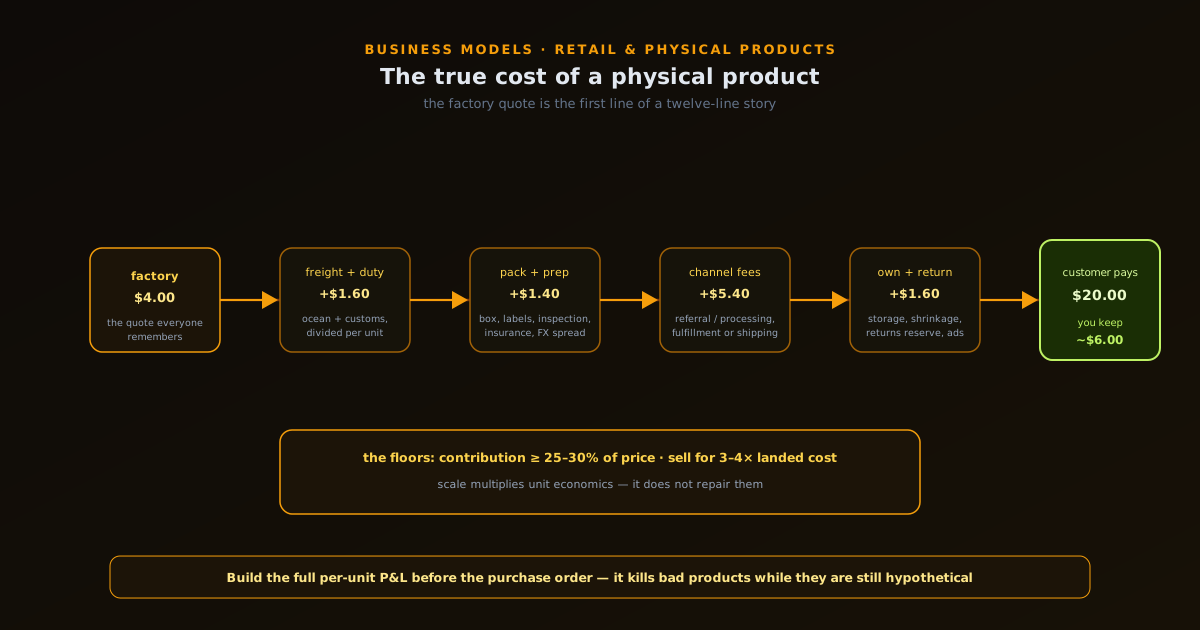
The factory quote is maybe half of what a physical product actually costs you by the time it reaches a customer. Landed cost is the discipline of counting the rest, before you order a thousand units of something unprofitable.
Contents
- 1.Overview
- 2.Landed cost: everything it takes to get the unit to sellable
- 3.Selling costs: the slice the channel takes
- 4.The costs of owning inventory at all
- 5.Assembling the per-unit P&L
- 6.Margin floors: the go/no-go rules
- 7.Negotiating the stack downward
- 8.Keep the model alive after launch
- 9.Respect for the four-dollar quote
Overview
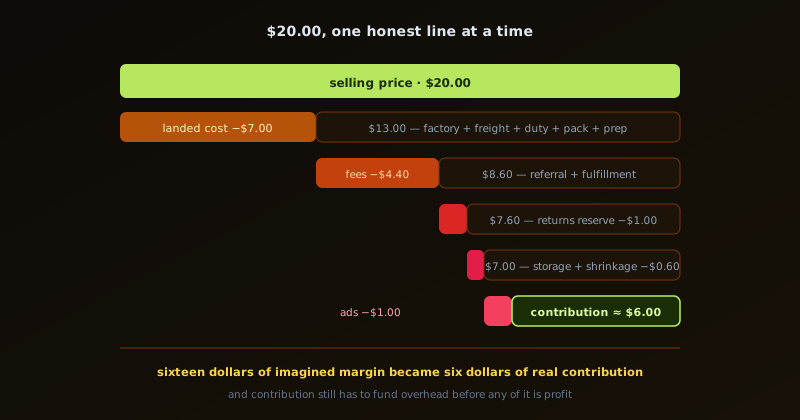
The most expensive spreadsheet error in small commerce is also the most common one: a founder finds a product that costs four dollars from the factory, sees it selling for twenty, and mentally pockets sixteen dollars of margin. Then reality invoices them, one line at a time. Freight to get the goods across an ocean. Duties at the border. Boxes and labels. The marketplace's cut. Payment processing. Storage by the month. The customers who send it back. The capital locked in stock that took ninety days to arrive and will take six months to sell. By the time every real cost is counted, the sixteen dollars is six, and for an uncomfortable number of products, it is zero or less, discovered only after a thousand units are paid for.
The discipline that prevents this is called landed cost, and the broader habit around it (building a complete per-unit profit-and-loss before committing money) is the single highest-value hour of work in any physical products business. None of it requires accounting training. It requires a list of cost categories that founders systematically forget, and the stubbornness to put a real number beside every one of them before the purchase order is signed. This article is that list.
Landed cost: everything it takes to get the unit to sellable
Landed cost answers a precise question: what does one unit cost you, in total, sitting in sellable condition at the place it will sell from? It starts with the factory unit price, but that number is just the down payment. Add inbound freight, and note that freight is quoted by volume and weight for the shipment, so it must be divided across the units it carries: a thousand dollars of ocean freight on five hundred units is two dollars per unit, on its way to becoming somebody's forgotten margin. Add customs duties and import taxes, which vary by product category and country of origin, and which you should look up before choosing a product, because category alone can swing the rate from zero to north of twenty percent.
Then the costs that hide in plain sight. Packaging (the retail box, the polybag, the insert, the shipping carton) often adds meaningful cents or dollars that the factory quote excluded. Prep and compliance: barcodes, labeling, any testing or certification your category requires. Inspection fees if you are wise enough to pay for quality control at the factory, which you should be, because a defect rate discovered after arrival converts directly into refunds and dead stock. Freight insurance. Currency conversion spread, if you paid in another currency. Each line is small; the habit of dismissing small lines is how four dollars of factory cost quietly becomes seven dollars landed, a seventy-five percent increase that many founders never compute, on the foundation number every later calculation depends on.
Selling costs: the slice the channel takes
The unit's journey from shelf to customer carries its own cost stack, and it varies dramatically by channel. Marketplace referral fees take a defined percentage of the sale price, commonly in the eight-to-fifteen percent range depending on category. If the marketplace also fulfills the order, fulfillment fees apply per unit, scaled to size and weight, which is why dimensions are a product-selection criterion and not a logistics afterthought: a product that crosses a size tier boundary can lose a dollar of margin to a centimeter. Selling from your own site swaps those fees for payment processing (typically around three percent plus a fixed per-transaction amount) plus the platform subscription, plus the outbound shipping you now arrange yourself or bake into the price.
Returns deserve their own line because they are a percentage, not an event. Every category has a return rate (low single digits for many goods, far higher for apparel and fit-dependent products) and each return costs you the outbound shipping you already paid, often return shipping too, processing labor, and frequently the unit itself, since returned goods may not be resellable as new. The honest way to account for this is to multiply expected return rate by total cost per return and charge that expectation against every unit sold: if eight percent of units come back at a twelve-dollar all-in cost per return, every sale (including the perfect ones) carries roughly a dollar of return expense. Founders who skip this line are not avoiding the cost; they are just letting it surprise them quarterly instead of pricing it monthly.
The costs of owning inventory at all
A third cost family attaches not to the sale but to the owning, and it is the family spreadsheets most reliably omit. Storage is the visible one: warehouses and fulfillment centers bill monthly by volume, with rates that often spike in the fourth quarter, and slow-moving stock can quietly accumulate storage charges that rival its production cost. Shrinkage (units lost, damaged, or miscounted across the journey) runs a percent or two for most operations and should be budgeted rather than mourned. Obsolescence is the brutal one for anything seasonal, dated, or trend-driven: the winter line unsold by February, the packaging made obsolete by a rebrand, the gadget superseded by its own version two. Some fraction of most inventory buys will eventually sell below cost or not at all, and a mature unit P&L carries a small reserve for that fate.
Then there is the cost of the money itself. Inventory is capital converted into boxes: if you put twenty thousand dollars into stock that sells through over six months, that money was unavailable for everything else the entire time: ads, a better supplier deal, or simply earning a return elsewhere. If the money was borrowed, the cost is the interest, explicitly. If it was your own cash, the cost is the opportunity it could not fund, and the risk, since the capital is now hostage to sell-through. This is why inventory turnover obsesses experienced retailers: the same margin earned twice a year versus six times a year is a threefold difference in what the business actually returns on its capital. A fat margin on stock that barely moves can be a worse business than a thin margin on stock that flies.
Assembling the per-unit P&L
With the categories named, the assembly is one evening of honest arithmetic. Build it per unit, at the realistic selling price (not the aspirational one) and let every line be slightly pessimistic, because every error you have made so far in this process has been optimistic.
- Selling price: what comparable products actually transact at, not your hoped-for premium.
- Landed cost: factory unit price + allocated freight + duties + packaging + prep + inspection, per unit.
- Channel fees: referral or processing percentage of price, plus per-unit fulfillment or outbound shipping.
- Returns reserve: expected return rate × all-in cost per return.
- Storage and shrinkage: monthly storage × expected months held, plus one to two percent of landed cost.
- Marketing cost per unit: total expected ad spend ÷ units sold; zero is not a real number for a new product.
- Contribution margin: price minus all of the above, the number that must fund overhead and still leave profit.
Margin floors: the go/no-go rules
The point of the per-unit P&L is a decision, so it helps to have decision rules waiting. Experienced operators converge on rough floors: contribution margin (what survives after every per-unit cost including marketing) should generally clear twenty-five to thirty percent of the selling price for a product sold through paid acquisition, because overhead, mistakes, and the cost of growth still have to live inside that slice. A product clearing ten percent contribution is not a lean opportunity; it is a machine for converting your capital into other companies' fees, with you doing the labor. The classic sanity check (sell it for three to four times landed cost) exists because that multiple is roughly what survives the full waterfall at typical fee structures.
The floors also clarify what to do when a candidate product fails them, because failure has remedies before abandonment. Raise the price, if differentiation can support it; pricing is the most powerful lever in the entire stack, since every added dollar flows straight to contribution. Cut landed cost: negotiate at volume, re-quote freight, redesign packaging to shrink the dimensional footprint, or move a size tier. Change the channel mix if marketplace fees are the dominant slice. Bundle units so fixed per-order costs amortize across more revenue. What the floors forbid is the most common move: proceeding anyway on the theory that scale will fix it. Scale multiplies unit economics; it does not repair them. A product losing a dollar a unit at small volume loses thousands a month at the volume you are dreaming of.
Negotiating the stack downward
A per-unit P&L that fails the floors is not always a death sentence, because most lines in the stack are softer than they first appear; they just require asking. Factory unit prices move meaningfully with volume commitments, and they also move with simplification: fewer colorways, standard materials, and tolerances no tighter than the product genuinely needs all show up as quote reductions. Freight responds to consolidation and patience: combining purchase orders into fuller containers, accepting slower sailings outside peak season, and re-quoting across forwarders annually rather than renewing by default. Duties respond to homework: product classification has genuine gray zones, and the same item can carry different rates depending on materials and declared category, which is exactly the kind of question a customs broker answers for a small fee that repays itself on the first shipment.
The most underrated lever in the whole stack is packaging redesign, because it attacks three lines at once. Smaller, lighter packaging cuts inbound freight (billed by volume), cuts fulfillment fees (set by size tier), and cuts storage (billed by cubic foot), and a centimeter saved at the design stage repeats its savings on every unit forever. Payment terms are the quiet fifth lever: moving a supplier from full prepayment to a deposit-and-balance structure does not change the unit cost, but it halves the capital locked in each order, which raises the return on the same margin. None of these negotiations are available to the founder who treats the first quote as physics. All of them are available to the one who treats the per-unit P&L as a list of conversations to have, which is the posture that separates operators who survive thin-margin retail from tourists who visit it.
Keep the model alive after launch
The pre-purchase model is a forecast; the post-launch version is a feedback instrument, and the businesses that thrive on thin retail margins are the ones that keep it current. Costs drift constantly and almost always upward: freight rates move with seasons and geopolitics, marketplaces revise fee schedules annually, storage spikes in the fourth quarter, suppliers re-quote at renewal, return rates reveal their true level only after a few hundred real orders. A quarterly hour spent re-running the per-unit P&L with actual observed numbers (real ad spend per unit, real return rate, real months-in-storage) catches the product whose margin quietly eroded from healthy to hollow while revenue looked fine.
Per-product granularity is the other half of the habit. Portfolio averages are where dying products hide: the catalog can show a comfortable blended margin while one SKU subsidizes two others that lost their economics a year ago. Ranking products by current contribution margin, not revenue, reorders your attention in ways that regularly surprise owners: the modest steady seller with fat contribution out-earns the flagship with the impressive top line and the invisible cost stack. The discipline closes the loop this article opened with: the founder who once nearly ordered a thousand unprofitable units now runs a catalog where every product re-justifies its unit economics four times a year, and the spreadsheet error that starts most commerce failures has nowhere left to hide.
Respect for the four-dollar quote
None of this is an argument against physical products; it is an argument for entering the model with eyes open, because physical commerce punishes optimism faster than any other business type. The same structure that makes retail margins thin makes them honest: every cost in the stack is knowable in advance, most are negotiable with effort, and a product that clears the floors with real numbers is a genuinely durable asset, defensible in ways that pure digital offerings often are not. The operators who last in this model are not the ones who found magic products; they are the ones who count everything, decide by contribution margin, and re-count quarterly without being asked, the discipline behind a boring, durable product like a well-run line of everyday socks.
So treat the factory quote with the respect it deserves: as the first line of a twelve-line story, not the story itself. The evening you spend building the full per-unit P&L is the cheapest insurance available in commerce: it costs nothing, it kills bad products while they are still hypothetical, and it occasionally does something even more valuable, which is to reveal that a boring-looking product with an unimpressive price clears every floor with room to spare. Those are the ones the spreadsheet was built to find.
Frequently asked questions
Quick answers to common questions about this topic.
What is landed cost?
Landed cost is the full cost to get a product to your door ready to sell: the unit price plus shipping, duties, and import fees. It is almost always higher than the factory price, which is why it is the number that matters.
Why is my real margin lower than my gross margin?
Because gross margin ignores marketplace fees, payment processing, returns, storage, and ad spend. Subtract those from the price and the "healthy" margin often shrinks dramatically; that fully-loaded figure is the true unit economics.
How do I calculate the true cost of a product?
Add landed cost plus every per-unit cost to sell it (fees, processing, returns allowance, fulfillment, and a share of ad spend), then compare that to your price. That fully-loaded per-unit figure is the true unit economics.
Related troubleshooting
Was this page helpful?
Your answer stays in this browser, it is not sent anywhere and no account or cookie is involved.