2026 · Novus Stream SolutionsAbout 10 min readNovus Stream Solutions
Wholesale vs direct-to-consumer: margin, volume, and who owns the customer
A product business eventually faces the fork: sell to stores at half price, or sell to customers at full price and do everything yourself. The right answer is usually a sequence, not a side.
Contents
Overview
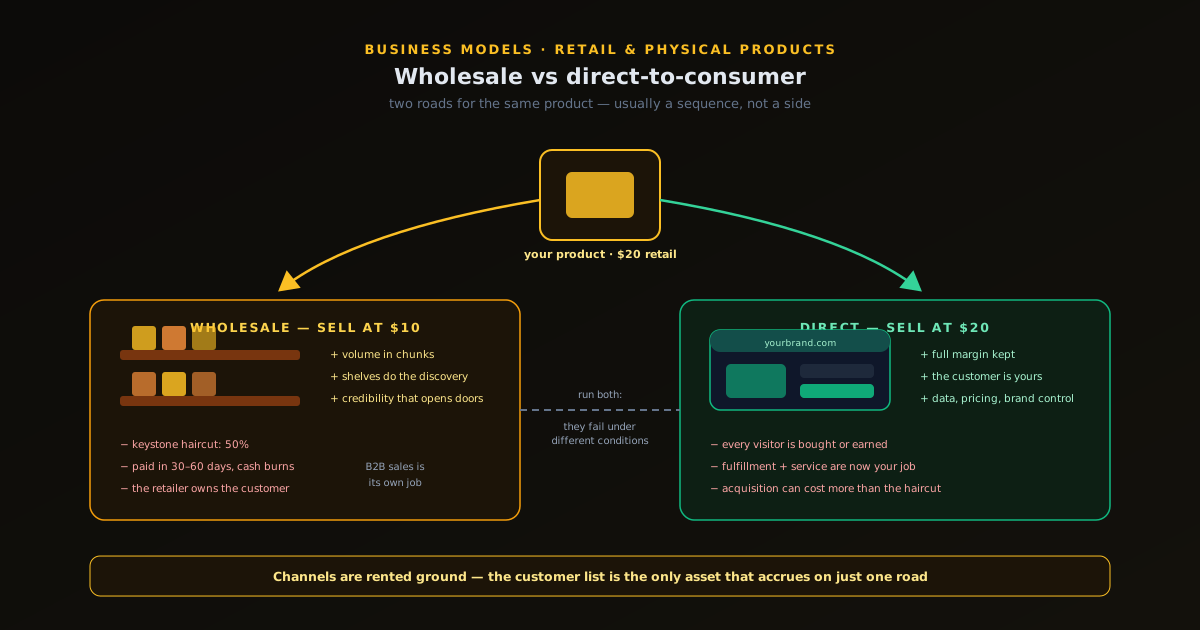
Every physical product brand that survives its first year arrives at the same fork. Down one road, wholesale: selling cases of product to retailers at roughly half the retail price, in exchange for their shelves, their foot traffic, and their checkout lines. Down the other, direct-to-consumer: keeping the full retail price by becoming the retailer yourself: running the store, buying the traffic, packing the boxes, answering the emails. Founders tend to arrive at the fork with a prejudice, usually formed by whichever success stories they read first, and the prejudice is expensive in both directions, because the roads are not rivals so much as different machines that convert the same product into different kinds of business.
This article walks both roads with the unit-economics discipline this series has been building: what wholesale's haircut actually purchases, what DTC's headline margin actually costs once the work is priced in, and the strategic question, who owns the customer, that outweighs the margin math more often than not. The destination is not a verdict but a sequencing logic, because the small brands that endure mostly run both channels eventually, in a deliberate order.
Wholesale: what the fifty percent buys
The wholesale arithmetic shocks first-time founders: the standard keystone convention means retailers buy at roughly half the retail price, so the twenty-dollar product ships out the door at ten, and from that ten you still fund the landed cost, your overhead, and your profit. Calculated against the unit P&L from earlier in this series, a product needs genuinely strong economics to survive the haircut; many products that work at DTC prices simply do not work at wholesale, and discovering that before the first trade show is a spreadsheet exercise, not a tragedy. The haircut, though, purchases real things. It buys volume in chunks: one purchase order can equal a month of DTC orders, with one invoice, one shipment, one customer-service relationship. It buys distribution and discovery: your product physically in front of shoppers who would never have found your website. And it buys validation that compounds: shelf presence in respected stores is social proof that opens other doors, including bigger retailers and better terms.
The costs beyond the margin are operational and worth naming plainly. Payment terms (invoices settled in thirty to sixty days) mean wholesale growth consumes cash exactly the way the inventory article warned, and a slow-paying retailer is an interest-free loan you did not agree to make. Concentration risk arrives wearing a friendly face: the flagship account that becomes forty percent of revenue is a single decision-maker away from being a crisis, and retail buyers change jobs, strategies, and shelf plans constantly. And the relationship work is its own job: line sheets, trade terms, reorder management, supporting sell-through so your product does not die quietly on a shelf it fought to reach. Wholesale is not passive distribution; it is B2B sales as a discipline, with the retailer as a customer who must be re-won every season.
DTC: what the full margin costs
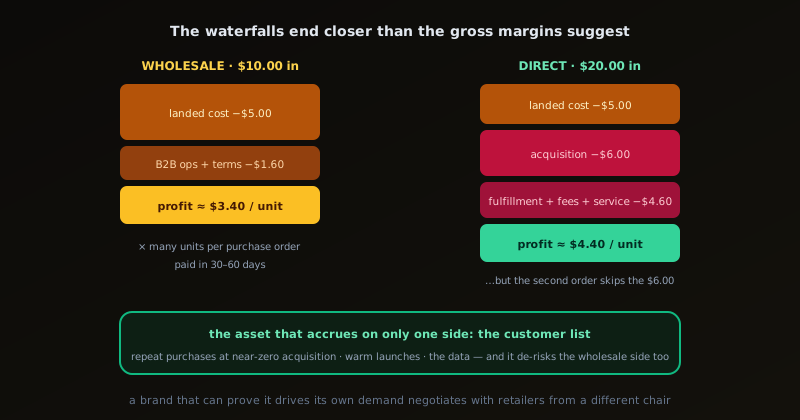
Direct-to-consumer's pitch is the mirror image: keep the whole twenty dollars, own the customer, control the brand. The arithmetic correction is that the retained margin is not profit; it is budget for performing retail's job yourself. The retailer's half paid for discovery, conversion, fulfillment, and service; in DTC, those costs return as line items. Customer acquisition is the heavyweight: paid traffic costs real money per click against conversion rates in the low single digits, and acquisition costs that exceed first-order profit are normal in competitive niches, survivable only where repeat purchase or basket size eventually repays them. Fulfillment returns as picking, packing, postage, and packaging per order. Service returns as the email inbox. The platform, payment processing, and the content treadmill of running a storefront fill in the rest. A brand netting twenty percent on DTC revenue after honest accounting is doing well, which is to say the two roads end closer together than their gross margins suggest.
What DTC genuinely delivers, and wholesale structurally cannot, is the customer relationship itself: the email address, the order history, the ability to launch a product to an audience you can actually reach. That asset changes the economics of everything downstream: repeat purchases arrive at near-zero acquisition cost, new products launch warm, and feedback flows directly instead of being filtered through a retail buyer's guesses. DTC also keeps pricing power and brand presentation in your hands, and it generates the data (which products convert, which messages work, what customers actually say) that wholesale brands operate without. The honest summary: DTC trades margin-for-labor at roughly the same exchange rate as wholesale trades margin-for-volume, but DTC's byproduct is an owned audience, and the owned audience is the only asset in either channel that compounds.
The question that breaks the tie: who owns the customer
When the margin math lands close, and it usually does, the deciding question is the one this series keeps reaching: who owns the customer relationship, and what is that ownership worth to your specific business? For some products, the answer genuinely favors wholesale. Impulse goods, gift items, and products bought on occasion rather than by brand loyalty monetize discovery better than relationships; the shopper who grabs your product at a boutique checkout was never going to join your email list, and the retailer's foot traffic is doing work no ad budget could replicate at the price. For replenishable, identity-adjacent, or community-prone products (consumables, apparel, hobby goods) the relationship is the business, and surrendering it to intermediaries caps the brand's ceiling permanently.
The ownership question also governs risk posture, in the language of the concentration articles earlier in this series. A pure-wholesale brand holds a portfolio of retailer relationships, each a concentration; a pure-DTC brand holds a portfolio of traffic channels, each rented from an algorithm. Neither is safe; they are differently fragile, which is the actual argument for running both: the channels fail under different conditions. Retail orders sag in downturns while DTC holds; ad costs spike while shelf velocity cruises. The blended brand has the counterweight structure this series recommends for balance sheets, applied to revenue, and the email list built through DTC even de-risks the wholesale side, because a brand that can prove it drives its own demand negotiates with retailers from a fundamentally different chair.
The sequencing playbook
For most small brands, the practical answer is a sequence that uses each channel for what it does best at each stage. Start DTC, not for the margin but for the learning: direct sales generate the conversion data, customer language, and repeat-rate evidence that tell you whether the product works at all, at a scale where mistakes are cheap and iteration is weekly. Marketplaces, covered in their own article, can supplement discovery in this phase. The DTC stage also builds the assets wholesale will later want to see: reviews, social proof, a brand that visibly moves product. Approaching retail buyers with proof of sell-through is a different conversation than approaching them with a prototype and a hope.
Add wholesale when the unit economics clear the keystone haircut and the operational base can survive purchase-order cash cycles: selectively at first, with independent boutiques whose buyers take chances and whose shelves confer credibility, then upward as references accumulate. Protect the channel relationship structurally: keep DTC pricing at true retail so wholesale partners are never undercut, reserve some products or variants for direct customers, and route the wholesale-discovered shopper toward the owned list with package inserts and registration hooks. The mature shape (a stable wholesale base providing volume and discovery, a DTC channel providing margin, relationships, and data, each hedging the other's failure modes) is not a compromise between the two roads. It is the destination the fork was always hiding.
Landing the first ten retail accounts
For brands whose worksheet points toward wholesale, the practical question is how the first accounts actually happen, and the answer is more door-to-door than founders expect. Independent boutiques and specialty stores are the entry tier, and their buyers are usually the owners themselves, reachable by a walk-in with samples, a concise email with a line sheet, or a direct message that respects their time. The artifact that does the selling is the line sheet: a clean one-pager with product photos (the imagery pipeline from this series' photography article earns its keep here), wholesale and suggested-retail prices, minimum order, and terms. The asks that work are small: a low minimum first order, net-thirty terms only after a first prepaid order, and a reorder conversation scheduled rather than hoped for. A founder who pitches ten local stores will typically land one to three, a hit rate that sounds discouraging until you notice it means ten conversations produce a wholesale channel.
Trade shows and online wholesale marketplaces are the scaling tier, each with the same caution: they amplify whatever your small-account experience taught you, including the mistakes. The preparation that separates brands that convert at shows from brands that collect business cards is unglamorous: sell-through data from existing accounts ("this turns four times a year at full price at these five stores" is the sentence every buyer wants), retail-ready packaging, and the operational proof that you can fill a purchase order on time. Which surfaces the real sequencing rule for the channel: wholesale readiness is mostly DTC homework. The reviews, the sell-through evidence, the refined packaging, and the production reliability all come from months of selling direct, one more reason the two roads in this article are stages of one journey rather than rival destinations.
The decision worksheet
Standing at the fork with a specific product, the choice reduces to checkable questions:
- Does the unit P&L survive a fifty percent wholesale price? If not, wholesale is closed until costs or price change.
- Is the product replenishable or relationship-prone? The more yes, the more the customer list matters, so weight DTC.
- Is it discovery-dependent or impulse-bought? The more yes, the more shelves matter, so weight wholesale.
- Can the business fund inventory ahead of thirty-to-sixty-day receivables? Wholesale growth eats cash on that schedule.
- Can the business sustain content, ads, and service indefinitely? DTC margin is a wage for that labor.
- What does the channel teach? Early on, DTC's data is worth more than wholesale's volume.
- Whichever road: is every customer touchpoint routing people toward the list you own?
Channels are rented; the brand is owned
The unifying frame, consistent with everything this series argues about platforms and audiences: every sales channel is rented ground. The retailer can discontinue you, the marketplace can suspend you, the ad platform can triple its prices: each channel is a landlord with its own moods, and the brand that lives entirely on one lease has handed its survival to a counterparty. What the brand actually owns is small and decisive: the product and its supply chain, the trademark and reputation, the customer list, and the operating knowledge of what sells to whom at what price. Channel strategy, seen from this altitude, is the art of using rented ground to grow owned assets, and both wholesale and DTC are judged by the same standard: not just what they pay per unit, but what they leave behind that nobody can take.
Which returns the fork to its proper size. Wholesale versus DTC is not an identity decision, despite the conference-stage rhetoric on both sides; it is a routing decision, revisitable every season, for moving one product's units through the world while the durable assets accumulate. Run the worksheet per product, sequence the channels by stage, keep the unit math honest in both directions, and route every shopper you can toward the relationship you own. The brands that get this right do not win the wholesale-versus-DTC debate. They quietly stop having it.
A final word on the cash mechanics, because wholesale's thirty-to-sixty-day terms are where good brands with good products still die. The gap between paying for inventory and being paid by retailers is a financing problem with named solutions: deposits negotiated on larger purchase orders, early-payment discounts offered to retailers who settle fast, invoice factoring for brands whose receivables outgrow their patience, and purchase-order financing for the order that is too big to fund and too good to decline. Each tool costs margin (factoring and PO financing meaningfully so) and each is cheaper than the alternative it prevents, which is declining growth or missing your own supplier payments to fund someone else's shelf. The discipline is to model the cash cycle before signing the big account, not after: a purchase order that doubles your volume also doubles the capital trapped in the gap, and the celebration-worthy account that bankrupts its vendors is a retail-industry cliché for a reason. Growth in wholesale is bought with liquidity; budget for it like the input it is.
Frequently asked questions
Quick answers to common questions about this topic.
What is the difference between wholesale and direct-to-consumer?
Wholesale sells in bulk to retailers who resell to shoppers, at lower margin per unit but higher volume and less marketing. DTC sells straight to the customer at full margin but requires you to handle demand, support, and acquisition.
Which is more profitable, wholesale or DTC?
DTC keeps more margin per sale; wholesale moves more units with less marketing cost. The better choice depends on whether your edge is the product (favoring wholesale reach) or the customer relationship (favoring DTC).
Can a brand do both?
Yes, and many do: DTC for margin and brand control, wholesale for volume and reach. The main risk is channel conflict on price, which is worth planning around deliberately.
Related troubleshooting
Was this page helpful?
Your answer stays in this browser, it is not sent anywhere and no account or cookie is involved.