2026 · Novus Stream SolutionsAbout 12 min readNovus Stream Solutions
Marketplaces vs your own store: fees, traffic, and platform risk
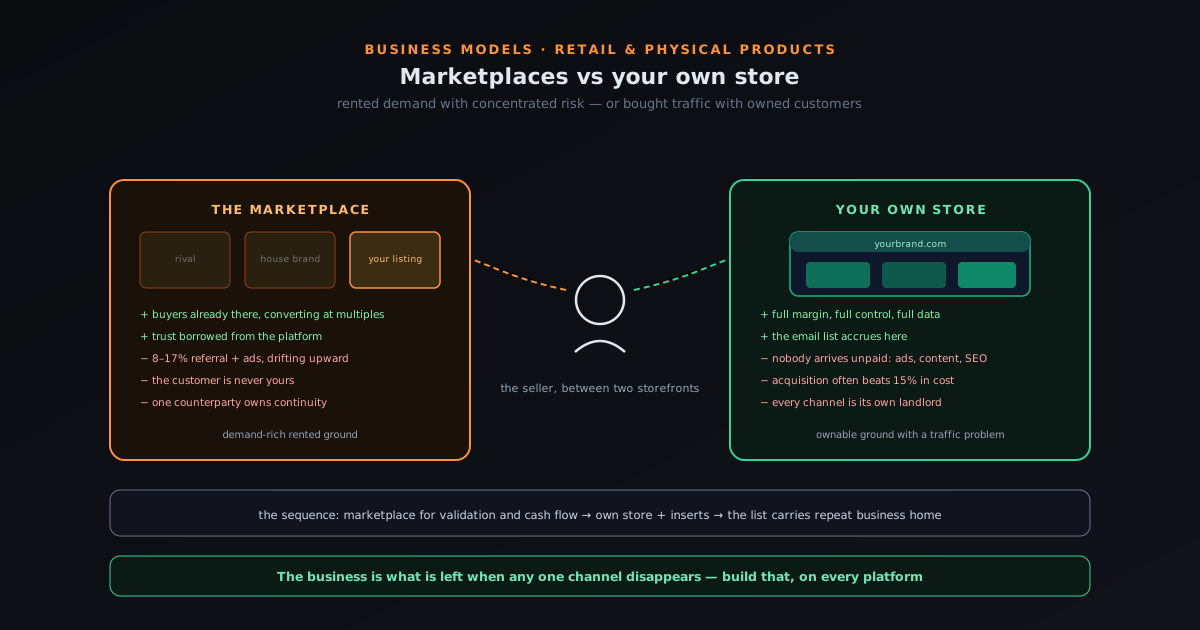
Sell where the buyers already are and pay the platform's rent, or build your own store and pay for every visitor yourself. The fee math is the surface; the ownership math is the decision.
Contents
- 1.Overview
- 2.What marketplace fees actually buy
- 3.What an own store actually costs
- 4.Platform risk: the line item sellers refuse to price
- 5.The sequencing playbook: both, in order
- 6.The second marketplace: diversification inside the rented tier
- 7.Operating two channels without doubling the work
- 8.The decision worksheet
- 9.Rent strategically; own deliberately
Overview
Ask a room of small sellers where to sell and the answers split into two confident camps. The marketplace camp points at the traffic: the buyers are already there, searching with payment details saved, and a new listing can make its first sale within days. Why would anyone start from zero? The own-store camp points at the invoice: fifteen percent of every sale, forever, to a platform that owns your customer, copies your winners, and can suspend you by email. Why would anyone build on that? Both camps are right about the other's weakness and wrong about their own, which is the usual signature of a question that has been framed as a war when it is actually a portfolio decision.
This article prices both channels honestly (the marketplace's rent and what it buys, the own-store's freedom and what it costs) then makes the case the camps both resist: for most small product businesses, the durable answer is a deliberate sequence of both, with each channel assigned the job it is structurally good at, and the customer list quietly accumulating as the only asset neither platform can repossess.
What marketplace fees actually buy
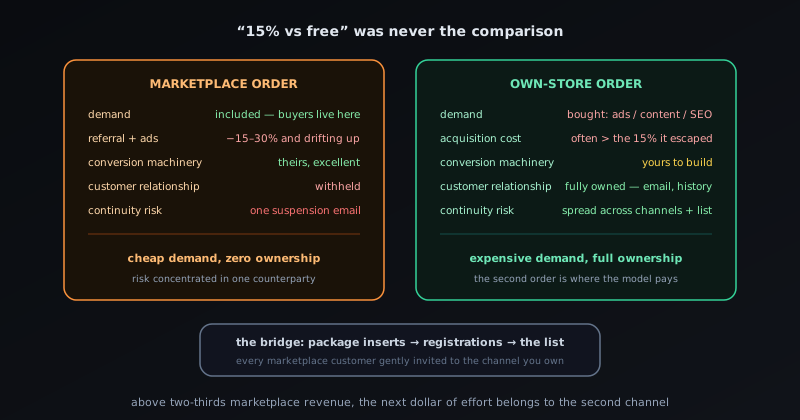
The marketplace's offer, stated plainly: in exchange for a referral fee (typically eight to seventeen percent depending on category, plus fulfillment and subscription costs where applicable) the platform rents you the most valuable real estate in commerce: position inside a search engine where buyers arrive with intent and leave with purchases. The conversion machinery alone justifies a large share of the rent. Marketplace buyers convert at multiples of independent-store rates, because the platform has spent decades removing every friction your own checkout still has: saved payment, trusted returns, familiar interface, delivery promises backed by infrastructure. And the trust transfer covered in this series' FBA case study does its work: the buyer who would hesitate at an unknown store's checkout buys from the unknown brand on the marketplace without blinking, because the platform is the counterparty they trust.
The costs beyond the visible fees are structural, and they compound with success. The customer is not yours: the platform controls the relationship, restricts off-platform contact, and in most categories will not even show you who bought. The competition is adjacent by design: rivals sit one click away in the same search results, price competition is the platform's explicit mechanism, and your successful listing is market research for every competitor, including, in some categories, the platform's own brands. And the dependence deepens silently: advertising on the platform becomes progressively less optional as organic placement tightens, so the effective take rate drifts upward over time. None of this makes marketplaces a bad deal. It makes them a specific deal: high-conversion demand, rented, at a rate that rises with your success, terminable by the landlord.
What an own store actually costs
The independent store's pitch (keep the whole price, own the customer, control everything) is true and persistently misquoted, because the platform fee it eliminates gets replaced by a larger line: customer acquisition. A store on modern e-commerce platforms costs little to stand up; what costs is that nobody arrives. Every visitor must be earned through ads (paid per click against low single-digit conversion rates, frequently summing to acquisition costs that exceed marketplace fees per order), through content and search (the compounding-but-slow library strategy this series has covered), through social presence (a content treadmill with its own labor price), or through an email list (the one cheap channel, which must itself first be built by the expensive ones). The honest comparison is never "fifteen percent versus zero." It is fifteen percent versus whatever your true blended acquisition cost turns out to be, and for young stores the latter is routinely higher.
What the store buys for that price is everything the marketplace withholds. The customer relationship arrives whole: the email, the history, the ability to market again at near-zero cost, which is why repeat-purchase businesses value own-store economics so differently from one-off sellers; the second order is where the model pays. Brand control arrives too: presentation, pricing, bundling, and storytelling unconstrained by a platform's template, plus margin structure free of category fee schedules. And the strategic data is yours (what converts, what language works, who buys what) feeding every decision from product development to the wholesale negotiations covered elsewhere in this series. The store is expensive demand with full ownership; the marketplace is cheap demand with none. Stated that way, the "war" dissolves into an allocation question.
Platform risk: the line item sellers refuse to price
Between the two cost columns sits the risk column, and it deserves more than the paragraph sellers usually give it. Marketplace dependence is single-counterparty risk in its purest commercial form: accounts get suspended (sometimes for cause, sometimes algorithmically and mistakenly) and the appeal process happens on the platform's timeline while revenue sits at zero. Policies shift annually: fee increases, category restrictions, listing requirement changes, each arriving by announcement and applying regardless of your planning. The concentration math from this series applies directly: a business with ninety percent marketplace revenue is a business whose continuity is a setting in someone else's admin panel, and a buyer valuing that business will discount it for exactly that reason, as the valuation article details.
The own store carries its own platform risks, usually underestimated by the independence camp: the ad platform whose cost-per-click doubles, the search algorithm whose update reroutes your traffic, the social channel whose reach evaporates. Every acquisition channel is itself a platform with a landlord. The difference is structural rather than moral: own-store risk diversifies across several rentable channels and is buffered by the owned list, while marketplace risk concentrates in one counterparty who also controls fulfillment of existing orders and held funds. Pricing this properly changes decisions: the marketplace's superior short-term economics buy, in part, a fatter tail risk, and the rational response is not abstinence but the same hedge this series prescribes everywhere: a second channel, built before the first one fails, funded by the first one's profits.
The sequencing playbook: both, in order
For most products, the channels slot into a sequence that uses each one's strengths to fund the other's weaknesses. Marketplaces first, for validation and cash flow: demand already exists there, so a new product learns fastest and earns soonest where the buyers are: testing price points, gathering reviews, and proving velocity with the platform's conversion machinery doing the heavy lifting. This is the phase where the FBA case study's worksheet governs: enter only if the unit math clears the full fee stack, and treat the marketplace's profits as the development budget for the channel you will own. The store launches alongside or shortly after (modestly, without expecting it to carry volume yet) because its early job is not revenue but presence: the brand home that marketplace shoppers who Google you actually find, the destination for package-insert invitations, the address where the list begins.
Then the deliberate migration of gravity. Every marketplace order is a customer the platform will not introduce to you, but inserts, warranty registrations, and brand-site exclusives legally and gently invite them to the owned channel, where the second purchase carries no referral fee and the relationship compounds. The store's acquisition engine builds on the timeline content always takes, funded by marketplace cash flow rather than racing it. The mature allocation (a marketplace presence harvesting the demand that lives there, an own store carrying the repeat business, the brand, and the launches, the list bridging both) is not a compromise between the camps. It is the portfolio both camps were arguing their way toward: each channel doing the one job it is structurally best at, neither holding the business hostage.
The second marketplace: diversification inside the rented tier
One refinement the binary framing misses: marketplace risk can be partially diversified without leaving the marketplace tier at all, and for many products the second marketplace is a better next investment than the struggling own store. The dominant general marketplace is rarely the only one with real demand in a category: handmade and design goods have their own venue, niche categories have specialist platforms, and most countries have regional marketplaces with thinner competition than the global giant. A seller whose product already has listings, photography, and reviews on one platform can stand up a second presence in days, reusing the entire asset base, and the second channel's revenue (even at a third of the first's) changes the risk arithmetic meaningfully: a suspension or fee shock on either platform is no longer an extinction event, merely a bad quarter.
The cautions are operational rather than strategic. Inventory now splits across channels (or fulfills from one pool with careful sync), pricing must stay consistent enough that the platforms' parity policies and your own wholesale partners are not offended, and each marketplace has its own fee schedule deserving the same per-unit waterfall before entry: the second platform's economics are never identical to the first's, and occasionally they are better. The strategic caution is subtler: multi-marketplace diversification is real but bounded, because the platforms correlate: a recession, a category trend, or a change in how shoppers search hits all of them together, and none of them hands you the customer relationship. The second marketplace buys time and stability; it does not buy ownership. It is best understood as the intermediate move in the sequence this article keeps describing: wider rented ground, funding the owned ground that the package inserts keep quietly building.
Operating two channels without doubling the work
The objection that stalls most both-and plans is operational, not strategic: running a marketplace presence and an own store sounds like running two businesses, and a solo seller has time for roughly one. The reassuring reality is that the channels share most of their machinery, and the duplicated work shrinks fast once you build for reuse from the start. Product photography is produced once and deployed everywhere: the same cutouts and lifestyle shots that satisfy the marketplace's spec also dress the store, which is why a consistent image pipeline pays across channels rather than per channel. Product descriptions, sizing copy, and FAQ content migrate with light editing. The genuine duplication lives in fulfillment and inventory accounting, and even those collapse if both channels draw from one stock pool with disciplined syncing.
The trap to avoid is treating the two storefronts as two strategies that each demand a full marketing program. They do not. The marketplace handles its own demand generation through search: your job there is listing quality and velocity, not traffic. The store's marketing is almost entirely the owned list and the package inserts that feed it, both of which run off work the marketplace channel is already doing. Read that way, the second channel is not a second business; it is a low-cost capture layer bolted onto the demand the first channel already pays to attract. The seller who internalizes this stops asking "can I afford to run both?" and starts asking the cheaper question: "is every order I already fulfill quietly building the asset I own?"
Pricing across channels is the one place the shared-machinery logic breaks and needs a deliberate decision. The marketplace's fee stack is heavier than the store's, so identical list prices yield very different contribution margins per channel, which tempts sellers to price lower on the store to reward direct buyers. That instinct is usually a mistake: many marketplaces enforce parity policies that penalize listings undercut elsewhere, and a store priced below the marketplace trains your best customers to buy where you keep less. The defensible pattern is matched list prices with the direct channel's advantage delivered as relationship value the platform cannot match (loyalty perks, bundles, early access, the occasional list-only offer) so the store wins on ownership and experience rather than on a sticker price that picks a fight with the platform you still depend on.
The decision worksheet
Standing at the fork with a specific product and a finite budget, the choice reduces to checkable questions:
- Does the unit P&L survive the marketplace's full fee stack (referral, fulfillment, advertising) per the FBA worksheet? If not, that door is closed regardless of preference.
- Is the product repeat-purchase or one-off? Repeat weights the own store; one-off weights the marketplace.
- Does demand already live on the platform? Are buyers searching for this category there? Existing demand is the marketplace's entire offer.
- Can you fund acquisition long enough for a store to find its channels (months of ads or content runway)?
- What is your current marketplace revenue share? Above two-thirds, the next dollar of effort belongs to the second channel almost regardless of ROI.
- Is every order, on every channel, routing the customer toward the list you own?
- And annually: re-run the blended math: fee schedules, ad costs, and conversion rates all drift, and the right allocation drifts with them.
Rent strategically; own deliberately
The frame that survives all the arithmetic is the one this series keeps arriving at from different directions: channels are rented ground, and the strategy is using rented ground to grow owned assets. The marketplace is gloriously good rented ground (demand-rich, conversion-optimized, instantly available) and treating it as evil is as costly as treating it as home. The own store is the most ownable ground in commerce (relationship-rich, margin-clean, fully controlled) and treating its traffic problem as an afterthought has bankrupted more idealists than any platform fee. The sellers who endure hold both truths at once: they pay the marketplace's rent with open eyes for the demand it genuinely delivers, they invest the proceeds in the store and the list that nobody can suspend, and they re-run the allocation math every year as the platforms reprice themselves.
And beneath both channels, the assets that actually constitute the business keep accumulating where this series always points: the product and its supply chain, the brand and its reviews, the customer list, the operating knowledge. Channel strategy done well is almost invisible in the end: orders arrive from several directions, no single landlord can end the company, and the question that started as a war ("marketplace or own store?") has quietly become a dial the owner adjusts each season. That is the real answer to the room of confident sellers: the channel is not the business. The business is what is left when any one channel disappears, and building that is a choice available on every platform, starting with the next order's package insert.
Frequently asked questions
Quick answers to common questions about this topic.
Should I sell on a marketplace or my own store?
Marketplaces bring built-in traffic but take fees and own the customer relationship; your own store keeps margin and data but you must drive the traffic yourself. Many sellers use marketplaces for discovery and their store for margin and loyalty.
What is platform risk?
The risk that a marketplace changes fees, rules, or rankings, or suspends your account, and your business, built on their platform, has no recourse. Owning a direct channel is insurance against it.
Can I use both channels?
Yes, and it is common: marketplaces for reach and your own store to capture repeat customers at full margin. See marketplaces vs DTC framing at Wholesale vs direct-to-consumer: margin, volume, and who owns the customer.
Related troubleshooting
Was this page helpful?
Your answer stays in this browser, it is not sent anywhere and no account or cookie is involved.