2026 · Novus LearnAbout 15 min readNovus Stream Solutions
Follow the source, not the answer: reading with claim-level citations
Novus Learn is a source-grounded reader built from official Wikipedia and Wikimedia content, not a generative answer engine. It shows the source on every topic and attaches citations to individual claims, so 'where did this come from?' always has an answer you can click.
Contents
- 1.Overview
- 2.Why 'the answer' is the wrong unit of trust
- 3.Source identity: knowing exactly what you are reading
- 4.Claim-level citations: verify a sentence, not an article
- 5.Disambiguation: choose the page you actually meant
- 6.The search-to-source loop in practice
- 7.What Novus Learn deliberately does not do
- 8.A private library you actually own
- 9.No account, no tracking: privacy as a structural choice
- 10.Visual Studio: visuals that earn their shape from the source
- 11.Planned, then shipped: your own documents
- 12.Where source-grounded reading belongs
Overview
Type a question into a generative answer engine and you get a fluent paragraph. It reads like an answer, which is exactly the problem: a synthesized paragraph hides the seams. You cannot see which source a sentence came from, whether the model fused two incompatible sources, or whether a plausible-sounding detail was invented outright. Novus Learn takes the opposite stance. It is a source-grounded reading tool built from official Wikipedia and Wikimedia content, not a system that writes answers for you. You search a topic, choose the exact page you meant, and read the material itself, with the source shown on every topic and citations attached to individual claims. The unit of trust is the source, not a paragraph you have to take on faith.
That difference is not cosmetic; it changes what you can do with what you read. When a tool hands you a finished answer, your only options are to believe it or to go verify it somewhere else. When a tool hands you the source with its structure intact and a citation on each claim, verification is part of reading rather than a separate chore. This post is about why that design is more trustworthy for real research, and how three supporting choices (explicit disambiguation, a private on-device library, and a no-account, no-tracking footprint) reinforce the same principle. None of them are add-ons. They are what it looks like to build a reading tool around honest sourcing rather than around the appearance of an answer.
Why 'the answer' is the wrong unit of trust
A generative answer engine optimizes for a single output: one confident paragraph that appears to resolve your question. That format is convenient, and it is also where the trust problem lives. A synthesized paragraph collapses many possible sources into one voice, and in doing so it discards the very thing that would let you check it. You cannot tell whether the model leaned on a strong reference or a weak one, whether it merged two contradictory sources into a false consensus, or whether a specific figure was drawn from evidence or generated to fit the sentence. The fluency is real; the provenance is missing. Confidence and correctness are not the same property, and an answer box shows you the first while hiding the second.
Novus Learn refuses that trade by never producing the paragraph in the first place. There is nothing to un-synthesize because nothing was synthesized: you are reading official Wikipedia and Wikimedia content in its own structure, with its own sections, its own emphasis, and its own references. If a statement seems surprising, you can follow it to the citation behind it instead of arguing with a model that cannot tell you where it got the idea. The point is not that encyclopedic content is infallible; it is that when the source is visible, its strengths and limits are visible too. You are evaluating a known, attributable source rather than an anonymous composite that presents every claim with identical, unearned confidence.
Source identity: knowing exactly what you are reading
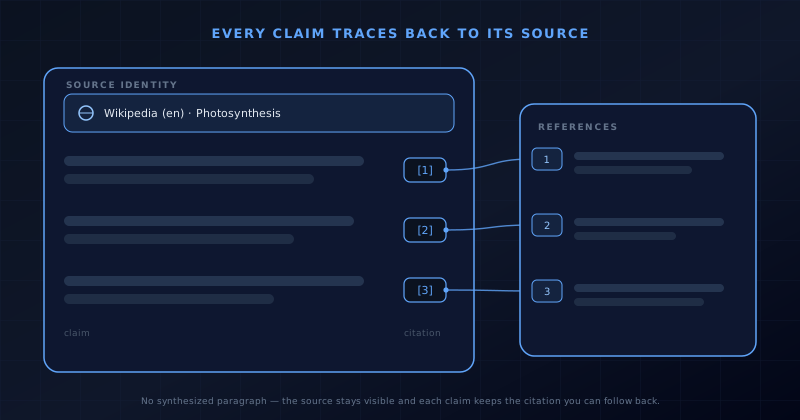
Every topic in Novus Learn carries its source identity (which Wikipedia edition and which specific page you are looking at), shown plainly rather than buried in a footer. That sounds like a small interface detail, but it is doing real work. Reading is only trustworthy when you know what you are reading, and the same search term routinely maps to several different things: distinct language editions, near-duplicate titles, and entirely separate subjects that happen to share a name. A tool that quietly picks one for you and hides the choice is asking you to trust a decision you never saw. By keeping the source identity visible, Novus Learn makes the provenance of the whole reading session legible before you engage with a single claim.
Source identity also anchors everything downstream. Because you know the edition and page, the citations you follow are the references that edition actually uses, and the connections between topics start from a known point rather than an inferred one. Contrast that with an answer engine, where the source is at best a list appended after the fact and at worst absent entirely; you get the conclusion without the identity of the thing that produced it. Holding the source in view the entire time is what turns reading into something you can cite yourself: when you carry a fact into your own work, you can say precisely which page and edition it came from, rather than attributing it to a model that will not remember and cannot be quoted.
Claim-level citations: verify a sentence, not an article
The sharpest expression of the source-grounded idea is granularity. Novus Learn attaches citations to individual claims, so verification happens at the level of a statement rather than a whole document. This matters because 'the article has sources' is a much weaker guarantee than 'this sentence has a source.' An article can be well-referenced overall while a particular claim inside it rests on nothing, and a reader skimming for one fact does not want to audit forty references to check a single line. Claim-level citation collapses that distance: you read a statement, you see the citation attached to it, and you follow it back to the specific reference that supports exactly that statement. Verification becomes a short, local action instead of a research project.
That granularity changes how you can read under pressure. When you are pulling one figure or one date into your own work, you do not need to trust the surrounding article; you need to trust that one line, and claim-level citations let you check precisely that. It also makes disagreement productive: if a claim looks wrong, the citation tells you whether the issue is the source, the reading, or your own assumption, rather than leaving you to argue with an opaque paragraph. A generative answer cannot offer this because its claims have no individual provenance to expose; the sentence and its evidence were never linked. Novus Learn keeps that link intact, which is the whole reason to follow the source instead of the answer.
Disambiguation: choose the page you actually meant
Before you can trust a citation you have to be reading the right thing, which is why disambiguation is an explicit step rather than a silent guess. In Novus Learn the flow is deliberate: you search a topic on Explore and see live Wikimedia results, then you select the intended edition and the specific page from the candidates. The same query (a name, a term, a title) often points at several distinct subjects or several language editions, and an answer engine typically resolves that ambiguity for you invisibly, occasionally landing on the wrong one and building a confident paragraph on top of the mistake. Making the choice visible means you never read the wrong article by accident, because you are the one who decided which article it is.
Explicit disambiguation is a quiet form of respect for the reader. It assumes you know which subject you mean better than a ranking heuristic does, and it refuses to bury a consequential decision inside an autocomplete. There is a featured surface to browse curated starting points when you are exploring rather than hunting for something specific, but the core act is the same: a candidate becomes your source only because you selected it. That decision then travels with you: the source identity you chose is the identity shown while you read and the identity attached to the citations you follow. Getting the page right at the start is what makes everything after it trustworthy, which is exactly why the tool spends a click on it instead of guessing.
The search-to-source loop in practice
In use, the whole experience reduces to three clear moves: search, select, inspect. Search surfaces candidate topics from Wikimedia as you type. Select resolves which one (which subject, which edition, which exact page), so ambiguity is handled before reading begins. Inspect opens the topic with its source identity shown and its claims carrying citations you can follow back. There is no fourth step where a model rewrites what it found, because rewriting is the thing the tool is built to avoid. The loop is short on purpose: it moves you from a vague question to a specific, attributable source in a couple of decisions, and it leaves the source intact so that reading and verifying are the same activity rather than two.
The loop also composes. A topic you inspect can lead you to related topics, and because each one starts from a known page rather than a synthesized summary, following a thread never quietly detaches you from your sources. This is what makes the tool a genuine research aid rather than a faster way to be misled: you can go deep, branch sideways, and come back, and at every point the question 'where did this come from?' has a concrete answer. An answer engine can also send you down a chain of questions, but each hop compounds the provenance problem, because you are trusting successive paragraphs with no way to audit any of them. Novus Learn keeps the chain anchored to sources the whole way through.
- Search: live Wikimedia results appear as you type a topic on Explore.
- Select: choose the intended edition and the exact page; disambiguation is a decision you make, not one the tool hides.
- Inspect: read with source identity shown and citations attached to individual claims.
- Save: keep a topic in a private, on-device library, with no account.
What Novus Learn deliberately does not do
It is worth stating the boundaries plainly, because a source-grounded tool is defined as much by its refusals as by its features. Novus Learn does not use a paid AI model to write answers, it does not paraphrase a source into an unattributed summary, and it does not invent citations. Each of those is a common behavior in generative tools, and each one severs the link between a statement and its evidence. Writing an answer replaces the source with a voice; paraphrasing into a summary strips the attribution that made the material checkable; fabricating a citation manufactures the appearance of provenance without the substance. Removing these behaviors is not a limitation the tool apologizes for; it is the design.
The discipline extends to how new capabilities are described. Novus Learn presents official Wikipedia and Wikimedia content and keeps the path back to it visible; where it adds something (the reading experience, the connections between topics), it adds around the source without rewriting it. That restraint is what lets the tool make a strong, honest claim: what you read can always be traced to a real, named source you can open yourself. A generative system cannot make that promise, because its output is a new artifact with no fixed origin. Building the product around what it refuses to do is how it earns the 'follow the source, not the answer' position rather than merely asserting it in a tagline.
A private library you actually own
Novus Learn is local-first, and the clearest expression of that is the library. You can save a topic, return to it later, and remove it, and all of that lives in your own browser rather than in an account on someone else's server. There is no sign-in gating your saved reading, no profile quietly accumulating a record of what you looked up, and nothing about the core experience that requires your material to leave your device. For a research tool this is more than a convenience: the list of things you are reading about is itself sensitive, and keeping it on-device means your curiosity is not turned into a data trail as a side effect of using the tool.
A local library also fits the grain of how research actually happens. You gather sources over time, revisit them as a question sharpens, and prune the ones that turned out to be irrelevant, a loop that works best when the collection is yours to manage directly. Because the saved topics are the same attributable pages you inspected, the library is not a folder of summaries you would have to re-verify later; it is a set of real sources you can reopen and follow exactly as you left them. The privacy and the provenance reinforce each other: what you keep is trustworthy because it is the source itself, and it is private because it never had to move off your machine to be saved.
- Save, revisit, and remove topics, all stored in your own browser.
- No sign-in and no profile: your reading history is not collected.
- Saved items are the real, attributable pages you inspected, not summaries to re-check.
No account, no tracking: privacy as a structural choice
The absence of an account is not a missing feature; it is a deliberate reduction of what the tool needs to know about you. Running local-first with no account and no tracking means the core search-to-source experience works without collecting who you are or what you read. That posture matters most precisely because of what the tool is for. People use a reading and research aid to investigate things they have not settled yet (health questions, unfamiliar topics, ideas they are still forming), and a tool that logged every one of those queries would create a sensitive record as a byproduct of ordinary use. Novus Learn declines to build that record, which is only possible because it does not depend on a server round-trip to function.
This is the same logic that runs through the rest of the portfolio: match the architecture to the job rather than defaulting to a centralized service that watches usage. A source-grounded reader has no need to phone home for the essential loop, so it does not. The benefit is not only privacy in the abstract; it is that the tool behaves the same whether or not anyone is watching, because there is no watching to switch off. You are not trading your reading habits for access, and you are not asked to trust a privacy policy about data that is never collected in the first place. Structural privacy of this kind is more durable than a promise, because there is nothing to leak.
Visual Studio: visuals that earn their shape from the source
Novus Learn includes Visual Studio, a surface that produces visuals which, in the app's own phrase, earn their shape from the source. The distinction is the same one that runs through the whole product: a visual should be derived from what the material actually says, not decorated onto it. A chart or diagram that traces back to the source extends the source-grounded idea into a different medium, where the risk of an invented, confident-looking artifact is if anything higher than in prose. Visual Studio applies the same standard there, which is why it is built to reflect the underlying material rather than to generate an attractive shape that happens to look authoritative.
It is also, honestly, a feature still finding its full scale. Visual Studio is live today but available with limited capacity while it expands, so it is best treated as a real, capacity-constrained surface rather than an always-on guarantee. Describing it that way is itself part of the source-grounded discipline: a tool built around honest sourcing should be equally honest about the maturity of its own features. Rolling the surface out carefully (rather than promising unlimited visuals it cannot yet reliably deliver) is consistent with a product that would rather under-claim and be trusted than over-claim and be caught. When capacity grows, the app and its documentation will say so together.
Planned, then shipped: your own documents
When this was written, importing your own documents was named as planned rather than live. That was deliberate, because presenting a coming feature as if it already worked would quietly contradict the entire premise of a tool built on honest sourcing. It shipped on 18 July 2026, and it accepts more than the plain text and Markdown originally sketched out: PDF, EPUB, and Word all work.
The implementation kept the local-first stance rather than compromising it. Files are parsed in the browser and the resulting project is stored in versioned IndexedDB snapshots on the device, so there is no upload in the usual sense and no server-side copy to request the deletion of. Your own documents were always the material most obviously worth keeping local, and the feature would have been worth less if it had arrived any other way.
One honest limitation survives: a scanned document is an image of text rather than text, so there is nothing for the parser to lift. Novus Learn produces a near-empty project rather than inventing content it could not find: correct behaviour, and an unwelcome surprise if you expected otherwise. Run a scan through OCR first and upload the result.
Where source-grounded reading belongs
The clearest way to place Novus Learn is by the job it does well: turning a question into reading you can stand behind. It is not trying to be the fastest way to a paragraph, and it is not competing to sound the most authoritative. It is competing to be the tool you reach for when it matters whether the thing you read is true and where it came from: coursework you will be graded on, a claim you are about to repeat in your own writing, a topic you are learning well enough to explain to someone else. In each of those cases the value is not a confident summary but a traceable source, and the whole design is bent toward producing the second.
Inside the wider portfolio, Novus Learn is the source-grounded reading app alongside the tools for image cutouts, creator video, PDF forms, and file conversion, each keeping its core job free and using the browser when local processing is the right architecture. The through-line is the same principle in a different domain: build the tool around what is actually true of the work rather than around a convenient appearance. Open the app at learn.novusstreamsolutions.com and start on Explore; read the hub documentation at Novus Learn for the full reference, and follow a single claim to its citation once. That one action is the fastest way to feel the difference between following the source and trusting the answer.
Frequently asked questions
Quick answers to common questions about this topic.
Is Novus Learn a generative AI answer engine?
No. It is source-grounded: it presents official Wikipedia and Wikimedia content with source identity and claim-level citations. It does not use a paid AI model to write or paraphrase answers, and it does not fabricate citations.
What does 'claim-level citations' mean?
Citations attach to individual statements rather than to a whole article, so you can verify a single sentence by following it to the specific reference behind it instead of auditing every source on the page.
Do I need an account, and is my reading tracked?
No account is required and the core reading experience is not tracked. Novus Learn is local-first: a private library saves topics in your own browser, so your reading history is not collected.
Can I upload my own documents to read this way?
Yes. Upload shipped on 18 July 2026 and accepts PDF, EPUB, and Word alongside plain text and Markdown. Files are parsed in your browser and stored in versioned IndexedDB snapshots on your device; there is no server-side copy.
Related workflow
From a source you can cite to a study pack you can hand out
Read from the source rather than a summary of it, then turn what you verified into a document someone else can use.
- Find the source and check the claim against itNovus Learn: The study material is extractive, not generative: what you get back is what the source says, which is the only kind you can safely cite.
- Assemble and finish the packNovus PDF Studio: Merge the pieces, add the fields a learner fills in, and sign it locally, so unpublished material stays unpublished.
Related troubleshooting
Was this page helpful?
Your answer stays in this browser, it is not sent anywhere and no account or cookie is involved.