2026 · Novus Stream Solutions (hub)About 12 min readNovus Stream Solutions
From scattered feedback to a roadmap, without a PM
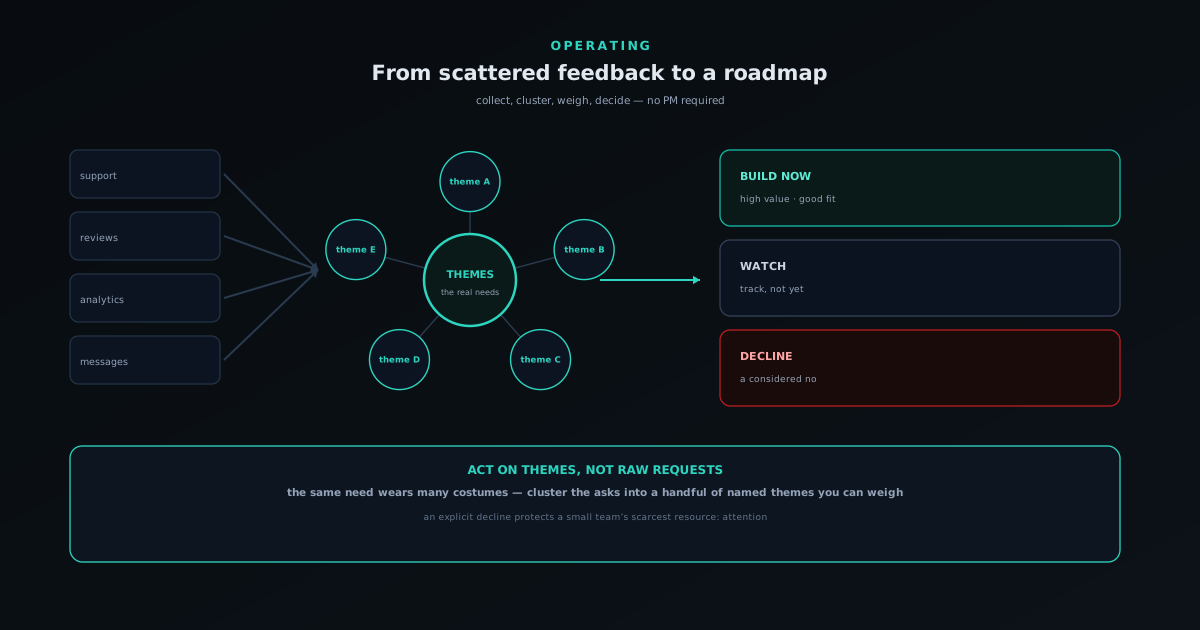
A small studio running several products hears from users constantly and from every direction at once (support threads, reviews, analytics, the occasional direct message) with no product manager to turn the noise into a plan. This is a lightweight system for doing that yourself: collect, cluster, weigh, and decide.
Contents
- 1.Overview
- 2.Get everything into one place
- 3.Cluster requests into themes
- 4.Weigh each theme honestly
- 5.Sort into build, watch, or decline
- 6.Make it a rhythm, not a rescue
- 7.Behaviour is feedback the user never typed
- 8.Separate the request from the problem behind it
- 9.Close the loop, even on a no
- 10.Do not optimise only for the people who speak up
Overview
A product manager’s core job, stripped to its essence, is to turn a chaotic stream of signals about what users want into a coherent decision about what to build next. A small studio running several products has exactly that chaotic stream (support threads, app-store reviews, analytics, the occasional direct message, the feature someone mentions in passing) and no product manager to make sense of it. The work does not go away just because the role is unfilled; it falls to whoever is building the thing, usually in the cracks between actually building it. The risk is that without a method, feedback gets handled by recency and volume: the last loud person, or the most-repeated complaint, sets the direction, which is a bad way to steer.
You do not need to hire a PM to do this well; you need a lightweight, repeatable method that turns scatter into a plan without consuming the time you would rather spend building. The method has four steps (collect everything into one place, cluster raw requests into the themes underneath them, weigh each theme honestly, and sort the result into a small number of decisions) and it works across several products at once because the themes, not the individual requests, are what you act on. This is that method, written for someone wearing every hat, who needs the signal without a full-time process around it.
Get everything into one place
The first failure mode is that feedback lives in a dozen places and is therefore never seen whole. The support inbox knows one set of frustrations, the reviews know another, the analytics know a third, and because no single view holds all of it, your sense of “what users want” is really just whichever channel you looked at most recently. The fix is unglamorous: a single list where every piece of feedback lands, regardless of where it came from. It does not need to be a fancy tool (a single document or simple board is plenty at this scale); it needs to be the one place, so that the whole picture exists somewhere even if it lives nowhere else.
What matters is the discipline of capture, not the sophistication of the capture tool. When a support reply surfaces a recurring confusion, it goes in the list. When a review names a missing feature, it goes in the list. When analytics show people repeatedly bouncing off a particular step, that goes in too, because behaviour is feedback even when nobody wrote it down. The act of getting heterogeneous signals into one homogeneous list is what makes the next step possible, and it quietly corrects the recency bias: once everything is in one place, the loud recent thing has to sit next to the quiet persistent thing, and the persistent thing often turns out to matter more.
Cluster requests into themes
Raw feedback is deceptive because the same underlying need shows up in many different costumes. One user asks for a specific export format, another complains that the output does not work in their tool, a third requests a setting you already have under a different name, and on the surface these look like three separate requests, but underneath they are one theme: people are struggling to get usable output into the next step of their workflow. If you act on the surface requests one at a time, you build three half-features and miss the real one. The crucial move is to cluster: group the raw items by the need underneath them, and treat the theme, not the individual request, as the unit you reason about.
This clustering is where most of the value of the whole exercise lives, because it converts a long, intimidating list of individual asks into a short, tractable list of themes you can actually weigh against each other. It is also what makes managing feedback across several products sane: a theme like “users want their output to drop cleanly into the next tool” might appear in both the background remover and the visualizer, and seeing it as one cross-product theme is far more useful than tracking a dozen scattered tickets. The grouping does not have to be perfect or permanent; it has to be good enough to turn noise into a handful of named needs you can hold in your head at once.
Weigh each theme honestly
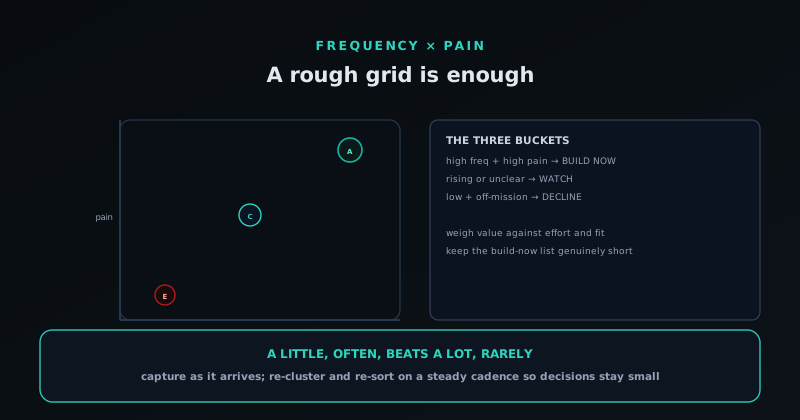
With a short list of themes, you can weigh them, and the goal is an honest comparison, not a precise score. Two questions on the value side carry most of the weight: how many people does this theme affect, and how much does it hurt the ones it affects. A papercut that mildly annoys everyone and a wall that completely blocks a few are different shapes of problem, and conflating them is how teams polish trivia while a real blocker festers. Frequency and pain together give you a rough sense of how much a theme matters, which is enough to rank it against the others without pretending to a rigour the inputs do not support.
On the other side of the ledger are two more questions: how much effort would addressing it take, and does it actually fit the product. The effort estimate keeps you honest about cost, so a high-value theme that is also cheap leaps to the front and an equally valuable one that is enormously expensive waits. Fit is the quieter filter and often the more important: a frequently-requested feature that pulls a single-purpose tool toward bloat can be the right thing to decline no matter how many people ask, which is the discipline argued in Keep, kill, or shelve: a structural "no" as a product filter. Weighing value against effort and fit, even roughly, is what separates a roadmap from a wish list.
Sort into build, watch, or decline
The output of weighing is not a ranked list of fifty things, which would just be a backlog by another name; it is a sorting of the themes into three buckets. Build now is the short list of high-value, reasonable-effort, good-fit themes you will actually work on next, kept genuinely short, because a roadmap that says everything is a priority says nothing. Watch is for themes that are not acted on yet but are worth tracking: maybe the frequency is rising, maybe the right solution is not clear, maybe it is waiting on something else. Decline is for the themes you have honestly decided not to do, which is not a failure of the process but one of its most valuable outputs.
The decline bucket deserves defending, because the instinct is to leave everything in a hazy “maybe later” that never resolves. Explicitly deciding not to do something (because it does not fit, because the effort dwarfs the value, because it pulls against what the product is) is a real decision that frees attention and keeps the product coherent. Recording it also means you stop re-litigating the same request every time it resurfaces; you can point to a considered “no” rather than re-deciding from scratch. A small team’s scarcest resource is attention, and a clear decline protects it better than a polite, permanent maybe.
Make it a rhythm, not a rescue
The reason this method works without a PM is that it is light enough to run as a small, regular habit rather than a periodic emergency. Feedback accrues continuously, so the worst way to handle it is to let it pile up untouched until the backlog is overwhelming and then attempt a heroic triage that exhausts you and happens once. Far better to spend a short, fixed slot regularly (capturing into the list as feedback arrives, and re-clustering and re-sorting on a steady cadence) so the picture stays current and the decisions stay small. This is the same logic as the operating rhythm in A weekly operating rhythm for a solo operator: a little, often, beats a lot, rarely.
Run this way, the method gives a small team most of what a product manager would provide (a coherent sense of what users actually need, a defensible decision about what to do next, and the discipline to decline well) without the headcount or the ceremony. The roadmap that comes out is not a grand document; it is a short, honest answer to “what next?”, refreshed often enough to stay true. That is enough. The goal was never to simulate a product organisation; it was to make sure the building is pointed at what matters, across every product, and a simple collect-cluster-weigh-decide loop does exactly that.
Behaviour is feedback the user never typed
The feedback that arrives in words is only half the signal, and often the less reliable half. People are bad at predicting what they will use and quick to ask for what they imagine they want, but their behaviour does not lie: where they drop off, which step they repeat, what they never discover, and where they give up are all feedback that nobody wrote down. A tool can have zero complaints about a particular feature and a quiet, damning analytics trail showing that almost everyone abandons the workflow right before reaching it. The silent majority does not file requests; they just leave, and the only way to hear them is to watch what they do rather than wait for what they say.
So the single list should include behavioural signals alongside the written ones, treated with equal weight. A high drop-off at a specific step is a theme even if not one person ever mentioned it; a feature with rich functionality and near-zero usage is telling you something even though the silence feels like contentment. Reading behaviour is also how you catch the gap between what users request and what they need: they may loudly ask for an advanced option while the data shows the real problem is that most of them never get past the first screen. Folding behaviour into the same collect-and-cluster process keeps the roadmap honest about the people who would never think to send feedback, which is most of them, and it is frequently where the highest-value, least-requested work hides.
Separate the request from the problem behind it
Users tend to send solutions, not problems. They ask for a specific button, a particular setting, a feature they saw somewhere else, and if you build exactly what they asked for, you often solve the wrong thing, because the request is their guess at a fix rather than a description of their actual difficulty. The discipline that pays here is to treat every request as evidence of an underlying problem and to dig for that problem before deciding what to build. The famous trap is the faster horse: take the literal request and you build a marginally better version of the wrong thing; understand the need beneath it and you might build something far better than what was asked for.
In practice this means asking, of every clustered theme, what is the user actually trying to accomplish when they make this request. Someone asking for a niche export format may really be trying to get the output into a specific downstream tool, and the better solution might be different from the format they named, or might serve five other requests at once. Separating problem from proposed solution is also what lets you decline a feature request without declining the user’s need: you can say no to the specific button while saying yes to solving what prompted it, often more cheaply and for more people. The request tells you something is wrong; your job is to figure out what, not to implement the user’s first guess at the cure.
Close the loop, even on a no
The step most small teams skip is telling people what happened to their feedback, and skipping it quietly wastes the goodwill the feedback represented. Someone who took the time to report a problem or request a feature has invested in your product, and a short message when you ship the thing they asked for, or when you have decided not to, turns a one-way complaint into a relationship. The user who hears “we built this because you asked” becomes an advocate; the user who hears nothing assumes their feedback fell into a void and stops bothering, which slowly starves you of exactly the signal this whole process depends on.
Closing the loop matters just as much on a decline, and arguably more, because a thoughtful no is more respectful than silence. Telling someone you considered their request and decided against it, with an honest reason, is a far better experience than leaving them wondering for months, and it rarely costs the goodwill people fear it will, because users mostly want to be heard, not necessarily obeyed. This is the same honesty that makes a structural no a usable product filter rather than a quiet disappointment: a decline you communicate is a decision; a decline you hide is just neglect. A small team cannot say yes to everything, but it can afford to respond to everyone, and that responsiveness is what keeps people sending the feedback that makes the roadmap possible at all.
Do not optimise only for the people who speak up
The single biggest distortion in feedback-driven product work is that the people who send feedback are not a representative sample of the people who use the product. Feedback skews toward the engaged, the frustrated, and the technical: the users invested enough to write in, annoyed enough to complain, or comfortable enough to articulate a request. The much larger group who quietly use the tool, get what they came for, and never say a word is silent by definition, and if you steer entirely by the loud signal you will steer the product toward the vocal minority and away from the silent majority who are the bulk of the value.
This is why the clustering and weighing steps matter so much, and why behaviour belongs in the mix alongside words: they are partial corrections for a sample that is inherently skewed. A request repeated by ten vocal users is real, but it is not automatically more important than a friction point that quietly costs you a quarter of all newcomers who never complained because they simply left. The discipline is to hold the written feedback and the behavioural data side by side and ask which group each is speaking for, so that a roadmap built from feedback does not quietly become a roadmap built only for the people who happen to enjoy giving it.
None of this means discounting the people who take the time to write (they are a gift, and closing the loop with them is worth doing); it means weighting their input honestly rather than treating volume as truth. The loudest request in the inbox and the most common path through the product are both data, and the art is refusing to let the one you can read most easily crowd out the one that matters most. A small team with no PM is especially prone to this trap, because the feedback that lands in a personal inbox feels urgent and personal in a way that a drop-off statistic never does, and correcting for that pull is most of what doing this well requires.
Frequently asked questions
Quick answers to common questions about this topic.
How do you prioritise features without a product manager?
With a lightweight, repeatable loop: collect all feedback into one place, cluster raw requests into the underlying themes, weigh each theme by how many it affects and how much it hurts them against the effort and product fit, then sort the result into build now, watch, or decline. The themes, not individual requests, are what you act on, which keeps it tractable even across several products.
Why cluster feedback into themes instead of acting on requests directly?
Because the same underlying need shows up as many different surface requests, and acting on each one separately builds several half-features while missing the real one. Clustering groups items by the need beneath them, turning a long list of asks into a short list of themes you can weigh against each other, and it reveals cross-product needs that scattered tickets hide.
How should I weigh one theme against another?
Roughly, on four questions: how many users a theme affects (frequency), how badly it hurts the ones it affects (pain), how much effort it would take, and whether it actually fits the product. Frequency and pain give value; effort and fit temper it. You are after an honest comparison to rank themes, not a precise score the inputs could not support anyway.
Is it really worth keeping a “decline” bucket?
Yes. It is one of the most valuable outputs. Explicitly deciding not to build something frees attention, keeps a single-purpose product coherent, and stops you re-litigating the same request every time it resurfaces, because you can point to a considered no. A vague permanent “maybe later” does none of that and quietly clogs the roadmap.
How often should a small team do this?
As a small, regular habit rather than a periodic rescue. Capture feedback into the single list as it arrives, and re-cluster and re-sort on a steady cadence so the picture stays current and the decisions stay small. Letting it pile up until a heroic, exhausting triage is the failure mode; a little and often keeps the roadmap honest without taking over the week.
Related troubleshooting
Was this page helpful?
Your answer stays in this browser, it is not sent anywhere and no account or cookie is involved.