2026 · Novus Stream SolutionsAbout 13 min readNovus Stream Solutions
When to add accounts to a free tool (and when not to)
Adding a signup is one of the easiest ways to ruin a free tool, and occasionally the right call. A field note on the instant-on default, the three real reasons to add accounts, and how to keep both kinds of front door.
Contents
- 1.Overview
- 2.Accounts are not free for the user, either
- 3.The instant-on default: why we resist the signup wall
- 4.The three real reasons to add an account
- 5.The wrong reasons to add an account
- 6.If you do add accounts, make them earn their place
- 7.Two front doors, kept on purpose
- 8.What the dashboard does not show you
- 9.A rule of thumb for the signup wall
Overview
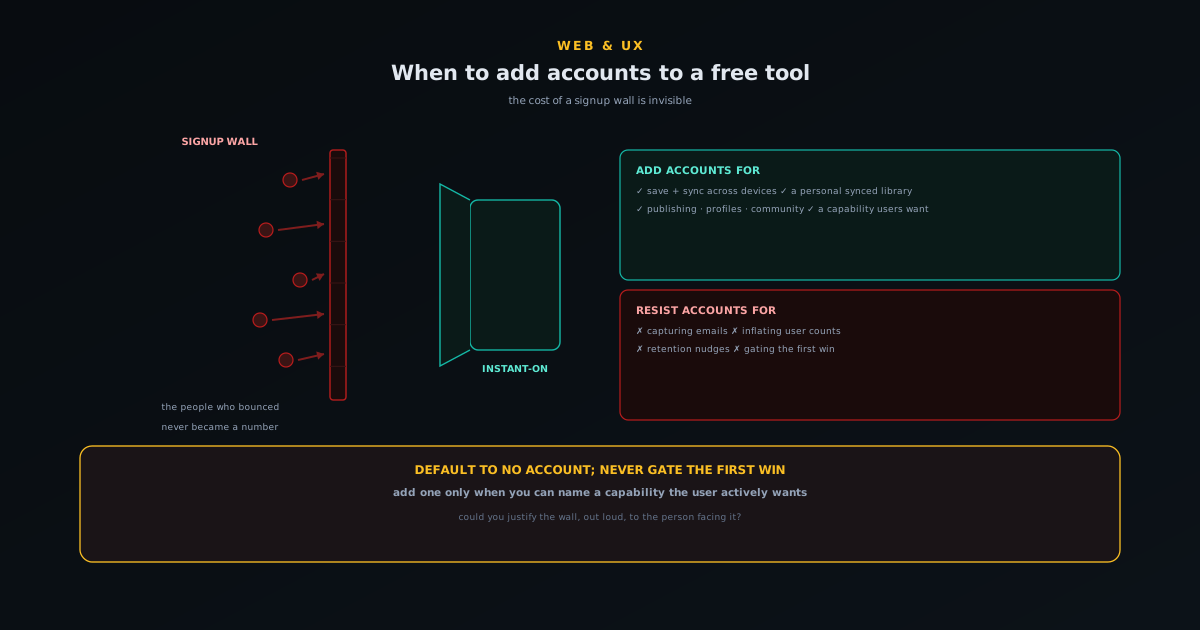
Adding a signup to a free tool is one of the most tempting and most damaging things a product team can do. It is tempting because accounts unlock saving, identity, email lists, retention metrics, and the comfortable feeling of "owning" your users. It is damaging because a signup wall is the single biggest piece of friction you can put between a person and the value they came for, and most of the time it taxes everyone to serve a need only some users have. This is a field note on the discipline of that decision: why no-account should be the default, the narrow set of reasons that actually justify accounts, and how to add them, when you must, without wrecking the thing that made the tool good.
The reason this is worth treating as a discipline rather than a default-yes is that the costs of accounts are easy to underestimate because they fall on the user, not on the dashboard. A signup wall does not show up as a line item; it shows up as the people who bounced before they ever became a number you could see. So the temptation is structurally lopsided: the benefits of accounts are visible and measurable, and the costs are invisible and borne by people who leave. Good product judgment here means weighting the invisible cost properly, which mostly means starting from "no account" and making accounts earn their way in.
Accounts are not free for the user, either
The first thing to internalize is that an account costs the user something real, even though it costs them no money. It costs attention and momentum: the person came to do a task, and a signup interrupts that with an unrelated chore: choosing a password, checking an email, deciding whether they trust you with their address before they have seen what you do. It costs trust up front, asked for before any has been earned. And it costs a small ongoing weight: one more account in a life already full of them. None of these are huge individually, but together they are exactly enough to make a meaningful fraction of people abandon a tool they would otherwise have loved.
Crucially, that cost is paid before the user has received anything, which is the worst possible time to charge it. A signup wall inverts the natural order of a good first experience (value first, commitment later) into commitment first, value maybe. For a free tool whose entire advantage is low friction and instant usefulness, that inversion throws away the main thing you had going for you. Recognizing that accounts have a real, if invisible, user cost is what reframes the decision correctly: not "why not add accounts," but "what is worth making every user pay this cost for," which is a much higher bar.
The instant-on default: why we resist the signup wall
The default Novus holds for its tools is instant-on: you open the tool and you are working, with no signup between you and the first result. NSS Background Remover at bgremover.novusstreamsolutions.com never asks for an account at all; Novus Visualizers at visualizers.novusstreamsolutions.com lets you browse, edit, and export without one, and only offers a signup when you want to save. This is not generosity for its own sake; it is the recognition that the first win is sacred. The moment a new user gets a real result is the moment they decide whether the tool is worth their time, and anything standing in front of that moment is sabotaging the only impression that matters.
Resisting the signup wall is really resisting a very natural growth instinct, which is why it takes discipline. Every analytics tool and growth playbook nudges toward capturing users early, and an email captured before the first result feels like a win. But a captured email from someone who never experienced the tool is close to worthless, and the friction that captured it cost you the users who would have actually stuck around. The instant-on default is a bet that earned trust beats captured trust: that a person who got value first and chose to come back is worth more than a person who was made to commit first and mostly did not. Holding that bet is the whole discipline.
The three real reasons to add an account
Accounts are not always wrong; there are genuinely good reasons to add them, and they share a shape: each is a need that structurally cannot be met without identity. The first is saving and continuity across devices: when users build work over time and need it to survive sessions and follow them to another machine, browser-local storage is not enough, and only an account can keep work that travels. The second is anything social (publishing, profiles, a community feed, following other creators) which simply cannot exist without knowing who the user is. The third is genuinely user-specific state that must persist and sync, like a personal library or settings that need to be the same everywhere.
What these have in common is that the account is serving the user, not just the business. Visualizers added accounts because its users wanted exactly these things: to keep and revisit a body of creative work, to publish it, and to build an audience: needs that local-only saving and an anonymous tool cannot satisfy. That is the test: an account is justified when it unlocks something the user actively wants and cannot otherwise have, not when it merely lets you collect or retain them. If you can name the user-facing capability the account enables, and it is one users are asking for, you have a real reason. If you cannot, you probably have a business reason dressed as a product one.
The wrong reasons to add an account
The wrong reasons are seductive because they feel like progress while actually serving the dashboard rather than the user. Adding accounts to capture emails for marketing, to inflate a registered-user count, to enable retention nudges, or simply because mature products "have accounts" are all reasons that make the metrics look better while making the product worse. Each one asks every user to pay the signup cost so the business can collect something, with no capability returned to the user in exchange. That is the tell: if the account benefits the company's funnel but does nothing the user wanted, it is a tax disguised as a feature.
The most insidious version is the gate placed in front of the first result (make an account to download, sign up to see your export, register to continue) because it monetizes the exact moment of highest user intent and lowest user patience. It works in the narrow sense that some people grit their teeth and comply, which is why it persists, but it does so by converting your best first impression into a transaction and chasing off everyone who will not pay it. A tool confident in its value does not need to hold the result hostage. Gating the first win is the clearest sign that accounts are being added for the wrong reason, and it is the one to refuse most firmly.
If you do add accounts, make them earn their place
When the reasons are real, the way to add accounts without ruining the tool is to keep them optional and to place the prompt at the moment of genuine need. Optional means the core task still works without signing in (browse, edit, export) so the account adds capability rather than acting as a gate. Placed at the moment of need means the prompt appears when the user does something an account would help with, like trying to save a project they clearly want to keep, rather than on arrival. That timing flips the account from an obstacle into an obvious yes, because by then the user has the value in hand and the signup solves a problem they actually have.
Visualizers is built exactly this way: everything works without an account, and the signup shows up as the natural answer to "I want this back later," which is the one moment a user genuinely wants an account. The account also has to deliver on what it promised (durable saves that actually persist, work that truly reopens with settings intact, a community that functions) because an account that asks for commitment and then loses the work is worse than no account at all. Optional, well-timed, and genuinely delivering: those three conditions are how accounts earn their place instead of just taking up space at the door.
Two front doors, kept on purpose
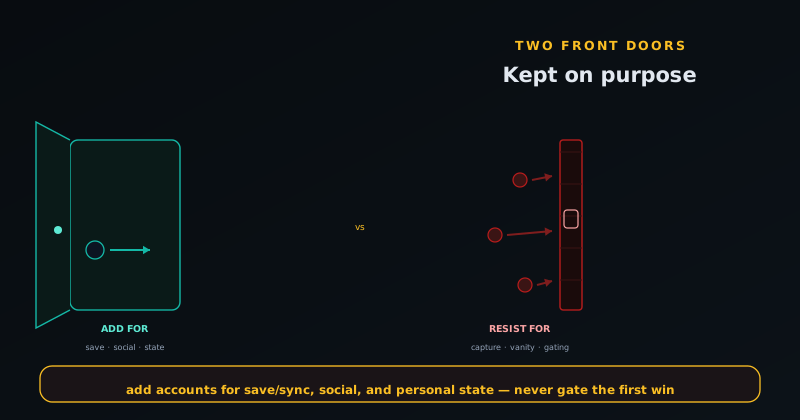
The Novus ecosystem ends up with two kinds of front door, and keeping both is a deliberate stance rather than an inconsistency. One door, NSS Background Remover, never asks who you are, because its users' needs are met without it and an account would only subtract. The other door, Novus Visualizers, offers an optional account because its users have the save, sync, and social needs that justify one, while still letting people in without signing in first. Same operation, two doors, each shaped by the use case behind it. The mistake would have been forcing one pattern on both, which would have meant either denying Visualizers users the saving they wanted or burdening Background Remover users with an account they did not.
Holding two doors is more work than standardizing on one, and that is precisely the point: the right answer follows the users, not the convenience of a single template. For anyone building a portfolio of tools, the lesson is that consistency of philosophy matters more than consistency of mechanism: both doors express the same belief that value comes first and accounts must earn their place, even though one has accounts and the other does not. That shared philosophy, applied honestly to each tool's actual users, is what keeps the doors coherent even when they look different. The unifying rule is the discipline, not the signup.
What the dashboard does not show you
The reason this decision goes wrong so often is that the metrics are biased toward adding accounts, and the bias is structural rather than a mistake anyone makes on purpose. Every account created is a number that goes up; every signup form filled is a measurable conversion; every email captured is an asset you can see in a list. The cost (the people who arrived, hit the wall, and left without ever becoming a data point) is invisible precisely because they never registered, never converted, never entered the funnel. You are comparing a visible gain against an invisible loss, and human judgment reliably overweights what it can see. That is why "should we add accounts" almost always feels like yes when you are staring at a dashboard.
Correcting for that bias means deliberately accounting for the loss you cannot measure directly. You can estimate it: watch how many people reach the point just before a signup and do not continue, compare completion rates with and without a wall when you can, and treat abandonment at the account step as a real cost rather than a rounding error. The discipline is to hold the invisible number in mind even though no chart displays it, because the decision is only honest if both sides of the ledger are weighed. A signup that adds a thousand registered users while quietly turning away three thousand who would have loved the tool is not the win the dashboard says it is.
There is a longer-term cost the dashboard hides too: the trust you spend by asking for commitment before delivering value. A user who is walled before their first result does not just sometimes leave; the ones who push through start the relationship having been charged before they were served, which is a worse footing than a user who got the value first and chose to come back. Captured trust and earned trust are not the same quality of relationship, and the difference compounds over time even though it never appears as a single metric. The tools that build durable loyalty are usually the ones that resisted the measurable short-term win in favor of the unmeasurable long-term one, which is exactly the trade the dashboard is worst at helping you see.
A rule of thumb for the signup wall
If you want a single heuristic, it is this: default to no account, and add one only when you can name a capability the user actively wants that is impossible without identity (saving across devices, publishing, a personal synced library) and even then, never gate the first win behind it. Make the account optional, place the prompt at the moment of genuine need, and make sure it delivers what it promised. If you cannot name the user-facing capability, or the only beneficiary is your funnel, do not add the account; you are about to tax every user to serve a need they do not have. The bar is high on purpose, because the cost is invisible and the temptation is constant.
One last way to pressure-test the decision is to imagine explaining it to a user out loud. "Sign in so your projects save across all your devices" is a sentence a user nods along to, because it names a benefit they recognize as theirs. "Sign in so we can grow our registered-user number" is a sentence you would never actually say, which is the tell that the account is serving you and not them. If the honest, plain-language reason for the signup is one the user would welcome, you probably have a real one; if the honest reason is one you would have to hide behind softer words, you are about to add friction for the wrong cause. The signup wall should always be something you could justify to the person facing it, in words they would agree with, and if it is not, that is your answer.
This test is useful precisely because it is hard to fool yourself with it. Marketing language can dress up a self-serving account requirement until it looks reasonable on a landing page, but the out-loud version strips the dressing away, because you cannot say a thing to a real person's face and hide its true purpose behind a euphemism. Teams that adopt this habit tend to make better calls almost automatically, since the act of phrasing the reason plainly surfaces whether it is a user benefit or a business grab before the wall ever ships. It costs nothing to run the test and it catches the most common mistake at its source, which is why it is worth making a reflex rather than an occasional check.
The deeper point is that accounts are a means, not a milestone. A free tool is not more grown-up for having a signup; it is more grown-up for adding accounts only where they genuinely serve the people using it and refusing them everywhere else. That discipline is harder than it sounds, because the pressure to capture users is relentless and the cost of capturing them does not show up where you are looking. But the tools people love are almost always the ones that respected their time at the door: they let them in, gave them the win, and asked for commitment only when commitment was the thing the user wanted. That is the standard worth holding, and it is the one these tools are built to.
Frequently asked questions
Quick answers to common questions about this topic.
Should a free tool require an account?
Usually not for the core workflow: gating first use behind signup loses people. Accounts earn their place when they enable something users want (durable saves, sync, community), and even then they work best as optional.
What is the risk of adding accounts too early?
Friction. A signup wall before a user has seen value is the most common reason people bounce. The Novus tools let you use everything first and sign in only to save.
When are accounts clearly worth it?
When work needs to persist across devices, or when a shared/community feature is the point. That is when an optional account adds real value without taxing the first-time experience.
Related troubleshooting
Was this page helpful?
Your answer stays in this browser, it is not sent anywhere and no account or cookie is involved.