2026 · Web & UXAbout 14 min readNovus Stream Solutions
Resisting feature creep: keeping each tool single-purpose and shipping more tools instead
The product philosophy of narrow tools over bloated suites: why each Novus tool stays focused on one job, why the answer to "can it also do X" is often a new tool rather than a bigger one, and what that buys users.
Contents
- 1.Overview
- 2.What a single-purpose tool buys the user
- 3.Why the answer to "can it also do X" is often a new tool
- 4.Features are not free even when the code is cheap
- 5.Focus is a feature users can feel
- 6.Breadth taxes maintenance, too
- 7.The slippery slope of one more thing
- 8.Focused tools compose better than bloated ones
- 9.Restraint as a competitive edge
- 10.When NOT to add a feature is the hard call
Overview
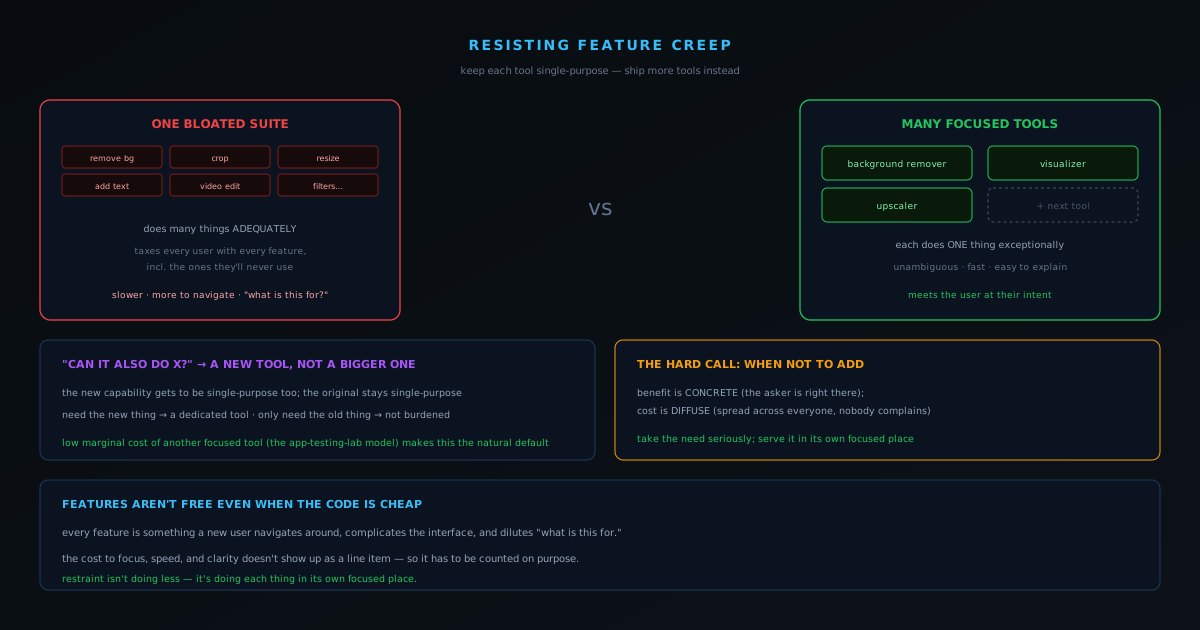
Every successful tool faces the same pressure: the request to do one more thing. The background remover works, so could it also crop, also resize, also add text, also edit video, also become a full image editor? Each addition sounds reasonable in isolation, and following all of them is how a clean, fast, single-purpose tool turns into a sprawling suite that does many things adequately and nothing exceptionally. The Novus philosophy resists that pressure deliberately: keep each tool focused on one job, and when a genuinely useful new capability appears, the answer is usually a new tool rather than a bigger one. This post is about why narrow beats wide, why shipping more tools beats growing one tool, and what that focus actually buys the people using them.
The instinct toward bloat is natural and usually well-intentioned: more features feels like more value, and saying yes to a user request feels like good service. But features are not free even when the code is cheap. Every feature added to a tool is something a new user has to navigate around, something that complicates the interface, something that dilutes the tool's answer to the question "what is this for." Feature creep is not a failure of restraint so much as a failure to count the cost of features that do not show up as a line item (the cost to focus, to speed, to clarity), and the discipline is to count that cost honestly.
What a single-purpose tool buys the user
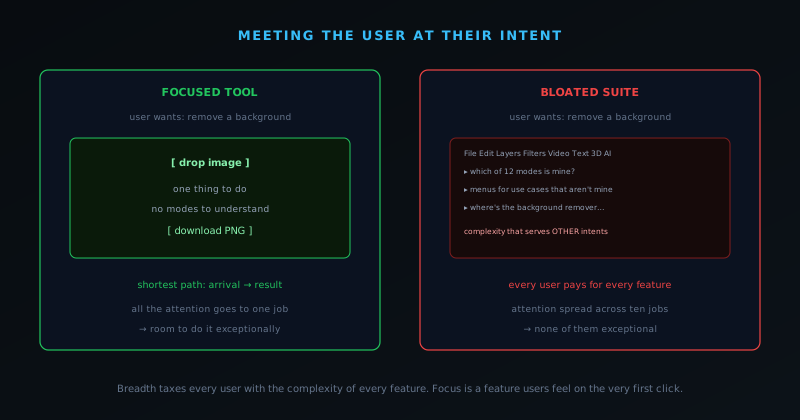
A tool that does one thing can be unambiguous about what it is for, and that clarity is worth more to a user than breadth. When someone arrives at a background remover, they know exactly what it does and exactly how to use it, because there is only one thing to do: there is no menu of modes to understand, no figuring out which of twelve features applies to their task, no interface complexity that exists to serve other use cases that are not theirs. The narrow tool meets the user at their intent: they came to do one thing, the tool does that one thing, and the path between arrival and result is as short as it can be. Breadth, by contrast, taxes every user with the complexity of every feature, including all the ones they will never use.
Single-purpose tools also tend to be better at their one job, because all of the attention goes there. The background remover's straight-alpha export, its handling of soft edges, its model tiers: these get the focus that they would not get if the same effort were spread across also being a video editor and a design suite. A tool that does one thing has room to do that thing exceptionally; a tool that does ten things rarely has the focus to do any of them exceptionally. And narrow tools can be fast and simple in a way wide ones cannot, because there is less to load, less to navigate, and less to maintain; the focus that helps the user also helps the tool stay quick and reliable.
Why the answer to "can it also do X" is often a new tool
When a genuinely useful adjacent capability appears, there are two ways to deliver it: add it to the existing tool, or build it as a new tool. The default in most products is to add it, because it reuses the existing audience and feels efficient. The Novus default leans the other way: build the new capability as its own focused tool, so that the original tool stays single-purpose and the new capability gets to be single-purpose too. A user who needs the new thing gets a tool dedicated to it; a user who only needs the original thing is not burdened with the new feature cluttering their experience. Both groups get a focused tool rather than one tool that is now trying to serve two intents at once.
This is why the portfolio is a set of tools rather than one growing application. The operating model that builds narrow products, ships them, and keeps the ones that work is exactly the model that makes "ship another tool" a natural response to a new need, because the marginal cost of another focused tool is low and the architecture supports it. Shipping more tools instead of growing one tool keeps each one sharp, keeps each one fast, and keeps each one easy to explain, and it means the answer to "should this do more" can be "yes, over here, as its own thing" rather than "yes, bolted onto this." The restraint is not about doing less; it is about doing each thing in its own focused place rather than piling everything into one.
Features are not free even when the code is cheap
The instinct toward feature creep rests on a hidden assumption that features are roughly free to add: that since the code is not that expensive, more capability is pure upside. This assumption is wrong, and seeing why is the key to resisting the creep. A feature has costs that never appear as a line item: it is something every new user has to navigate around, something that complicates the interface, something that dilutes the tool's answer to the question of what it is for, and something that has to be maintained, tested, and kept working as everything else changes. These costs are real and recurring, and they are paid by every user and by the operation forever, not just once when the feature is built.
The reason these costs are easy to ignore is that they are diffuse and invisible, while the benefit of a feature is concrete and visible. You can point to the feature and the user it helps; you cannot easily point to the slight additional confusion every other user now navigates, the small increment of interface complexity, the marginal dilution of focus. So the accounting feels lopsided in favor of adding, because the benefit is countable and the cost is not, which is exactly the bias that produces feature creep. Counting the diffuse costs honestly, even though they do not show up as cleanly as the benefits, is the discipline that resists the creep. A feature that looks free because its code is cheap is usually not free at all once its costs to focus, simplicity, and maintenance are tallied, and tallying them is what reveals when an addition is not worth it despite seeming obviously good.
Focus is a feature users can feel
It is worth stating positively what narrowness buys, because resisting features can sound purely defensive when it is actually delivering something users value: focus is itself a feature, one users feel even if they could not name it. A focused tool is comprehensible at a glance, fast because there is less to load and navigate, and unambiguous about its purpose, and those qualities are experienced as ease: the tool just does the thing, cleanly, without making the user wade through capabilities that are not theirs. Users do not arrive wanting breadth; they arrive wanting to accomplish a specific task, and a tool that meets that task directly, without the overhead of everything else it could also do, serves them better than a broader one that buries their task among others.
This is why focus is not a limitation imposed on users but a benefit delivered to them. The clarity of a single-purpose tool, the speed that comes from its narrowness, the confidence of knowing exactly what it is for: these are positive experiences that a bloated suite cannot offer, because breadth necessarily costs clarity, speed, and focus. When the philosophy resists adding a feature to preserve the tool's focus, it is protecting something users actively value, not depriving them of something they wanted. The framing of narrow-versus-wide as restraint-versus-generosity is misleading; it is really focus-versus-dilution, and focus is the thing users feel as quality. Recognizing that a focused tool gives users a better experience, not a lesser one, is what turns feature restraint from an apology into a value proposition.
Breadth taxes maintenance, too
Beyond the user-facing costs, feature breadth taxes the operation's ability to maintain quality, which matters acutely for a small team. Every feature is something that has to keep working as the tool, its dependencies, and its environment evolve: a surface that can break, a behavior that has to be preserved, a piece of the system that competes for the limited attention available to keep everything reliable. A tool with a narrow feature set has a small surface to maintain well; a tool that has accreted many features has a large surface that the same limited attention has to cover, which means each feature gets less care and the overall reliability tends to slip. Breadth dilutes maintenance attention exactly as it dilutes user focus.
For a one-person operation, this maintenance tax is a hard constraint, not a soft preference. There is a finite amount of attention available to keep the portfolio working, and every feature added is a claim on that finite attention forever. A narrow tool can be kept excellent because its small surface fits within the available care; a tool bloated with features eventually exceeds what the operation can maintain well, and quality degrades across the board as attention spreads too thin. Resisting feature creep is therefore partly a matter of staying within the maintenance budget, keeping each tool's surface small enough that it can actually be kept reliable by the people available to maintain it. The discipline that keeps tools focused is the same discipline that keeps them working, because an unmaintainable pile of features serves no one regardless of how good each looked when it was added.
The slippery slope of one more thing
Feature creep is dangerous precisely because it never arrives as a single bad decision but as a sequence of individually reasonable ones, each of which is hard to refuse on its own. The first additional feature is clearly useful and only slightly complicating; the second, given the first, is a small further step; and so on, with each addition justified relative to the current state rather than against the original focused vision. No single step looks like the one that ruined the tool, because none of them did individually: the ruin is in the accumulation, which is invisible at each step and obvious only in retrospect once the tool has become a bloated suite nobody decided to build.
This is why resisting feature creep requires a principle held against each individual request rather than case-by-case judgment, because case-by-case judgment loses the slippery slope every time. Evaluated in isolation, almost any proposed feature can be justified (it is useful, it is not much code, someone wants it), so the only defense is a standard that asks not "is this feature good" but "does this belong in this focused tool." Without that standard, each reasonable yes leads to the next, and the tool slides down the slope one defensible decision at a time. The discipline is to recognize that the danger is the cumulative slope, not any single step, and to hold a principle that can say no to individually-good features for the sake of the focus they would collectively erode. Guarding against the slope means judging additions against the tool's purpose, not against their own isolated merit, because their own merit will always argue for yes.
Focused tools compose better than bloated ones
A practical advantage of keeping tools narrow that is easy to overlook is that focused tools compose (they can be combined into workflows precisely because each does one clear thing), whereas bloated tools resist composition. When each tool has a clear, single purpose, a user can chain them into a pipeline that fits their specific need: cut out at bgremover.novusstreamsolutions.com/background-remover, upscale at bgremover.novusstreamsolutions.com/upscale, compress at bgremover.novusstreamsolutions.com/tools/image-compressor, each step a focused tool doing its part. The clarity of each tool's purpose is what makes it a clean component that fits into a larger flow. A bloated tool that does many things adequately is harder to fit into a workflow, because its sprawling, overlapping capabilities do not slot cleanly alongside other tools the way a focused one does.
This composability means a set of focused tools is often more capable, in combination, than a single tool that tried to do everything, while remaining individually simpler. The user assembles exactly the workflow they need from clean components, rather than navigating one complex application that approximates many workflows poorly. This is the deeper logic behind shipping more focused tools rather than growing one wide one: the focused tools are not just individually better but collectively more flexible, because they compose. A portfolio of sharp, single-purpose tools gives users both the clarity of each tool and the power of combining them, which a single bloated suite cannot match. Narrowness at the level of each tool produces breadth at the level of the workflow, achieved through composition rather than through any one tool trying to contain everything, which is a better way to deliver capability than the monolith.
Restraint as a competitive edge
The discipline of staying narrow, which can feel like a constraint, is actually a competitive edge, because most products fail to maintain it and the ones that do stand out for their clarity and speed. The natural gravity of software is toward bloat (features accumulate, interfaces grow complex, focus dilutes), so a tool that resists that gravity and stays sharp, fast, and clear is distinguishing itself from the majority that did not. In a landscape of tools that have grown into complicated suites, a tool that does one thing exceptionally well and gets out of the way is a genuinely different and often preferable experience, which is a real differentiator rather than a limitation.
This edge compounds for a portfolio that applies the discipline consistently. A set of tools each of which is focused, fast, and clear presents a coherent alternative to the bloated norm, an ecosystem where every tool respects the user's time and intent rather than burdening them with everything it could also do. The restraint that produces this is hard, which is exactly why it is a defensible advantage: competitors will feel the same pressure to add features and most will give in, leaving the disciplined operation's focus as a durable point of difference. Resisting feature creep is therefore not just good product hygiene but a strategy, turning the unglamorous discipline of saying no into the visible quality of tools that stay sharp while others bloat. The restraint is the edge, and it is available to any operation willing to count the diffuse costs of features and hold the line that most do not.
When NOT to add a feature is the hard call
The discipline is hardest in the specific moment, when a real user asks for a real feature that would genuinely help them, because saying no feels like bad service and the feature really would be useful to that person. This is where the philosophy earns its keep, because the cost of the feature is diffuse and the benefit is concrete: the asking user is right in front of you and the cost is spread across every other user's slightly more complicated experience, which is easy to discount precisely because no individual user shows up to complain about a feature existing. The honest accounting has to weigh the concrete benefit to the asker against the diffuse cost to everyone, and that accounting usually favors keeping the tool focused even though it feels less accommodating in the moment.
The resolution that keeps both the focus and the goodwill is to take the request seriously as a signal of a real need while declining to satisfy it by bloating the tool, which is exactly what "a new tool rather than a bigger one" accomplishes. The user's need is real and worth serving; the question is only where, and the answer that protects every existing user is "in its own focused place." That reframe turns the hard no into a different yes: not "we will not build that," but "we will build that as the focused thing it deserves to be, rather than as a complication of this." Keeping each tool single-purpose and shipping more tools instead is how a portfolio stays a set of sharp, fast, clear tools rather than collapsing into one suite that does everything and excels at nothing. The companion posts cover the MVP scoping discipline that is the same instinct applied within a single product and the operating model that makes shipping more tools viable.
Frequently asked questions
Quick answers to common questions about this topic.
How do you avoid feature creep in a product?
Keep each tool focused on one job and ship a new tool when a new need appears, rather than piling features onto one app. A single-purpose tool stays fast and obvious; a do-everything tool becomes slow and confusing.
Isn't it better to have one app that does everything?
Rarely. One bloated app is harder to learn and maintain than several sharp ones. Users reach for the tool that clearly does their task: breadth as separate tools beats breadth crammed into one.
How do you keep a large suite of tools usable?
Consistent patterns and progressive disclosure: each tool behaves the same way, and advanced options stay out of the way until needed. That is what keeps even a large toolset navigable.
Related troubleshooting
Was this page helpful?
Your answer stays in this browser, it is not sent anywhere and no account or cookie is involved.