2026 · Novus VisualizersAbout 13 min readNovus Stream Solutions
What we deliberately left out of the Visualizers MVP, and why scoping down shipped it
The first version of Novus Visualizers shipped by being ruthless about scope: nail one workflow (upload, customize, export) and defer everything that did not make that core loop more reliable. A counter to feature-creep thinking.
Reviewed and updated August 1, 2026. Re-checked against the Novus Visualizers V3 catalog on August 1, 2026. The app now ships ten engines with six modes each, sixty modes in total, so the counts, the engine list, and the mode arithmetic in this article have been corrected. The Logo engine landed after this piece was first published.
Contents
- 1.Overview
- 2.Defining "done" as a user outcome, not a feature list
- 3.Protecting the core loop
- 4.Defer, do not delete
- 5.Recognizing the never-ships trap early
- 6.The hidden cost of shipping a feature too early
- 7.Sequencing as a competitive advantage
- 8.Knowing when a deferred feature is ready
- 9.Reliability is the first impression
- 10.The same discipline across the portfolio
- 11.The counter to feature-creep thinking
Overview
Most products that never ship do not fail from a lack of ideas. They fail from a surplus of them: a roadmap so full of things that "should" be in version one that version one never arrives. The first release of Novus Visualizers shipped specifically because it refused that trap. The discipline was not adding features fast; it was deciding, deliberately and uncomfortably, what to leave out so the core could be reliable. This post is about that decision: what the MVP was scoped down to, the principle used to draw the line, and why leaving things out is what got the product live.
A note on honesty before the specifics: this is about the scoping philosophy and the shape of the decision, not a tell-all list of every individual feature that was cut, because the value here is the reasoning that any builder can apply, not a changelog of deferrals. The useful, transferable thing is the rule used to decide what was in and what waited, and that rule is worth more than any particular feature it included or excluded.
Defining "done" as a user outcome, not a feature list
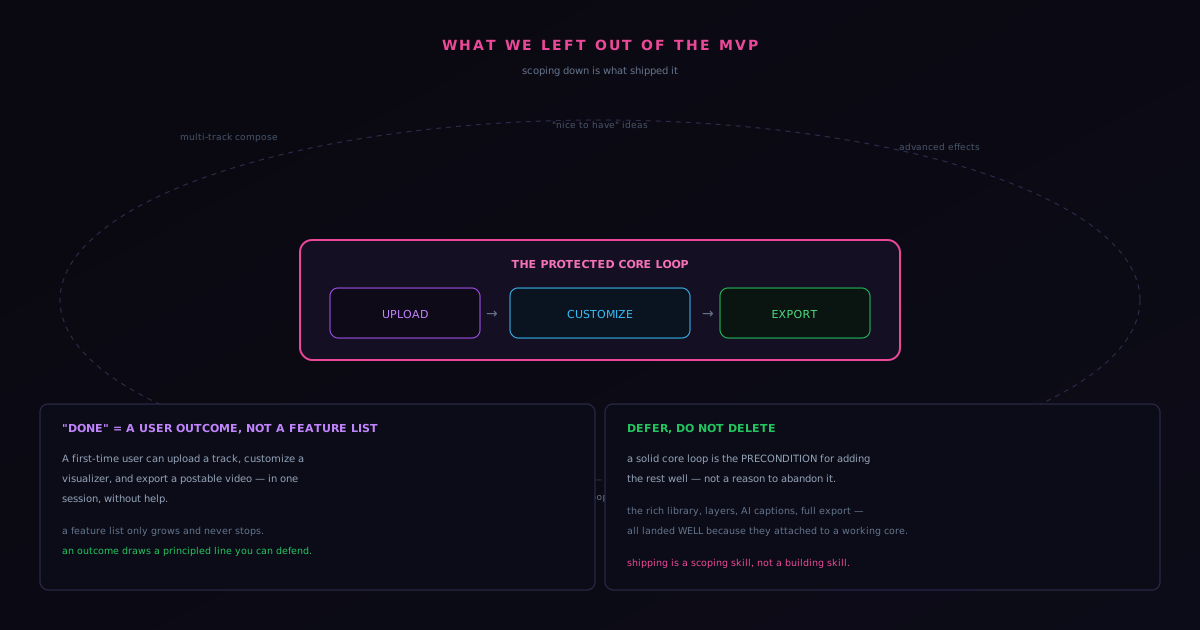
The single most important decision was how to define "done" for the MVP, because that definition is what every scope question gets measured against. The wrong definition is a list of features ("done means it has these twelve things") because that list only ever grows and has no principled stopping point. The definition used instead was a user outcome: a person who has never seen the app can upload a track, customize a visualizer enough to make it feel like theirs, and export a finished video they can actually post, in a single session, without needing help. If a real first-time user could complete that loop reliably, the MVP was done. If they could not, no amount of additional features would fix it.
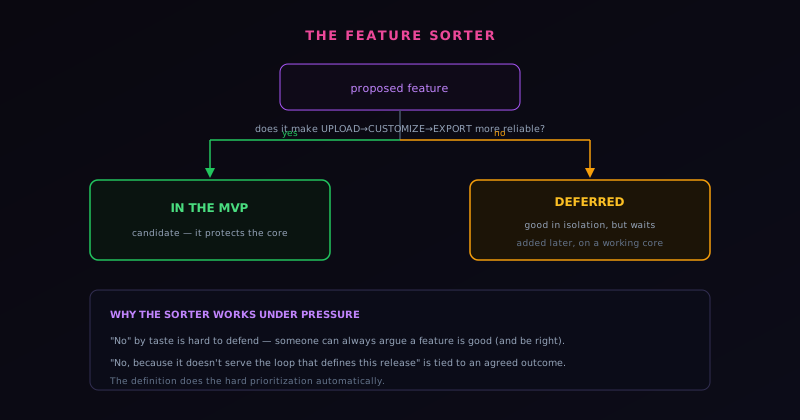
That outcome-based definition is powerful because it immediately sorts every proposed feature into one of two buckets: does this make the upload-customize-export loop more reliable, or does it not? Anything in the first bucket is a candidate for the MVP. Anything in the second bucket, no matter how appealing, waits. The definition does the hard prioritization automatically, which is exactly what you need under the pressure of building, when every idea feels urgent and the temptation is to say yes to all of them. A feature is not judged by how cool it is in isolation but by whether it serves the one outcome that defines the release.
Protecting the core loop
The core loop (upload, customize, export) got the overwhelming majority of the attention, and protecting it meant actively resisting things that would have diluted it. Every hour spent on a feature outside the loop was an hour not spent making the loop itself dependable, and a dependable loop was the whole bet. The reasoning is that a minimal product that delivers reliably on its promise builds more trust than an ambitious product that delivers on some promises while breaking others. A user who completes the core workflow on their first try and gets a usable video forms a positive judgment of the whole product. A user who gets distracted by a half-finished advanced feature and never reaches a finished export forms the opposite judgment, regardless of how impressive that advanced feature looked.
This is why the visible breadth of the product at launch was narrower than the list of things that were technically possible to build. Breadth is a demo asset; reliability is a product asset. A wide product with a shaky core demos well and frustrates real users; a narrow product with a solid core demos modestly and keeps the users it gets. The MVP chose the second profile on purpose, betting that the people who actually completed a visualizer and exported it would be worth more than the people impressed by a longer feature list they never successfully used.
Defer, do not delete
Scoping down is often misread as cutting ambition, but the right frame is sequencing it. The features left out of the MVP were not abandoned; they were deferred, with the explicit intent that the core loop becoming solid was the precondition for adding them well. This distinction matters for morale and for architecture. For morale, "we will build this once the foundation is ready" is a very different message than "we are not building this," and it keeps good ideas alive without letting them derail the release. For architecture, building the narrow core first gives later features a stable thing to attach to: you are extending a working product rather than trying to stabilize a sprawling one.
The evidence that the deferral approach was right is what the product became after the MVP. The capabilities that now make Novus Visualizers rich (the ten engines and their modes, layered editing, captions, the full range of export options) are things that landed well precisely because they were added on top of a core loop that already worked, rather than being crammed into a version one that could not yet reliably get a user from upload to export. Each later capability made the core better instead of competing with it for stability. That is the payoff of deferring rather than deleting: the ambitious version still gets built, just in an order where each piece can actually succeed.
Recognizing the never-ships trap early
The failure mode the MVP scoping avoids has a recognizable shape, and learning to spot it early is more valuable than any single scoping decision. The trap announces itself in phrases: this feature "obviously" has to be in version one, the product would be "embarrassing" without that capability, you "can't launch" until this list is done. Each individual claim sounds reasonable, which is exactly why the trap is so effective: the roadmap grows one defensible addition at a time until launch is perpetually one more feature away. The warning sign is not any single feature but the pattern of the must-have list never shrinking, only growing, as each completed item reveals two more that now seem essential.
Recognizing this early lets you intervene before months are sunk into a version one that never arrives. The intervention is to challenge the word "must": must-have for whom, measured against what definition of done? Almost always, the honest answer is that the feature would be nice and is not actually required for a real user to get real value, which moves it from the launch list to the deferred list. The teams that ship are the ones that notice the must-have list growing without bound and respond by tightening the definition of done rather than by working harder to complete an ever-expanding scope. Seeing the trap for what it is (defensible additions compounding into paralysis) is the first defense against it.
Sequencing as a competitive advantage
It is worth elevating sequencing from a tactic to a genuine advantage, because the ability to decide what to build in what order is one of the clearest differentiators between teams that ship and teams that stall. Two teams with the same ideas and the same skill can have wildly different outcomes based purely on sequencing: the one that builds a narrow, reliable core and extends it ships and learns and improves, while the one that tries to build everything at once stays perpetually pre-launch, learning nothing from real users because there are none. The ideas were identical; the order of building them determined who has a product.
This advantage compounds, because shipping a working core early starts a feedback loop that a never-shipping competitor never gets. Real users reveal what actually matters, which informs which deferred features to prioritize, which produces a better product faster than any amount of pre-launch planning. The team that sequenced well is not just earlier to market; it is learning from reality while the over-scoped team is still guessing. Sequencing is therefore not a minor project-management skill but a strategic capability, and treating the order of building as a deliberate decision (narrow core first, extensions in an order where each can succeed) is a large part of why some teams turn ideas into products and others turn ideas into endless roadmaps. The discipline to sequence is the discipline to ship.
Knowing when a deferred feature is ready
Deferral only works if deferred features actually get built eventually, so the system needs a way to know when a deferred feature's time has come, rather than leaving it in limbo forever. The signal is the precondition the deferral was based on: a feature was deferred because the core loop needed to be solid first, so the feature becomes ready to build when that core is genuinely dependable and the feature can attach to it cleanly. Readiness is not about the feature suddenly becoming more important; it is about the foundation it depends on having become stable enough to build on well.
This is why the deferred list is not a graveyard but a queue ordered by foundation-readiness. Once the upload-customize-export core was reliable, the deferred capabilities (more engines, layered editing, captions, richer export) each had a stable base to attach to, and they were added in turn as the foundation supported them. The discipline is to revisit the deferred list as the foundation matures, pulling features into active development when their preconditions are met rather than either rushing them early or forgetting them entirely. Knowing when to build a deferred feature is the back half of the defer-do-not-delete principle, and it is what ensures scoping down at launch leads to a rich product over time rather than a permanently minimal one. The features wait their turn, and their turn comes when the ground beneath them is solid.
Reliability is the first impression
A reason the narrow-but-reliable MVP beats the broad-but-shaky one comes down to how first impressions form: a user judges a product on whether it delivered on what it promised them, not on the length of its feature list. A first-time user who completes the core loop and gets a usable video forms a positive judgment of the whole product, and that judgment colors everything they encounter afterward. A first-time user who hits a broken feature or fails to reach a finished export forms a negative judgment that no amount of additional capability redeems, because they never got far enough to see it. The first impression is made at the core, which is why the core is where reliability has to be absolute.
This is why breadth at launch is a poor trade against reliability. A wide feature set is a demo asset that impresses in a screenshot, but the actual users who form the product's reputation are the ones trying to complete a real task, and for them a shaky core that breaks mid-task is far more memorable than a missing advanced feature they never reached for. The MVP's narrowness was a bet that the people who successfully completed a visualizer would be worth more than the people impressed by a longer list they never used, and that bet is sound precisely because reliability at the core is what produces the positive first impression that retains users. You only get one first impression, and it is made on whether the basic promise was kept, not on how many promises were listed.
The same discipline across the portfolio
The scoping discipline that shipped the visualizer MVP is not a one-off but a philosophy that recurs across the whole tool portfolio, which is part of why it is worth articulating as a principle rather than a single decision. Each tool in the ecosystem stays deliberately focused on doing one thing well rather than growing into a sprawling suite, and that restraint is the same outcome-based scoping applied at the level of a tool's identity rather than a single release. The question "does this make the core thing more reliable, or does it dilute it" governs not just what goes in version one but what a tool is allowed to become over time.
Seeing the MVP scoping as an instance of a portfolio-wide discipline explains why it is treated so seriously. A team that scopes one product ruthlessly and then lets everything else sprawl has learned a tactic; a team that applies the same focus across every tool has a philosophy that compounds. The visualizer's narrow, reliable launch and its disciplined growth afterward are the same instinct that keeps each tool single-purpose, and that consistency is itself a competitive trait: focused tools that each do one job well, maintained by a small team, rather than bloated suites that do many things adequately. The scoping lesson from the MVP is the local view of an operating principle that shapes the entire portfolio, which is why it generalizes so readily beyond the one product it was learned on.
The counter to feature-creep thinking
Feature creep is not a character flaw; it is the default gravity of building software, and it has to be actively resisted with a principle rather than willpower. The principle here was the outcome-based definition of done, which gave a non-arbitrary way to say no. "No" is hard to say when the only reason is taste, because someone can always argue the feature is good, and they are usually right that it is good in isolation. "No, because it does not make the core loop more reliable and the core loop is what defines this release" is a reason that holds up under pressure, because it is tied to an agreed outcome rather than to one person's judgment in the moment.
The broader lesson, which applies well beyond a music visualizer, is that shipping is a scoping skill more than a building skill. The teams that ship are not the ones that build fastest; they are the ones that decide most clearly what not to build yet. Novus Visualizers reached a real, usable first release because it was willing to look narrower than it could have, protect one workflow until it was dependable, and trust that the rest could be added in an order where it would land well. The same discipline shows up across the Novus tool portfolio, where each tool stays deliberately single-purpose rather than growing into a bloated suite, a philosophy the companion post on resisting feature creep covers directly.
Frequently asked questions
Quick answers to common questions about this topic.
Why leave features out of an MVP?
Scoping down is what makes shipping possible. By deferring everything that was not essential to the core upload-customize-export loop, the team got a real, usable product into users' hands faster, and let actual usage decide what to build next.
How do you decide what to cut from a first release?
Keep what is required for the core promise to work end to end, and defer the rest. The test is whether a feature is needed for a user to finish the central task; if it only adds breadth, it can wait for evidence that people want it.
Does a smaller MVP mean a worse product?
No. A focused MVP that does one workflow reliably beats a broad one that does many things unreliably. Novus Visualizers has since grown well past its MVP, but only along directions real usage validated.
Related workflow
A track to a release-ready visualizer, per platform
Render the visual once, then produce the platform masters from it, instead of re-rendering the whole video for every aspect ratio.
- Render the beat-synced videoNovus Visualizers: Pick the engine and mode against your actual track; the analysis is done on your audio, not on a preset preview.
- Trim or upscale the exportNSS Background Remover: The video utilities handle the tidy-up pass so the render does not have to be repeated to fix ten seconds of it.
- Produce the per-platform mastersNovus Convert: Each destination wants a different container and bitrate; converting the finished render is far cheaper than re-rendering it.
Related troubleshooting
Was this page helpful?
Your answer stays in this browser, it is not sent anywhere and no account or cookie is involved.