2026 · Field notesAbout 11 min readNovus Stream Solutions
Shipping production work with frontier AI
Production-level digital work is reachable with frontier AI when humans keep review, tests, ownership, and rollback. Treat Sol, Fable · Opus 5, and Gemini as capable collaborators, not a ranking.
Contents
- 1.Overview
- 2.Redefine production before you generate anything
- 3.Scope before generate
- 4.The draft → verify → ship loop
- 5.Tests and acceptance gates are the real interface
- 6.Code review habits still apply, even more so
- 7.Docs, content, and design use the same loop
- 8.Silent wrongness is the default hazard
- 9.When not to use AI
- 10.Team and solo operations need different scaffolding
- 11.Changelog honesty beats capability theater
- 12.Content, support, and ops are production too
- 13.Measure outcomes, not prompt folklore
- 14.Interchangeable collaborators, durable process
- 15.A practical checklist before you hit deploy
Overview
Production-level output is now reachable for many digital jobs with frontier AI. That sentence would have been hype two years ago and is still easy to misuse today. The accurate version includes the conditions: humans keep review, tests, ownership, and rollback. Sol, Fable · Opus 5, and Gemini can act as interchangeable capable collaborators depending on the task. None of them absolves you of the duty to know what shipped and why. This guide is about the loop that makes that duty practical rather than theatrical.
The temptation is to equate fluent drafts with finished work. Frontier systems are fluent under pressure. They produce patches, pages, diagrams, and release notes that look like they belong in your repository. Looking like they belong is not the same as belonging. Shipping with frontier AI means redesigning “done” around verification. If you already ship small apps with discipline, AI becomes an accelerator inside that discipline. If you do not, AI becomes a high-speed way to industrialize mistakes.
Redefine production before you generate anything
Production does not mean “the model answered.” It means an artifact that meets a named acceptance gate, survives the checks you trust, and has a person accountable for its consequences. For code, that usually means scoped changes, passing tests, reviewed diffs, and a release path you can reverse. For content, it means factual checks, link validity, voice match, and publishing metadata. For design, it means constraints honored, states covered, and accessibility basics not left as optional polish.
Write the definition of done in plain language before the first prompt. Include what must not change. Include the audience and the risk. Include how you will know the work failed after release. This upfront clarity is more valuable than a clever system prompt. Frontier collaborators optimize for the goal you state. If you state vibes, you get vibes. If you state gates, you get something you can accept or reject without a philosophical debate.
Scope before generate
Unscoped generation is how AI sessions become expensive archaeology. Narrow the job to a verb and a boundary: add validation to this form, rewrite this docs section to match the house voice, propose three layout options for this empty state, fix the failing test without changing public API. Point at files, routes, and examples. State forbidden moves explicitly: no dependency upgrades, no drive-by renames, no new abstractions unless required.
Sol, Fable · Opus 5, and Gemini all handle scoped work better than open-ended “improve the app” quests. Scope is also how you keep models interchangeable. A well-specified task can be handed to whichever system is available or cheapest that day. A vague quest creates tribal knowledge around one model’s conversational style. Prefer portable briefs over mystical prompt folklore.
- Name the artifact and the files or surfaces that may change.
- List acceptance checks that a skeptic could run.
- State constraints and non-goals in the same breath as the goal.
- Time-box the first draft so wandering has a natural stop.
The draft → verify → ship loop
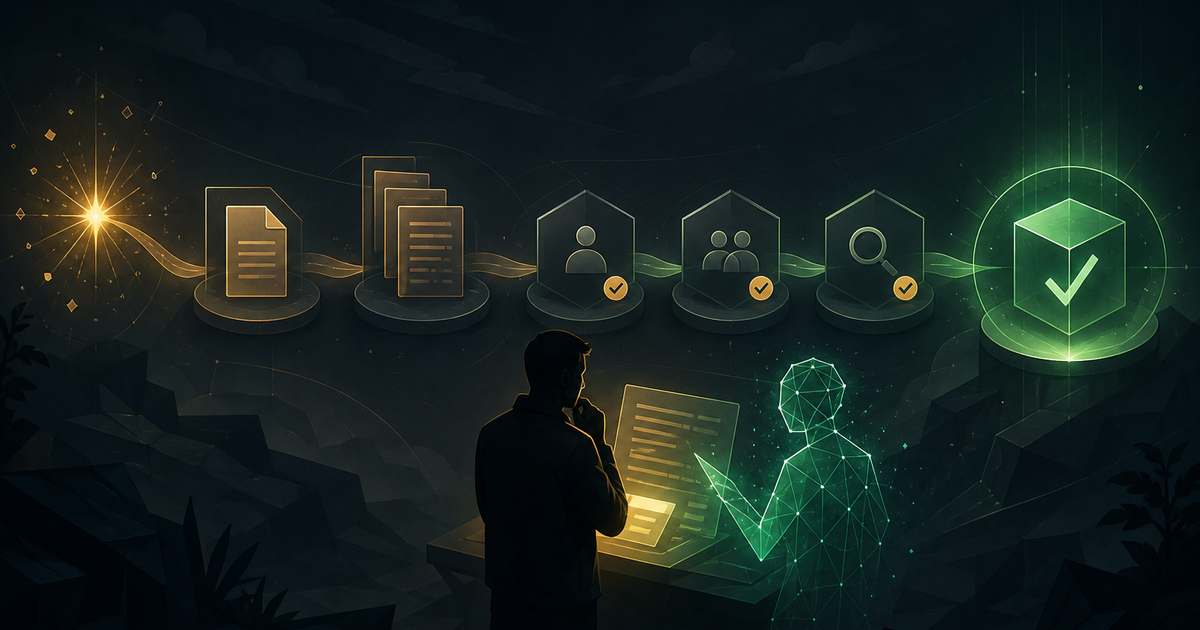
Treat the model’s first useful output as a draft even when it looks final. Verification is a separate phase with different tools: compilers, test runners, browsers, link checkers, design previews, source documents, and human reading for judgment calls. Shipping is a third phase that uses your normal release machinery (branches, previews, changelogs, monitoring), not a special AI bypass. Keeping the phases distinct prevents the common failure mode where generating and shipping collapse into one enthusiastic click.
Iterate inside the loop without losing the plot. If verification fails, feed the failure back as evidence, not as anger. Ask for a minimal fix. Re-run the same gates. If the draft cannot meet the gate after a few cycles, stop and reconsider the approach, the model, or whether the task was specified poorly. Endless regeneration is not diligence; it is a sign the process needs a human decision.
Tests and acceptance gates are the real interface
Frontier AI is most trustworthy when the environment talks back. Unit tests, typechecks, lint rules, visual snapshots, build-time content validation, and scripted smoke checks convert taste into signal. An agent that can run those checks can often correct itself. An agent that only hears “looks good?” will optimize for looking good. Invest in gates that fail loudly. They are not bureaucracy; they are the API between human standards and model speed.
Write acceptance gates for non-code work too. A blog post might require every external link to resolve, every image path to exist, a minimum section count, and a FAQ of fixed length. A design pass might require focus states, empty states, and contrast checks. If a gate cannot be automated, make the manual checklist short and mandatory. The point is to make “done” disagreeable to argue with.
Code review habits still apply, even more so
Review AI-authored diffs with the same suspicion you would apply to a fast junior engineer who writes clean-looking code: check for invented APIs, weakened tests, hidden scope expansion, copy-paste near-duplicates, and “helpful” refactors you did not request. Read the diff hunk by hunk. Run the app. Do not approve because the commit message is eloquent. Eloquence is free now.
Establish review norms for AI assistance. Some teams require the author to state what the model did and what was verified by hand. Some ban merging model-only changes without a local run. Some require smaller pull requests when AI is involved because large generated diffs hide risk. Pick norms you will actually follow. The goal is not to shame AI use; it is to keep ownership visible when the authoring speed exceeds ordinary attention.
Docs, content, and design use the same loop
The shipping loop is not only for code. Frontier systems draft documentation, blog posts, UI copy, and layout options quickly. The verification layer changes shape but not purpose. For docs, compare against the live product behavior, not against the model’s memory. For content, check claims, links, voice, and whether the piece teaches something an operator can use. For design, validate constraints, hierarchy, and states rather than falling for a pretty static frame.
Cross-link your content gates to automation where possible. A build-time validation gate that fails on missing images or dead internal links is exactly the kind of mechanical honesty AI-assisted publishing needs. Humans still judge whether the argument is true and useful. Machines can refuse to ship a broken package. Together they make high-volume publishing safer than either alone.
Silent wrongness is the default hazard
The dangerous outputs are not the obvious nonsense. They are the almost-right patches, the nearly-correct explanations, and the plausible citations that point somewhere adjacent to the truth. Silent wrongness passes casual reading and fails under load, under edge cases, or under a reader who knows the domain. Frontier models increased the polish of wrong answers. Your process must increase the rate at which wrong answers are caught.
Build habits that assume silent wrongness. Independently open every critical source. Prefer runnable checks over narrative reassurance. Ask the model to list uncertainties and then verify those uncertainties yourself instead of trusting the list completely. When something feels oddly easy, slow down. Ease is often the tell that a constraint was dropped somewhere you have not looked yet.
When not to use AI
There are production tasks where AI should be absent or tightly sandboxed. Legal commitments, security-sensitive changes you cannot fully review, secret handling, irreversible data migrations, and situations where the cost of a subtle error dwarfs the time saved are candidates for human-only or human-led work with minimal generation. “The model is smart now” is not a control. If you cannot explain the change and its blast radius, you are not ready to ship it regardless of authorship.
Also skip AI when the work’s value is precisely taste, relationship, or accountability that customers expect to be human. A personal apology, a pricing decision, a strategic bet, or a careful editorial judgment may use AI for research support without outsourcing the call. Knowing when not to use the tool is part of professional use. Unlimited generation is not maturity.
Team and solo operations need different scaffolding
On a team, AI shipping needs shared norms: how to disclose assistance, what must be tested, who reviews, and how incidents are attributed without theater. Without norms, one engineer’s acceleration becomes another engineer’s review nightmare. Keep pull requests smaller, require reproducible verification notes, and agree on which model surfaces are approved for which data classes. Sol, Fable · Opus 5, and Gemini can coexist if the process is shared.
Solo operators need scaffolding that replaces missing reviewers. That usually means stronger automated gates, preview soaks, checklists, and a personal rule that nothing customer-facing ships the same hour it was generated. Solo speed is real; solo blind spots are also real. Use the models as collaborators and use time delays, checklists, and instrumentation as the missing second set of eyes.
Changelog honesty beats capability theater
When AI helps you ship, write changelogs about user-visible outcomes, not about which frontier model drafted the work. Users care that the bug is fixed, the docs are accurate, and the feature behaves. Internal notes can record the collaborator and the verification steps for learning. External notes should stay concrete. Inflating releases with AI mythology trains your audience to discount your updates.
Be honest internally about failures too. If a model-introduced regression shipped, say so in the incident note and tighten the gate that would have caught it. Blaming the vendor alone teaches nothing. Blaming yourself alone without changing the process also teaches nothing. The useful artifact is a sharper loop: better scope, better tests, better review prompts, clearer ownership.
Content, support, and ops are production too
Production is not only the deploy button. A tutorial that teaches the wrong route, a support reply that invents a policy, or a changelog that misstates a breaking change can damage users as surely as a bad release. Apply the same draft → verify → ship loop to those artifacts. For content, verification means clicking the paths, checking screenshots against the live UI, and confirming claims against docs. For support, it means policy lookup before improvisation. For ops scripts, it means dry runs and restricted credentials.
Frontier systems are especially tempting here because the first draft often sounds finished. That fluency is exactly why a second pass is mandatory. Sol, Fable · Opus 5, and Gemini can draft a calm, confident answer that is subtly wrong about billing, privacy, or product status. The operator who ships that answer owns the consequence. Treat non-code production with the same seriousness you would give a database migration: clear brief, verified claims, named owner, and a way to correct the record quickly.
The same standard applies to design drafts and marketing copy. An interface mock that looks polished can still violate accessibility, brand, or product constraints. A landing paragraph that reads well can still overpromise. Require an acceptance check for those artifacts too: contrast, keyboard path, factual claims, and a second human pass when the audience is large. Production quality is a property of the delivered experience, not of the medium that produced the draft.
If your week includes a mix of code, docs, support, and design, give each stream its own verification habit instead of one vague promise to “be careful.” A five-minute path click-through, a policy lookup, a contrast check, and a scoped diff review are cheap compared with a public correction. Frontier AI makes drafting abundant; your process must make verification routine.
Measure outcomes, not prompt folklore
Measure what matters after release: defect rate, time-to-merge for scoped tasks, incident frequency, content correction rate, support burden, and cost per successful artifact. If AI assistance increases throughput while those indicators stay stable or improve, you have a real gain. If throughput rises and incidents rise with it, you have accelerated risk. Frontier branding will not save a process that cannot see its own outcomes.
Avoid optimizing for prompt cleverness as a status game. Portable briefs, strong gates, and boring verification beat a private library of magic incantations. When a new model version arrives, whether Sol, Fable · Opus 5, Gemini, or the next name in the race, rerun the same measurement set. Keep the winners that move outcomes. Discard rituals that only move feelings.
Interchangeable collaborators, durable process
The healthy stance in 2026 is pragmatic pluralism. Use whichever frontier system fits the task today. Do not marry a ranking. Do not rewrite your engineering culture every time a demo lands on social media. Keep Sol, Fable · Opus 5, and Gemini behind the same walls: scoped briefs, verification gates, human ownership, and rollback. That is how production stays production while capability keeps moving.
If you need a single sentence to operate by, use this one: the model may draft the work, but only a person can ship it. Everything else in this guide is machinery to make that sentence true under deadline pressure. Build the machinery once. Let the models compete inside it. Ship the artifact you can defend.
A practical checklist before you hit deploy
Before release, confirm the acceptance gate written at the start still matches what you built. Confirm tests or equivalent checks ran against the final artifact, not an earlier draft. Confirm the diff is scoped. Confirm secrets and private data were handled under policy. Confirm a rollback or fix-forward path exists. Confirm a human can explain the change in one plain paragraph. If any confirmation fails, you are not shipping late; you are shipping honestly later.
This checklist is deliberately unromantic. Frontier AI already supplies the romance: speed, fluency, the feeling that a week of work arrived in an afternoon. Your job is to supply the friction that keeps reality attached. Do that, and production work with frontier AI is not a slogan. It is a repeatable operating habit for solo builders and small teams who intend to still be proud of what they shipped next month.
- Acceptance gate named and still applicable.
- Independent verification completed on the final artifact.
- Diff or deliverable scoped to the requested job.
- Privacy, cost, and permission boundaries respected.
- Owner named, rollback known, changelog concrete.
Frequently asked questions
Quick answers to common questions about this topic.
Can frontier AI really produce production-level work?
Yes for many digital jobs (code, docs, content, design drafts) if humans define scope, verify artifacts, run tests or acceptance checks, retain ownership, and keep a rollback path. The model drafts; the operator ships. Without those controls, polished output is still a draft with unknown risk.
Which model should I use: Sol, Fable · Opus 5, or Gemini?
Treat them as interchangeable capable collaborators and choose by task fit, latency, cost, privacy, and tool integration, not by a permanent ranking. Keep your verification loop constant so switching models does not mean inventing a new process.
What is the minimum shipping loop for AI-assisted work?
Scope the job and acceptance gate, generate a draft, verify with independent checks (tests, previews, source comparison, design QA), review the diff like a teammate wrote it, ship behind the normal release path, and watch outcomes with an easy rollback. Skip any of those and you are gambling on eloquence.
When should I not use AI on a production task?
Skip or tightly constrain AI when requirements are legally sensitive, when you cannot verify the output, when the blast radius of a subtle error is high, when secrets cannot be safely handled, or when the work’s value is precisely the human judgment AI tends to flatten. Speed is not a reason to bypass ownership.
Related troubleshooting
Was this page helpful?
Your answer stays in this browser, it is not sent anywhere and no account or cookie is involved.