2026 · Novus Stream Solutions (hub)About 13 min readNovus Stream Solutions
How we ship and test small apps without a full team
A behind-the-scenes look at the Novus approach to building and validating apps with a lean team: fast cycles, real usage data, and clear criteria for what stays in the portfolio.
Contents
- 1.Overview
- 2.What the build cycle actually looks like
- 3.How we validate with real usage instead of surveys
- 4.The criteria for what stays in the portfolio
- 5.What small teams can take from this approach
- 6.The feedback loop between shipping and roadmap decisions
- 7.What maintenance mode means for products that have found their fit
- 8.Why we call it a free-apps studio
- 9.Activation as the metric that matters
- 10.Shipping the narrow version without cutting corners
- 11.Deciding to cut a product without calling it failure
- 12.The three-mode workflow behind each release
Overview
Novus Stream Solutions is a free-apps studio. We build free, ad-supported apps that rival (and often surpass) paid alternatives, removing the paywalls that block you from exporting or using a feature, and we build them with modern AI tooling at the core of how we work. That framing is deliberate and operational: we build small, useful digital products, ship them into real usage conditions, measure what happens, and decide what to grow and what to move on from. It is not marketing language; it is how we make product decisions. It means we do not spend years building in secret hoping to get everything right before anyone sees it. We ship early, learn from real behavior, and iterate from evidence rather than speculation.
The practical challenge of this approach for a small team is shipping without cutting corners on quality. Fast does not mean careless. The products in the Novus portfolio stay live because they work reliably for what they claim to do, not because they are feature-complete. This is a meaningful distinction. A minimal product that delivers on its promise builds more trust than an ambitious product that delivers on some promises while breaking others.
What the build cycle actually looks like
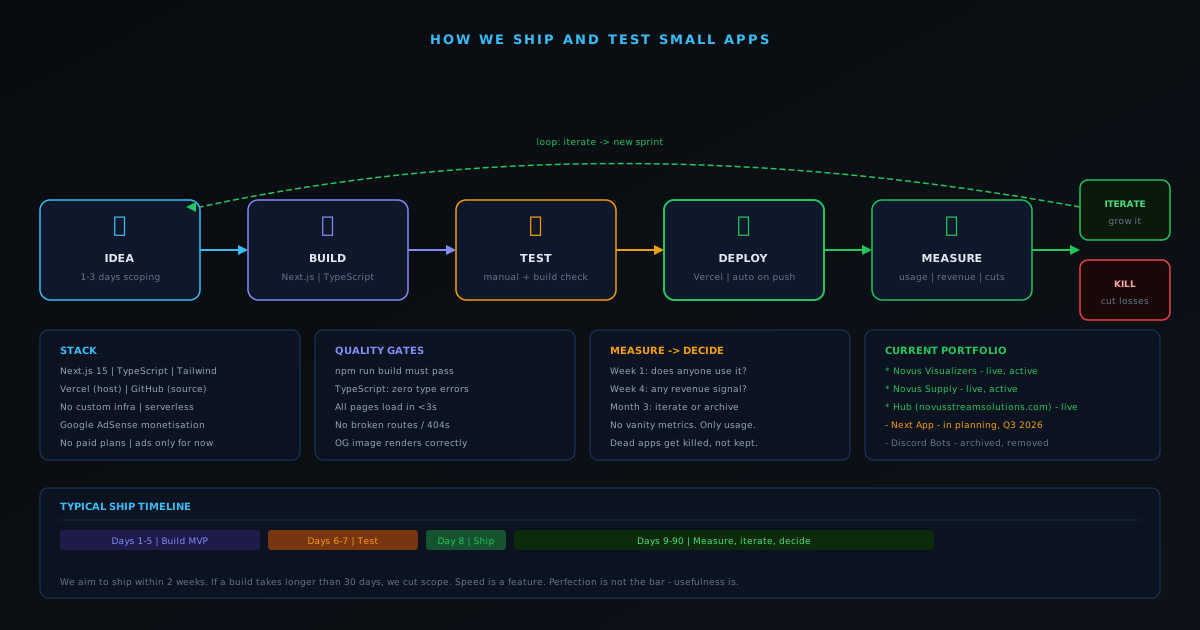
Every product starts with the narrowest version of the useful thing. For Novus Visualizers, the narrowest version is: upload music, customize a visualizer, export a video. Not forty export formats, not real-time collaboration, not a library of a hundred templates. The upload-edit-export loop. If that loop works reliably and users can complete it without friction, the product is ready for the next layer. If it does not work reliably, adding more features makes the problem worse rather than better.
This approach requires resisting the pull toward completeness that hits every product team at some point. The feeling that one more feature, one more option, one more configuration would make the product ready is almost always a delay mechanism rather than a quality signal. The discipline is shipping the narrow version and measuring whether users can do the thing the product is supposed to help them do. That measurement tells you more about what to build next than any planning document does.
How we validate with real usage instead of surveys
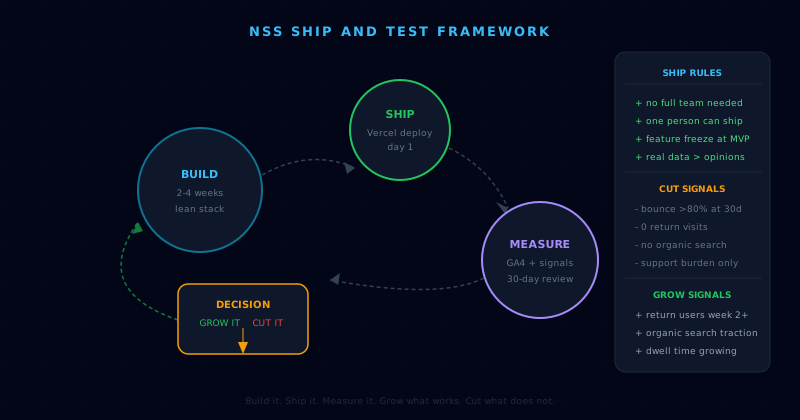
The most reliable signal about whether a product is working is what users actually do with it, not what they say they would do with it. We track activation events (did the user complete the primary workflow?) rather than counting signups or measuring session length in isolation. A product with a 90 percent trial-to-activation rate is healthier than a product with 10 times the signups and a 15 percent activation rate, even if the latter looks bigger on a dashboard.
Real usage data also surfaces failure modes that no one would have predicted in planning. A step that seems obvious in the product interface creates consistent confusion when tested by people who have no context for how the product was designed. A feature that seemed secondary turns out to be the one users attempt first. These discoveries require live users, not mock tests or pre-launch focus groups. We accept that the first version will have rough edges in places we did not anticipate, because discovering those edges in production with real users is more valuable than discovering them in a longer build cycle that still could not have predicted them all.
The criteria for what stays in the portfolio
Not every product earns a permanent place in the portfolio. The criteria for staying are simple: the product does what it claims, users can figure out how to use it without significant hand-holding, and there is evidence of real usage rather than just initial signups. A product that checks all three criteria gets continued investment and development. A product that fails consistently on one of those criteria gets a defined improvement window and then a decision about whether to fix, pivot, or cut.
Cutting a product is not failure in our model; it is the system working correctly. A product that does not earn its place should not continue occupying development attention and operational infrastructure. The honest acknowledgment that something did not work and the decision to redirect that energy is what allows the studio to keep the rest of the portfolio sharp. Every product in the current Novus portfolio has passed its own version of this evaluation, which is why the portfolio is small enough to actually maintain well.
What small teams can take from this approach
This operating model is not unique to Novus; it is what allows small teams to compete with larger organizations that have more resources but slower decision cycles. When you can ship a minimal product in weeks rather than months, you can run more experiments per year, accumulate more real-world evidence, and make better-informed investment decisions about where to focus. The constraint of a small team forces the discipline of the narrow version: you cannot build everything, so you have to build the most important thing first.
The practical implementation starts with honest scoping. Define the smallest version of the product that delivers genuine value on its own. Resist adding dependencies that are nice-to-have rather than necessary. Ship that version to real users as quickly as the quality floor allows, not to production by default, but to a meaningful population who will actually use it. Then measure activation, not just arrival. The products that get better over time are the ones where the team closes the loop between what shipped and what users did with it, consistently, without skipping the measurement step when results are uncomfortable.
The feedback loop between shipping and roadmap decisions
The build-ship-measure model only delivers its full value if real usage data actually changes what gets built next. A team that ships a product, collects user behavior data, and then builds the next feature from a planning document rather than from the data has broken the loop. The measurement step is only worth doing if its outputs create decisions: priorities shifted, features deprioritized, workflows simplified based on where users actually struggled. When that connection is genuine, the roadmap becomes a live document updated by evidence rather than a plan updated by stakeholder preference.
Keeping the feedback loop short is the operational discipline that makes this work at small-team scale. Long cycles between shipping and roadmap revision mean that early user behavior is already months old when it informs the next decision, which reduces its relevance. A lightweight monthly review of activation data, support ticket patterns, and direct user feedback against the current roadmap is enough to maintain a live connection between what shipped and what comes next, without requiring a dedicated analytics function to generate insights.
What maintenance mode means for products that have found their fit
Not every product in the portfolio needs to be in active feature development at all times. A product that reliably does what it claims, generates consistent usage, and requires low support volume has earned the right to enter a lower-intensity investment phase (maintenance mode) while development attention goes to products that are still finding their fit. Maintenance mode is not neglect; it means keeping the product operational, secure, and accurate, fixing bugs when they surface, and updating documentation as the surrounding ecosystem changes.
Recognizing when a product is ready for maintenance mode is itself a judgment call. The signal is stabilization across the metrics that matter: activation rate plateauing at a high level, support volume low and consistent, and no significant user feedback pointing to unresolved friction. A product that reaches this state without having been cut has proven its value in the portfolio. The studio model succeeds when it produces a small number of stable, well-maintained products alongside a healthy pipeline of new products under active evaluation, not when every product is perpetually under heavy development regardless of its maturity stage.
Why we call it a free-apps studio
The "free-apps studio" label is deliberate and operational rather than a marketing flourish, because it describes precisely what we do and how product decisions get made: we build free, ad-supported apps that rival (and often surpass) paid alternatives, removing the paywalls that block you from exporting or using a feature, and we decide what to keep by building a small useful thing, shipping it into real usage, measuring what happens, and choosing to keep, kill, or double down based on the evidence. Framing the work as a studio that ships free apps under real conditions treats each product as a hypothesis tested against actual user behavior rather than a bet placed and defended regardless of how it performs. This framing is honest about the uncertainty inherent in building products and disciplined about resolving that uncertainty with evidence rather than conviction.
The studio framing also sets the right expectations internally and externally about what success and failure mean. When each app is an experiment, a product that does not work is not an embarrassment to be hidden but a result to be acted on: the experiment ran, the evidence came in, and the decision follows. This removes the sunk-cost pressure to keep defending a product that the evidence says is not working, because the model treats cutting a product as the system functioning correctly rather than as a failure to be avoided. Describing the operation as a free-apps studio built with modern AI tooling is therefore not just a description but a commitment to a way of working: ship to learn, measure honestly, and let the evidence drive the keep-kill-double-down decision, which is the discipline that lets a small team build effectively without the institutional attachment that keeps larger organizations defending products their own data has already judged.
Activation as the metric that matters
The single metric that the studio treats as authoritative is activation (did the user actually complete the core workflow the product exists to enable) rather than the signup counts and session-length figures that flatter a dashboard without indicating whether the product works. A product with a high activation rate, where most users who try it successfully do the thing it is for, is healthier than a product with many times the signups and a low activation rate, even though the latter looks bigger by the vanity metrics. Activation is the metric that matters because it measures whether the product delivers its value, which is the only thing that ultimately determines whether it has a reason to exist.
Focusing on activation rather than arrival changes what gets optimized and what gets built next, directing effort toward the path from signup to value rather than toward maximizing the top of the funnel. When activation is the metric, the questions become where users drop off before reaching value and what friction prevents completion, which point directly at the improvements that actually matter. A team optimizing signups might pour effort into acquisition while the product quietly fails to activate the users it attracts; a team optimizing activation fixes the product so the users who arrive succeed. Treating activation as the metric that matters is therefore the measurement discipline that keeps the studio honest about whether its products work, since activation reveals the truth that signups conceal: whether the people who tried the product actually got the value it promised, which is the difference between a product that is growing and one that is merely accumulating arrivals who leave without succeeding.
Shipping the narrow version without cutting corners
The studio ships the narrowest useful version of a product first, but narrow is not the same as careless, and holding that distinction is one of the harder disciplines of the approach. Shipping narrow means the product does fewer things, not that it does them badly: the upload-edit-export loop of a visualizer is a narrow scope, but it has to work reliably for the narrow product to be worth shipping. The corners that must not be cut are the ones that determine whether the core thing works: reliability, clarity, and the quality of the essential workflow. A narrow product that does its one job dependably builds trust; a narrow product that does its one job unreliably destroys it, which is why narrow scope and high quality on that scope have to go together.
The temptation that shipping narrow has to resist is not the temptation to add features (that pull is toward breadth, which the narrow scope deliberately rejects), but the temptation to cut quality to ship faster, which would undermine the whole premise. The value of shipping narrow is that it lets a small team deliver something that works well by concentrating its limited capacity on a small surface, which only pays off if that small surface is genuinely solid. Shipping a narrow product with cut corners gets the worst of both worlds: limited capability and unreliable execution. The discipline is therefore to keep the scope narrow and the quality high simultaneously, delivering a product that does little but does it well, which is the combination that makes the studio's minimal first versions worth shipping rather than embarrassing. Narrow without cut corners is the standard, because narrow with cut corners would fail the trust test that even a minimal product has to pass.
Deciding to cut a product without calling it failure
One of the hardest and most important disciplines in our model is deciding to cut a product that has not earned its place, and doing so without treating the decision as a failure to be mourned or avoided. A product that consistently fails its criteria (does not do what it claims, cannot be used without heavy hand-holding, shows no real usage beyond initial signups) should not continue consuming the development attention and operational infrastructure that the rest of the portfolio needs. Cutting it is the system working correctly: the experiment ran, the evidence said it was not working, and the decision redirects the energy to where it can produce more value. This is fundamentally different from failure; it is the resolution of an experiment that resolved negatively.
Framing the cut as a correct decision rather than a failure is what makes the model actually function, because a team that treats every product as something that must succeed will keep defending products the evidence has already judged, which sacrifices the rest of the portfolio to sunk-cost attachment. The honest acknowledgment that something did not work, and the willingness to redirect that energy, is precisely what keeps the surviving products sharp and the operation focused. Every product currently in the portfolio earned its place by passing the evaluation that others failed, which is why the portfolio is small enough to maintain well. Deciding to cut a product without calling it failure is therefore the discipline that protects the whole operation, because the alternative (keeping every product regardless of evidence) would spread the small team's limited capacity across a growing collection of products that do not work, which is how a free-apps studio degrades into an unfocused sprawl that maintains nothing well.
The three-mode workflow behind each release
Behind the studio's shipping discipline is a concrete development workflow that runs each change through three distinct modes (expanding the prompt or intent, planning the implementation, and then coding) with the planning pass treated as non-negotiable because skipping it is where rework comes from. This three-mode structure separates the thinking from the doing: the first mode clarifies what is actually being built, the second decides how before any code is written, and the third executes against that plan. The discipline is that the planning mode cannot be skipped in the rush to code, because a change that goes straight from intent to implementation without the planning pass reliably produces the rework that costs more than the planning would have.
The three-mode workflow is what lets a small team ship frequently without the chaos that unstructured fast shipping produces, because it front-loads the thinking that prevents downstream mistakes. Pairing this with deploys that ride preview environments (so a change can be promoted or rolled back without an incident) keeps the cost of shipping low enough that the studio can run many small experiments rather than a few large bets. The workflow stays deliberately lightweight, the minimum structure that keeps work moving and prevents the rework-generating shortcuts, rather than heavy process that would slow a small team down. The three-mode workflow behind each release is therefore the operational mechanism that makes the studio's rapid, evidence-driven shipping sustainable, providing just enough structure (clarify, plan, code) to ship fast without the rework and incidents that skipping the structure would produce, which is exactly the balance a small team needs to run many experiments without drowning in the consequences of unstructured speed.
Related troubleshooting
Was this page helpful?
Your answer stays in this browser, it is not sent anywhere and no account or cookie is involved.