2026 · Novus VisualizersAbout 14 min readNovus Stream Solutions
Novus Visualizers: the MVP launch path for turning uploaded music into exportable videos
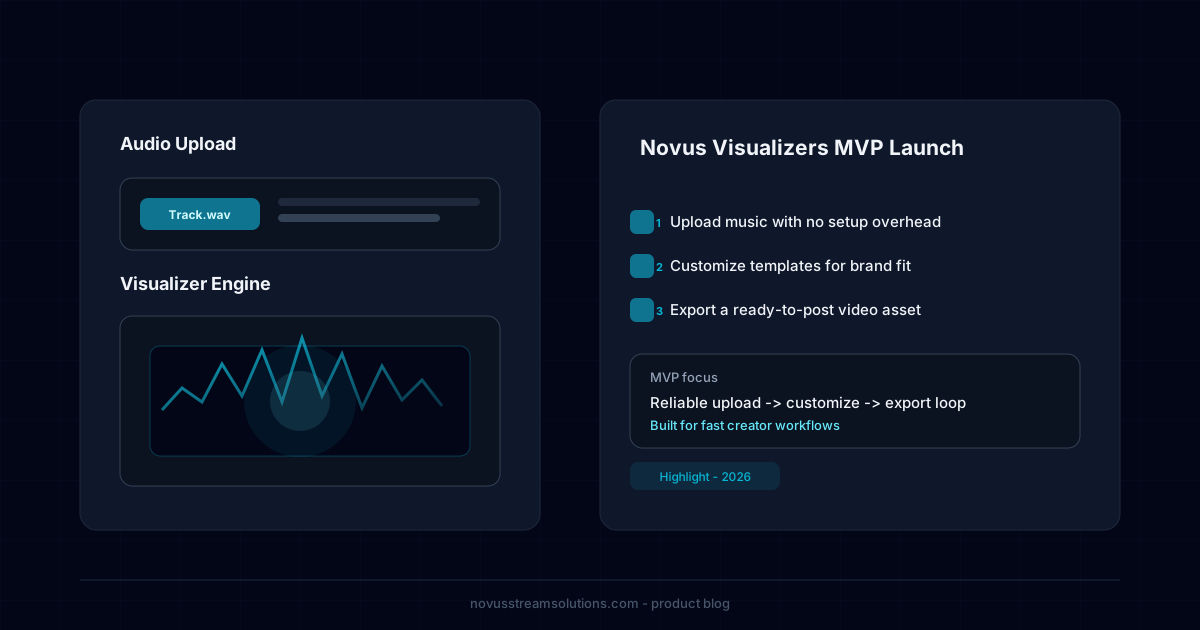
visualizers.novusstreamsolutions.com is our new music visualizer app: upload a track, customize a visualizer, and export a finished video from one focused workflow.
Contents
- 1.Overview
- 2.Why this product belongs in the Novus portfolio now
- 3.What the MVP is designed to do well first
- 4.How we are positioning the release publicly
- 5.What users can expect as the app develops
- 6.Integrating Visualizers into a repeatable content release workflow
- 7.Next capabilities on the Visualizers roadmap
- 8.The upload-first interaction model and why it matters
- 9.Choosing a narrow scope on purpose
- 10.Where Visualizers sits beside the hub
- 11.What release-ready video actually means for creators
- 12.Measuring the MVP by completion, not feature count
- 13.Where the MVP ended up
- 14.The accounts reversal
Overview
Novus Visualizers exists because too many music-video workflows are heavier than they need to be. A creator finishes a track, knows they need a visual asset, and then gets pushed into a chain of tools that were designed for full production houses or deep motion-design specialists. The result is usually one of two bad outcomes: either the artist settles for a generic output they do not really want, or they lose hours rebuilding a simple visualizer concept across software that was never optimized for this job. The MVP direction for Novus Visualizers is a direct answer to that gap.
The core promise is simple and intentionally narrow: upload the music, customize a visualizer, and export a video you can actually use. That is the workflow we want to make dependable first. The app is not trying to pretend it replaces every advanced editing suite on day one. It is trying to eliminate the waste between a finished track and a presentable visual result, especially for artists, marketers, and operators who need a fast route to a branded deliverable.
Why this product belongs in the Novus portfolio now
The Novus ecosystem already had strong edges around distribution and operations. The missing layer was media packaging: a product that helps turn an audio release into an asset that can move through the rest of the system. Visualizers fills that role cleanly. It gives creators a way to produce an exportable video that can then be posted, embedded, announced, or reused across the other Novus surfaces without forcing them into a production stack that is far more complex than the task requires.
That is why the timing makes sense even in the middle of a major website update. The hub is being refreshed to better explain the ecosystem, and this app gives the portfolio a concrete new spoke with an immediately understandable use case. When someone lands on the portfolio, ventures page, docs, or product blog, the story becomes more complete: Novus is not only about the channels where creators communicate, but also about helping them prepare the assets those channels need.
- Upload audio into a guided creation flow instead of starting from a blank editing environment.
- Begin from an editable visualizer direction rather than hand-animating a full video from zero.
- Export a finished asset that is ready for distribution, review, or promo use.
What the MVP is designed to do well first
The first release should be judged by reliability and speed, not by how many edge-case controls can fit into a sidebar. If users can upload a track, choose a visual starting point, customize the visual output enough to make it feel on-brand, and export a clean video without fighting the interface, the MVP is doing its job. That is a meaningful product outcome already. It turns a repetitive, deadline-heavy creative task into a process that feels structured and repeatable.
That focus also creates a healthier roadmap. Instead of expanding in random directions, the app can deepen around the real creation loop: stronger previews, richer editing options, better asset handling, more export flexibility, improved project persistence, and eventually broader collaboration or review workflows. Starting from a stable upload-edit-export path gives those future additions something solid to attach to. Starting from a chaotic all-things-for-all-users launch would do the opposite.
How we are positioning the release publicly
The public site should talk about Novus Visualizers with disciplined confidence. We know what the app is for. We know the domain. We know the primary user action. We know the MVP direction. That is enough to publish strong messaging right now. The right tone is not vague teaser copy and not inflated "everything platform" language. It is concrete: this is a music visualizer app where users upload music, customize the visualizer, and export a video from a guided workflow that is being brought to MVP completion.
That positioning is also why documentation and the launch article serve different jobs. The docs explain how the product is supposed to work and what users should expect during the MVP phase. This article is the narrative layer: why the product matters, why it is arriving now, and what principle is guiding the release. If the site stays consistent on that split, it will feel more mature through the update cycle and easier for search, support, and users to understand.
What users can expect as the app develops
Transparency about roadmap direction is more trustworthy than silence. The MVP phase is exactly that: a defined, limited scope with a clear purpose. Users who try the app during this phase should understand they are working with a version optimized for the core workflow rather than a finished product with every edge case solved. That context lets them evaluate it fairly and use it confidently for what it is designed to do well now.
As the upload-edit-export loop becomes more reliable, the development roadmap will expand around that core. Stronger preview capabilities, richer customization controls, more export format flexibility, and eventually collaborative review workflows are natural directions. The principle throughout is that new capabilities should make the core loop better, not distract from it. Users who bookmark the Novus Visualizers docs page will find changes documented as they ship; the changelog at novusstreamsolutions.com tracks ecosystem milestones including Visualizers updates as they happen.
Integrating Visualizers into a repeatable content release workflow
The highest-value use of Novus Visualizers is not as a one-off tool for a single release; it is as a consistent component of a recurring content production workflow. Creators who build Visualizers into their standard release cadence get compounding value: each track they release has a visual asset that can move through the same distribution channels without requiring the creator to rebuild a production process from scratch every time. The first few sessions will feel slower as the workflow gets established; by the third or fourth release, the time-from-export-to-posted should be significantly shorter than any alternative approach.
Building the workflow means defining where Visualizers sits in your release calendar (typically between final audio delivery and the promotional push) and deciding which export settings are your defaults before you open the project. Creators who choose consistent visual identity settings (color palette, animation style, export resolution) across releases build a recognizable visual brand without actively managing it. The consistency is a byproduct of the documented defaults, not an additional creative effort on each project.
Next capabilities on the Visualizers roadmap
The next capabilities in the Visualizers development plan follow directly from what early users struggled with in the MVP. Richer template options that give users more visual starting points without requiring custom design skill. Faster preview rendering so creators can evaluate options without committing to a full export. Improved file format guidance at the upload step to reduce the confusion that generated the largest share of early support requests. These are not ambitious feature additions; they are quality improvements to the core loop, which is exactly where post-MVP investment should go.
Beyond the core loop improvements, the roadmap includes export flexibility for different platform specifications, project persistence so creators can return to a saved configuration across sessions, and eventually a way to share or duplicate settings across projects for teams and creators managing multiple releases simultaneously. None of these are committed ship dates; they are the direction the product is heading based on real usage evidence. The Novus changelog will document capabilities as they ship rather than as they are planned, so the most accurate picture of current Visualizers functionality is always what the docs and changelog say, not what any roadmap preview suggests.
The upload-first interaction model and why it matters
Most creative tools start with a blank canvas and ask the user to build, which is the right model for open-ended creation but the wrong one for a focused task like turning a finished track into a visual asset. Novus Visualizers inverts this: the user uploads their audio first, the app analyzes it, and then presents visualizer options already fitted to that track's characteristics. This upload-first model changes the creative experience from imagining how music might fit a scene to choosing among options that already respond to the specific track, which is both faster and less intimidating for the many creators who are not motion designers and do not want to start from nothing.
The upload-first decision shapes the entire feel of the product because it meets the user where they actually are: they have a finished track and a need for a visual, not a desire to design an animation from scratch. By analyzing the audio up front and presenting responsive starting points, the app does the work of bridging from the music to the visual, which is exactly the work that makes generic visualizer tools frustrating. The user's creative input then becomes customization of something that already works rather than construction of something from zero, which is the right division of effort for the job. This interaction model is a large part of why the MVP can deliver on its promise of a fast route from track to usable video, because it removes the blank-canvas paralysis that makes the alternative tools feel heavier than the task requires.
Choosing a narrow scope on purpose
The MVP scope (upload, customize, export) is deliberately narrow, and the discipline to keep it that way was one of the harder parts of the build, because every product team feels the pull toward adding the one more feature that would make the product more impressive. Real-time preview without buffering, multi-track composition, a library of a hundred templates, deep custom waveform design: each would have made the product look more capable in a demo, and each would have delayed the core workflow becoming reliable. Choosing the narrow scope meant accepting that the first release would do less in order to do the essential thing well, which is the trade that lets a small team ship something dependable rather than something sprawling and fragile.
The narrow scope also produces a healthier roadmap, because a stable core loop gives future features something solid to attach to. Rather than expanding in random directions to fill out a feature list, the product can deepen around the real creation loop (better previews, richer customization, more export flexibility, project persistence), each addition making the proven core better rather than diluting attention across an unfinished surface. Starting from a reliable upload-edit-export path means every subsequent feature is built on a foundation that works, whereas starting from a broad, shallow launch would have meant building on an unstable base where nothing was quite finished. The narrow scope is therefore not a limitation to apologize for but the deliberate foundation that makes everything built on top of it more likely to work, which is exactly the discipline our free-apps studio approach is built to enforce.
Where Visualizers sits beside the hub
Novus Visualizers does not exist in isolation; it fills a specific gap in the Novus ecosystem that the other pieces did not cover. The hub handles the narrative and reference layer, and the missing piece was media packaging: a way to turn an audio release into a distributable visual asset that could then move through the rest of the system. Visualizers fills that role cleanly, giving creators a way to produce an exportable video that can be posted, embedded, or reused across the other surfaces without forcing them into a production stack far heavier than the task warrants. The product makes sense as a portfolio addition precisely because it completes a capability the ecosystem was missing rather than duplicating one it already had.
This positioning also clarifies what Visualizers is and is not trying to be. It is not attempting to replace full production suites or become an everything-platform for video; it is the focused media-packaging spoke that turns audio into a shareable asset, sitting alongside the hub. When someone encounters the Novus portfolio, Visualizers makes the ecosystem story more complete: Novus is not only about where creators communicate, but also about helping them prepare the assets those channels need. Understanding where Visualizers sits relative to the hub is what keeps its scope honest: it is one well-defined spoke with a clear job, which is exactly the shape that lets a small team maintain it well rather than a sprawling product trying to be everything to everyone.
What release-ready video actually means for creators
The promise of an exportable, release-ready video is more specific than it sounds, because a video that technically exports but needs additional processing before it can be posted has not actually saved the creator the time the tool promised. Release-ready means the export is in a format and at a quality that drops directly into the creator's distribution channels without a further editing or conversion step. The platform-specific export presets (proportioned and capped for the destinations creators actually use) exist precisely so the output matches where it is going, rather than producing a generic file the creator then has to reformat for each platform. The video that comes out is the video that gets posted, which is the difference between a tool that saves time and one that merely relocates the work.
Delivering genuinely release-ready output is what validates the whole premise of the product, because the entire point is to eliminate the waste between a finished track and a presentable visual result. A tool that produced almost-ready video would reintroduce exactly the friction it was meant to remove, sending the creator back into the heavier editing tools to finish the job. By exporting video that is actually ready for the destination (correct proportions, sensible resolution and frame rate, a format the platform accepts), Visualizers keeps the creator inside the fast path from track to posted asset. Release-ready is therefore not a marketing adjective but a functional requirement that the export pipeline has to meet for the product to deliver its core value, which is why the export presets and the format choices are treated as central to the product rather than as an afterthought.
Measuring the MVP by completion, not feature count
The right way to judge the Visualizers MVP is not by how many features it has but by whether users can actually complete the core workflow, which is a fundamentally different success criterion than feature count. A user who uploads a track, customizes a visualizer to feel on-brand, and exports a usable video without fighting the interface represents a successful outcome, regardless of how many advanced controls the sidebar lacks. Measuring by completion keeps the focus on whether the product does its essential job reliably, rather than on whether it can list an impressive number of capabilities that may or may not contribute to anyone actually getting a video made.
This completion-focused measurement also drives the roadmap in the right direction, because the data on where users succeed and where they drop off points directly at what to improve. Users who complete the core workflow are far more likely to return than users who hit friction before finishing, which means the highest-value improvements are the ones that raise the completion rate (making the core loop more reliable, faster, and clearer) rather than adding adjacent features before the center is solid. Judging the MVP by completion rather than feature count is what keeps the product honest about whether it is actually serving creators, since a feature-rich tool that users cannot navigate to a finished video is failing at its only real job, while a focused tool that reliably gets users from track to export is succeeding even with a modest feature set.
Where the MVP ended up
This post describes an MVP that turned an uploaded track into an exportable video. Judged by the standard it set for itself (completion rather than feature count), it worked, and what came after is worth recording because two of the changes reversed decisions made here.
The visual system settled into nine engines carrying six modes each: Particles, Trails, Bloom, Character Motion, Radial, Spectrum, Bars, Tunnel, and Waveform, for 54 named modes in total. That number went up and then down. A July rebuild expanded to 24 engine families across four dimensions (96 combinations), and the following release consolidated back to nine engines and 54 modes, because a catalog that large made choosing harder rather than easier and most of the combinations were variations nobody was reaching for.
The editor split in two rather than growing one surface: a guided Classic editor and a node-based Studio workstation, sharing one saved document and one deterministic renderer so the preview always matches the export. Beat-sync was rebuilt across all nine engines with deterministic timing, so the same track and seed land the same hits every render.
The accounts reversal
The bigger reversal was accounts. Visualizers spent a stretch of 2026 deliberately account-free, and then added accounts, which sounds like a retreat and was not, because of what they were added for.
Nothing was put behind them. Creating, editing, and exporting still work as a guest, watermark-free and unmetered, and billing and export quotas were removed outright rather than kept in reserve. What an account buys is durability: a project (the audio, the engine and mode, the layer composition, every setting, and its album) persists and reopens on another device with everything intact. The problem being solved was losing work, not monetisation.
Accounts are username and password with no email required, optional passkeys, and one-time recovery codes, which is an unusual arrangement and a deliberate one: no email means no mailing list and nothing to leak. On top of that sits a community layer (immutable publishing, follows, likes, saves, comments with moderation, and attributed remixes), which is optional and private by default. Exports remain copyright-free and yours regardless of any of it.
Related workflow
A track to a release-ready visualizer, per platform
Render the visual once, then produce the platform masters from it, instead of re-rendering the whole video for every aspect ratio.
- Render the beat-synced videoNovus Visualizers: Pick the engine and mode against your actual track; the analysis is done on your audio, not on a preset preview.
- Trim or upscale the exportNSS Background Remover: The video utilities handle the tidy-up pass so the render does not have to be repeated to fix ten seconds of it.
- Produce the per-platform mastersNovus Convert: Each destination wants a different container and bitrate; converting the finished render is far cheaper than re-rendering it.
Related troubleshooting
Was this page helpful?
Your answer stays in this browser, it is not sent anywhere and no account or cookie is involved.