2026 · Novus Stream Solutions (hub)About 12 min readNovus Stream Solutions
Repurposing one piece of content into ten
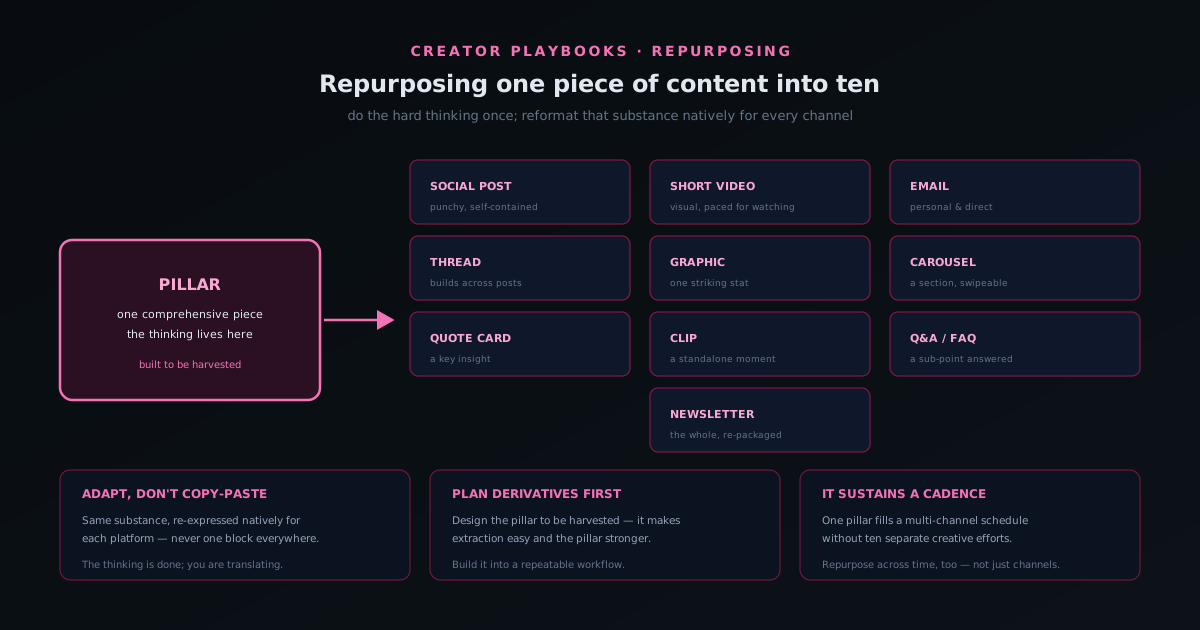
Publishing across channels does not require creating from scratch each time. A repurposing system turns one substantial piece of content into ten adapted formats, built around a pillar and tailored per platform, not lazily copy-pasted.
Contents
- 1.Overview
- 2.Why repurposing beats creating from scratch
- 3.The pillar-and-derivatives model
- 4.Adapt, do not just copy-paste
- 5.Plan the derivatives before you create the pillar
- 6.Build it into a repeatable workflow
- 7.How repurposing sustains a cadence
- 8.Get the pillar right, because repurposing amplifies it
- 9.Repurpose across time, not just channels
Overview
The hardest way to maintain a presence across multiple content channels is to create something new from scratch for each one, and yet that is how many creators and small businesses try to do it: separately writing a blog post, then separately making a video, then separately producing social posts, treating each as an independent creation. This is exhausting and unsustainable, which is why so many content efforts start strong and then collapse under the effort. Repurposing is the alternative: creating one substantial piece of content and systematically adapting it into many formats for many channels, so that one act of creation yields ten pieces of output. It is the difference between ten separate creations and one creation plus nine adaptations, and the second is dramatically less work for nearly the same reach.
The leverage of repurposing comes from where the effort in content actually lives. The genuinely hard part of content is the thinking (developing the ideas, doing the research, working out the insights), and that hard part is done once when you create the substantial original piece. Adapting that thinking into different formats is comparatively easy, because the intellectual work is already complete; you are repackaging existing substance, not generating new substance. This is why one good pillar piece can become a video, a series of social posts, an email, a thread, and more, each reaching a different audience on a different platform, all from a single underlying body of work. This guide covers the model behind effective repurposing, how to adapt rather than copy-paste, and how to build a repeatable workflow that turns one piece into ten without the effort of creating ten.
Why repurposing beats creating from scratch
The fundamental reason repurposing wins is efficiency: it extracts far more output and reach from each unit of the scarce, expensive resource that is genuine creative and intellectual effort. When you create something from scratch for every channel, you pay the full cost of creation (the thinking, research, and development) every single time, which limits how much you can publish and how many channels you can sustain. When you repurpose, you pay that full cost once and then pay only the much smaller cost of adaptation for each additional channel, which multiplies your output without multiplying your effort. For a small operation with limited time, this efficiency is the difference between a sustainable multi-channel presence and burning out trying to feed every platform separately.
Repurposing also serves the audience better than single-channel publishing does, which is a benefit beyond pure efficiency. People consume content in different formats and on different platforms (some read, some watch, some prefer short social posts, some prefer long-form), so the same idea expressed across multiple formats reaches people who would never have encountered it in its original form. A point made in a blog post reaches readers; the same point in a video reaches viewers; in a social post, scrollers; in an email, subscribers. Repurposing is therefore not just doing less work for the same reach, but actually expanding reach by meeting audiences in their preferred format and place. The combination (more reach for less effort) is what makes repurposing a foundational practice for any small content operation, and the reason that trying to create everything fresh is usually a path to exhaustion rather than growth.
The pillar-and-derivatives model
Effective repurposing is built around a structure: a substantial pillar piece, from which many smaller derivative pieces are drawn. The pillar is the comprehensive original (a thorough blog post, a detailed video, an in-depth guide) that contains the full thinking on a topic, and it is where you invest the real creative effort. Because the pillar is substantial and covers a topic comprehensively, it naturally contains many distinct points, sections, examples, and insights, each of which can become its own derivative piece. A single comprehensive pillar might contain ten quotable insights, five distinct sub-points, several examples, and a central argument, each of which is raw material for a separate smaller piece of content.
The derivatives are these extracted pieces, adapted to other formats and channels: a key insight becomes a social post, a section becomes a short video, a list becomes a thread, the whole thing becomes an email, a striking statistic becomes a graphic. The pillar-and-derivatives model works because the pillar does the heavy lifting of developing the substance, and the derivatives simply surface and reformat parts of that substance for different contexts. This is why investing in genuinely substantial pillars is the foundation of good repurposing: a thin, shallow original yields few good derivatives, while a rich, comprehensive one yields many, because there is more substance to draw from. The model reframes content creation around producing strong pillars and then systematically harvesting them, rather than producing a scattered stream of unconnected small pieces, and it is the structure that makes one-to-ten repurposing tractable rather than haphazard.
Adapt, do not just copy-paste
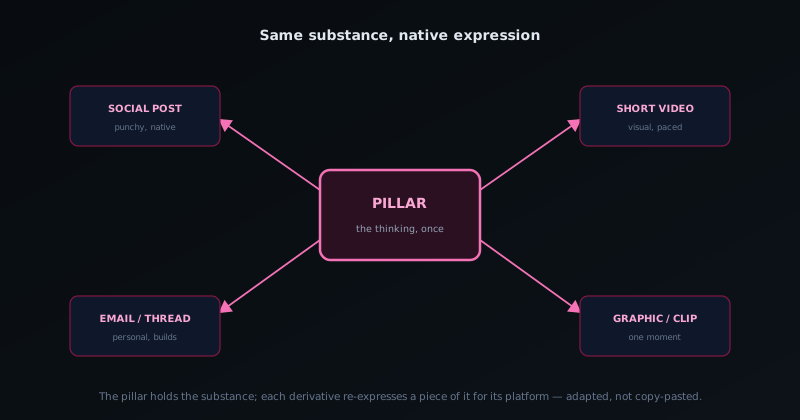
The critical skill that separates effective repurposing from lazy cross-posting is adaptation: each platform has its own format, norms, and audience expectations, and a derivative piece must be genuinely adapted to the platform it is published on, not merely copied from the pillar and pasted everywhere. The same idea is expressed differently on different channels (a blog paragraph, a video segment, a short social post, and an email each have different lengths, tones, structures, and conventions), and content that ignores these differences, pasting identical text across platforms, performs poorly because it fits none of them. Adaptation means taking the underlying idea from the pillar and re-expressing it natively for each platform, so it feels like it belongs there rather than like it was dumped from elsewhere.
This is the difference between repurposing that works and the kind that gives repurposing a bad name. Genuine adaptation respects what each platform rewards: a social post is punchy and self-contained, a video is visual and paced for watching, an email is personal and direct, a thread builds across connected posts. Taking a pillar's insight and crafting it specifically for each of these (same substance, different expression) produces derivatives that perform on their platforms, while mechanically copying the pillar's exact words everywhere produces content that feels off and underperforms on every platform. The good news is that adaptation, while a real skill, is far less effort than original creation, because the substance is already developed; you are translating, not authoring. The discipline is to always adapt (to treat each derivative as a native piece for its platform drawn from the pillar, never as a copy-paste), because that discipline is what makes the multiplied output actually effective rather than just abundant.
Plan the derivatives before you create the pillar
A subtle but powerful upgrade to repurposing is to plan the derivatives before creating the pillar, rather than creating the pillar and then scrambling to find pieces to extract afterward. When you know in advance that a pillar will be repurposed into a video, a set of social posts, an email, and a thread, you can build the pillar with those derivatives in mind: structuring it with clear, extractable sections, including quotable insights and standalone points, and covering the topic comprehensively enough to yield rich derivatives. This forward planning makes the extraction far easier, because the pillar is designed to be harvested rather than having to be mined for fragments after the fact.
Planning derivatives upfront also improves the pillar itself, because designing content to be repurposable tends to make it better-structured and more comprehensive. A pillar built to yield ten derivatives must contain ten worthwhile points, clearly delineated, which is a higher standard than a pillar written without that intention and usually produces a stronger original. So the planning serves double duty: it makes the repurposing efficient and it raises the quality of the pillar. The practical version is to decide, when planning a pillar, what derivatives it will feed and across which channels, and to shape the pillar accordingly, ensuring it has the extractable structure, the standalone insights, and the comprehensive coverage that good derivatives require. This shifts repurposing from a reactive afterthought (what can I salvage from this?) to a proactive design (this pillar is built to become these ten things), which is how the most efficient content operations approach it.
Build it into a repeatable workflow
Repurposing delivers its full value when it becomes a repeatable workflow rather than an ad-hoc activity, because a defined process makes the one-to-ten transformation reliable and fast instead of something figured out anew each time. A repurposing workflow specifies the steps: create the pillar, then extract a defined set of derivatives (this many social posts, a video, an email, a thread), adapt each to its platform, and schedule them across the channels and over time. With the workflow defined, producing the ten pieces from one pillar becomes a routine execution of known steps, which is both faster and more consistent than improvising the repurposing each time and risking that it does not happen at all once the pillar is done.
A workflow also ensures the repurposing actually happens, which is a real risk because the pillar feels like the finished work and the derivatives can be neglected once the satisfying part is done. By making the derivatives a defined part of the process (not optional extras but specified outputs of every pillar) the workflow ensures each pillar is fully harvested rather than left as a single piece with its repurposing potential unrealized. This is where repurposing connects to the broader content production system: a repeatable content production line (covered in Building a repeatable content production line) incorporates repurposing as a standard stage, so that creating a pillar automatically triggers the derivative production. Building repurposing into the workflow this way is what turns it from a good idea that happens occasionally into a consistent engine that reliably multiplies every pillar, which is the difference between knowing about repurposing and actually getting its benefits.
How repurposing sustains a cadence
One of repurposing's most valuable effects is that it makes a consistent publishing cadence sustainable for a small operation, solving the central problem of content marketing: maintaining a steady output across channels is exhausting when each piece is created from scratch. With repurposing, one pillar generates enough derivatives to fill a publishing schedule across multiple channels for a meaningful stretch, which means the cadence is fed by periodic substantial creation rather than by constant fresh production for every slot. A creator who produces one strong pillar and repurposes it into ten pieces has ten pieces of content to publish, sustaining the cadence without ten separate creative efforts, which is what makes a multi-channel presence achievable for one person or a tiny team.
This connection between repurposing and cadence is why repurposing is not just an efficiency tactic but a sustainability strategy for content. The reason content efforts so often collapse is burnout from the relentless demand of feeding channels, and repurposing directly addresses that by reducing the creation burden while maintaining the output, making the cadence something that can be kept up over the long term rather than abandoned after an exhausting burst. The operating-model view of maintaining a content cadence (covered in The cadence behind a site you can trust) relies heavily on repurposing as the mechanism that makes a sustainable rhythm possible. For a small operation, repurposing is therefore the practical answer to how you maintain a real content presence across channels without a team: you create substantial pillars at a manageable pace and multiply each into the steady stream of output that the channels require, turning an impossible workload into a sustainable one.
Get the pillar right, because repurposing amplifies it
Because repurposing multiplies a pillar into many pieces, it multiplies whatever is in the pillar (including its errors, its weaknesses, and its inaccuracies) which means quality control on the pillar matters more in a repurposing system than it would for a standalone piece. An error in a pillar that is repurposed into ten derivatives is now an error propagated across ten pieces and ten channels, so the leverage that makes repurposing efficient also makes mistakes in the source more costly. This raises the standard for the pillar: it should be accurate, well-reasoned, and genuinely strong before it is harvested, because everything drawn from it inherits its qualities, good and bad alike.
The practical implication is to invest the quality control at the pillar stage, where it protects all the derivatives at once, rather than trying to fix problems downstream in each derivative separately. A pillar that is checked, accurate, and substantive yields derivatives that are reliable by inheritance; a pillar that is rushed or wrong yields derivatives that spread its problems across every channel. This is another reason the pillar deserves the real creative and editorial effort while the derivatives are adaptations: the pillar is the single point at which quality is determined for the whole set, so getting it right is the highest-leverage quality work in the entire repurposing system, just as getting it wrong is the most amplified mistake.
Repurpose across time, not just channels
Repurposing is usually thought of as adapting one piece across many channels at one time, but there is a second, often-missed dimension: repurposing across time, by revisiting and re-deriving from pillars long after they were created. A strong pillar does not exhaust its repurposing potential in a single round of derivatives; it can be returned to months later for fresh derivatives, re-promoted to audiences who missed it the first time, updated and repurposed again, or combined with other pillars into new pieces. The value in a substantial pillar is large enough that a single extraction rarely captures all of it, so treating pillars as durable assets to repurpose repeatedly over time extends their return well beyond their initial publication.
Repurposing across time also leverages the reality that audiences grow and change, so content that was repurposed for one audience can be repurposed again for the larger or different audience that exists later: the people who follow you now never saw the derivatives from a year ago, making re-derivation a way to deliver valuable content to new audience members without new creative effort. This temporal dimension compounds the efficiency of repurposing: not only does one pillar become ten pieces across channels, but those pillars remain a reservoir to draw from indefinitely, yielding more derivatives as time passes and the audience evolves. The fullest version of repurposing therefore treats the body of pillars as a permanent, reusable asset base (repurposed across channels for breadth and across time for longevity) which is how a content operation extracts the maximum reach and return from the genuinely hard work of creating substantial original pieces, rather than letting that work yield a single burst of output and then be forgotten.
Frequently asked questions
Quick answers to common questions about this topic.
What is content repurposing?
Creating one substantial piece of content (a pillar) and systematically adapting it into many formats for many channels (a video, social posts, an email, a thread, graphics) so one act of creation yields ten pieces of output. The hard thinking is done once; the derivatives reformat that substance.
Is repurposing just copy-pasting the same thing everywhere?
No. That is the lazy version that performs poorly. Each platform has its own format and norms, so derivatives must be genuinely adapted: same underlying idea, re-expressed natively for each channel. Adaptation is far less effort than original creation but is what makes the multiplied output effective.
How do I get ten pieces from one?
Build around a substantial pillar that comprehensively covers a topic, so it naturally contains many extractable points, insights, and examples. Each becomes a derivative adapted to a platform. Planning the derivatives before creating the pillar makes both the extraction easier and the pillar stronger.
Why does repurposing matter for a small team?
It makes a consistent multi-channel cadence sustainable. One pillar repurposed into ten pieces fills a publishing schedule without ten separate creative efforts, reducing the burnout that causes most content efforts to collapse. It also reaches people who prefer different formats and platforms.
Related troubleshooting
Was this page helpful?
Your answer stays in this browser, it is not sent anywhere and no account or cookie is involved.