2026 · Novus VisualizersAbout 13 min readNovus Stream Solutions
Building a repeatable content production line
The creators who keep up are not faster; they have a system. How to turn ad-hoc asset creation into a repeatable production line so each release is a routine, not a project.
Contents
- 1.Overview
- 2.Decide the system once
- 3.Templatize the visuals
- 4.Run the same steps every time
- 5.Refine the line over time
- 6.Why consistency comes from systems, not speed
- 7.Removing decisions is the real gain
- 8.The template as the core of the line
- 9.The brand kit as the identity layer
- 10.Default settings and the output spec
- 11.How a fixed path lowers the mental load
- 12.Refining the line without breaking it
- 13.The consistency dividend the line pays
- 14.One release, walked through the line
- 15.Knowing when to add and when to simplify
Overview
The creators who release consistently are rarely working faster in the moment; they have removed the decisions. Each release runs through the same steps, from the same templates, in the same look, so the creative energy goes into the content and not into rebuilding the process every time. This is how to turn ad-hoc asset creation into a repeatable production line.
Decide the system once
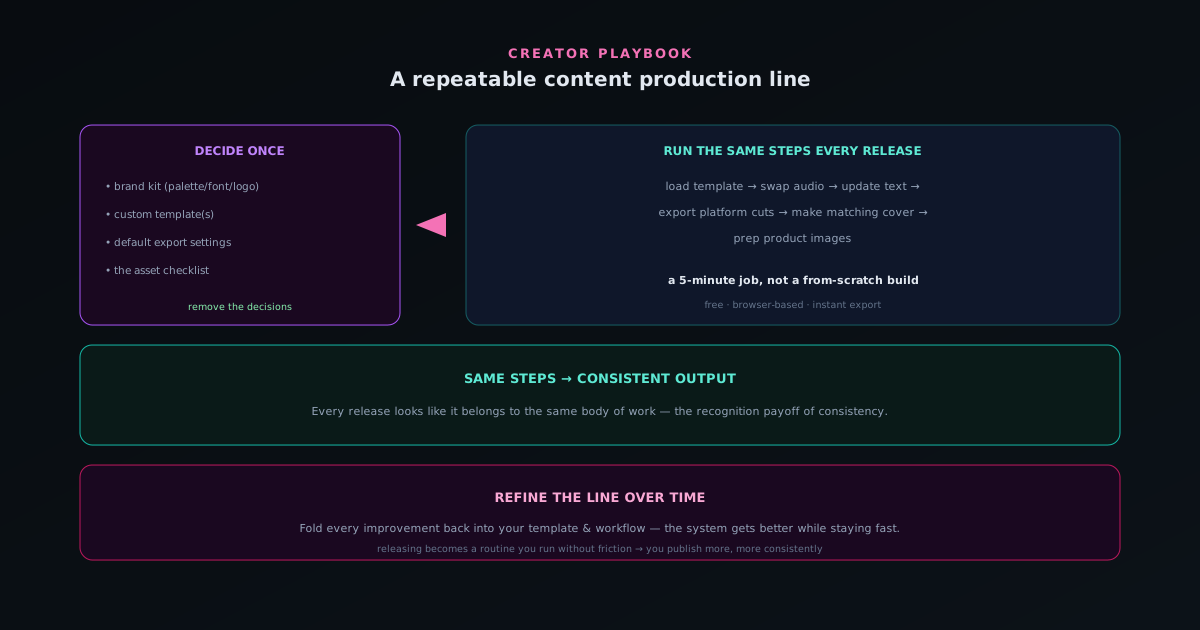
A production line is a set of fixed decisions made ahead of time: your brand kit (palette, font, logo) in visualizers.novusstreamsolutions.com/creator-studio, a custom template or two for your visualizers, your default export settings, and the exact list of assets each release needs. Making these once means you never re-decide them under deadline pressure.
The point is not to be rigid creatively; it is to make the repetitive parts automatic so the creative parts get your attention.
Templatize the visuals
In Novus Visualizers, build a custom template at visualizers.novusstreamsolutions.com/editor that captures your engine, layers, colors, text styling, and intro/outro, and save it. For the next release you load the template, swap in the audio, update the title, and export, a five-minute job instead of a from-scratch build. Keep a small set (energetic, chill, vertical) to cover most of what you make.
The brand kit does the same for identity: every new project starts on-brand without re-choosing colors and fonts.
- Custom template(s) for visualizers.
- Brand kit for identity.
- Default export settings + asset checklist.
Run the same steps every time
With the system in place, each release follows a fixed path: load template → swap audio → update text → export the platform cuts → make the matching cover → prep any product images. Because the tools are free, browser-based, and instant to export, the whole routine is fast and costs nothing per release.
Following the same steps also means consistent output: every release looks like it belongs to the same body of work, which is the recognition payoff from the consistency guides.
Refine the line over time
A production line is not static. When you discover a better engine, a stronger intro, or a faster step, fold it into your template and workflow so every future release benefits. Treat the system as living: small refinements compound into a process that gets better while staying fast.
The end state is the goal worth aiming for: releasing becomes a routine you can run without friction, so you publish more, more consistently, with less effort each time.
Why consistency comes from systems, not speed
The creators who appear to release effortlessly are rarely working faster in any given moment; they have built a system that removes the friction the rest of us pay every time. The difference is not raw speed but the absence of repeated decision-making: each release runs through the same steps, from the same templates, in the same look, so the effort goes into the content rather than into reconstructing the process. Understanding that consistency is a property of systems rather than of working faster is the key reframe, because it means the path to releasing consistently is building the system once, not hustling harder each time.
This distinction matters because trying to keep up through sheer effort is unsustainable, while a system makes consistency the default state rather than a feat. A creator relying on willpower and speed burns out and falls behind during busy or low-energy stretches; a creator with a production line keeps shipping because the routine carries them when motivation does not. The system absorbs the variability that would otherwise break a cadence. So the goal is not to become faster but to remove the decisions and rebuilding that slow every release down, which a production line does by settling the repeatable parts ahead of time. Consistency is engineered, not willed, and the engineering is the production line.
Removing decisions is the real gain
The deepest benefit of a production line is subtle: it removes decisions, and decisions are surprisingly expensive. Every choice you make under deadline (which engine, what colors, which export settings, what the asset list is) consumes attention and energy and slows you down, and worse, re-deciding the same things every release means never accumulating the benefit of having decided. A production line front-loads these decisions, making them once, deliberately, when you are not under pressure, so that release day involves executing settled choices rather than making fresh ones.
This is why the production line feels like it speeds things up even though the actual production steps are unchanged: the time and energy that used to go into re-deciding are simply gone, redirected to the content or saved entirely. Decision fatigue is real, and a creator who must re-choose their whole approach each release exhausts themselves on choices that should have been settled long ago. By fixing the repetitive decisions in advance, the production line preserves your limited decision-making energy for the choices that genuinely vary (the content itself), which is the right place for it. Removing decisions is not a minor convenience; it is the core mechanism by which the system makes releasing feel light.
The template as the core of the line
At the heart of a visual production line is a reusable template that captures everything about your look so you never rebuild it from scratch. A template that stores your engine choice, your layers, your colors, your text styling, and your intro and outro means the next release starts from a finished design rather than an empty canvas: you load the template, swap in the new audio, update the title, and export. What was a from-scratch build becomes a few-minute job, because the creative structure is already in place and only the content changes.
The leverage of a template is that it converts a repeated creative effort into a one-time one. The first time you build the look is real work; every reuse after that is nearly free, which is exactly the asymmetry a production line exploits. Keeping a small set of templates (perhaps one energetic, one calm, one vertical) covers most of what you make while still letting you start each release from a finished foundation. The template is where the production line's speed actually lives, because it is the artifact that lets you skip the most time-consuming part of each release. Building good templates once is the highest-return investment in the whole system, since every future release draws on them.
The brand kit as the identity layer
Alongside the template, a brand kit serves as the identity layer of the production line, ensuring that every project starts on-brand without re-choosing the visual identity each time. Where the template captures the structure of a particular look, the brand kit captures the consistent elements that should carry across all your work (your palette, your font, your logo), so that every new project inherits them automatically. This is what keeps a body of work visually unified even as individual templates and content vary, because the identity layer is constant beneath the varying structure.
Separating the identity layer from the template layer is a useful distinction, because it lets you vary the look of individual releases while keeping the brand constant. You might use different templates for different moods, but the brand kit ensures they all share the colors and type that make them recognizably yours. This is the production-line version of the consistency that builds recognition: the brand kit automates it, so consistency is the default rather than something you must remember to apply. Together, the template and the brand kit form the two-part core of the system (structure and identity), and a release flows from loading both and adding only the new content, which is the essence of a production line that is fast and consistent at once.
Default settings and the output spec
Two less glamorous parts of the production line round out the system: your default export settings and the fixed list of assets each release requires. Settling your export settings once (resolution, frame rate, formats, the platform presets you use) means you never reconfigure them under deadline, and your output stays consistent in technical quality across releases. Defining the exact set of assets each release needs turns the open-ended question of "what do I have to make?" into a fixed checklist you execute, which both prevents omissions and removes another recurring decision.
These two elements function as the output specification of the production line: the settings define how each asset is produced technically, and the asset list defines which assets are produced. Together they ensure that running the line yields a complete, technically-consistent set every time, without you having to remember the requirements or re-derive the settings. This is the same removing-decisions principle applied to the output side: by fixing what you produce and how, you guarantee a complete and uniform result while sparing yourself the choices. The output spec is what makes the line's end state predictable: run it and you reliably get the full set, correctly produced, which is exactly what a repeatable system should deliver.
How a fixed path lowers the mental load
With the components in place, each release follows a fixed path (load the template, swap the audio, update the text, export the platform cuts, make the matching cover, prep any product images), and the value of that fixity is largely psychological. A fixed sequence means you are never wondering what to do next or whether you have forgotten a step; you are following a known path, which is far less cognitively demanding than navigating an open-ended process each time. The mental load of releasing drops because the path is laid out, and you simply walk it rather than figuring it out.
This reduced mental load is what makes a production line sustainable over many releases, because it keeps each one from being a fresh exercise in coordination. An ad-hoc process demands that you hold the whole workflow in your head and make it up as you go, which is tiring and error-prone; a fixed path externalizes that structure, so your working memory is free for the content. The fixed sequence also makes the process teachable and delegable, should the operation ever grow, because it is written down as steps rather than living only in one person's head. For a solo creator, though, the immediate benefit is simply that releasing stops being mentally heavy, which is a large part of why a production line lets you publish more without burning out.
Refining the line without breaking it
A production line should improve over time, but there is an art to refining it without undermining the consistency that is its point. The right way to evolve the line is to fold genuine improvements into the templates and workflow deliberately (a better engine, a stronger intro, a faster step), so that every future release inherits the upgrade, rather than improvising changes per release that fragment the consistency. The distinction is between updating the system, which propagates cleanly to all future output, and tinkering with individual releases, which reintroduces the per-release decision-making the system exists to remove.
This means treating the production line as a living system that you periodically and deliberately improve, not a static one you never touch nor a fluid one you constantly alter. When you discover a real refinement, update the template so it becomes the new default; between such updates, run the line as-is for consistency. This rhythm of stable operation punctuated by deliberate improvement is what lets the line get better over time while staying fast and consistent in the meantime. The mistake to avoid is continuous tinkering, which keeps the system from ever settling into the smooth routine that delivers its benefits. Refine deliberately, then run consistently, and the line compounds into something that is both increasingly good and reliably fast.
The consistency dividend the line pays
Beyond speed, a production line pays a consistency dividend that connects directly to brand recognition: because every release runs through the same templates and the same look, the output is automatically consistent, which is exactly what builds a recognizable body of work. A creator working ad-hoc produces releases that vary in look, undermining the recognition that consistency would build; a creator running a production line produces releases that share an identity by default, because the system enforces it. So the line is not just a speed tool but a consistency tool, and the two benefits reinforce each other.
This dividend is why the production line ties together everything in the creator playbooks. It produces the complete asset sets the checklist specifies, in the consistent brand the recognition guide describes, through the free on-device toolkit, on a repeatable basis. The system is the mechanism that makes consistent, complete, professional output the default rather than an aspiration, which is what lets a solo creator build a recognizable brand and a steady cadence at once. The consistency dividend means that simply by running the line, you are building recognition over time: the consistency comes free with the efficiency, which is the compounding payoff that makes investing in the production line worthwhile far beyond the per-release time it saves.
One release, walked through the line
It helps to see the whole system in motion with a concrete pass. A new track is ready, and instead of facing a blank slate, you open your saved template (the one whose engine, layers, colors, and text styling you settled long ago) and load the audio into it. The visuals immediately react to the new track in your established look, because the template did the structural work in advance. You update the title text, glance at the result, and the main video is essentially done, in minutes rather than the hour a from-scratch build would take.
From there the line continues along its fixed path: export the platform cuts using the presets, add a caption to the vertical version, make the cover to match using the same palette, and prep any accompanying images. At no point did you re-decide your colors, your engine, your export settings, or which assets to make: all of that was settled, so the release was execution, not invention. That is what running the line feels like: a smooth sequence of known steps producing a complete, on-brand set, with your actual attention spent only on the one thing that genuinely changed, which is the content. The worked example is unremarkable precisely because that is the point: a release that used to be a project is now a routine.
Knowing when to add and when to simplify
A mature production line requires judgment about its own complexity, because a line can become bloated with steps and templates that slow it down as easily as it can be too sparse to serve. The discipline is to add to the line only when an addition genuinely earns its place (a template that covers a real recurring need, a step that meaningfully improves the output) and to resist accumulating options and steps that add complexity without proportional value. A production line that grows a dozen rarely-used templates and a tangle of optional steps has reintroduced the decision-making it was meant to remove.
Equally, periodically simplifying the line (pruning templates you do not use, removing steps that no longer pay off) keeps it lean and fast. The goal is a line with exactly the components you need and no more, which delivers the speed and consistency benefits without the drag of unused complexity. This is the same product discipline that governs the apps themselves: add deliberately, prune regularly, keep the system matched to actual needs. For the production line, that judgment is what keeps it serving you over the long run rather than slowly calcifying into something elaborate and slow. A good line stays simple enough to run effortlessly while covering everything you actually make, and maintaining that balance is the ongoing work of owning a production system.
Frequently asked questions
Quick answers to common questions about this topic.
How do I make content creation repeatable instead of a weekly scramble?
Define a fixed pipeline (capture, process, package, publish) and run every piece through the same steps. A repeatable line removes decisions: you are executing a known process rather than reinventing the workflow each time.
How do I turn one piece of content into many assets?
Start from one source (a track, a shoot, a long video) and derive crops, cutouts, clips, and thumbnails from it. One song can become a visualizer, a cover, a lyric video, and social clips from the same tools.
What makes a content system actually stick?
Low friction. If the tools are free, fast, and need no signup, the process gets followed; if each step requires logins or paid exports, the system breaks down. Keeping the toolchain lightweight is what keeps the line running.
Related workflow
A track to a release-ready visualizer, per platform
Render the visual once, then produce the platform masters from it, instead of re-rendering the whole video for every aspect ratio.
- Render the beat-synced videoNovus Visualizers: Pick the engine and mode against your actual track; the analysis is done on your audio, not on a preset preview.
- Trim or upscale the exportNSS Background Remover: The video utilities handle the tidy-up pass so the render does not have to be repeated to fix ten seconds of it.
- Produce the per-platform mastersNovus Convert: Each destination wants a different container and bitrate; converting the finished render is far cheaper than re-rendering it.
Related troubleshooting
Was this page helpful?
Your answer stays in this browser, it is not sent anywhere and no account or cookie is involved.