2026 · Operating modelAbout 12 min readNovus Stream Solutions
The cadence behind a site you can trust
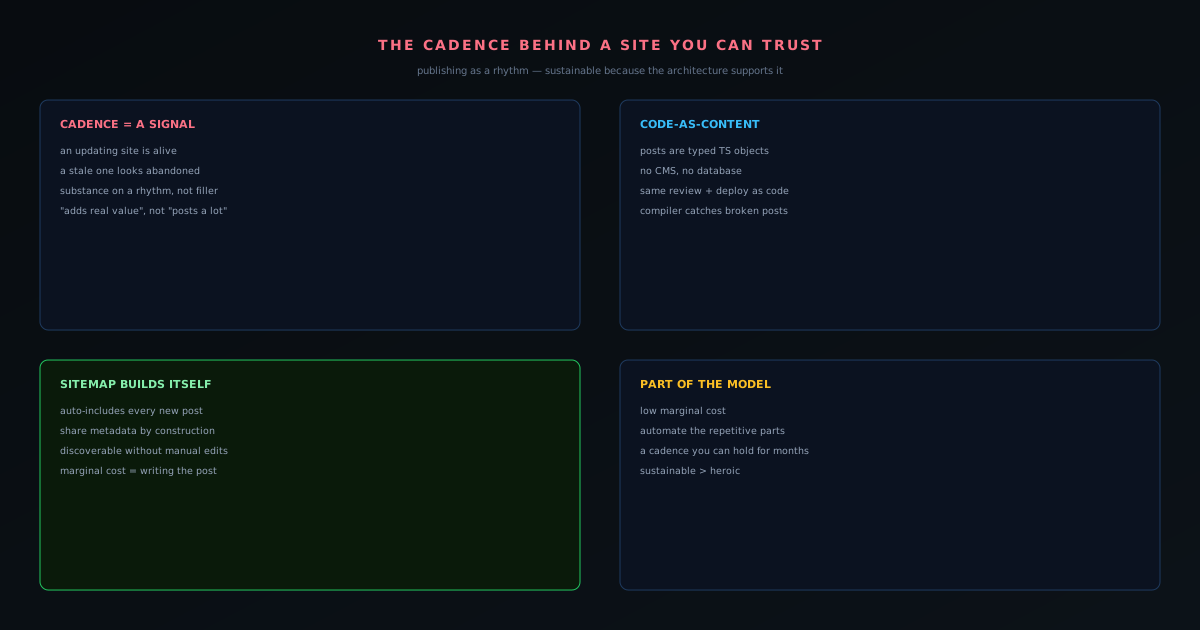
A site that updates is a site that is alive. We treat publishing as an operating rhythm, not a launch event, and the code-as-content architecture, with an auto-building sitemap, is what makes a steady cadence sustainable for a solo operation. Here is the model.
Contents
- 1.Overview
- 2.Cadence as a signal, not a stunt
- 3.Why code-as-content makes cadence cheap
- 4.The sitemap builds itself
- 5.What a stale site silently tells visitors
- 6.Why thin filler backfires at cadence
- 7.The compiler as a copy editor for structure
- 8.Every post is a permanent asset
- 9.Cadence and discoverability reinforce each other
- 10.The honest motivation, stated plainly
- 11.No CMS, no separate system to feed
- 12.Driving the marginal cost of one more post toward zero
- 13.Cadence as part of the operating model
Overview
A site that has not changed in a year tells visitors something, and it is not flattering: this might be abandoned. A site that visibly updates tells the opposite story: there are people here, working, improving things. For a small operation trying to earn trust from both readers and the systems that index the web, a steady publishing cadence is one of the cheapest credibility signals available. We treat publishing as an operating rhythm rather than a series of launch events, and this post is about why, and the architecture that makes the rhythm sustainable for a solo team.
The honest motivation includes the practical: we are working toward advertising approval, and a site that demonstrably updates with substantive content is a site that is clearly active and maintained. But the deeper reason is that cadence and trust are linked regardless of any single goal. A living site is a trustworthy one.
Cadence as a signal, not a stunt
There is a wrong way to chase cadence: pump out thin, repetitive filler to hit a number. That backfires, because readers and indexers both recognize hollow content, and a flood of it signals desperation rather than vitality. The right way is to make each published piece genuinely substantive (a real article with a real argument and tailored illustration) and to publish those on a regular rhythm. The signal that builds trust is "consistently adds real value," not "posts a lot."
This is why our additions come as in-depth, first-party articles with unique hero and inline graphics rather than syndicated filler. The cadence only works as a trust signal if what fills it is worth reading. Volume without substance is noise; substance on a rhythm is a reputation.
Why code-as-content makes cadence cheap
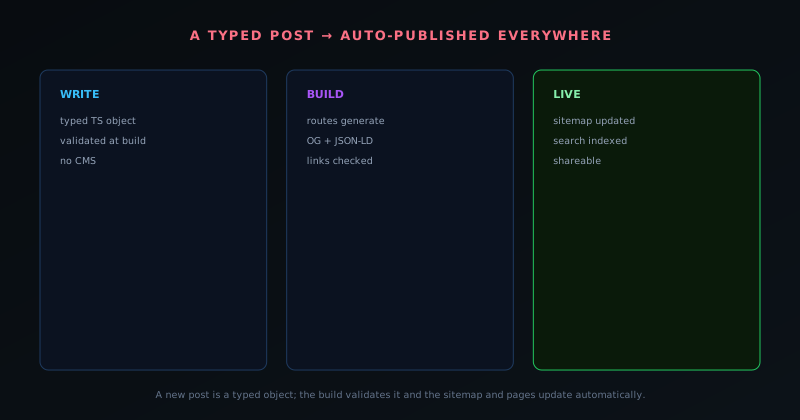
A steady cadence is only sustainable if publishing is low-friction, and the architecture here is built for exactly that. The content is code: posts are type-safe TypeScript objects in the repository rather than entries in a separate CMS or database. That sounds like more work and is actually less, because publishing becomes part of the same version-controlled, reviewed, deployed workflow as everything else, with no separate system to maintain, no CMS to keep updated, and no database to operate. A new article is a new typed object, shipped the same way a code change ships.
The type safety is a quiet accelerator. Because each post must satisfy the post type and reference valid categories and related slugs, a malformed or half-finished post is caught at build time rather than published broken. The compiler is a copy editor for structure, which removes a whole class of "the post went out with a broken link" mistakes that slow other publishing setups down.
The sitemap builds itself
The piece that makes cadence truly hands-off is automation downstream of publishing. The sitemap is generated from the content data (every new post, tutorial, category, and tool map is auto-included) and every page carries its share metadata and structured data by construction. So when a new article ships, it is discoverable to crawlers without a manual sitemap edit, and shareable with correct previews without a manual metadata step. The act of adding the content is the act of publishing it everywhere it needs to appear.
This removes the silent tax that kills cadence in many small operations: the per-post manual chores. If every publish required hand-editing a sitemap, writing meta tags, and updating an index, the friction would compound until publishing slowed to a trickle. Automating that chain means the marginal cost of one more post is writing the post, and that is the cost you want to be paying.
What a stale site silently tells visitors
A site communicates its vitality whether or not it means to, and a site that has not changed in a long time sends a quietly damaging message: this might be abandoned. Visitors read staleness as a signal about whether anyone is still behind the project, whether the products are still supported, whether it is safe to invest attention or trust. None of that is stated anywhere; it is inferred from the absence of motion. For a small operation trying to earn confidence from people who have no other reason to extend it, an obviously inactive site is a headwind that no amount of good copy on the existing pages overcomes.
The inverse is just as real and is the lever a cadence pulls. A site that visibly updates (new, substantive content arriving regularly) signals the opposite: there are people here, working, improving things, paying attention. That impression of an active, maintained operation is one of the cheapest forms of credibility available, because it requires no claims, only evidence. The content itself does the reassuring. For both human visitors deciding whether to trust the products and automated systems assessing whether the site is alive and worth crawling often, visible activity is a foundational signal, and a steady publishing rhythm is how you produce it deliberately rather than hoping it happens.
Why thin filler backfires at cadence
There is a wrong way to chase a publishing rhythm, and it is worth naming because it is tempting: pump out thin, repetitive, low-substance posts to hit a number. This backfires, and it backfires precisely with the audiences cadence is meant to impress. Readers recognize hollow content immediately and a flood of it signals desperation rather than vitality; the systems that assess sites for quality are increasingly able to distinguish substantive content from padding, and a pile of filler can do more harm than silence. The signal that builds trust is not "posts frequently" but "consistently adds genuine value," and filler fails the second test while technically passing the first.
This is why the cadence here is built from in-depth, first-party articles with original illustration rather than syndicated or templated filler. The rhythm only works as a credibility signal if what fills it is worth reading, which means the discipline is not just to publish often but to publish substantively often, a much harder bar that filler cannot clear. Volume without substance is noise that actively undermines the trust it was meant to build; substance on a rhythm is a reputation compounding over time. The whole point of pairing cadence with depth is that neither works alone: depth without cadence looks abandoned, and cadence without depth looks desperate.
The compiler as a copy editor for structure
A subtle benefit of content-as-code is that the type system acts as a structural copy editor, catching a class of publishing mistakes before they ever go live. Because each post must satisfy a defined type (required fields present, categories valid, related-post references pointing at real slugs) a malformed or half-finished post fails to build rather than shipping broken. The compiler will not let you publish a post that references a category that does not exist or links to a slug that is not there, which removes an entire family of "the post went out with a broken link" errors that plague publishing setups where content is loose data.
This matters more at cadence than it would for an occasional post, because frequency multiplies the chances of a small structural slip. Publishing often by hand, in a system with no validation, means more opportunities to fat-finger a link, forget a field, or mis-tag a category, and those errors accumulate into a sloppy-feeling site. Type-checked content turns each publish into a validated operation: if it builds, its structure is sound. The compiler is not editing prose, but it is enforcing the scaffolding around the prose, which frees the human attention to go entirely to the writing rather than to checking that the plumbing is correct each time.
Every post is a permanent asset
A reason cadence compounds in value is that each substantive post is not a disposable update but a durable asset that keeps working long after it is published. Unlike a social post that scrolls away in hours, a genuine article on a specific topic continues to be discoverable, continues to answer the question it addresses, and continues to bring in readers searching for that topic indefinitely. A back catalog of such posts is an accumulating body of work, where the value of today's post adds to the value of all the previous ones rather than replacing them, so the site grows more useful and more discoverable with every addition.
This permanence is what makes a steady cadence an investment rather than a treadmill. The effort spent on a post pays back not once but continuously, and the catalog as a whole becomes a compounding asset: more entry points, more answered questions, more reasons for both readers and crawlers to return. Seen this way, daily publishing is not a demand that resets each morning but a process of steadily building something that keeps appreciating. The discipline of cadence is really the discipline of consistently adding to a permanent, compounding library, which is a far more motivating frame than chasing a recurring quota that vanishes the moment it is met.
Cadence and discoverability reinforce each other
Fresh content and discoverability are linked in a way that rewards a steady rhythm specifically. A site that regularly publishes new, substantive pages gives the systems that index the web reasons to visit more often, and each new page is another entry point through which someone might find the site. The automation that makes this hands-off (a sitemap that auto-includes every new post, share metadata and structured data emitted by construction) means that the act of publishing is also the act of making the content discoverable, with no separate manual step to expose it to the world.
This reinforcement is part of why cadence is worth the discipline beyond the appearance of activity. A regularly-updated, properly-exposed site is one that gets crawled, indexed, and surfaced more readily than a static one, so the rhythm does not just signal vitality to human visitors but actively improves the odds that new readers find the work at all. The combination (substantive content, published steadily, automatically made discoverable) is a flywheel: more content yields more entry points yields more visitors yields more reason to keep publishing. The automation ensures the discoverability half happens for free, so the operator's only job is to keep the substantive content coming.
The honest motivation, stated plainly
It is worth being candid about one driver behind the cadence, because honesty is consistent with how the whole operation talks about itself: part of the motivation is qualifying for advertising approval, and a site that demonstrably updates with substantive content is a clearer candidate for it than a static one. There is no contradiction between that practical goal and the deeper rationale: a site that publishes real value regularly is exactly what both an ad network and a reader want to see, so the incentive and the principle point the same way. Stating the motivation plainly is better than pretending the cadence is purely altruistic.
The reason the honest framing holds up is that the work required to satisfy the practical goal is the same work that makes the site genuinely better. There is no version of "look active for approval" that succeeds through filler, because the systems assessing the site reward substance; the only path that works is publishing content worth reading on a steady rhythm, which is also simply the right thing to do for the site's readers. So the AdSense motivation does not corrupt the cadence into a cynical exercise: it aligns with it, because the bar for looking credibly active and the bar for being genuinely useful turn out to be the same bar. Naming the motivation does not undercut the value; the value is what satisfies the motivation.
No CMS, no separate system to feed
A hidden reason many publishing efforts stall is the overhead of the publishing system itself: a content management system to keep updated, a database to operate, a separate admin interface to log into, each a small standing tax on the act of publishing. The content-as-code approach removes that entire category of overhead by making posts part of the same repository, the same version control, and the same deployment as the application. There is no separate CMS to maintain, no database to back up and migrate, no second system that can break independently of the site. Publishing is just another code change, shipped the same way every other change ships.
Eliminating the separate system matters for cadence because every piece of infrastructure between an idea and a published post is friction, and friction compounds against frequency. A setup that requires logging into a CMS, fighting its editor, and managing its quirks adds drag to every single publish, and over a sustained rhythm that drag is what wears the habit down. With content as code, the only tools involved are the ones already used to build the site, so there is no context-switch into a publishing system and no maintenance burden for one. Fewer moving parts means fewer reasons publishing slows down, which is exactly what a long-term cadence needs to survive.
Driving the marginal cost of one more post toward zero
The single metric that determines whether a cadence is sustainable is the marginal cost of one more post: everything you do to support publishing should push that cost down toward the irreducible minimum, which is the writing itself. When the architecture handles the chores automatically (the publish step, the sitemap inclusion, the share metadata, the structured data, the search indexing) none of those add to the per-post cost, so the only thing standing between an idea and a live, discoverable, shareable post is composing it. That is the right place for the cost to live, because the writing is the part that carries the value; everything else is overhead that automation should absorb.
This framing turns sustainability into an engineering target rather than a matter of willpower. Each manual step that would otherwise repeat per post is a small recurring tax that, multiplied across a daily rhythm, eventually breaks the habit; removing those taxes one by one is how you make the cadence hold. The goal is that producing the hundredth post is no more operationally burdensome than producing the first, because the only work that scales with post count is the writing, and all the mechanical surrounding work has been automated to a fixed, near-zero marginal cost. A cadence you can hold for months is not a feat of discipline so much as the result of having driven the per-post overhead down until discipline is barely required.
Cadence as part of the operating model
Publishing fits the same operating philosophy as the products: keep the marginal cost low, automate the repetitive parts, and make the system sustainable for a small team over the long run rather than heroic for a short burst. A cadence you can hold for months because the architecture supports it is worth far more than a sprint you cannot repeat. The goal is not a flurry of activity followed by silence; it is a site that keeps visibly, sustainably improving.
That is what ties content cadence to everything else here. It is not a marketing afterthought bolted onto the engineering; it runs on the same code-as-content foundation, the same automation, the same low-overhead discipline. The personal side (how you actually keep this up without burning out) is its own post, and the architecture deep-dive covers why content-as-code is the right substrate for a publishing rhythm.
Frequently asked questions
Quick answers to common questions about this topic.
Why does a consistent content cadence matter?
Consistency compounds: a steady publishing rhythm builds topical authority, gives search engines fresh, interlinked content to index, and signals an active, trustworthy site. Sporadic bursts do not build the same momentum.
Is publishing daily necessary?
Not strictly: the key is a sustainable, predictable rhythm you can maintain. A reliable weekly cadence beats a daily one you burn out on, because consistency over time is what compounds.
How do you keep a cadence without sacrificing quality?
Build a repeatable production system and a backlog so each piece is execution, not a scramble. See Publishing every day without burning out.
Related troubleshooting
Was this page helpful?
Your answer stays in this browser, it is not sent anywhere and no account or cookie is involved.