2026 · Field notesAbout 13 min readNovus Stream Solutions
Publishing every day without burning out
A daily publishing habit is great for a site and brutal on a person if you do it wrong. The trick is systems over willpower (templates, a backlog, batching, and a definition of "good enough to ship") so the cadence runs on a process, not on heroics.
Contents
- 1.Overview
- 2.Willpower is the wrong engine
- 3.Build a buffer, then publish from it
- 4.Define "good enough to ship"
- 5.Separate creating from publishing
- 6.Batch by type to stay in flow
- 7.The streak is a tool, not a master
- 8.Lower the bar for what a publish day requires
- 9.Protect the inputs, not just the outputs
- 10.How to skip a day without breaking the system
- 11.The compounding payoff of simply showing up
- 12.Design a weekly shape, not just a daily one
- 13.Make the tools remove friction
Overview
A daily publishing habit is one of the best things you can do for a small site and one of the fastest ways to burn yourself out if you run it on willpower. The romantic version (wake up inspired, write something brilliant, post it, repeat forever) collapses within a couple of weeks of real life, where some days you are tired, uninspired, or busy with everything else a solo operation demands. The durable version runs on systems instead. This field note is about the systems that let a daily cadence survive contact with an actual human schedule.
The reframe that matters: publishing every day is not a feat of discipline you summon each morning. It is the output of a process you set up once, so that on the bad days the process carries you and your willpower is not the single point of failure.
Willpower is the wrong engine
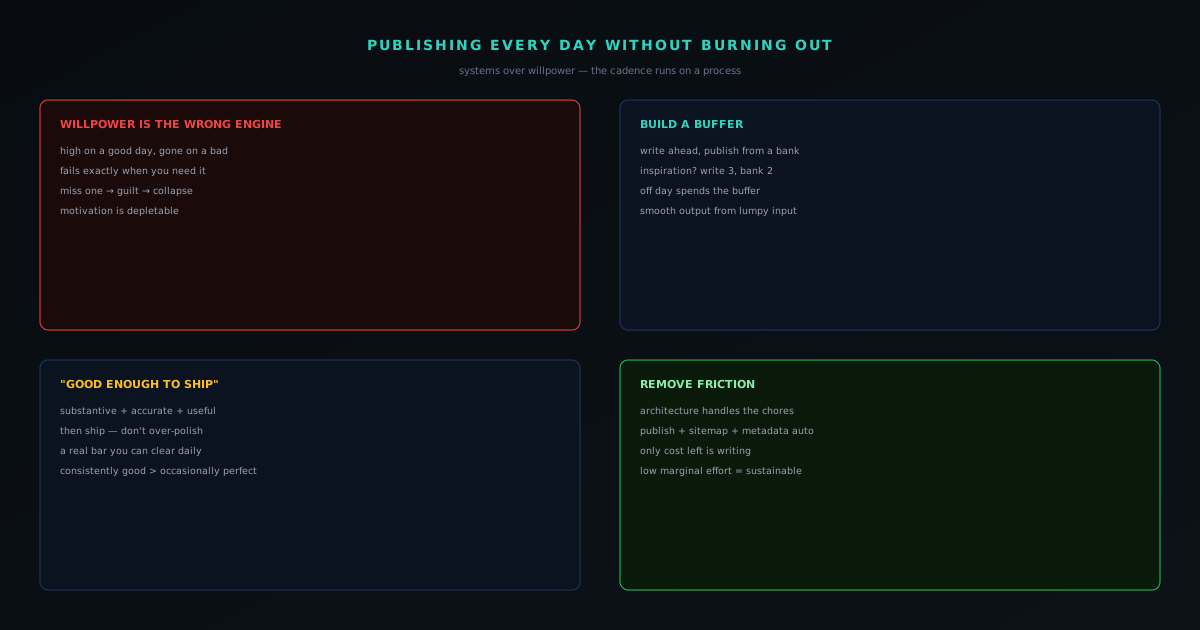
Willpower is a terrible thing to build a daily habit on because it is variable and depletable. It is high on a good day and gone on a bad one, and a system that only works when your motivation is high is a system that fails exactly when you most need it to hold. Anyone who has tried to sustain a daily creative output on motivation alone knows the pattern: a strong start, a missed day, guilt, a second missed day, and a quiet collapse of the whole habit.
Systems are steadier because they do not depend on how you feel. A template removes the blank-page decision. A backlog removes the today-I-have-nothing panic. A clear bar for shipping removes the perfectionist spiral. Each system replaces a moment where willpower would otherwise be load-bearing with a process that works regardless of mood.
Build a buffer, then publish from it
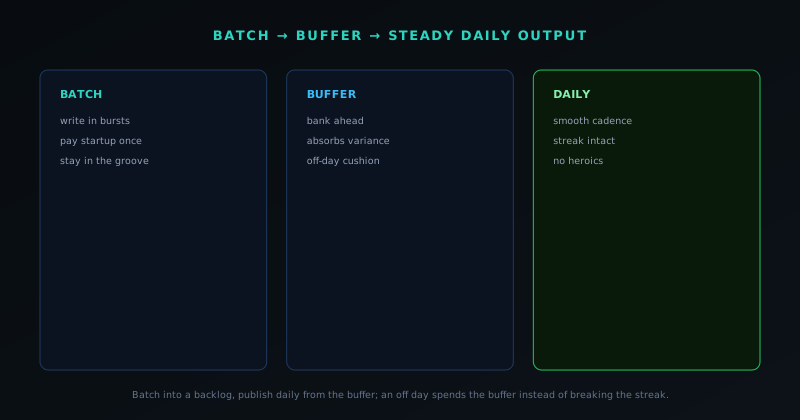
The single most protective system is a backlog. Instead of writing today what publishes today (which means a single bad day breaks the streak) you write ahead and publish from a buffer. When inspiration strikes, you do not write one piece; you write three, and bank two. The daily publish then draws from the bank, so an off day spends down the buffer instead of breaking the chain. The cadence the audience sees is smooth even though your actual output is lumpy, because the buffer absorbs the variance.
Batching feeds the buffer efficiently. Producing several related pieces in one focused session is far more efficient than context-switching into writing once a day, because you pay the startup cost once and stay in the groove. Bank what you batch, publish daily from the bank, and refill the bank whenever you have a good run. The buffer is what converts an unsteady human into a steady-looking output.
Define "good enough to ship"
Perfectionism is the other great killer of cadence. If every piece has to be your best work ever, the bar rises until shipping becomes agonizing and then stops. The antidote is a clear, honest definition of good enough: substantive, accurate, genuinely useful, well-illustrated, and then shipped, rather than polished for another three hours chasing a marginal improvement nobody will notice. "Good enough to ship" is not "low quality"; it is a real quality bar that you can actually clear daily without it consuming you.
Setting that bar deliberately frees you from the two failure modes at once: the thin filler that does not meet the bar, and the over-polished piece that meets it ten times over at the cost of the next nine posts. Hit the bar, ship, move on. The cadence is served by consistently good, not occasionally perfect.
Separate creating from publishing
One of the most freeing structural moves is to stop treating creating and publishing as a single act that must happen on the same day. When writing today is what must go live today, a single bad day breaks the chain, and the pressure to produce on demand is exactly what makes the demand feel crushing. Decoupling the two (writing whenever the writing is good, publishing on a steady schedule from what you have already written) removes that brittleness. The day's publish draws from a reserve rather than from that morning's inspiration, so the cadence the audience sees is smooth even though the act of creation is irregular, which it always is.
This separation also improves the work itself, not just the sustainability of producing it. When you write under the gun of same-day publishing, you accept whatever you can produce in the time available; when you write ahead into a reserve, you can write when you have something to say and set aside what is not ready, publishing only the pieces that cleared the bar. The schedule pulls from finished work rather than forcing unfinished work out the door. Decoupling creation from publication is therefore not just a buffer against bad days but a quality mechanism, because it lets the publishing rhythm be steady while the creative rhythm stays honest about when good work actually happens.
Batch by type to stay in flow
Beyond batching in general, batching by type of work is what really preserves a solo creator's energy, because the expensive thing is not the work itself but the context-switching between kinds of work. Writing, illustrating, editing, and the mechanical parts of publishing each use a different mode of attention, and flipping between them constantly pays a startup cost every time. Grouping like with like (a session of drafting, a session of illustrating, a session of final edits) means you pay the startup cost once per mode and then stay in that groove, which is dramatically more efficient than producing one complete post end to end every day with all its mode-switches.
This matters for a daily cadence specifically because the alternative (fully producing one post each day) forces the maximum number of context switches at the worst possible frequency. Batching by type lets a few focused sessions feed many days of output: a strong drafting session might produce several pieces, an illustration session might handle their graphics together, and the published cadence draws steadily from that batched work. The reserve and the batching reinforce each other (you batch by type into the reserve, and you publish daily from it) so the human producing the work operates in efficient, sustained modes while the audience experiences a consistent stream. Working in batches is how you make irregular, mode-grouped effort look like regular output.
The streak is a tool, not a master
A publishing streak is genuinely useful (it builds momentum, signals reliability, and creates a small daily reason to keep going) but it has to remain a tool that serves the work rather than a master the work serves. The failure mode is when protecting the streak becomes more important than the quality of what fills it, and a creator starts shipping thin filler purely to avoid breaking the chain. At that point the streak has inverted from a helpful structure into a harmful pressure, producing exactly the low-substance content that undermines the trust the cadence was meant to build. The streak is valuable only while it motivates good work, not while it forces bad work.
Keeping the streak in its place means being willing, occasionally, to let substance win over continuity: to publish a genuinely strong piece a day late rather than a hollow one on time, if those are the only options. In practice a healthy reserve makes this dilemma rare, because there is usually banked work to draw on, but the principle matters: the streak is in service of consistently adding value, and if it ever pulls against that goal, the goal wins. A creator who treats the streak as sacred will eventually sacrifice quality to it; one who treats it as a useful habit, held loosely, gets its motivational benefit without letting it corrupt the standard. Use the streak; do not be used by it.
Lower the bar for what a publish day requires
Sustainability improves when you are honest that not every published piece has to be a magnum opus, and that a healthy cadence is made of consistently good work rather than occasional masterpieces. Perfectionism is one of the great killers of a publishing habit: if every post must be your best work ever, the bar rises until shipping becomes agonizing and then stops. The antidote is a clear, honest definition of good enough (substantive, accurate, genuinely useful, well-illustrated) and then shipping, rather than polishing for hours chasing a marginal improvement no reader will notice. Good enough to ship is a real quality bar, not a low one, and clearing it daily is the goal.
Setting that bar deliberately frees you from two failure modes at once: the thin filler that does not meet it, and the over-polished piece that meets it ten times over at the cost of the next nine posts. Both are forms of mismanaging the bar (one too low, one too high) and a clear definition of good enough rules out each. Hit the bar, ship, move on; the cadence is served by consistently good, not occasionally perfect. For a solo creator, internalizing that a strong-but-not-perfect piece shipped today beats a perfect piece shipped next month is what makes a daily rhythm psychologically survivable, because it removes the impossible standard that would otherwise grind the habit to a halt.
Protect the inputs, not just the outputs
A daily output habit quietly depends on a steady supply of inputs (things to say, observations worth writing up, problems freshly solved) and a system focused only on output will eventually run the well dry. Substantive writing comes from having encountered something worth writing about, so protecting the activities that generate raw material is part of sustaining the cadence: doing the actual work that the writing reflects, noticing what is non-obvious about it, and capturing those observations as they happen rather than trying to manufacture insight on a deadline. The output cadence rests on an input cadence that is easy to neglect.
In practice this means keeping a running capture of ideas and observations so that the blank-page problem rarely arises: when it is time to write, you are drawing from a stocked well of things you already found worth noting, not staring at an empty page hoping inspiration arrives on schedule. A creator who only ever produces, without replenishing what they produce from, burns out not just on the effort of writing but on the strain of having nothing left to say. Treating the inputs as something to protect and cultivate, alongside the systems that handle the outputs, is what keeps a long-running cadence from becoming a hollow exercise in hitting a number with progressively less to fill it.
How to skip a day without breaking the system
Even with every system in place, life occasionally wins (illness, a crisis, a genuinely empty tank) and a sustainable practice has to survive the missed day rather than collapsing on it. The reserve is the primary defense: an off day spends down the buffer instead of breaking the visible cadence, so a single bad day is invisible to the audience and costs only some banked work. But beyond that, the mental framing matters: a missed day is a data point, not a failure, and the catastrophe is not skipping once but letting one skip become the unraveling of the whole habit through guilt and abandonment.
The discipline, then, is to make skipping survivable and recoverable rather than forbidden. When the buffer absorbs the miss, there is nothing to recover from; when it does not, the move is simply to resume the next day without treating the gap as proof the system failed. A practice built on willpower treats a missed day as a moral failing and often dies of the resulting guilt; a practice built on systems treats it as the buffer doing its job or, at worst, a single point on a long trend that is still climbing. Designing for the inevitable bad day (expecting it, cushioning it, and resuming after it without drama) is what turns a fragile streak into a durable habit that can run for years.
The compounding payoff of simply showing up
The reason all this system-building is worth the trouble is that a sustained publishing habit compounds in a way sporadic bursts never do. Each substantive piece is a permanent asset that keeps working, and a steady cadence accumulates those assets faster than the occasional flurry, so the back catalog grows into something far more valuable than any single post. The creator who shows up consistently for a year ends up with a body of work, a discoverable library, and a visible record of reliability that the creator who published brilliantly for two weeks and then vanished never builds. Consistency, not intensity, is what produces the compounding, and consistency is exactly what systems protect.
This long-view payoff is also what makes the daily discipline psychologically bearable, because it reframes each post from a draining obligation into a small deposit in an appreciating account. On any given day the marginal post can feel insignificant, but the habit is not about any single day: it is about the trajectory, and the trajectory only exists if you keep showing up. Knowing that the value accrues over months and years, not in any one publish, is what lets a creator keep going through the days when the immediate feedback is thin. The systems carry you through the unmotivated days; the compounding is the reward for letting them, and together they turn showing up from a grind into the most reliable lever a small operation has.
Design a weekly shape, not just a daily one
Sustaining a daily cadence is easier when you stop thinking purely in days and design the shape of a whole week, because not every day has the same energy and pretending otherwise sets you up to fail. A realistic week might concentrate the demanding creative work (the drafting and illustrating that fill the reserve) into the days when your focus is highest, and lean on the buffer and lighter tasks on the days that are busier or lower-energy. The published cadence stays daily, but the production behind it follows a weekly rhythm that respects the natural variation in capacity rather than demanding peak output every single day.
Thinking in weeks also gives you a unit at which to plan and recover that a daily frame does not. A single hard day is absorbed by the buffer; a planned lighter stretch within a week is absorbed by the batching done on the stronger days. This is how a cadence becomes humane rather than relentless: the audience experiences steadiness, while the creator works in a sustainable weekly pattern of intense and light periods. Designing that shape deliberately (deciding when the heavy lifting happens and trusting the systems to carry the rest) is what lets a daily output survive the reality that human energy is weekly and uneven, not flat and daily.
Make the tools remove friction
The last system is structural: make the act of publishing as frictionless as possible so the daily cost is writing and nothing else. When the architecture handles the chores (the publish step, the sitemap, the share metadata, the indexing) automatically, the only thing standing between an idea and a published post is the writing itself. Every manual chore you would otherwise repeat per post is a small tax that, multiplied by daily, eventually breaks the habit. Removing those taxes is what keeps the marginal effort of one more post low enough to sustain.
Put together, the systems are simple: write ahead and bank a buffer, batch your production, define and respect a real "good enough," and remove every bit of per-post friction you can. None of it relies on being inspired every morning. That is the whole point. The cadence post covers why this rhythm matters for the site, the production-line post covers the wider system it feeds, and the honest-measurement post covers keeping your head straight while you do it.
Frequently asked questions
Quick answers to common questions about this topic.
How can you publish daily without burning out?
Batch the work, reuse templates and a repeatable structure, keep a backlog ahead of you, and scope each piece realistically. A system turns daily publishing into execution rather than a daily creative emergency.
Is daily publishing sustainable?
Only with systems, and only if the cadence fits your capacity. The honest move is to pick a rhythm you can hold; a sustainable weekly cadence beats a daily one you abandon.
How do you keep quality up at a high cadence?
Standardize the format and research process so each piece starts from a known structure, and write a backlog when inspired to cover the dry days. Consistency of process protects quality.
Related troubleshooting
Was this page helpful?
Your answer stays in this browser, it is not sent anywhere and no account or cookie is involved.