2026 · Field notesAbout 13 min readNovus Stream Solutions
Measuring honestly when the numbers are small
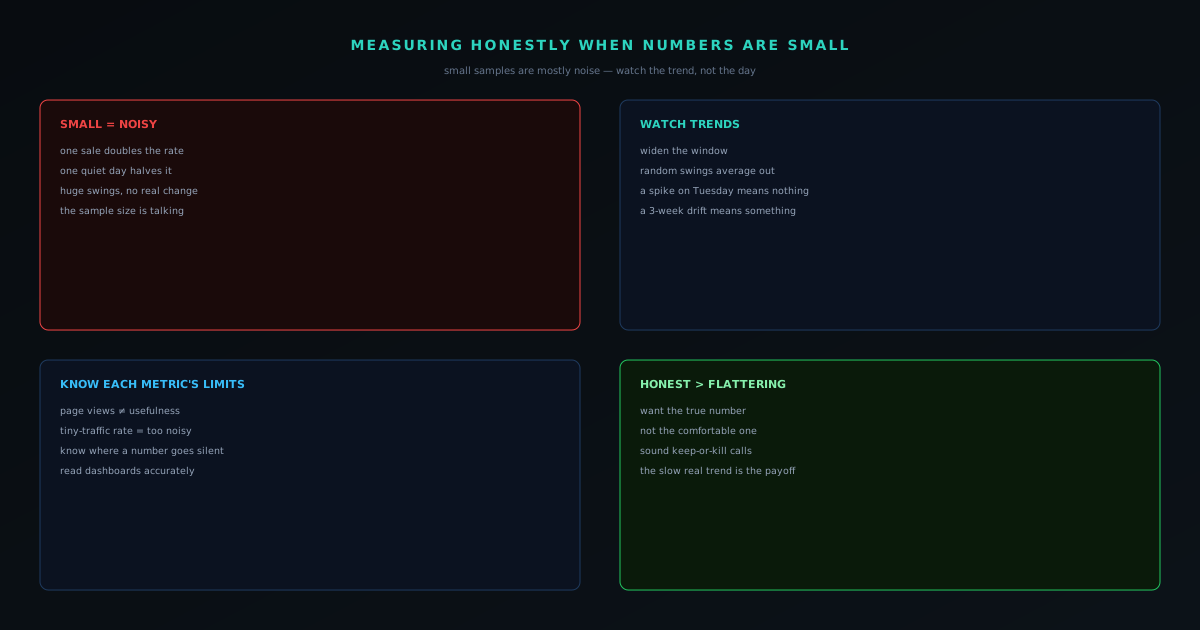
When your traffic and sales are small, the metrics are noisy and easy to misread, in both directions. Honest measurement at small scale means knowing what a number can and cannot tell you, watching the right signals, and not fooling yourself with a good day or a bad one.
Contents
- 1.Overview
- 2.Small samples are mostly noise
- 3.Watch trends, not single days
- 4.Know what each number can and cannot tell you
- 5.Why percentages mislead at small n
- 6.The mood-rollercoaster tax
- 7.Vanity metrics versus the ones that matter
- 8.Knowing what a number cannot tell you
- 9.Patience as a measurement strategy
- 10.Compare against your own past, not against giants
- 11.Attribution is noisier than the totals
- 12.What changes once you have more data
- 13.Honest beats flattering, every time
Overview
When you are small, your numbers lie to you constantly: not maliciously, just statistically. A handful of visitors, a few sales, a thin trickle of signups: at that scale, the metrics are dominated by noise, and noise is easy to misread as signal in both directions. A single good day feels like a breakthrough; a single bad day feels like failure; and both feelings are usually wrong. This field note is about measuring honestly when the numbers are small, which is a real skill and a different one than measuring at scale.
The stakes are higher than they look, because the decisions you make early (what to build, keep, or kill) depend on reading these noisy signals correctly. Fool yourself with the numbers and you will make confident decisions on imaginary information. Honest measurement is the foundation under every honest decision.
Small samples are mostly noise
The basic statistical fact is that small samples swing wildly. With a few visitors a day, one extra sale doubles your conversion rate and one quiet afternoon halves it, and neither swing means anything about the underlying reality: it is the sample size talking, not a change in the world. The smaller the numbers, the larger the relative noise, so the natural day-to-day variation at small scale is enormous in percentage terms even when nothing has actually changed.
Internalizing this is the first defense against self-deception. When you know that a single day's number is dominated by randomness, you stop reading meaning into individual data points. The good day was probably luck; the bad day was probably luck; the truth is somewhere in the pattern over time, not in any one reading.
Watch trends, not single days
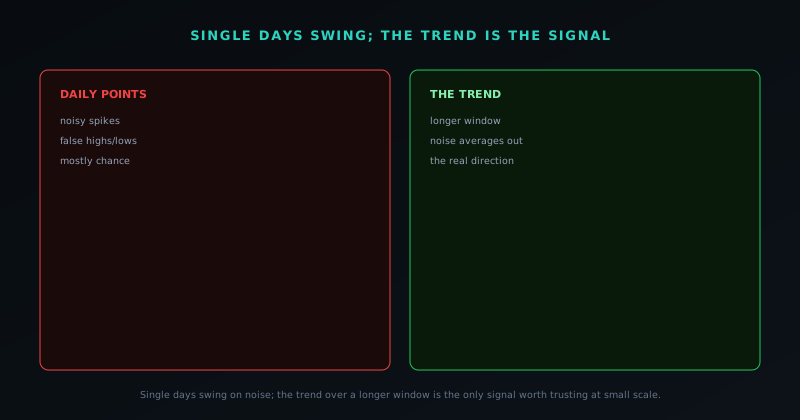
The practical response to noise is to look at trends over enough time to wash it out, not at single days. A line that drifts upward over weeks is meaningful; a spike on Tuesday is not. Widening the window is how you separate the signal from the noise: the longer the period, the more the random swings average out and the more the genuine direction shows through. At small scale especially, the trend is the only thing worth trusting, because any single point is mostly chance.
This also protects your emotional stability, which matters more than it sounds when you are running everything yourself. If your mood tracks daily numbers, you will ride a rollercoaster of false highs and false lows that has nothing to do with reality and everything to do with variance. Watching the trend keeps you steady, which keeps your decisions steady.
Know what each number can and cannot tell you
Honest measurement also means understanding the limits of what a given metric reports. A page-view count, gathered with consent through privacy-respecting analytics, tells you something about reach but nothing about whether anyone found the page useful. A conversion rate on tiny traffic is too noisy to optimize against confidently. Knowing the boundary of each number (what it genuinely measures and where it goes silent) prevents you from over-interpreting a metric into a conclusion it cannot actually support.
The discipline here is the same honesty the products are built on, turned inward. Just as the tools are labelled accurately about what their models do and do not do, your own dashboards deserve to be read accurately about what they do and do not prove. A number you understand the limits of is useful; a number you over-trust is a trap.
Why percentages mislead at small n
A specific trap at small scale is the percentage, which feels precise and is often nearly meaningless. A conversion rate that "doubled" or a metric that "rose 50 percent" sounds significant until you notice the underlying counts: two sales instead of one, three signups instead of two. Percentages compress small absolute changes into large-sounding relative ones, and at small n that compression is actively deceptive: the same one-event change that produces a dramatic percentage swing is well within the random noise of the system. Reading the percentage without looking at the raw counts behind it is one of the most common ways a small operator fools themselves into seeing a trend that is not there.
The defense is to always look through the percentage to the absolute numbers, because the counts tell you whether a change is even capable of being meaningful. A jump from one to two is a hundred-percent increase and tells you essentially nothing; the same percentage on counts of a thousand and two thousand would be a real signal. At small scale, the honest habit is to think in raw events first and percentages second, treating any large-looking percentage built on tiny counts as noise until proven otherwise. The number that looks most impressive (the big percentage on small data) is precisely the one most likely to be an artifact of the sample size rather than a fact about the world.
The mood-rollercoaster tax
There is a real and underappreciated cost to misreading small-scale metrics that has nothing to do with bad decisions: the emotional toll of riding the noise. When a solo operator's mood tracks daily numbers, they experience a rollercoaster of false highs on the good days and false lows on the bad ones, none of which reflects any actual change in the underlying reality: it is all variance. That emotional volatility is exhausting, and because running a small operation is already taxing, adding a self-inflicted rollercoaster driven by statistically meaningless daily swings is a genuine drain on the stamina the work requires.
Watching the trend instead of the day is therefore not only the statistically correct practice but a form of self-protection. A longer window averages out the swings that would otherwise jerk your mood around, leaving a steadier signal that is both more accurate and far easier to live with. The operator who internalizes that a single day is mostly chance stops celebrating the spikes and despairing at the dips, and conserves their emotional energy for the work rather than spending it reacting to noise. Stability of temperament is a real asset for someone running everything themselves, and honest measurement (refusing to read meaning into individual data points) is part of how you protect it. Calm comes from looking at the trend.
Vanity metrics versus the ones that matter
Not all numbers are equally worth tracking, and a particular hazard at small scale is the vanity metric: a number that is large, easy to grow, and disconnected from anything that actually matters. Page views, impressions, follower counts, and the like can climb impressively while the things that sustain an operation (engaged users, actual sales, people who return) stay flat, and fixating on the vanity number produces a comforting story that the real situation does not support. The honest discipline is to identify which metrics genuinely indicate health for your specific operation and to anchor on those, even when a flashier number is available to feel good about.
Distinguishing the meaningful from the vain is partly about asking what a number would change if it moved. A metric worth tracking is one whose movement would actually alter a decision or reflect a real shift in the operation's health; a vanity metric is one that can swing widely without anything important changing. For a small operation, the meaningful numbers are often the unglamorous ones (does anyone come back, does anything sell, does engagement deepen) rather than the large top-of-funnel counts that are easiest to grow and least connected to survival. Choosing to watch the metrics that matter, and to ignore the ones that merely flatter, is a precondition for measuring honestly at all, because you cannot read a signal honestly if you are looking at the wrong number.
Knowing what a number cannot tell you
Honest measurement requires understanding the boundary of each metric (what it genuinely reports and where it goes silent) because over-interpreting a number into a conclusion it cannot support is its own form of self-deception. A page-view count gathered through privacy-respecting analytics tells you something about reach but nothing about whether anyone found the page useful; a conversion rate on tiny traffic is too noisy to optimize against confidently; an engagement number might reflect a handful of enthusiasts rather than broad interest. Each metric has a question it can answer and many it cannot, and treating it as answering more than it does manufactures false confidence.
This discipline is the same honesty the products are built on, turned inward on your own dashboards. Just as the tools are labelled accurately about what their models do and do not do, your metrics deserve to be read accurately about what they do and do not prove. A number you understand the limits of is genuinely useful; a number you over-trust is a trap that leads to confident decisions on imaginary information. Knowing that a metric is silent on a question (that page views say nothing about usefulness, that a small-sample rate says little about anything) is what keeps you from filling that silence with a story you want to believe. Respecting the boundaries of your data is the foundation of trusting it.
Patience as a measurement strategy
At small scale, patience is not just a virtue but an actual measurement strategy, because the only reliable way to extract signal from noisy small-sample data is to let more of it accumulate over time. A trend that is invisible in a week of tiny daily numbers becomes legible over a couple of months, as the random swings average out and the underlying direction asserts itself. The operator who demands answers from a few days of data will be misled; the one who is willing to wait for the trend to reveal itself gets a true reading. Time is the tool that turns noise into signal when you cannot get a larger sample any other way.
This patience is hard precisely because a small operation is anxious for evidence that the work is paying off, and the temptation is to read the early, noisy numbers as a verdict. But an early verdict from insufficient data is worse than no verdict, because it is confidently wrong in a random direction. The honest stance is to make deliberate changes, then give them a fair window before judging, accepting that the real answer takes time to emerge. Pairing this with a steady output habit is natural, because the slow, genuine trend that honest measurement eventually reveals is exactly what a sustained cadence is quietly building, and seeing it requires the patience to keep going long enough for the signal to surface.
Compare against your own past, not against giants
A demoralizing and unhelpful habit at small scale is comparing your numbers to those of large, established operations, which guarantees you always feel behind and learn nothing actionable. The relevant comparison is almost always against your own past (is this month's trend better than last quarter's, is the trajectory pointing the right way) because that comparison controls for everything specific to your situation and isolates the only thing you can affect, which is your own progress over time. Measuring yourself against a competitor with a different scale, history, and budget tells you nothing you can act on; measuring against your past self tells you whether what you are doing is working.
This internal comparison is also more honest because it is harder to game with a flattering reference point. It is easy to find some giant whose numbers make you feel small or some failure that makes you feel large; neither reading reflects your actual situation. Your own historical trend is the fair baseline, immune to that cherry-picking, and it answers the question that matters: are the deliberate changes you are making moving the operation in the right direction? Anchoring measurement to your own trajectory keeps the focus on improvement you control rather than on a comparison that is either falsely discouraging or falsely reassuring, and it is the comparison a small operation can actually learn from.
Attribution is noisier than the totals
If raw totals are noisy at small scale, attribution (figuring out which channel, post, or change produced a given result) is noisier still, and it is worth being especially humble about it. With small numbers, the handful of sales or signups you can trace to a source is so few that assigning credit confidently is usually impossible; the visitor who bought may have encountered you several times across several channels, and pinning the conversion on the last click or the first touch is a simplification that small data cannot support. Over-trusting attribution at this scale leads to confident decisions about where effort is paying off that the data cannot actually justify.
The honest response is to hold attribution loosely and lean on it less than the totals. Broad patterns over long windows (this channel has consistently coincided with more engagement over months) are more trustworthy than precise per-event attribution, which is mostly noise when the events are few. A small operator is better served by directional judgments held tentatively than by a false precision about exactly which action caused which result. Knowing that attribution is even less reliable than the already-noisy totals keeps you from building strategy on the shakiest part of small-scale data, which is exactly the part that most tempts over-interpretation because it seems to promise actionable cause-and-effect.
What changes once you have more data
It is worth noting that this is a small-scale problem specifically, and that the discipline shifts as the numbers grow, because understanding the transition keeps you from misapplying small-scale caution forever. When traffic and sales are tiny, almost everything is noise and the only honest reading is the long trend; as volume grows, individual days and even individual changes become statistically meaningful, and you can start to read shorter windows and run real comparisons with more confidence. The noisiness is a function of the sample size, so the same skepticism that is essential at small n becomes overly conservative once n is large enough for the signal to firm up.
Recognizing where you are on that curve is part of measuring honestly. Applying small-sample caution when you finally have robust data would mean ignoring real signal out of habit; applying large-sample confidence to tiny data is the original sin this whole piece warns against. The honest operator calibrates their interpretation to the actual volume they have (heavy skepticism and long windows while small, progressively sharper reading as the numbers grow) rather than clinging to one mode regardless of scale. The goal throughout is the same: read the data for what it can actually support, no more and no less, which means the rules tighten or relax with the sample size rather than staying fixed.
Honest beats flattering, every time
The deepest temptation at small scale is to choose the flattering reading over the honest one: to seize on the metric that looks good, frame the spike as a trend, and quietly ignore the signals that disagree. It feels better in the moment and it is corrosive over time, because decisions made on flattering misreadings fail in ways that honest measurement would have prevented. The operating model only works if "measure honestly" is real, and it is only real if you apply it when the honest answer is not the one you wanted.
So the posture is to want the true number more than the good number. Watch the trend, respect the noise, know each metric's limits, and resist the pull toward the comfortable interpretation. That honesty is what lets you make sound keep-or-kill calls from small data, and it pairs with the sustainability of a daily habit, because the slow, real trend that honest measurement reveals is exactly what a steady cadence is quietly building. The product-filter post covers making honest calls from these signals, and the publishing post covers keeping the faith while the trend takes its time.
Frequently asked questions
Quick answers to common questions about this topic.
How do you measure a product when traffic is small?
Focus on activation and real use (did someone actually get value) rather than vanity totals like signups or pageviews. With small numbers, qualitative signal and behavior matter more than statistically thin rates.
Why are vanity metrics misleading early on?
They flatter without indicating real value: signups and views can climb while nobody actually uses the product. Honest measurement tracks whether users reach the outcome the product promises.
Can you trust conversion rates from a tiny sample?
Not much: small samples swing wildly, so a single conversion can move a rate dramatically. Treat early numbers as directional and lean on qualitative feedback until the sample is meaningful.
Related troubleshooting
Was this page helpful?
Your answer stays in this browser, it is not sent anywhere and no account or cookie is involved.