2026 · Novus Stream Solutions (hub)About 12 min readNovus Stream Solutions
One recording, a week of content: a repurposing system for solo creators
Trying to create something new every single day is why most people quit posting. The creators who last do the opposite: they record once and harvest a week of content from it. This is a concrete production system for turning one recording session into a full week of posts across formats, and the free tools to run it.
Contents
- 1.Overview
- 2.Why batch-and-repurpose beats daily-from-scratch
- 3.Recording the anchor piece to be harvested
- 4.The production line: one recording to a week
- 5.Choosing anchor topics that harvest well
- 6.Adapting one point to each platform, not copy-pasting
- 7.Quality control: repurposing is not spam
- 8.Batch the production, not just the recording
- 9.Build a buffer and get ahead
- 10.Consistency beats intensity
- 11.Scheduling the week and keeping it sustainable
Overview
The reason most people fail at content is not talent or ideas; it is the impossible standard they set themselves of creating something new, from scratch, every single day. Faced with a blank page each morning, even motivated creators burn out within weeks, because daily-from-nothing is a treadmill that only gets faster. The creators who actually sustain a presence for years are almost never the ones with superhuman discipline; they are the ones who quietly stopped playing that game and switched to a completely different model: record once, in a focused session, and harvest a week or more of content from that single recording. The output looks like relentless daily creation from the outside; the input is one good session and a production line.
This is the difference between making content and running a content system, and the system is learnable. The core idea is repurposing (covered as a principle in Repurposing one piece of content into ten) but principle is not enough; what makes it work in practice is a concrete, repeatable production line you can run without deciding everything from scratch each time. This guide lays out that line end to end: how to record one anchor piece designed to be harvested, how to break it down into a week of posts across formats, how to schedule the week so it posts itself, and where the free ecosystem tools fit for the visual and audio pieces. The goal is to make a week of content the output of an afternoon, not seven separate scrambles.
Why batch-and-repurpose beats daily-from-scratch
There are a few reasons the record-once model wins so decisively, and they compound. The first is the cost of context-switching: starting a new piece of content from nothing has a large fixed overhead (finding the idea, getting into the right headspace, setting up to record or write), and paying that overhead seven times a week is exhausting in a way that the actual creating is not. Batching pays it once. You sit down in creation mode a single time, and because you are already warmed up and in flow, producing the raw material for a week is far less than seven times the effort of producing one day worth.
The second reason is quality and coherence. A week of content harvested from one thoughtful recording is more coherent than seven disconnected daily posts, because it all flows from a single developed idea rather than seven half-formed ones squeezed out under deadline pressure. Your best thinking goes into the anchor piece, and everything derived from it inherits that quality. The third reason is simply sustainability: a model you can keep up is infinitely better than a brilliant one you abandon in a month, and batch-and-repurpose is sustainable precisely because it decouples the hard creative work (occasional, focused) from the steady output (frequent, mechanical). The production-line mindset behind this is developed further in Building a repeatable content production line.
Recording the anchor piece to be harvested
The whole system depends on the anchor (the one substantial recording everything else comes from), and the key shift is to record it knowing it will be harvested, which changes how you make it. The anchor can be whatever format suits you: a talking-head video, a podcast episode, a livestream, a long voice memo walking through a topic. What matters is that it is substantial enough to contain multiple distinct, separable points, because each separable point is a future clip or post. A rambling stream of consciousness is hard to harvest; a recording that moves through, say, five clear ideas gives you five natural extraction points.
Recording to be harvested means a few small habits while you create. Make each key point self-contained, so it makes sense pulled out of context: a clip that needs the surrounding ten minutes to land is not a clip. Naturally restate the question or topic before answering it, so an extracted segment is intelligible on its own. Leave small pauses between points, which make clean cuts much easier later. And keep a rough mental or written list of the distinct points as you go, because that list becomes your harvesting map. None of this constrains the recording much; it just means creating with the downstream uses faintly in mind, which is the single habit that turns one recording into a week instead of one post.
The production line: one recording to a week
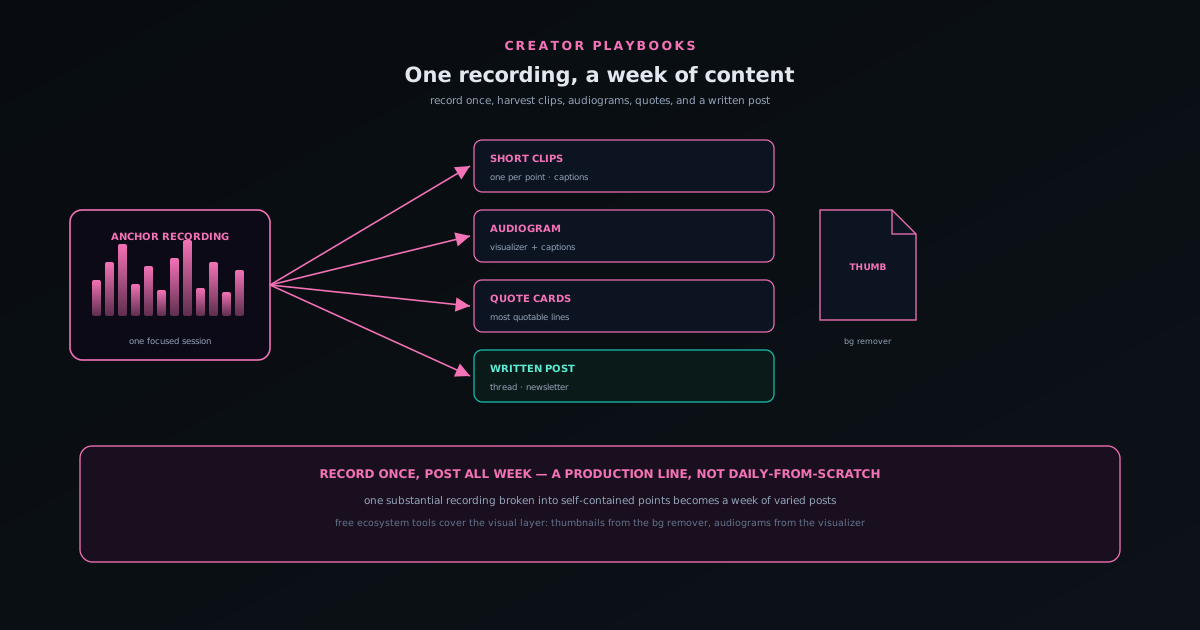
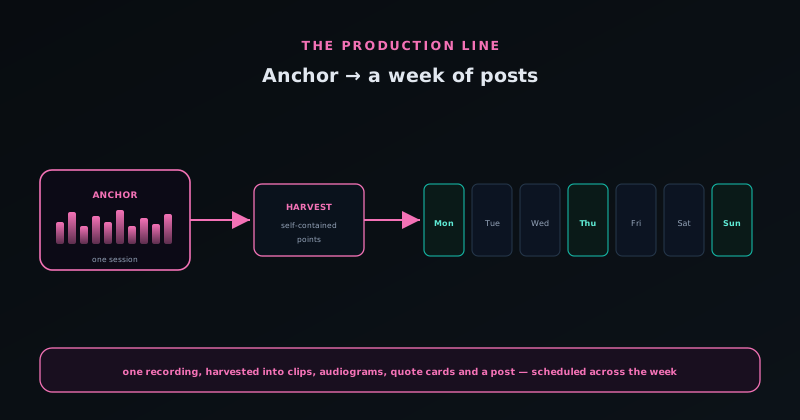
With the anchor recorded, harvesting is mechanical, which is the point: you are executing a known process, not making fresh creative decisions. Start by pulling the distinct points into short clips: each self-contained segment becomes a short vertical video for the platforms where short-form lives, with captions added so it works without sound. From the audio alone, you can make audiograms (a waveform or visualizer over the audio with captions), which are perfect for platforms where you have audio but no compelling video, and this is exactly where a music or audio visualizer earns its place, turning a sound clip into a watchable post. The most quotable lines become quote cards: simple, branded text graphics that travel well on image-first platforms.
Then there is the written layer. The anchor naturally summarises into a written post (a thread, a newsletter section, a short article) that captures the whole idea for the text-first audiences and, helpfully, gives the piece a permanent home that search can find. Every visual asset in this line needs production, and this is where the free ecosystem tools fit cleanly: thumbnails and clean graphics for the clips and cards come from bgremover.novusstreamsolutions.com/background-remover and the image tools, and the audiogram-style visual comes from the music visualizer at visualizers.novusstreamsolutions.com/editor, both running in the browser with no upload. The same one-source-many-outputs logic applied to a music release specifically is in One song, five assets: cover art, Canvas, lyric video, overlays, and SFX from a single track. The output of this line, from a single recording, is comfortably a week of varied content: several clips, an audiogram or two, a handful of quote cards, and a written post.
Choosing anchor topics that harvest well
Not every topic harvests equally well, so part of the system is choosing anchor subjects that naturally contain many separable pieces. A topic that is really one narrow point yields one clip and little else; a topic that has several facets, a few strong opinions, a story or two, and some concrete tips yields a week of distinct outputs from a single recording. Before recording, it is worth asking whether the subject is rich enough to break into parts (a how-to with multiple steps, a topic with several common myths to bust, a story with distinct beats) because the richness of the anchor sets the ceiling on the harvest.
A useful habit is to keep a running list of anchor-worthy topics rather than deciding on the spot, so that when you sit down to record you are choosing from candidates you already know are meaty. The best anchors often answer a question your audience repeatedly asks, because that guarantees both that the topic matters and that it has enough surface area to explore from several angles. Choosing well at this stage is leverage: a slightly better topic choice can be the difference between a recording that grudgingly yields three posts and one that comfortably fills a fortnight.
Adapting one point to each platform, not copy-pasting
A subtle mistake in repurposing is to take one piece and post the identical thing everywhere, which performs poorly because each platform has its own format, length, and norms. The better approach is to adapt each harvested point to the platform it is going to: the same idea becomes a captioned vertical clip on a short-video platform, a punchy text post elsewhere, a longer written treatment in a newsletter, and a visual quote on an image-first feed. The underlying point is shared, but its expression is native to where it lands, which is what makes it feel like it belongs rather than like a cross-post.
This adaptation is far less work than creating fresh content for each platform, because the thinking is already done: you are reshaping a known point, not inventing a new one. It also lets the same idea reach different parts of your audience in the form each prefers, multiplying the value of the original recording without multiplying the creative effort. The skill to develop is seeing one point and instantly knowing its four or five native forms, which comes quickly with practice and turns a single recording into genuinely platform-appropriate output rather than the same thing pasted five times.
Quality control: repurposing is not spam
There is a failure mode where repurposing degrades into spam (flooding every channel with low-effort fragments of the same thing), and avoiding it is what separates a content system from noise. The guardrail is that every piece you publish has to stand on its own and be worth someone time independently; a clip that makes no sense without the original, or a quote card with nothing behind it, fails that test. Repurposing should produce many genuinely good standalone pieces from one rich source, not many thin ones that only make sense as advertisements for the original.
This is why the recording-to-be-harvested discipline matters so much: if each point was made self-contained at the recording stage, each harvested piece naturally stands alone. It is also why the written, permanent version of the anchor is valuable: it gives the fragments a home to point back to for anyone who wants the full treatment, so the short pieces can be genuinely short without leaving people stranded. The test for any harvested piece is simple: would this be worth posting even if it were the only thing you made this week? If yes, it earns its place; if no, it is filler.
Batch the production, not just the recording
The efficiency of recording once extends to the production stage if you batch that too, rather than processing each piece individually as you post it. Editing five clips in one sitting is far faster than editing one clip on five different days, because you stay in the same tools and mindset and pay the setup cost once. The same applies to making the quote cards, the audiograms, and the thumbnails: doing all of one type together, assembly-line fashion, is dramatically quicker than scattering the work across the week alongside everything else.
This is where having a consistent visual system pays off, because batched production only flows if you are not redesigning from scratch each time. Reusable templates for thumbnails and quote cards, a known visualizer style for audiograms, and a repeatable clip format mean the batch is execution rather than invention, which is exactly what the free ecosystem tools support, with the background remover handling thumbnails and clean graphics and the visualizer handling audiograms, all in the browser. Batching the production turns the harvest from a week of small chores into one focused session that fills the pipeline.
Build a buffer and get ahead
The real unlock of the whole system arrives once you are producing more than you immediately need, because then you can build a buffer: a backlog of finished, scheduled content that runs ahead of real time. A buffer is what makes a content cadence survive the weeks when life intervenes: a busy stretch, a holiday, an emergency that would otherwise break a daily-from-scratch streak simply draws down the buffer instead, and the output never visibly stops. Getting even two or three weeks ahead changes content from a constant pressure into a system that runs on its own.
The way to build the buffer is to produce slightly more than you publish for a while, banking the surplus, until you have a comfortable runway. It compounds: with a buffer in place, each recording session tops it back up rather than scrambling to fill next week, which removes the deadline stress that causes most people to quit. The endpoint of the one-recording-a-week system is not just consistent output but consistent output you are ahead of, which is the difference between content as a treadmill and content as a machine you have built and can step back from.
Consistency beats intensity
The deepest reason this system works is that consistency, not intensity, is what compounds in content, and the record-once model is built for consistency. A creator who posts steadily for a year reaches far more people and builds far more trust than one who posts brilliantly for a month and then burns out, because audiences reward showing up reliably and platforms reward steady activity. The whole point of the production line is to make showing up reliably possible without the heroic effort that is impossible to sustain.
This reframes what good looks like: the aim is not the single best piece you can make under pressure, but a sustainable stream of genuinely good pieces produced from a sane amount of effort. The record-once-harvest-many approach delivers exactly that: your best thinking goes into the occasional anchor, and the steady output flows from it without the daily-blank-page dread. Over the timescales that actually matter for building an audience, the sustainable system beats the unsustainable sprint every time, which is why the creators who last are almost always the ones running some version of this.
None of this means the anchor recordings can be careless, of course; the quality of the week still flows from the quality of the source, so the occasional intense effort goes there, into making the anchor genuinely good. The shift is in where the intensity lives: concentrated in the few sessions that feed everything, rather than spread thin across a daily scramble. Put the effort into the source and let the system carry it the rest of the way, and the output stays both good and steady in a way that neither pure intensity nor pure routine achieves on its own.
Scheduling the week and keeping it sustainable
The final step is to turn the pile of harvested assets into a week that posts itself, because content that sits in a folder unposted is wasted work. Map the assets onto the days: lead with the strongest clip, space the others through the week, drop the audiograms and quote cards on the days that suit those formats, and anchor the written post where your text audience is. Then schedule them in advance with whatever scheduling tool you use, so the week runs on its own while you are not thinking about it. The whole point of doing the work in a batch is that the posting becomes passive: you did the thinking once, and now it simply goes out.
Sustainability comes from making this a routine rather than a heroic effort. A single recording session plus a harvesting session, on a regular cadence (weekly, fortnightly, whatever fits your life) produces a steady stream of content with none of the daily-blank-page dread that ends most creators runs. As you repeat the cycle, both halves get faster: you learn to record more harvestable anchors, and the harvesting line becomes muscle memory. The aim is not to produce the most content possible but to produce a consistent, sustainable stream from a sane amount of effort, which is what actually compounds over the years that matter. Build the line once, run it on a cadence, and a week of content stops being seven scrambles and becomes the natural output of one good session.
Frequently asked questions
Quick answers to common questions about this topic.
How can one recording become a week of content?
A substantial anchor recording (a video, podcast, stream, or long voice memo) contains multiple distinct points, and each becomes a separate asset: short vertical clips, audiograms, quote cards, and a written summary post. Harvesting those from one session produces a week of varied content without creating something new each day.
Why is batching better than posting something new daily?
Daily-from-scratch pays the large fixed overhead of starting from nothing seven times a week, which burns people out. Batching pays it once, in flow, so a week of raw material costs far less than seven days of separate efforts. It also produces more coherent content (all from one developed idea) and is sustainable, which beats a brilliant model you abandon.
How should I record the anchor piece?
Record it knowing it will be harvested: make each key point self-contained so it makes sense pulled out of context, restate the question or topic before answering, leave small pauses between points for clean cuts, and keep a rough list of the distinct points as your harvesting map. Aim for a recording that moves through several clear ideas.
What assets should I harvest from one recording?
Short vertical clips (one per self-contained point, with captions), audiograms (a visualizer or waveform over an audio clip with captions), quote cards from the most quotable lines, and a written post (thread, newsletter, or article) that captures the whole idea and gives it a searchable home.
What tools do I need to run this?
A way to cut clips and add captions, plus image and visual tools for thumbnails, quote cards, and audiograms. The free Novus ecosystem tools cover the visual layer (the background remover and image tools for thumbnails and clean graphics, and the music visualizer for audiogram-style posts) all in the browser with no upload.
How do I keep this sustainable?
Make it a routine: a single recording session plus a harvesting session on a regular cadence (weekly or fortnightly), then schedule the week in advance so posting is passive. Both halves get faster with repetition. The goal is a consistent, sustainable stream from a sane amount of effort, not the maximum possible output.
Related troubleshooting
Was this page helpful?
Your answer stays in this browser, it is not sent anywhere and no account or cookie is involved.