2026 · Novus Stream Solutions (hub)About 13 min readNovus Stream Solutions
Refreshing old content to keep (and regain) rankings
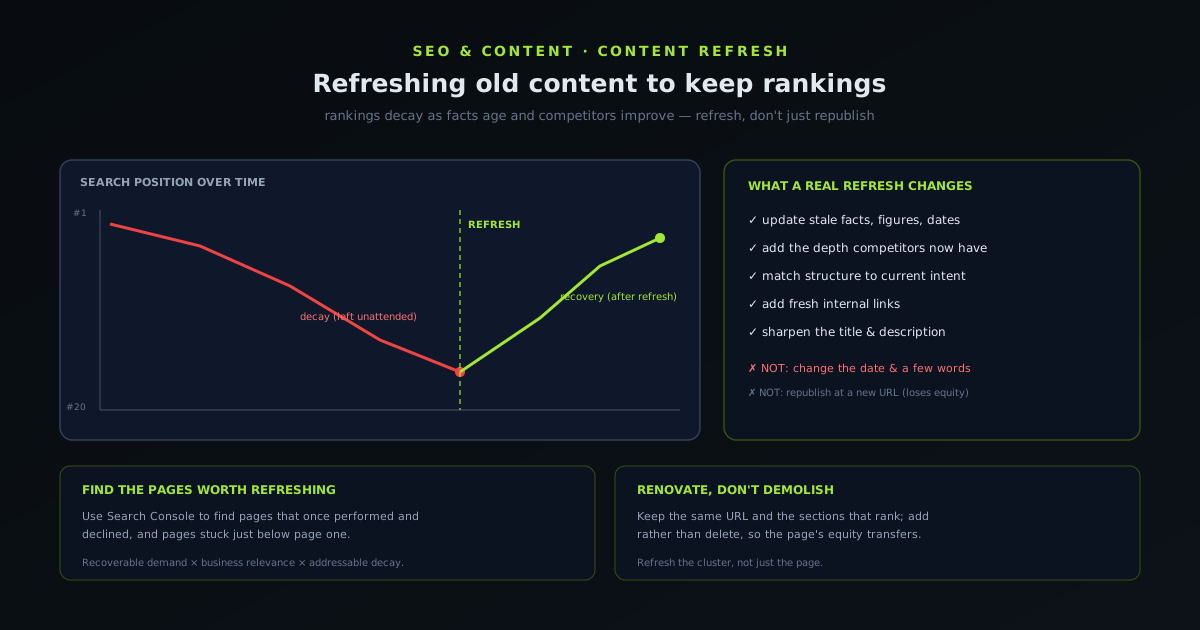
A page does not hold its ranking forever; content decays as facts age and competitors improve. Refreshing what you have already published is often higher-return than writing something new. Here is how to do it without losing equity.
Contents
- 1.Overview
- 2.Why content decays in the first place
- 3.Finding the pages worth refreshing
- 4.What to actually change in a refresh
- 5.The cosmetic-refresh trap
- 6.Updating without losing the equity
- 7.Make refreshing a recurring habit
- 8.Refresh the cluster, not just the page
- 9.Refresh, consolidate, or retire
- 10.Measuring whether a refresh worked
Overview
A page that ranks well today will not rank well forever, and understanding why is the start of one of the highest-return activities in content marketing. Rankings decay for reasons that have nothing to do with the page getting worse: the facts it states age and become stale, competitors publish fresher and more complete versions, search intent shifts as the way people search a topic evolves, and the page slowly loses relative quality even as it sits unchanged. This decay is gradual and easy to miss (a page slips from the first position to the fifth to the second page over months), which is why the traffic from older content quietly erodes unless something is done. Refreshing that content, rather than only ever writing new pieces, is how you defend and reclaim the rankings you already earned.
The case for refreshing over constantly producing new content is one of leverage. A page that already ranks has equity: it is indexed, it has earned links and authority, it has a track record with search engines. A refresh builds on all of that, whereas a brand-new page starts from zero and has to earn its place over months. Updating an existing page to be current and comprehensive is often faster and more effective than writing a new one, because you are improving an asset that already has a foundation rather than constructing a new foundation from scratch. This guide covers why content decays, how to find the pages most worth refreshing, what to actually change, and, crucially, how to update a page without accidentally destroying the equity that made it worth refreshing in the first place.
Why content decays in the first place
Content decay has a handful of distinct causes, and naming them helps you diagnose what a given page needs. The most common is staleness: a page that states facts, figures, prices, or recommendations that were accurate when written but have since changed now misinforms readers and signals to search engines that it is out of date. A second cause is competitive: even a page that stays accurate loses ground when competitors publish newer, more thorough, better-structured pieces on the same topic, because ranking is relative: your page can decline simply because others improved. A third is intent drift: the way people search a topic, and what they expect to find, evolves over time, so a page that perfectly matched the intent two years ago may now miss what searchers actually want.
These causes matter because they point to different fixes. A stale page needs its facts updated; a page losing to competitors needs to become more comprehensive or better than the new alternatives; a page suffering intent drift needs its angle or structure rethought to match what searchers now expect. Treating all decay as the same problem (and "refreshing" by changing the date and tweaking a few words) fixes none of them, which is why so many superficial refreshes do nothing. The productive approach is to diagnose why a specific page declined and address that cause, which usually means real work: current facts, deeper coverage, or a restructured page that better answers the query as it is searched today. Decay is not random; it has reasons, and effective refreshing targets the reason.
Finding the pages worth refreshing
Not every old page deserves a refresh, so the first step is identifying the ones where the effort will pay off, which means looking at the data rather than refreshing alphabetically or by gut feeling. The highest-priority candidates are pages that once performed and have since declined; they had proven demand and ranking ability, so recovering them is realistic and valuable. Search Console is the tool for finding these: comparing a recent period against an earlier one surfaces the pages that lost the most clicks and impressions, which are exactly the pages where decay is costing you measurable traffic. A page that fell from strong to weak is a better refresh target than a page that never performed, because the former has a demonstrated ceiling to recover toward.
A second category worth refreshing is pages stuck just below where they could be: those ranking on the edge of the first page, where a meaningful improvement could push them into the high-traffic positions, turning a page that gets little into one that gets a lot. These near-miss pages are leverage points: small relative gains produce large traffic gains because of how click-through concentrates at the top. Beyond the data, prioritize pages on topics that still matter to your business and pages whose facts have genuinely gone stale (where leaving them is actively harmful). The discipline is to refresh where the combination of recoverable demand, business relevance, and addressable decay is highest, rather than spreading refresh effort evenly across an archive where much of it would be wasted.
What to actually change in a refresh
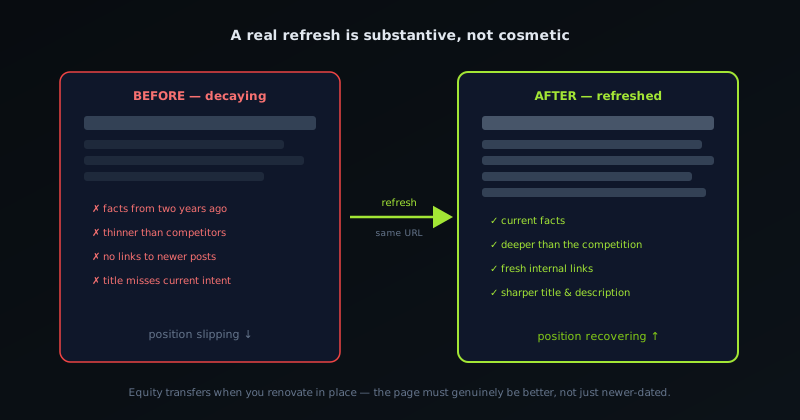
A real refresh is substantive, and it starts with accuracy: update every fact, figure, date, price, screenshot, and recommendation that has changed since publication, because correcting staleness is both the most basic and the most important part of keeping a page valuable. From there, the highest-impact change is usually depth: adding the sections, questions, and subtopics that the page lacks but that searchers and competing pages now cover, so the page becomes the more complete answer rather than the thinner one. Updating the structure to match how the topic is searched today, improving clarity, and adding examples or specifics that the original glossed over all raise the page above the bar it has slipped below.
Two refresh moves are easy to overlook and disproportionately effective. First, internal links: a page published two years ago has no links from anything you wrote since, so adding contextual links to it from newer, relevant pages (and from it to your newer pages) both passes authority and signals renewed importance, which is why internal linking is half of a good refresh (see Internal linking that actually moves the needle). Second, the title and meta description: rewriting them to better match current search intent and to be more compelling can lift click-through even without a ranking change, recovering traffic from the same position. The combination (current facts, greater depth, structure matched to intent, fresh internal links, and a sharper title) is what a substantive refresh contains, and it is genuine work rather than a date change.
The cosmetic-refresh trap
The most common way content refreshing fails is the cosmetic refresh: changing the publication date, swapping a few words, and hoping the appearance of freshness restores the ranking. This does not work, and it is worth understanding why, because the misconception is widespread. Search engines evaluate the actual content and its quality relative to alternatives, not the date stamp. Updating the date on an unchanged page fools no one and may even be treated as a manipulation signal. A page declined because of a real cause (staleness, weaker relative quality, intent drift), and only addressing that cause reverses the decline. Cosmetic changes address the symptom (an old-looking date) rather than the disease (a page that is now worse than its competition).
Worse, cosmetic refreshing wastes the very effort that could have fixed the page, creating the illusion of action while the page continues to decay. A business that "refreshes" by bulk-updating dates feels productive and sees no results, then concludes that refreshing does not work, when what does not work is the cosmetic version of it. The honest standard for a refresh is that the page should genuinely be better after it (more accurate, more complete, more useful) than it was before, such that it deserves to rank higher on its merits. If a refresh does not make the page meaningfully better, it is not a refresh; it is a date change. Holding refreshes to the standard of real improvement is what separates the practice that recovers rankings from the ritual that merely looks like it should.
Updating without losing the equity
A page worth refreshing has earned equity (its ranking history, its links, its authority), and the cardinal rule of refreshing is to improve the page without throwing that equity away. The single most important way to preserve it is to keep the same URL: update the existing page in place rather than publishing the refreshed version at a new address, because a new URL starts from zero and abandons everything the old one earned. If the URL absolutely must change, a proper redirect from the old to the new is essential to carry the equity across, but the default and far safer move is to edit the page at its existing address, so all its accumulated authority transfers seamlessly to the improved version.
Preserving equity also means being careful about what you remove. If a page ranks for several queries, stripping out the sections that serve some of them to "tighten" the page can cost the rankings those sections earned, so additions and improvements are safer than deletions unless content is genuinely redundant or wrong. Keep the elements that are working (the URL, the sections that rank, the structure that serves intent) and build on them, rather than rewriting wholesale in a way that discards the page's proven strengths. The mental model is renovation, not demolition: you are improving a structure that has value, and the goal is to make it better while keeping everything that made it worth improving. Refreshes that respect this preserve and build equity; refreshes that ignore it can leave a page worse off than if it had been left alone.
Make refreshing a recurring habit
Content refreshing is most effective as an ongoing maintenance practice rather than a one-time rescue mission, because decay is continuous (pages are always aging, competitors are always improving, intent is always shifting), so the content library needs continuous tending. Building a regular cadence of reviewing performance and refreshing the pages that have declined turns refreshing from a panic response to a sudden traffic drop into a steady discipline that keeps the whole library healthy. A periodic review (quarterly is common) of which pages have lost ground, followed by substantive refreshes of the highest-priority ones, prevents the slow erosion that otherwise accumulates unnoticed across an archive.
Treating refreshing as a habit also reframes how you think about an aging content library: rather than a pile of old posts to be forgotten, it becomes a portfolio of assets to be maintained, each capable of being kept current and competitive. For a content operation, the ratio of refreshing to new production is a strategic choice, and as a library grows, the leverage tilts toward refreshing: there is more existing equity to defend and build on, and refreshing a proven page often beats betting on a new one. Many businesses underinvest in refreshing because new content feels more like progress, but the data usually shows that maintaining and improving existing winners returns more than constantly chasing new topics. A deliberate refresh habit is how a content library compounds rather than decays.
Refresh the cluster, not just the page
A refresh delivers more when it strengthens a topic cluster rather than improving a single isolated page, because search rewards demonstrated authority on a topic, and that authority lives in how a group of related pages cover the subject and link together. When you refresh a page, the opportunity is to also strengthen its connections to the related pages around it: updating the internal links so the refreshed page is well-tied into the cluster, and ensuring the cluster as a whole presents a current, comprehensive treatment of the topic. A refresh that improves one page and re-links it to its neighbors lifts the cluster, which lifts every page in it, rather than improving one page in isolation.
This is why the most strategic refreshing happens at the level of topics, not individual posts: identifying a topic where your cluster has decayed and refreshing the key pages together, re-establishing the internal linking among them, produces a compounding improvement that single-page refreshes cannot match. The cluster becomes current and authoritative again as a unit, and the renewed internal links distribute the benefit across all its pages. For how clusters work and why they outperform scattered standalone posts, see Topic clusters explained: how to structure a product blog; the refreshing implication is that you should view your content not as a list of pages to update one by one, but as a set of topic clusters to keep current as wholes, refreshing the pages within a cluster together so the topical authority they collectively represent stays strong.
Refresh, consolidate, or retire
Not every declining page should be refreshed, and part of managing an aging library is deciding between three responses (refresh, consolidate, or retire) based on what a given page warrants. Refreshing fits a page that addresses a topic still worth ranking for and can be made competitive again. Consolidation fits the situation where several thin or overlapping pages compete with each other; merging them into one stronger page resolves the internal competition and concentrates the equity, which often ranks better than any of the fragments did alone. Retiring fits a page on a topic no longer relevant, or one too weak to justify the effort, where removing or redirecting it is healthier than maintaining it.
Making this decision deliberately prevents two opposite mistakes: refreshing pages that should be consolidated or retired (wasting effort on pages that will not recover regardless) and retiring pages that should be refreshed (discarding recoverable equity). The diagnostic is to ask what the page contributes and whether that contribution is best served by improving it, merging it, or removing it, a judgment about the page's role in the library rather than a reflex to refresh everything that declined. A library managed this way stays lean and strong, with effort concentrated on the pages worth improving, redundancy consolidated into authority, and dead weight cleared, which is a healthier outcome than treating refresh as the only tool for every aging page.
Measuring whether a refresh worked
A refresh is a hypothesis (that improving the page will recover or grow its traffic), and like any hypothesis it should be checked rather than assumed, which means watching the page's performance after the update. The metrics to track are the same ones that identified the page as a candidate: its rankings for the queries it targets, and its clicks and impressions in Search Console. Improvement usually takes a few weeks to register as search engines recrawl and reassess the page, so the right horizon is patient (checking back a month or two after the refresh rather than the next day), but a substantive refresh of a well-chosen page typically shows measurable recovery in that window.
Measuring refreshes also teaches you which kinds of refreshes work on your content, which sharpens future effort. If pages refreshed with added depth recover strongly while pages given only updated facts do not, that tells you where the leverage is for your library; if certain topics respond and others do not, that informs where to focus. Over time, this feedback turns refreshing from a hopeful activity into a measured one, where you invest in the refresh moves that demonstrably pay off and stop wasting effort on those that do not. The discipline of checking results closes the loop: it confirms that the work recovered real traffic, distinguishes substantive refreshes from cosmetic ones by their outcomes, and continuously improves your sense of how to keep an aging library performing, which is the whole point of treating content as an asset to maintain rather than a stream to produce and abandon.
Frequently asked questions
Quick answers to common questions about this topic.
Does changing the publish date improve rankings?
No. Search engines evaluate the actual content relative to competitors, not the date stamp. A cosmetic refresh (new date, a few changed words) does not reverse decay and may be seen as manipulation. Only substantively improving the page recovers its ranking.
How do I find which old pages to refresh?
Use Search Console to compare a recent period against an earlier one and surface pages that lost the most clicks and impressions. Prioritize pages that once performed and declined, pages stuck just below page one, and pages whose facts have gone stale.
Will refreshing a page lose the ranking it already has?
Not if you keep the same URL and build on what works. Update the page in place rather than republishing at a new address, preserve the sections that rank, and add rather than delete. Equity transfers seamlessly when you renovate instead of demolishing.
How often should I refresh content?
Make it a recurring habit rather than a one-time fix: a quarterly review of which pages have declined, followed by substantive refreshes of the highest-priority ones, works well. As a library grows, defending and improving existing winners often returns more than constantly producing new posts.
Related troubleshooting
Was this page helpful?
Your answer stays in this browser, it is not sent anywhere and no account or cookie is involved.