2026 · Novus Stream SolutionsAbout 12 min readNovus Stream Solutions
Internal linking that actually moves the needle
Internal links are one of the few ranking factors you fully control, and most sites waste them. Here is what internal links actually do, and how to link your pages so the structure genuinely helps.
Contents
- 1.Overview
- 2.What internal links actually do
- 3.Link with descriptive anchor text
- 4.Link from strong pages to ones that need help
- 5.The cluster linking pattern
- 6.Do not link everything to everything
- 7.Orphan pages are wasted pages
- 8.Click distance and keeping pages reachable
- 9.The links you control versus the ones you do not
- 10.Internal links serve readers first
- 11.A simple internal linking routine
Overview
Internal links (the links from one page on your site to another) are one of the few ranking factors you completely control, and most sites barely use them. Unlike backlinks from other sites, which you can influence but not dictate, internal links are entirely yours to place: you decide which pages link to which, with what anchor text, in what structure. That control makes internal linking unusually high-leverage, because you can actively shape how authority flows through your site, how readers navigate it, and how search engines understand the relationships between your pages. Yet most sites either neglect internal linking entirely or do it carelessly, leaving real, free ranking benefit on the table.
This is a practical guide to internal linking that actually moves the needle, as opposed to the perfunctory "related posts" widget most sites treat as sufficient. Done well, internal linking helps readers find more of what they need, spreads ranking authority to the pages that need it, and makes your site's structure legible to search. Done carelessly (or not at all), it leaves pages stranded, wastes authority, and forfeits a benefit that costs nothing but attention. The good news is that because you fully control it, improving internal linking is one of the most directly actionable things you can do for your site.
What internal links actually do
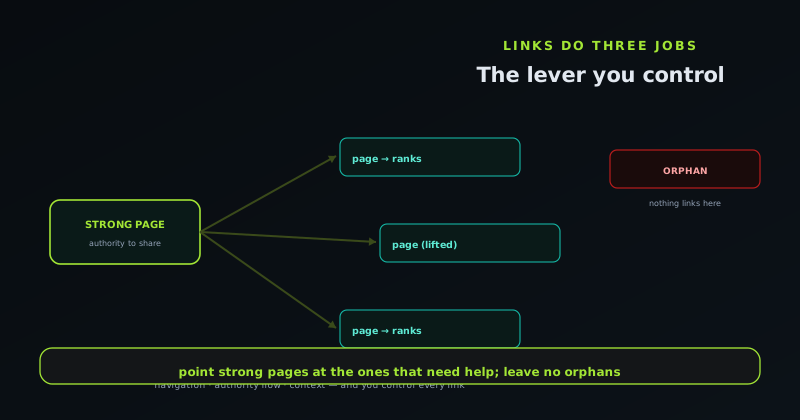
Internal links do three distinct things, and understanding them separately is the key to using links well. First, they help readers navigate: a link to a related page lets a reader who wants more go get it, which improves engagement and keeps people on your site finding value. Second, they spread ranking authority: pages accumulate authority, and links pass some of that authority to the pages they link to, so internal links let you direct authority toward the pages that need it. Third, they provide context: the links from a page, and the anchor text used, help search engines understand what a page is about and how it relates to the rest of your site.
These three functions are why internal linking is more than a navigational convenience. The navigation function serves readers directly; the authority function shapes how rankings distribute across your site; the context function helps search understand your content and structure. A good internal link often serves all three at once: pointing a reader to genuinely relevant content, passing authority to a page you want to strengthen, and signaling the topical relationship. Thinking about links in terms of these three jobs, rather than just "linking related stuff," is what turns internal linking from a vague good practice into a deliberate tool you can aim.
Link with descriptive anchor text
The anchor text (the clickable words of a link) matters because it tells both readers and search engines what the linked page is about, so descriptive anchors are far more useful than generic ones. A link that says "how to make a transparent PNG" tells the reader exactly what they will get and tells search engines what the destination page is about; a link that says "click here" or "read more" tells neither anything. Descriptive anchor text serves the reader by setting accurate expectations and serves search by providing context about the destination, which is why it is one of the simplest high-value internal linking habits.
The discipline is to write anchor text that genuinely describes the destination, naturally, as part of the sentence. This usually means linking a meaningful phrase that names the topic of the linked page rather than a generic call to action or an awkward keyword insertion. Natural, descriptive anchors read well for humans and provide clean context for search; forced or repetitive keyword anchors read badly and can look manipulative. The goal is anchors that a reader would find genuinely helpful in deciding whether to click, because that same helpfulness is what makes them useful as context signals. Descriptive, natural anchor text is a small habit that improves every internal link you place.
Link from strong pages to ones that need help
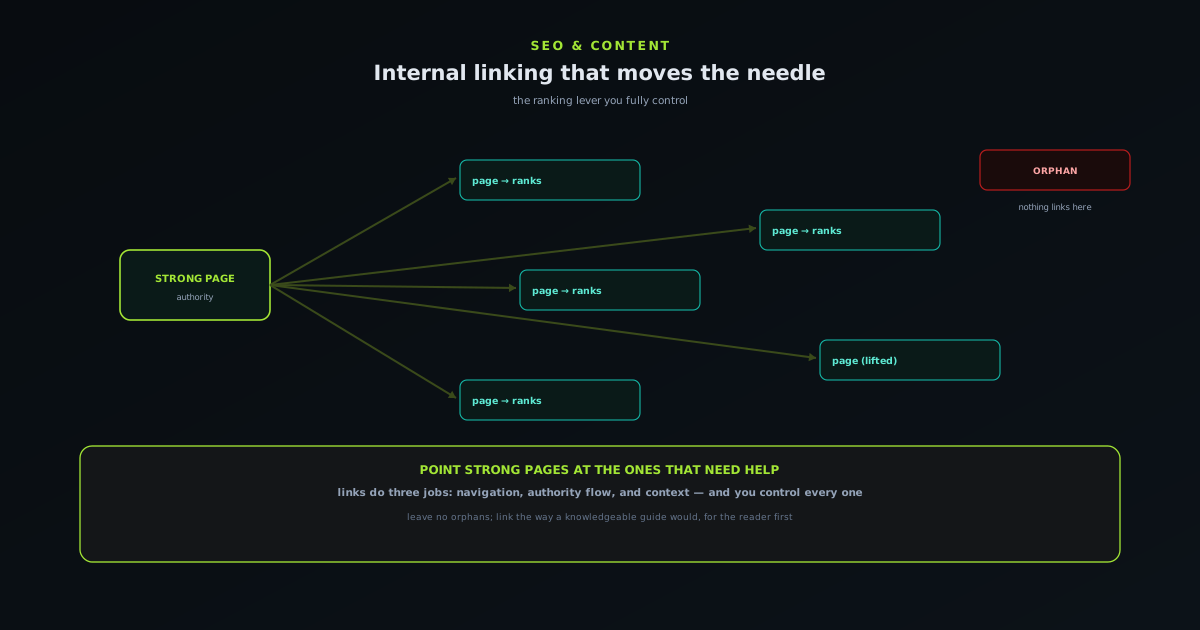
One of the most powerful internal linking moves is to link from your strong, authoritative pages to the pages you want to strengthen, because that is how you direct authority where it is most useful. Your best pages (the ones with the most authority, whether from age, backlinks, or traffic) have authority to share, and linking from them to newer or weaker pages that you want to rank passes some of that authority along. This is a deliberate way to lift pages that deserve to rank but have not yet, using the authority your established pages have already earned. It is one of the few ways to actively boost a specific page rather than just hoping it rises.
The practical move is to identify your strongest pages and your pages that need help, then add genuine, relevant links from the former to the latter where the connection is real. The links still have to make sense (you are not stuffing irrelevant links into your strong pages, but rather finding the genuine relationships and linking them) but within that constraint, consciously directing authority from strong pages to ones that need it is a high-leverage habit. Most sites link haphazardly and let authority flow randomly; a site that deliberately points its strong pages at the ones it wants to strengthen is using internal linking as the directed tool it can be.
The cluster linking pattern
If your content is organized into topic clusters, the internal linking pattern is largely defined for you: spokes link to their pillar, the pillar links to its spokes, and spokes link to sibling spokes where genuinely relevant. This pattern is what makes a cluster function as a cluster rather than a set of unconnected posts: the links knit the related content together, spread authority through the group, and signal the topical relationship to search. Following the cluster linking pattern consistently is one of the highest-return internal linking practices, because it builds the connected structure that demonstrates depth and lets authority concentrate where it counts.
The cluster pattern also gives you a clear rule for which links to add, which solves the common paralysis of not knowing what to link to what. Within a cluster, the answer is defined: connect each spoke to its pillar and to its genuinely related siblings, and connect the pillar out to all its spokes. Across clusters, link where topics genuinely bridge. This structure prevents both under-linking (leaving pages stranded) and over-linking (connecting everything to everything), because it ties linking to the real topical relationships your cluster structure already encodes. If you build content in clusters, the linking pattern comes with it, which is one more reason the cluster model is worth adopting.
Do not link everything to everything
A common over-correction, once people learn internal linking matters, is to link aggressively and indiscriminately, cramming links between pages with only loose relationships. This is counterproductive: too many links dilute the value of each, irrelevant links confuse rather than help readers and search, and a page stuffed with links reads as spammy and serves no one well. The value of an internal link comes partly from its relevance and selectivity: a link that genuinely points to closely related content is worth far more than one of fifty links to vaguely related pages. More links is not better; more relevant links is better.
The discipline is to link where there is a genuine relationship and a real reason for a reader to follow, and to resist linking just to link. Each internal link should pass the test of whether a reader interested in this content would genuinely benefit from the linked page; if yes, link it with descriptive anchor text, and if not, leave it out. Selective, relevant linking concentrates value and serves readers; indiscriminate linking dilutes value and clutters the page. The goal is a site where the links genuinely map the real relationships between your content, not one where everything is mechanically connected to everything in the hope that more links help. Quality and relevance of links beats quantity every time.
Orphan pages are wasted pages
An orphan page (a page with no internal links pointing to it) is a page you have largely wasted, because it is hard for both readers and search engines to find and it receives no authority from the rest of your site. You may have written an excellent page, but if nothing links to it, readers navigating your site will never reach it and search engines will struggle to discover and value it. Orphan pages are a surprisingly common problem, especially on sites that publish steadily without a linking discipline, and every orphan is a page whose potential is throttled by its isolation.
The fix is to make sure every page you publish gets linked to from relevant existing pages, ideally as part of publishing it rather than as a cleanup task later. When you add a new post, link to it from the related posts and the relevant pillar or category, so it enters the site's structure connected rather than stranded. Periodically auditing for orphan pages and connecting them is worthwhile, but building the habit of linking each new page in as you publish prevents orphans from accumulating. No page should stand alone; every page should be reachable through the site's internal links, both so readers can find it and so it receives the authority and context that linking provides.
Click distance and keeping pages reachable
Beyond simply being linked, pages benefit from being reachable within a few clicks of your important entry points, because pages buried deep in the structure are harder for both readers and search engines to reach and tend to receive less authority. The rough principle is that important pages should not be many clicks away from your homepage or main hub pages; the deeper a page is buried, the weaker its position. Keeping your important content within a shallow click distance of your strong entry points ensures it is easy to find and well-supported by the site's authority flow.
This shapes how you think about site structure and linking together. A flat, well-connected structure where important pages are reachable quickly tends to outperform a deep, poorly linked one where valuable content is buried layers down. Hub pages (category pages, pillar pages, the homepage) act as distribution points that keep the pages they link to reachable and supported, which is part of why the cluster-and-category structure works so well. When you place a page, consider how a reader and a crawler would reach it and how many clicks from your strong pages it sits; keeping the important content shallow and well-linked is part of internal linking that actually moves the needle.
The links you control versus the ones you do not
It is worth appreciating why internal linking deserves more attention than it usually gets: it is the part of your link profile you completely control. Backlinks from other sites are valuable but largely outside your direct control: you can earn and influence them, but you cannot simply decide to have them. Internal links are entirely your decision: you choose every one, with full control over which pages link to which, with what anchors, in what structure. That makes internal linking a rare case of a genuine ranking factor that you can improve purely through your own effort, without depending on anyone else.
This control is exactly why neglecting internal linking is such a waste: it is free, fully within your power, and most sites barely use it. While you are working hard to earn backlinks you cannot guarantee, you can simultaneously optimize the internal links you fully control, directing authority, connecting your content, and improving navigation entirely on your own terms. The leverage is real and immediate: improving your internal linking does not require anyone else's cooperation or any budget, just the attention to do it deliberately. Of all the things you can do for your site's search performance, internal linking is among the most directly actionable, because it is the one part of the equation that is entirely yours.
Internal links serve readers first
It is worth grounding the whole practice in the reader, because internal links that are placed for search reasons alone tend to be the bad kind, while links placed to genuinely help the reader tend to be the good kind that also helps search. A link earns its place when a reader, at that point in the content, would genuinely benefit from the linked page: when it answers a question the current content raises, provides the depth the reader now wants, or points to the natural next step. Links placed for that reason are relevant, contextual, and well-anchored by nature, because you are linking to genuinely related content the reader would value. The reader-first test is the simplest guide to good linking.
This reader-first framing also resolves most of the judgment calls. Should you add this link? Ask whether a reader would genuinely benefit from it here; if yes, add it with descriptive anchor text, and if no, leave it out. How many links is too many? As many as genuinely serve the reader, and no more, because links beyond what helps the reader start to clutter and dilute. Which pages should link to which? The ones whose content genuinely relates from the reader's perspective. Linking for the reader produces exactly the relevant, selective, well-structured linking that also happens to be what search rewards, which is the same humans-first convergence that runs through good content generally. Serve the reader with your links, and the search benefits follow; link for search alone, and you tend to produce the cluttered, irrelevant linking that helps no one.
A simple internal linking routine
To put this into practice, adopt a small routine. When you publish a new page, link to it from the relevant existing pages (its pillar, its category, its genuine siblings) so it enters the structure connected rather than orphaned, and add links from the new page to the related existing content. Use descriptive anchor text on every link. Periodically review your strongest pages and add genuine links from them to pages you want to strengthen. And occasionally audit for orphan pages and buried important content, connecting what has been stranded. None of these steps is complicated; the value comes from doing them consistently rather than leaving internal linking to chance.
Over time, this routine builds a site whose internal structure genuinely helps: readers navigate easily to more of what they need, authority flows deliberately toward the pages that should rank, and search understands the relationships between your content. The difference between a site that links carelessly and one that links deliberately is large and entirely free to capture, because it depends only on your own consistent attention. Internal linking is the rare ranking lever you fully control, and treating it as the deliberate tool it is (rather than an afterthought) is one of the highest-return habits available to anyone building a content site. Link with intent, and the structure you build will quietly move the needle.
Frequently asked questions
Quick answers to common questions about this topic.
Why is internal linking important for SEO?
Internal links spread authority between pages, help search engines discover and understand content, and keep readers moving deeper into your site. A well-linked site ranks and converts better than a set of orphan pages.
How should I add internal links?
Contextually, with descriptive anchor text, pointing to genuinely related content, and make sure every link resolves to a real page. Link from new posts to relevant older ones and vice versa.
What is the most common internal-linking mistake?
Orphan pages with no inbound links, and generic anchors like "click here." Specific anchors to related pages help both readers and crawlers understand the connection.
Related troubleshooting
Was this page helpful?
Your answer stays in this browser, it is not sent anywhere and no account or cookie is involved.