2026 · Novus Stream SolutionsAbout 12 min readNovus Stream Solutions
Programmatic SEO without the spam
Programmatic SEO earned a bad name by flooding the web with thin, templated junk. Done responsibly, it is just scaling genuinely useful pages. Here is where the line between scale and spam actually is.
Contents
- 1.Overview
- 2.What programmatic SEO actually is
- 3.Why it earned a bad reputation
- 4.The line between scale and spam
- 5.Start with real user intent
- 6.Every page must earn its existence
- 7.Templates are fine; thin content is not
- 8.The data behind the pages has to be genuinely useful
- 9.How to tell if you have crossed the line
- 10.Quality at scale is a maintenance commitment
- 11.A responsible programmatic SEO checklist
Overview
Programmatic SEO has a deservedly mixed reputation. The technique (generating many pages from a template and a dataset to target many related searches) has been used to flood the web with thin, near-identical junk pages that exist only to catch search traffic and deliver nothing once you arrive. That abuse is what most people picture when they hear the term, and it is why "programmatic SEO" sounds like a synonym for spam to a lot of people. But the technique itself is not the problem; the thinness is. Done responsibly, programmatic SEO is just scaling genuinely useful pages, and the line between the two is clearer than it first appears.
The distinction worth holding onto is that programmatic SEO is a production method, not a quality level. You can use a template and a dataset to produce pages that are genuinely useful (each one answering a real question with real, specific information) or to produce pages that are worthless padding around a keyword. The method is the same; the difference is whether each generated page actually earns its place by being useful to the person who lands on it. This guide is about staying on the right side of that line: using the efficiency of programmatic generation without producing the spam that gave it a bad name.
What programmatic SEO actually is
At its core, programmatic SEO is the practice of creating many pages systematically rather than writing each one by hand, typically by combining a page template with a structured dataset so that each row of data becomes a page targeting a specific search. A tool comparison site might generate a page for every pairing of tools; a local service site might generate a page for every city it serves; a reference site might generate a page for every item in a catalog. The appeal is leverage: one well-designed template plus good data can produce hundreds or thousands of pages that each target a long-tail search too specific to justify hand-writing individually.
This is genuinely powerful when the underlying searches are real and the data behind each page is genuinely useful, because it lets you serve a long tail of specific intent that would be uneconomical to address one page at a time. The searches exist (people really do look for "tool X vs tool Y" or "service in city Z"), and a page that actually answers that specific query is a useful page, whether it was written by hand or generated from a template. Programmatic SEO is the efficient way to meet a large amount of real, specific demand, which is exactly why it is valuable when done well and harmful when done lazily.
Why it earned a bad reputation
The bad reputation comes from the lazy version, which is everywhere. The lazy version takes a template, plugs in a dataset, and generates thousands of pages that are technically distinct but substantively empty: the same boilerplate with a different keyword swapped in, padded with auto-generated filler, offering nothing a real person actually needed. These pages exist to catch search traffic, not to serve it, and the experience of landing on one is the familiar disappointment of clicking a promising result and finding a thin, generic page that does not answer your question. Multiplied across thousands of pages, this is the spam that made the technique notorious.
Search engines have spent years getting better at detecting and demoting exactly this pattern, which is why the lazy version is also increasingly ineffective as well as harmful. Thin, templated, low-value pages at scale are precisely what quality systems are designed to catch, so the spammy approach tends to either fail to rank or get penalized once detected. The reputation problem and the effectiveness problem point the same direction: the version of programmatic SEO that gave it a bad name is also the version that increasingly does not work. That convergence is good news, because it means doing it responsibly is both the ethical choice and the effective one.
The line between scale and spam
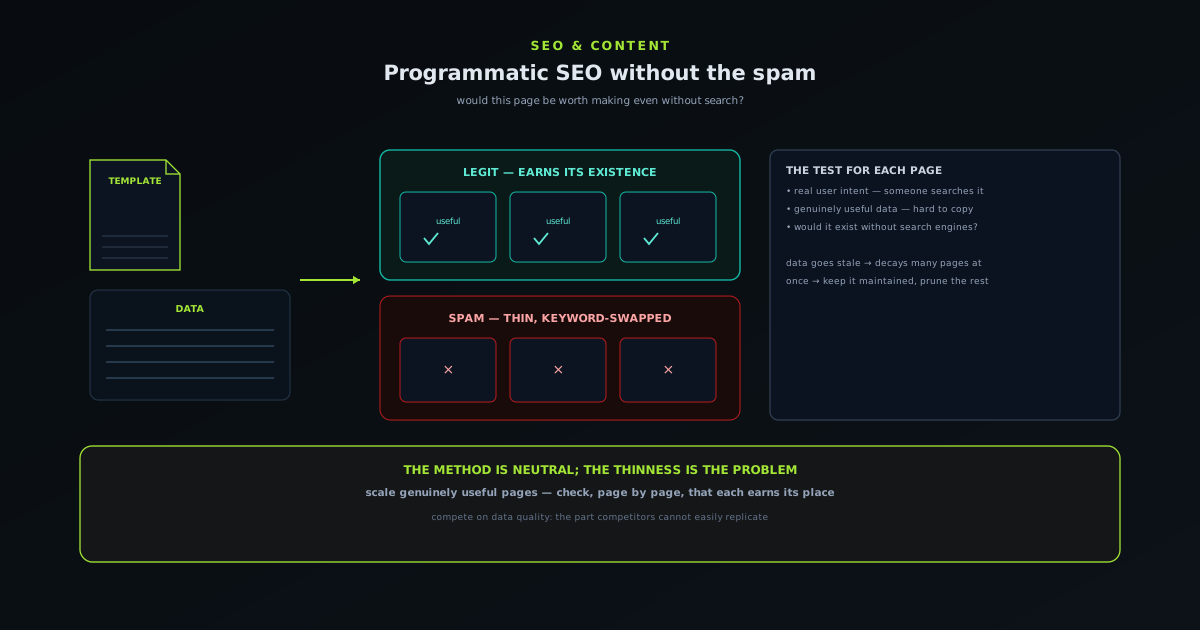
The line is simpler than it sounds: a programmatic page is legitimate if it would be worth creating even if search engines did not exist. If the page genuinely helps the person who lands on it (answers their specific question, gives them real information, solves their actual problem) then producing it programmatically is just an efficient way to make something useful. If the page exists only to capture a search and offers nothing once the visitor arrives, it is spam regardless of how it was made. The test is not the production method but the value delivered: would a real person be glad they landed here?
This reframes the whole question productively. Instead of asking "is programmatic SEO okay," ask "does each page I am generating actually deserve to exist on its own merits." If the answer is yes (each page meets a real need with real content) then scale it confidently, because you are using an efficient method to do a good thing many times. If the answer is no (the pages are thin padding around keywords) then no amount of technical cleverness makes it legitimate, and you should either make the pages genuinely useful or not make them. The line is value per page, and it is a line you can check honestly by looking at any single generated page and asking whether it earns its place.

Start with real user intent
Responsible programmatic SEO starts from real searches that real people make, not from a list of keyword combinations you could theoretically target. The difference is whether there is genuine intent behind a query (an actual person with an actual question) versus a mechanically generated permutation that no one is really searching for. Building pages for real intent means each page has a genuine audience to serve; building pages for every possible keyword combination means most of your pages serve no one, which is both wasteful and exactly the pattern that reads as spam. Anchor the whole effort in demand that actually exists.
Finding real intent means doing the research to understand what your audience actually searches for and which of those searches your pages can genuinely satisfy. Some long-tail queries are real and underserved (perfect candidates for programmatic pages that answer them well) while others are theoretical permutations with no real searchers behind them. The discipline is to generate pages only for the queries with genuine intent and the data to satisfy them, rather than for every combination your template could produce. Starting from real intent naturally limits you to pages worth making, which is the simplest way to avoid generating spam: only make the pages someone is actually looking for.
Every page must earn its existence
The governing principle is that every single generated page must earn its existence by being genuinely useful to the person who lands on it, and you should be willing to check this page by page rather than assuming it at scale. It is easy to lose sight of individual page quality when you are producing thousands at once, but the search engine and the visitor experience each page individually, so each one has to stand on its own. A useful test is to pull up random generated pages and ask whether you would be satisfied landing on this exact page after searching for its target query. If too many fail that test, the system is producing spam regardless of the few good examples.
This per-page accountability is what separates responsible scaling from mass production of junk. Scaling useful pages means each page meets the quality bar; mass-producing junk means the average page does not, even if a handful do. The willingness to hold every page to the standard (and to not generate pages that cannot meet it) is the core discipline. If a particular slice of your dataset cannot support useful pages, do not generate them; a smaller set of pages that each earn their place beats a larger set padded with ones that do not. Quality per page, enforced even at scale, is the whole game.
Templates are fine; thin content is not
A common misunderstanding is that using a template is itself the problem, when the actual problem is thin content. Templates are perfectly legitimate: a consistent structure that presents genuinely useful information is good design, not spam, and plenty of excellent, useful pages share a template. What makes programmatic content spammy is not that the pages share a structure but that they share a lack of substance: the same empty boilerplate with a keyword swapped in. A template filled with real, specific, useful information for each instance is a good page; the same template filled with filler is a bad one. The template is neutral; the substance is what matters.
The practical implication is that you should invest in the substance behind the template rather than worrying about the template itself. A well-designed template that presents genuinely differentiated, useful data for each page is exactly how good programmatic SEO works: the structure is consistent, but the content within it is real and specific to each instance. The failure is not structural consistency; it is when the "content" within the structure is generic padding that does not change meaningfully from page to page. Build a good template, then make sure each page has real substance to fill it, and the templated nature becomes a strength rather than a liability.
The data behind the pages has to be genuinely useful
Since programmatic pages are only as good as the data that fills them, the quality of your underlying dataset largely determines whether the pages are useful or thin. Pages generated from rich, accurate, genuinely informative data can be excellent; pages generated from sparse or low-value data will be thin no matter how good the template is. This means the real work of responsible programmatic SEO is often in the data (assembling, verifying, and enriching the information that each page presents) rather than in the page generation itself. Good data is what gives each page something real to say.
This is also where you can build a genuine, defensible advantage. If your programmatic pages are built on data that is more accurate, more complete, or more useful than what competitors offer, your pages are genuinely better and deservedly rank, while competitors relying on thin or scraped data produce the spam that gets demoted. Investing in proprietary or carefully assembled data turns programmatic SEO from a race-to-the-bottom tactic into a durable strength, because the value lives in information competitors cannot easily replicate. The lesson is to compete on the quality of the data behind your pages, which is both what makes them useful and what makes them hard to copy.
How to tell if you have crossed the line
There are reliable signals that programmatic SEO has tipped into spam, and watching for them keeps you honest. The clearest is the per-page test: if you cannot look at a random generated page and feel confident a searcher would be glad to land on it, you have crossed the line. Other signals include pages that are nearly identical to each other with only a keyword changed, content that is auto-generated filler rather than real information, pages targeting queries no one actually searches, and a dataset so thin that the pages have nothing substantive to present. Any of these means you are producing volume without value, which is the definition of the spammy version.
The honest response to crossing the line is to either raise the quality or reduce the scope, not to push more thin pages out and hope. If your pages are too similar, differentiate them with real, specific content; if the data is too thin, enrich it or do not generate those pages; if the queries are not real, stop targeting them. It is far better to have a smaller set of genuinely useful programmatic pages than a large set of thin ones, both because the useful ones actually rank and because the thin ones can drag down trust in your whole site. Crossing the line is recoverable, but only by fixing the value problem rather than the volume.
Quality at scale is a maintenance commitment
A subtlety that responsible programmatic SEO has to reckon with is that quality at scale is not a one-time achievement but an ongoing maintenance commitment, because the data behind your pages and the queries they target both change over time. Data goes stale (prices change, facts shift, items are added or removed), and a programmatic page built on data that is no longer accurate becomes a thin or misleading page even though it was useful when generated. The leverage of producing many pages from a dataset cuts both ways: it lets you create value at scale, but it also means that when the data decays, many pages decay at once. Keeping a large set of programmatic pages genuinely useful requires keeping the underlying data current.
This maintenance burden is part of the honest cost of programmatic SEO done well, and ignoring it is one of the quieter ways a once-legitimate set of pages drifts into thin, outdated junk. The discipline is to treat the data as a maintained asset (updated, verified, and pruned as needed) rather than a one-time input you generate from and forget. Pages whose data has gone stale should be refreshed or removed, not left to mislead readers and drag down trust in the whole site. The same per-page accountability that governs creation governs maintenance: every page should still earn its existence today, not just on the day it was generated. Responsible programmatic SEO is therefore a commitment to keep the pages useful over time, not just to make them useful once, which is exactly the kind of ongoing care that separates a genuine resource from a field of decaying templated pages.
A responsible programmatic SEO checklist
To keep the effort on the right side of the line, a few checks applied consistently do most of the work. Generate pages only for searches with real intent, not every possible keyword combination. Make sure each page is built on data substantial enough to be genuinely useful, and be willing to skip the pages your data cannot support. Use templates for consistent structure, but fill them with real, differentiated content rather than boilerplate. Spot-check random pages against the standard of "would a searcher be glad to land here," and treat a failure as a signal to fix quality, not to ship more. Connect the pages with sensible internal structure so they support each other rather than sprawl.
Applied together, these checks turn programmatic SEO back into what it should be: an efficient way to serve a large amount of real, specific demand with genuinely useful pages. The spam version flooded the web with thin junk and earned the technique its bad name, but the responsible version (anchored in real intent, built on real data, and held to a real per-page standard) is simply good content production at scale. The method is not the problem; the laziness was. Use the leverage of programmatic generation to do a useful thing many times, hold every page to the standard, and you get the benefits of scale without becoming the spam that made people wary of it in the first place.
Frequently asked questions
Quick answers to common questions about this topic.
What is programmatic SEO?
Generating many pages from structured data and a template, for example a page per location, product, or comparison. Done well it scales useful coverage; done badly it produces thin, duplicate spam.
How do you keep programmatic SEO from being spam?
Each page must answer a real query with genuinely useful, distinct content, not just swapped keywords. Add unique data, depth, and internal links, and only generate pages that deserve to exist.
Will Google penalize programmatic pages?
It penalizes thin, low-value, duplicative pages, not scale itself. Pages that are substantive and helpful can rank even at volume; the line is value per page, not page count.
Related troubleshooting
Was this page helpful?
Your answer stays in this browser, it is not sent anywhere and no account or cookie is involved.