2026 · Novus Stream Solutions (hub)About 10 min readNovus Stream Solutions
Pruning and consolidating content without losing rankings
Most SEO advice is about publishing more. The advice a maturing site actually needs is the opposite: how to remove and merge pages that are quietly holding it back, without throwing away the rankings and links those pages earned. Done carefully, pruning and consolidation are among the highest-return things you can do to a content library.
Contents
- 1.Overview
- 2.Why thin and duplicate pages drag the whole site down
- 3.Start with an honest audit
- 4.Keep, refresh, merge, or remove
- 5.Keyword cannibalization and how consolidation fixes it
- 6.The 301 redirect: how you keep the equity
- 7.What to expect after you consolidate
- 8.Make pruning a habit, not a one-off
Overview
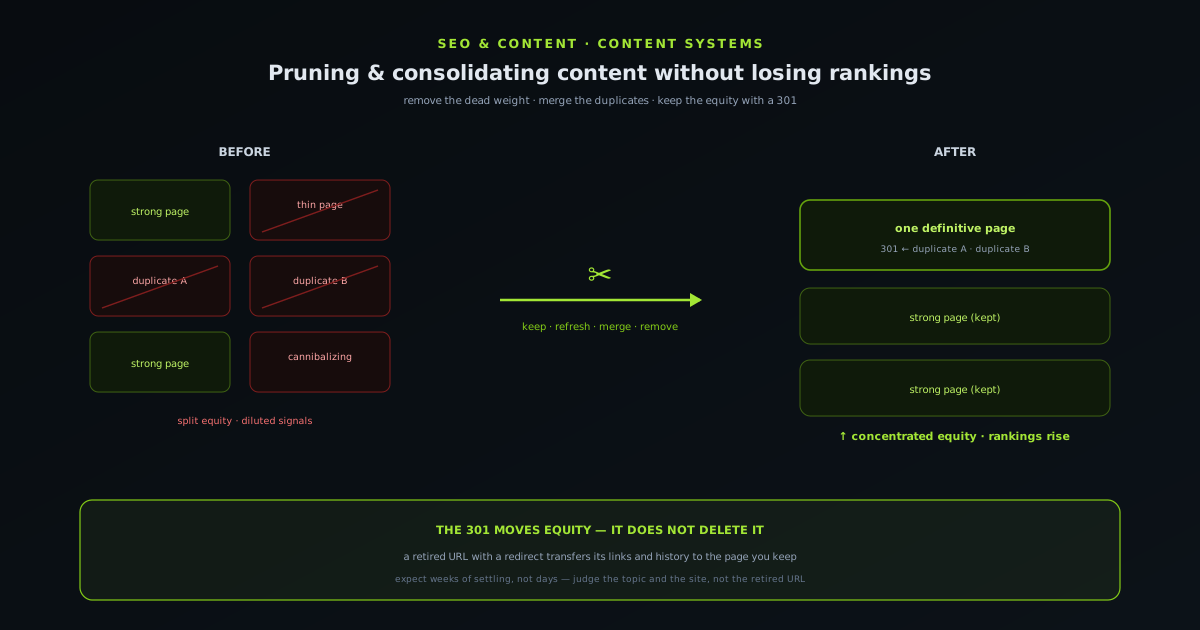
Almost all content advice points in one direction: publish more. Write the next article, target the next keyword, fill the next gap. That advice is right for a young site with too little content, and quietly wrong for a maturing one, because a library that only ever grows eventually accumulates a layer of pages that are not pulling their weight: thin posts that never ranked, near-duplicates that compete with each other, and old pieces that no longer reflect what you would say today. Left alone, that dead weight does not just sit there harmlessly; it dilutes the signals search engines use to judge the whole site, spreads your internal links and authority across pages that do not deserve them, and makes the good content harder to find. Pruning and consolidation are how you take that weight back off.
The fear that stops people doing it is reasonable: removing or merging pages sounds like throwing away rankings and links you worked for. The good news is that done carefully, you keep almost all of the value, because the equity a page earned can be redirected to the page you keep rather than deleted with the URL. This article is the careful version of the playbook: how thin and duplicate pages hurt you, how to audit what you have, how to decide whether each page should be kept, refreshed, merged, or removed, how to recognise and fix keyword cannibalization, and how the humble 301 redirect lets you do all of it without losing the ground you gained.
Why thin and duplicate pages drag the whole site down
It is tempting to assume a weak page is simply neutral (it does not rank, so it does nothing), but that is not how a site is judged. Search engines form an impression of a site as a whole from the pages that make it up, and a library padded with thin, low-value, or redundant pages reads as a weaker, less focused site than the same library with those pages removed. Crawl attention is finite too: every low-value URL is one more thing for a crawler to fetch and reconsider, attention that would be better spent on the pages you actually want ranked. So the underperformers are not free to keep; they impose a quiet tax on everything around them.
Duplication adds a sharper problem on top of the general drag. When two or more of your own pages target the same intent, they do not combine their strength; they split it, and they confuse the search engine about which one to show, so it may rank the weaker of the two, alternate between them, or rank neither well. The links and authority that should have concentrated on a single strong page are scattered across several mediocre ones. Removing the dead weight and merging the duplicates reverses both effects at once: the site reads as more focused, and the strength that was spread thin gets gathered back onto the pages that can use it.
Start with an honest audit
You cannot prune sensibly without first seeing what you have, so the work begins with an inventory rather than a hunch. List every indexable page and pull two kinds of signal against each: how it performs (organic traffic, impressions, clicks, and whether it ranks for anything over a meaningful window) and what it is for (the search intent it serves and whether any other page serves the same one). The performance data tells you which pages are inert; the intent mapping tells you which pages are stepping on each other. Together they turn a vague sense that "the site has gotten messy" into a concrete, page-by-page picture you can act on.
Resist the urge to judge a page on traffic alone, because a low-traffic page is not automatically a candidate for removal. Some pages exist to serve a small but real need, to support a topic cluster, or to rank for a term that matters commercially even at low volume, and those earn their place despite modest numbers. The audit is there to surface candidates and give you the evidence to decide, not to hand down automatic verdicts. Give each underperformer a fair hearing: is it inert because it is genuinely redundant, or because it was never given a chance to rank and could with a refresh and some internal links?
Keep, refresh, merge, or remove
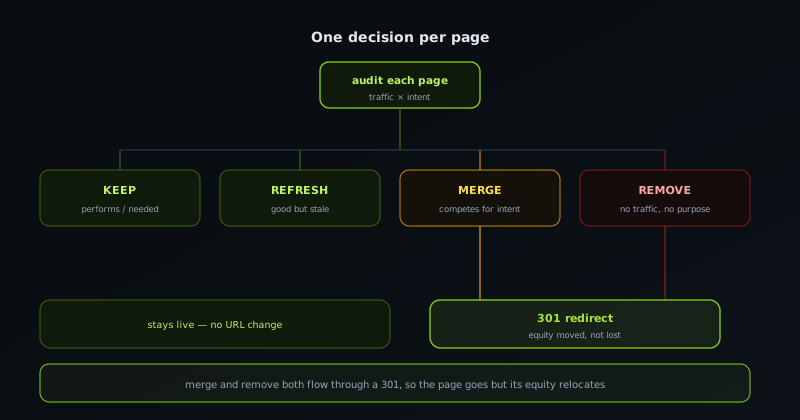
Every candidate page resolves into one of four decisions, and naming them keeps the cleanup from sliding into indiscriminate deletion. Keep is for pages that are doing their job or serve a real need; they stay untouched. Refresh is for pages with good bones (the right topic, some history) that have simply gone stale or thin; these are worth updating rather than removing, and the companion discipline of refreshing old content covers that path in full. Merge is for two or more pages that cover the same ground; you combine the best of them into one definitive page. Remove is for pages with no traffic, no purpose, and no path to either; they go.
The two decisions that carry risk are merge and remove, because both change or retire a URL, and that is exactly where the technique matters. The principle to hold onto is that you almost never simply delete a URL that has any history; you retire it with a redirect so its accumulated equity flows somewhere useful. A page being removed should usually redirect to the most relevant surviving page; a set of pages being merged should redirect the retired URLs to the new combined page. Decided this way, pruning stops feeling like loss and starts feeling like what it is: concentrating scattered value onto fewer, stronger pages.
- Keep: the page performs or serves a real need; leave it alone.
- Refresh: good topic, gone stale or thin; update it rather than remove it.
- Merge: several pages cover the same intent; combine into one definitive page and redirect the rest to it.
- Remove: no traffic, no purpose, no path to either; retire it and redirect the URL to the closest relevant page.
Keyword cannibalization and how consolidation fixes it
Keyword cannibalization is the specific failure that consolidation is best at curing, and it is more common than most site owners realise. It happens when several of your pages target the same query, so instead of one authoritative page that earns the ranking, you have two or three that each capture a slice of the relevant links and signals and none of which is strong enough to win. You can usually spot it in the data as a single query where the ranking URL flips between pages over time, or where two of your URLs both appear, weakly, for the same term. That flipping is the search engine telling you it cannot decide which of your pages is the answer, because you have given it more than one.
The fix is to stop competing with yourself by choosing one page to be the answer and consolidating the others into it. Take the strongest of the competing pages (or write a new, better one), fold in whatever the others did well, and then redirect those others to your chosen page so their equity reinforces rather than dilutes it. The outcome is exactly what you wanted all along: a single, clearly strongest page for the intent, no longer splitting its strength with siblings. This is also why a clean topic-cluster structure, with one definitive page per topic, prevents cannibalization from recurring: it gives every intent an obvious, single home.
The 301 redirect: how you keep the equity
The single technical idea that makes safe pruning possible is the permanent redirect, the 301. When you retire a URL and point it with a 301 at another page, you are telling search engines that the content has permanently moved here, and they respond by transferring the great majority of the old page’s ranking signals (its links, its authority, its history) to the destination. That is the mechanism that turns removal from a loss into a transfer: the page goes, but the value it earned does not evaporate, it relocates to the page you kept. Skipping the redirect is the mistake that gives pruning its bad reputation, because a deleted URL with no redirect simply drops, and any links and equity pointing at it are wasted.
A few disciplines keep redirects clean. Always redirect to the most relevant destination, not reflexively to the homepage, because a redirect to an unrelated page is treated far less generously than one to a genuine replacement. Avoid chaining redirects through several hops; point the old URL straight at the final destination. Update your internal links to target the surviving URL directly rather than relying on the redirect to catch them, so visitors and crawlers reach the real page in one step. And give it time: consolidation is not instant; search engines need to recrawl, process the redirects, and settle the merged page into its new, stronger position, which can take weeks rather than days.
What to expect after you consolidate
It is worth setting expectations honestly, because the results of pruning are real but rarely immediate, and the interim can be unnerving if you are not prepared for it. In the first weeks after a round of consolidation, you may see some turbulence as search engines recrawl the changes, process the redirects, and re-evaluate the merged pages; rankings can wobble before they settle. This is normal and not a sign the work failed. What you are watching for over the following weeks is the pattern that signals success: the surviving pages holding or improving their positions, the merged pages ranking better than any of their predecessors did alone, and the overall picture of a tighter, more focused site.
The measurement that matters is at the level of the topic and the site, not the individual retired URL. Of course the page you redirected away lost its traffic: that traffic was supposed to move to the page you kept, and the honest question is whether the destination and the topic as a whole came out ahead. Judge the project by whether the consolidated pages are stronger than the fragments were, whether cannibalized queries now resolve cleanly to one URL, and whether the site reads as more authoritative for having shed its dead weight. Framed that way, content pruning is not a risky act of deletion; it is portfolio management for a content library, and one of the highest-return forms of SEO maintenance a maturing site can do.
Make pruning a habit, not a one-off
The biggest mistake after a successful cleanup is treating it as a finished project rather than a recurring practice. A content library accrues dead weight continuously: every new batch of posts risks overlapping an old one, every published piece eventually ages, and intents you once split across pages quietly reappear. A site that prunes once and then only publishes will simply rebuild the same problem over the following year. The fix is to fold a light audit into your normal rhythm: on a regular cadence, revisit the inventory, flag the new underperformers and the fresh overlaps, and make the small keep-refresh-merge-remove decisions before they compound into another big mess.
Building the habit also changes how you publish, which is the deeper benefit. Once you have felt the cost of cannibalization and cleaned it up, you start asking before you write whether a new piece will strengthen an existing page or compete with it, and often the better move is to improve the page you have rather than add a rival. That single question, applied consistently, keeps the library tending toward one strong page per intent instead of many weak ones, which is the structure consolidation was reaching for in the first place. Pruning and disciplined publishing are two sides of the same practice: a library that grows in strength rather than just in size.
Frequently asked questions
Quick answers to common questions about this topic.
Will deleting old pages hurt my SEO?
Not if you redirect them. Deleting a URL outright wastes any links and equity pointing at it, but retiring it with a 301 redirect to the most relevant surviving page transfers the great majority of that value to the destination. The risk in pruning comes almost entirely from removing URLs without redirects, not from removing weak pages as such.
What is keyword cannibalization?
It is when two or more of your own pages target the same search query, so they split the relevant links and signals instead of concentrating them, and the search engine struggles to decide which to rank. You often see it as a query where your ranking URL flips between pages over time. The fix is to consolidate the competing pages into one definitive page and redirect the others to it.
How do I decide whether to keep, merge, or remove a page?
Audit each page on two axes: how it performs (traffic, impressions, rankings) and what intent it serves. Keep pages that perform or serve a real need, refresh good pages that have gone stale, merge pages that compete for the same intent, and remove pages with no traffic and no purpose, redirecting any merged or removed URL to the closest relevant surviving page.
How long does it take to see results after consolidating content?
Expect weeks, not days. Search engines need to recrawl the changes, process the redirects, and re-evaluate the merged pages, and rankings often wobble before they settle. Judge success by whether the surviving and merged pages hold or improve over the following weeks and whether previously cannibalized queries now resolve cleanly to one URL.
Is content pruning a one-time cleanup?
It works best as a recurring habit. A growing library continuously accumulates thin pages, stale posts, and fresh overlaps, so a site that prunes once and then only publishes rebuilds the same problem. Fold a light audit into your regular rhythm and ask, before publishing, whether a new piece will strengthen an existing page or compete with it.
Related troubleshooting
Was this page helpful?
Your answer stays in this browser, it is not sent anywhere and no account or cookie is involved.