2026 · Novus Stream Solutions (hub)About 12 min readNovus Stream Solutions
Print-on-demand as a business model, honestly
Print-on-demand lets you sell physical products with no inventory and no upfront stock: the item is made only after it sells. That safety is real, but it comes at the cost of thin margins and lost control. An honest breakdown.
Contents
Overview
Print-on-demand is one of the most accessible ways to start a physical-product business, and also one of the most misunderstood, because its central promise (sell products with no inventory and no upfront cost) is genuinely true while hiding a trade-off that determines whether the model works for you. In a print-on-demand business, you design products (apparel, prints, mugs, accessories) and list them in your store, but you hold no stock; when a customer orders, a third-party provider produces that single item and ships it directly to the customer. You never buy inventory, never store anything, and never handle fulfillment. This removes the largest risk and cost of selling physical products (buying stock that might not sell), which is why print-on-demand attracts so many first-time sellers.
The honest version of print-on-demand, though, requires looking squarely at what you give up in exchange for that safety, because the no-inventory model is not free: it trades inventory risk for thin margins and lost control over fulfillment, and whether that trade is worth it depends entirely on your situation. Many people enter print-on-demand seeing only the upside (no risk, no upfront cost) and are then disappointed by the downside (small profit per item, no control over the customer experience). This guide is the honest breakdown: how the model actually works, the real economics of its margins, what you sacrifice in control, where it genuinely fits, and how to make it work despite its constraints, so you can decide whether print-on-demand suits what you are trying to build rather than discovering its limits after committing to it.
How print-on-demand actually works
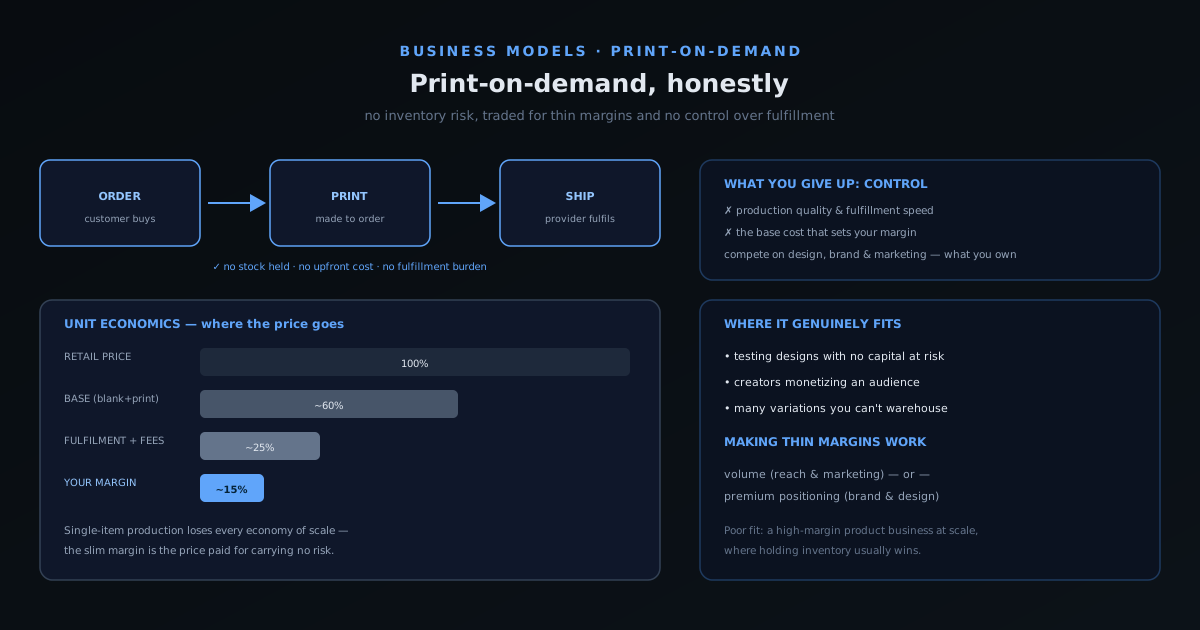
The mechanics of print-on-demand are what make it so accessible. You create designs and apply them to products offered by a print-on-demand provider: the provider maintains the catalog of blank items (shirts, mugs, posters) and the printing capability, and you supply the artwork and set your retail prices. Your store displays these products as if you stocked them, but no physical item exists until a customer places an order. When that order comes in, it routes to the provider, who prints your design on the blank item, packages it, and ships it to your customer, often with your branding on the packaging. You are billed the base cost (the item plus printing plus the provider's fulfillment) and you keep the difference between that and what the customer paid.
This made-to-order, drop-shipped model is what eliminates inventory: because each item is produced only after it sells, you never own stock and never risk money on unsold inventory. It also eliminates the operational burden of fulfillment (no packing, no shipping, no warehousing) since the provider handles all of it. The result is a business you can start with essentially no capital and run without touching a physical product, which is the genuine and significant appeal. But this same structure (a third party producing and fulfilling each order at a base cost you do not control) is also the source of the model's constraints, because the convenience of having someone else make and ship everything means they capture a large share of the price and own the parts of the experience you cannot touch. Understanding the mechanics makes both the appeal and the trade-off clear: the thing that removes your risk and effort is the same thing that thins your margin and limits your control.
The margin reality
The defining economic fact of print-on-demand is that margins are thin, because the provider's base cost (covering the blank item, the printing, and their fulfillment) consumes most of the retail price, leaving you a slice that is far smaller than sellers expect. When you make each item one at a time on demand, you lose all the cost advantages of producing in volume: there is no bulk discount, no economy of scale, just the relatively high per-unit cost of single-item production, marked up to a retail price the market will bear. The space between that base cost and a competitive retail price is your margin, and it is usually slim, which means print-on-demand requires either volume or premium positioning to generate meaningful income.
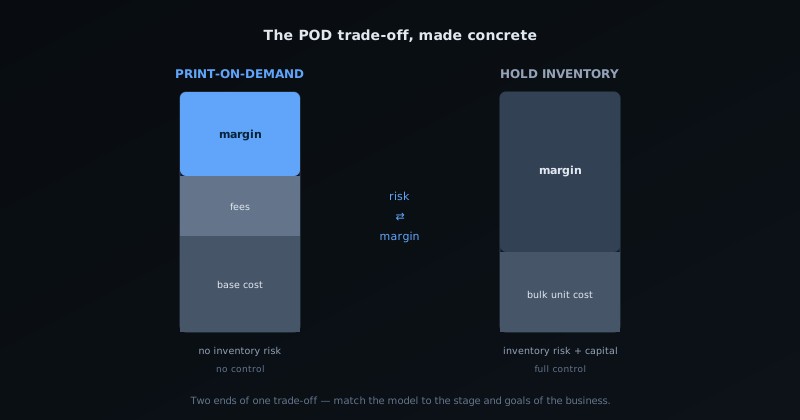
This margin reality is why print-on-demand is better understood as a low-margin, low-risk model than as the easy-profit business it is sometimes sold as. The honest comparison is with holding inventory: a seller who buys stock in volume pays much less per unit and keeps a far larger margin, but takes on the risk and cost of that inventory; a print-on-demand seller takes no inventory risk but accepts the thin margin as the price of that safety. Neither is universally better (they are different points on a risk-margin trade-off), but pretending print-on-demand has the margins of an inventory business sets sellers up for disappointment. The realistic expectation is that each sale yields a modest profit, so the business works by selling enough volume at that modest margin, or by commanding prices high enough (through strong design and branding) to widen the slim margin into something worthwhile. The landed-cost framework that makes this concrete is covered in The true cost of a physical product: landed cost and the unit economics of inventory.
What you give up: control
Beyond thin margins, print-on-demand costs you control over the parts of the business that a third party now owns, and this loss of control has real consequences for the customer experience you can offer. Because the provider produces and ships every order, you do not control production quality, fulfillment speed, or shipping reliability: if the provider prints poorly, ships slowly, or makes an error, it is your brand the customer blames, but you cannot directly fix it. You are dependent on the provider's standards and operations, which means your customer experience is only as good as theirs, and you have limited recourse when they fall short. For a business where the product and the experience are the brand, this dependency is a significant constraint.
The control you give up also includes the product itself and the economics: you are limited to the items and customization the provider offers, you cannot easily differentiate on the physical product (since competitors can use the same blanks and provider), and you cannot negotiate the base cost that determines your margin. This means print-on-demand businesses compete largely on design, branding, and marketing rather than on the product or the experience, because those are the parts you still control. The strategic implication is that succeeding in print-on-demand requires excelling at the things you own (distinctive designs, strong brand, effective marketing, and a great storefront experience) while accepting that the production and fulfillment, which you do not own, will be standard. Sellers who understand this build their advantage where they actually have control; sellers who expect to control the whole experience are frustrated by how much of it the provider holds.
Where print-on-demand genuinely fits
Despite its constraints, print-on-demand fits genuinely well in several situations, and recognizing them is how you use the model where it is strong rather than where it disappoints. It fits best when avoiding inventory risk is the priority: for someone testing designs or a new product line without committing capital, for a creator monetizing an audience with merchandise they do not want to warehouse, or for a business with many design variations where holding stock of each would be impractical. In these cases, the thin margin is an acceptable price for the ability to offer products with zero inventory risk and no fulfillment burden, because the alternative (buying stock of unproven designs) carries a risk the seller specifically wants to avoid.
Print-on-demand also fits as a starting point or a complement rather than necessarily the permanent core of a business. A seller can use it to validate which designs and products sell, then transition the proven winners to held inventory for better margins once demand is established, using POD's no-risk testing to inform a lower-risk inventory bet. Creators and content businesses use it to add a merchandise line that monetizes their audience without becoming a logistics operation. The common thread in the good fits is that the value of avoiding inventory (testing, low commitment, audience monetization without operations) outweighs the cost of thin margins for that specific purpose. Where print-on-demand fits poorly is as a strategy to build a high-margin product business at scale, because the model's economics cap the margin; for that, holding inventory and the control it brings is usually necessary. Matching the model to the purpose is what separates the sellers it serves well from those it frustrates.
Making thin margins work
Given that thin margins are inherent to print-on-demand, making the model profitable means working with that constraint rather than wishing it away, and there are two broad paths. The first is volume: at a modest margin per item, enough sales add up to meaningful income, so a business that drives substantial traffic and converts it can profit despite the slim per-unit margin. This path depends on marketing and reach (getting enough of the right people to the store), which means the real work of a volume-based print-on-demand business is audience and marketing, not the products themselves. For creators with an existing audience, this path is natural; for sellers starting cold, it requires building that reach, which is the genuine difficulty.
The second path is premium positioning: rather than competing on price with a thin margin, build a strong enough brand and distinctive enough designs that you can charge prices high enough to widen the margin. A print-on-demand product sold as a generic item competes on price and earns the minimum margin; the same product sold as part of a desirable, well-branded line can command a premium that makes each sale meaningfully profitable. This path depends on design and branding excellence (the things you control), and it is how print-on-demand sellers escape the race to the bottom that the model's low barriers otherwise encourage. The realistic approach usually combines both: distinctive, premium-positioned products that command better-than-minimum margins, sold to an audience you can reach efficiently. What does not work is expecting comfortable margins without either volume or premium positioning, because the model simply does not provide them: the margin must be earned through reach or brand, since the production economics will not supply it.
Comparing it to holding inventory
The clearest way to understand print-on-demand is to set it against its main alternative (holding inventory), because the two represent opposite ends of a risk-margin trade-off, and the right choice depends on which end suits your situation. Holding inventory means buying stock in volume at a low per-unit cost, which yields healthy margins, but it requires upfront capital and carries the risk that the stock does not sell, plus the cost and effort of storage and fulfillment. Print-on-demand inverts every term: no upfront capital, no inventory risk, no fulfillment burden, but thin margins and no control. One trades money and risk for margin and control; the other trades margin and control for safety and simplicity.
Neither end of this trade-off is correct in general; the right position depends on your capital, your risk tolerance, your volume, and how much control the business needs. A well-funded seller confident in demand and wanting strong margins and control leans toward inventory; a seller avoiding risk, testing designs, or monetizing an audience without operations leans toward print-on-demand. Many businesses move along the spectrum over time (starting with print-on-demand to test with no risk, then shifting proven products to inventory for margin as demand and capital allow), using each model where it is strongest. The mistake is treating one model as simply better; the productive frame is matching the model to the stage and goals of the business, with full awareness of what each side of the trade-off gives and takes. The related comparison of how your sales channel interacts with these economics (owning the customer versus renting a marketplace audience) is covered in Wholesale vs direct-to-consumer: margin, volume, and who owns the customer and Marketplaces vs your own store: fees, traffic, and platform risk.
Design and branding are the real product
Since print-on-demand sellers cannot differentiate on the physical item (competitors can use the same blanks and the same provider), the real product they are selling is the design and the brand, which are the only elements they genuinely control and the only basis on which they can compete. This reframes where the effort should go: not into the (uncontrollable) production but into distinctive designs, a coherent brand, and the storefront experience, because these are what make one print-on-demand store succeed where another with identical underlying products fails. A seller who treats the designs as the product, and invests accordingly, builds something defensible; a seller who treats the blanks as the product has nothing a competitor cannot replicate.
Branding does double duty in print-on-demand by both differentiating the store and supporting the premium positioning that thin margins require, since a strong brand lets a seller charge more than a generic equivalent. The same shirt sold as an anonymous item competes on price at the minimum margin, while sold as part of a desirable, well-branded line it can command a price that makes the margin workable, and the difference is entirely in the design and brand the seller controls. This is why the sellers who do well in print-on-demand are, in practice, designers and brand-builders more than they are merchants: the model hands the production to a provider and leaves the creative and brand work as the seller's true domain and only real competitive edge.
The honest bottom line
Print-on-demand is a real and useful business model, but only when entered with clear eyes about what it is: a low-risk, low-margin, low-control way to sell physical products, best suited to testing, audience monetization, and situations where avoiding inventory matters more than maximizing margin. It is not a shortcut to an easy, high-margin product business, and the sellers who succeed with it are those who understand its economics and build their advantage in the areas they control (design, brand, marketing, and the storefront experience) rather than those who expect the model to provide margins it structurally cannot. Going in with accurate expectations is the difference between using print-on-demand effectively and being disappointed by it.
The honest bottom line is that print-on-demand removes the biggest barrier to starting a physical-product business (inventory risk and upfront cost), and in exchange asks you to accept thin margins and limited control, which is a genuinely good trade for some purposes and a poor one for others. Used as a no-risk way to test products, monetize an audience, or start without capital, it is excellent; expected to be a high-margin business at scale, it disappoints. The model rewards sellers who match it to the right purpose, excel at the controllable parts, and either drive the volume or build the premium positioning that thin margins require. Approached this way, print-on-demand is a valuable tool in the physical-product toolkit; approached as a get-rich-easy scheme, it teaches an expensive lesson about the relationship between risk and margin that this honest breakdown is meant to provide upfront instead.
Frequently asked questions
Quick answers to common questions about this topic.
Is print-on-demand really risk-free?
It removes inventory risk: items are made only after they sell, so you never buy unsold stock. But it is not free of trade-offs: you accept thin margins and no control over production, quality, or fulfillment in exchange for that safety. The risk you avoid is paid for in margin and control.
Why are print-on-demand margins so thin?
Each item is produced one at a time on demand, so you lose all the cost advantages of volume production. The provider's base cost (blank item + printing + fulfillment) consumes most of the retail price, leaving a slim margin. Holding inventory yields far better margins but adds risk.
How do you make money with thin POD margins?
Two paths: volume (enough sales at a modest margin add up, which depends on marketing and reach) or premium positioning (strong branding and distinctive designs that command higher prices). Most successful sellers combine both. Comfortable margins without either are not realistic in POD.
When does print-on-demand make sense?
When avoiding inventory risk matters most: testing designs without committing capital, monetizing an audience with merchandise you do not want to warehouse, or starting with no money. It fits poorly as a strategy to build a high-margin product business at scale, where holding inventory usually wins.
Related troubleshooting
Was this page helpful?
Your answer stays in this browser, it is not sent anywhere and no account or cookie is involved.