2026 · Novus Stream Solutions (hub)About 12 min readNovus Stream Solutions
Dropshipping, honestly: how the model actually works
Dropshipping gets sold as easy money and dismissed as a scam, and it is neither. It is a legitimate fulfillment model with low upfront cost and a specific set of hard trade-offs. Here is how it really works, honestly.
Contents
- 1.Overview
- 2.How the order actually flows
- 3.The real advantages
- 4.The real problems
- 5.Where the margin actually goes
- 6.Choosing products and suppliers you never touch
- 7.The customer experience you do not see
- 8.Marketing is the actual business
- 9.When dropshipping makes sense as a stepping stone
- 10.Who the model actually suits
Overview
Few business models attract as much hype and as much scorn as dropshipping. One crowd sells it as a near-effortless path to passive income (no inventory, no upfront cost, run it from a laptop) while another dismisses the whole thing as a scam built on overpriced junk and fake urgency. The truth is more boring and more useful than either: dropshipping is a legitimate fulfillment model with a specific structure, real advantages, and real, often underestimated trade-offs. Understanding it honestly (neither as a shortcut to riches nor as inherently dishonest) is what lets you decide whether it fits what you are trying to build. This guide explains how the model actually works, where the money goes, what is genuinely hard about it, and who it suits.
At its core, dropshipping is simply a way of fulfilling orders in which you never hold the inventory yourself. You list products for sale; when a customer buys, you place that order with a supplier who ships the product directly to the customer; your business is the storefront, the marketing, and the customer relationship, but never the warehouse. That single structural fact (you sell before you buy, and you never touch the product) is what creates all of dropshipping's advantages and all of its problems at once. It is a real model used by real businesses; it is also the model most often wrapped in unrealistic promises, which is exactly why an honest look at the mechanics matters more here than almost anywhere else in commerce.
How the order actually flows
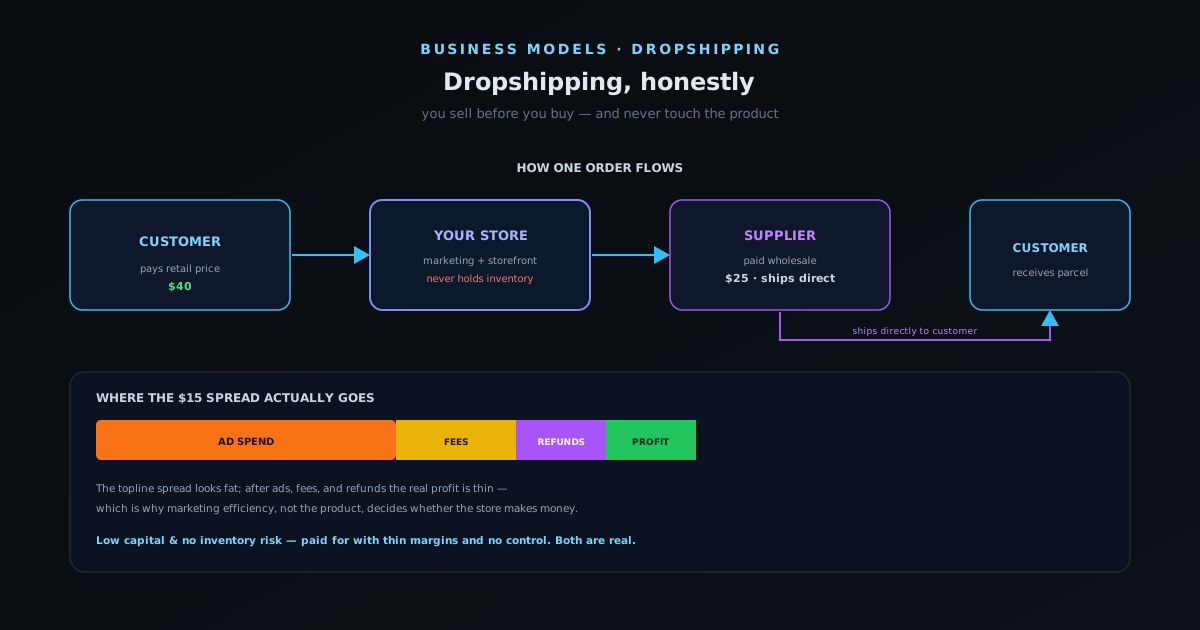
Walk a single order through and the model becomes concrete. A customer visits your store and buys a product at your retail price; you receive that payment. You then place an order for the same product with your supplier at their (lower) wholesale or list price, paying them and giving them the customer's shipping address. The supplier picks, packs, and ships the product directly to your customer, often in plain or your-branded packaging. You never see, touch, or store the item; your margin is the difference between what the customer paid you and what you paid the supplier, minus your costs to make the sale. The entire physical side of commerce (inventory, warehousing, packing, shipping logistics) sits with the supplier.
This flow is why dropshipping is described as low-capital and low-overhead: you do not buy stock before you sell it, so you are not laying out money for inventory that might not move, and you do not need a warehouse or fulfillment staff. You only pay the supplier after a customer has already paid you, which means the model can, in principle, run with very little working capital. That structural elegance is real and is the legitimate appeal of the model. But the same structure that removes the inventory risk also removes your control and compresses your margin, and those costs are where the honest accounting begins, because the advantages are front and center in every pitch, and the trade-offs are usually left out.
The real advantages
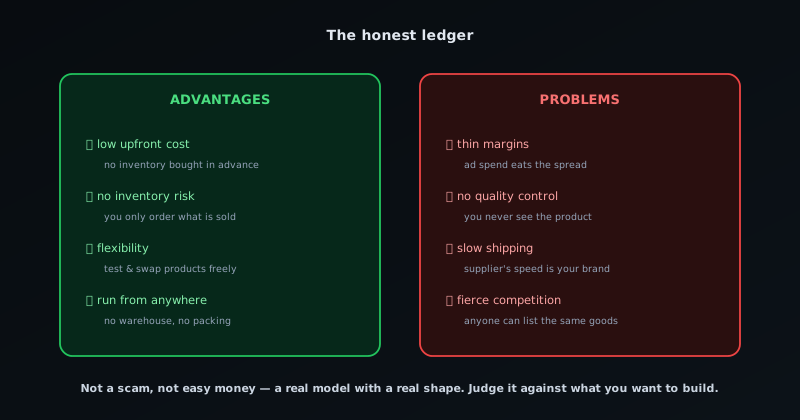
It is worth stating the genuine advantages plainly, because they are real and they are why the model exists. The first is low upfront cost: because you do not buy inventory in advance, you can start with far less capital than a traditional retail business that must purchase stock before it can sell anything. The second is low risk on the inventory itself: you cannot get stuck with unsold stock you paid for, because you only order what is already sold. The third is flexibility: you can test products, add and remove them, and pivot your catalog quickly, since you are not committed to inventory you have to clear. For someone exploring what to sell, that ability to test without committing capital is a legitimate strength.
These advantages make dropshipping a reasonable way to validate demand and learn the mechanics of running a store without betting savings on inventory. You can put a product in front of customers, see whether it sells, and find out what marketing works, all with limited downside on the stock side. That is a genuine use of the model, and it is why even people who are skeptical of the hype acknowledge dropshipping has a real place: as a low-capital way to test products and build the storefront-and-marketing muscle that every commerce business needs, regardless of how it eventually fulfills. The trouble starts when these real advantages are presented as the whole story, with the equally real costs left off the page.
The real problems
The trade-offs are the half of the model the hype omits, and they are serious. The first is thin margins: because anyone can list the same supplier's products, dropshipped goods tend toward price competition, and the gap between supplier price and what the market will pay is often small, frequently squeezed further by the advertising it takes to make sales. After ad costs, payment fees, and the supplier price, the margin on a dropshipped sale can be slim, which means the model lives or dies on marketing efficiency far more than on the product. The second problem is loss of control: you do not handle the product, so you cannot guarantee its quality, you depend on the supplier's shipping speed and reliability, and a supplier who runs out of stock or ships late creates a problem you must own with the customer but cannot directly fix.
That lack of control bleeds into the third problem, which is the customer experience. Long shipping times are common when products come from distant suppliers, and slow delivery, inconsistent quality, and packaging you did not control all land on your brand, not the supplier's. You are responsible for customer service and returns on products you never see, which is genuinely hard to do well. The fourth problem is that the low barrier to entry cuts both ways: the same ease that lets you start lets everyone start, so competition is fierce and undifferentiated stores struggle to stand out. None of these problems makes dropshipping a scam: they make it a model with real operational difficulty that the marketing around it systematically hides. The honest version of the pitch keeps these costs in frame next to the advantages.
Where the margin actually goes
To see why dropshipping margins are thin, follow the money on a sale. Start with the retail price the customer pays. Subtract the supplier's price for the product and their shipping: that is your gross spread. Now subtract the cost of getting that customer, which for most dropshipping is paid advertising, and which is frequently the largest single cost; subtract payment processing fees; subtract the cost of the inevitable refunds, chargebacks, and customer-service time on products you do not control. What remains is your actual profit, and on a competitively priced, ad-driven dropshipped product, it is often a small fraction of the retail price rather than the fat markup the topline spread suggests. The dynamics behind that landed cost are the same ones explored in The true cost of a physical product: landed cost and the unit economics of inventory.
This is why the advertising side dominates dropshipping economics: when the product margin is thin, the difference between a profitable store and an unprofitable one is almost entirely how efficiently you can acquire customers. A store that can sell to a visitor cheaply profits on a thin spread; a store whose ad costs exceed its spread loses money on every sale no matter how many it makes. That dependence on marketing efficiency is the real skill of dropshipping, and it is the opposite of passive: it is a demanding, constantly-shifting discipline of advertising, conversion, and testing. Anyone who tells you the model is hands-off has either not done it or is selling you a course; the honest version is that dropshipping moves the hard work from inventory to marketing, and the marketing is genuinely hard.
Choosing products and suppliers you never touch
The hardest practical part of dropshipping is one the model creates by design: because you never handle the product, you are choosing both what to sell and who fulfills it largely blind, on the strength of listings and samples rather than a warehouse you control. Picking a product is choosing a supplier at the same time, and possibly a supplier who is slow, inconsistent, or selling the identical item to a thousand other stores. The work that a stocking retailer does by physically inspecting and committing to inventory becomes, in dropshipping, the work of vetting suppliers you can only evaluate at arm length.
The mitigations are real but partial. Ordering samples yourself (actually buying the product as a customer would) is the single most useful check, because it reveals the true quality, the real shipping time, and the unboxing experience your customers will get. Building a relationship with a smaller number of reliable suppliers beats spraying orders across many unknown ones, and it is what separates a durable dropshipping operation from a churn of refund complaints. But the underlying constraint never disappears: you are responsible to the customer for a product and a fulfillment process you do not directly control, which is the model defining tension.
The customer experience you do not see
Because fulfillment happens out of your sight, the customer experience is largely out of your hands, and that is the source of most dropshipping pain. Long shipping times are the classic problem: when goods ship from far away, the gap between order and arrival can be weeks, and a customer who expected a normal delivery window grows anxious, asks where their order is, and sometimes demands a refund before it even arrives. You absorb all of that as the seller, even though the delay is in a supply chain you do not run.
Quality control is the other invisible risk. The item the customer receives is the one the supplier shipped, not one you inspected, so a batch quality problem, a wrong item, or damaged packaging lands on your reputation without passing through your hands. The honest takeaway is that dropshipping trades the capital and effort of holding inventory for a permanent loss of control over the two things customers judge you on most: speed and quality. Managing it means setting expectations honestly up front about shipping times and choosing suppliers whose consistency you have actually verified, rather than pretending the gap does not exist.
Marketing is the actual business
A clarifying way to understand dropshipping is that, because almost anyone can list the same product from the same supplier, the product itself is rarely the differentiator; the marketing is. The real business is not sourcing, which is commoditised, but finding an audience, creating demand, and presenting the product compellingly enough that people buy from you rather than the hundred identical stores. That means dropshipping is, in practice, a marketing operation with a fulfillment method attached, and success tracks your ability to acquire customers profitably far more than your ability to source.
This reframes where the effort and the risk actually sit. Your costs are dominated by advertising and customer acquisition, not inventory, so the make-or-break number is whether you can acquire a customer for less than the margin you earn on them, a calculation that is brutal when the product is cheap and the competition is bidding up the same ad space. The stores that work are the ones that build a genuine brand, an audience, or a content engine that lowers their acquisition cost over time, rather than renting attention at a loss. If you do not enjoy or excel at marketing, dropshipping is unlikely to suit you, because marketing is the job.
When dropshipping makes sense as a stepping stone
Dropshipping is often oversold as a destination when it works best as a stepping stone: a low-capital way to test whether a product sells before you commit money to inventory. Used this way, it is genuinely useful: you can validate demand for a product with real orders rather than guesswork, learn the marketing, and find out which items move, all without the cash and risk of buying stock up front. The information you buy with those early dropshipped sales is worth more than the thin margin you make on them.
The natural next step, once a product proves itself, is to transition the winners to a model with more control (holding inventory, using a fulfillment service, or negotiating better terms), where the margins are healthier and the customer experience is yours to manage. The contrast with holding inventory, and the cash-flow trade it involves, is the heart of the decision. Treating dropshipping as a validation tool that graduates into a real supply chain, rather than as a permanent passive-income machine, is the honest framing the hype usually omits.
It is also worth being clear-eyed about the version of dropshipping sold in get-rich-quick pitches, which bears little resemblance to the working model described here. The fantasy is passive income from a store that runs itself; the reality is a demanding marketing operation with thin margins, real customer-service load, and constant competition. Approached honestly (as a low-capital way to test products and learn marketing, with a plan to graduate the winners), it is a legitimate and useful tool. Approached as a shortcut to effortless money, it almost always disappoints, which is exactly the gap between the honest model and the hype this piece is meant to close.
Who the model actually suits
Given the honest picture, dropshipping suits some situations well and others poorly. It suits someone who wants to test products and learn commerce with limited capital and is realistic that the margins are thin and the work is in the marketing, a learning and validation tool more than a destination. It suits a seller who has a genuine marketing edge, a way to reach an audience cheaply, since marketing efficiency is where the profit lives. And it can suit a niche where you can differentiate (through branding, curation, content, or a specific audience you serve well) rather than competing on the same generic products everyone else dropships at the bottom of a price war.
It suits poorly anyone expecting passive income, anyone who needs control over product quality and shipping, and anyone trying to build a defensible brand on undifferentiated products that any competitor can list identically. For those goals, the related models often fit better: holding your own inventory buys control and margin at the cost of capital and risk; print-on-demand offers a no-inventory structure with built-in differentiation through your own designs, covered in Print-on-demand as a business model, honestly; and where you sell (your own store versus a marketplace) shifts the economics again, as Marketplaces vs your own store: fees, traffic, and platform risk lays out. The honest conclusion is not that dropshipping is good or bad, but that it is a specific tool with a specific shape: low capital and low inventory risk bought with thin margins and little control. Judge it against what you actually want to build, with both columns of the ledger in view, and it becomes a clear-eyed choice rather than a hyped one or a dismissed one.
Frequently asked questions
Quick answers to common questions about this topic.
What is dropshipping, exactly?
It is a fulfillment model where you never hold inventory. You list products, and when a customer buys, you order the item from a supplier who ships it directly to the customer. Your business is the storefront, marketing, and customer relationship; the supplier handles the physical product. Your margin is the spread between retail and supplier price, minus your costs.
Is dropshipping a scam?
No. It is a legitimate model used by real businesses. What is often a scam is the marketing around it that sells it as effortless passive income. The honest version: low upfront cost and no inventory risk, paid for with thin margins, no control over quality or shipping, and intense competition.
Why are dropshipping margins so thin?
Because the same supplier products are available to everyone, prices get competed down, and the largest cost is usually the advertising needed to make sales. After supplier price, ad spend, payment fees, and refunds, profit is often a small fraction of the retail price, which is why marketing efficiency, not the product, decides whether a store is profitable.
Who is dropshipping a good fit for?
People testing products and learning commerce on low capital, sellers with a real marketing edge or cheap way to reach an audience, and niches you can differentiate through branding or curation. It is a poor fit for anyone expecting passive income, needing quality and shipping control, or building a brand on undifferentiated products.
Related troubleshooting
Was this page helpful?
Your answer stays in this browser, it is not sent anywhere and no account or cookie is involved.