2026 · Novus Stream SolutionsAbout 12 min readNovus Stream Solutions
Pricing a free tier: where the upgrade line goes
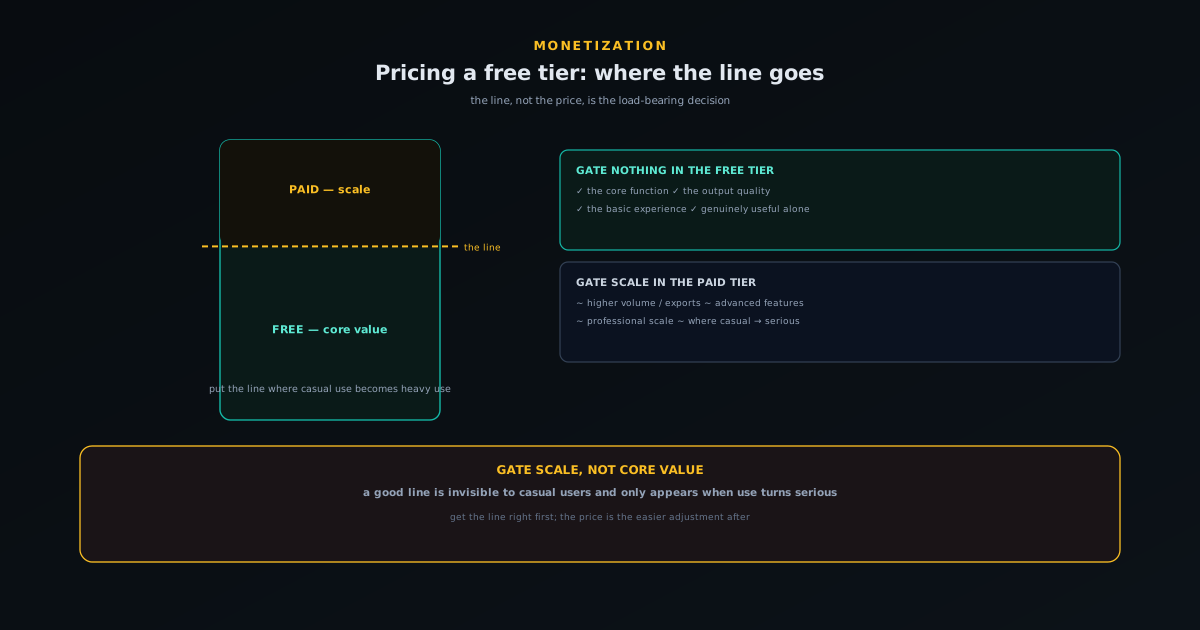
The hardest decision in freemium is not the price of the paid tier; it is where the line between free and paid goes. Put it in the wrong place and you cripple the free tier or give away the paid one.
Contents
- 1.Overview
- 2.The free tier is a positioning decision, not a giveaway
- 3.The cardinal rule: the free tier must be genuinely useful
- 4.Where the upgrade line actually goes
- 5.Good upgrade lines versus bad ones
- 6.A real example: an export-based line
- 7.What you should never cripple
- 8.Free as funnel versus free as the product
- 9.Pricing the paid tier (the easier half)
- 10.Test where the line goes
Overview
The hardest decision in freemium pricing is not what to charge for the paid tier; that is comparatively easy to test and adjust. The hard decision is where the line between free and paid goes: what you give away versus what you charge for. Put that line in the wrong place and everything else fails, because a free tier that gives away too little is useless and attracts no one, while a free tier that gives away too much leaves no reason to upgrade and generates no revenue. The upgrade line is the load-bearing decision in any freemium model, and it is the one most often gotten wrong. This is about where that line should actually go.
The reason the line is so hard is that it has to satisfy two opposing requirements at once: the free tier must be genuinely useful enough to attract and retain users, and the paid tier must offer enough additional value to justify paying. Those pull in opposite directions (the more you give away free, the better the free tier and the weaker the upgrade incentive), and the art is finding the line that satisfies both. Get it right and the free tier draws people in while the paid tier converts the ones who need more; get it wrong and you fail on one side or the other. Everything below is about finding that line deliberately rather than guessing.
The free tier is a positioning decision, not a giveaway
It helps to stop thinking of the free tier as charity and start thinking of it as positioning, because the free tier is doing real strategic work. It is your acquisition channel, your trust-builder, your demonstration of quality, and your top of funnel all at once: the free tier is how people discover you, try you, and decide you are worth paying for. A free tier that is genuinely useful does all of that; a free tier that is a crippled demo does none of it, because it neither attracts users nor builds the trust that leads to upgrades. The free tier is a deliberate investment in acquisition and trust, not money left on the table.
Seeing the free tier this way changes how you set the line. If the free tier's job is to attract, satisfy, and build trust, then it has to be genuinely good (good enough that people use it, rely on it, and recommend it), which means giving away real value, not a frustrating taste. The cost of that generosity is offset by what it buys: a stream of users who trust you and a subset who will pay when they need more. A free tier optimized to give away as little as possible fails at its actual job, while one optimized to be genuinely useful does the acquisition and trust work that makes the paid tier possible. The free tier earns its keep by being good, not by being limited.
The cardinal rule: the free tier must be genuinely useful
The single most important rule is that the free tier must be genuinely useful on its own: useful enough that someone could rely on it indefinitely and be glad they did. This sounds like it would cannibalize the paid tier, but it is actually what makes the whole model work, because a free tier people genuinely value is what attracts them, retains them, builds the trust that leads to upgrades, and generates the word of mouth that brings more people. A free tier that is deliberately crippled to force upgrades attracts no one and converts no one, because frustrated users leave rather than pay. Genuine usefulness in the free tier is the foundation, not a threat to revenue.
The fear that a genuinely useful free tier will prevent upgrades misunderstands where upgrades come from. People upgrade not because the free tier was made painful but because they hit a genuine need the paid tier serves: more scale, more capability, a specific feature their growing use requires. The free tier being genuinely useful is what got them in and using the product enough to reach that need in the first place. Crippling the free tier to force upgrades just prevents people from ever getting far enough to have an upgrade reason. The path to conversion runs through a genuinely valuable free tier, not around it, which is why the cardinal rule is to make the free tier truly good.
Where the upgrade line actually goes
If the free tier must be genuinely useful, where does the upgrade line go? The reliable answer is to gate on scale and advanced needs rather than on core value: to let the free tier deliver the core value completely while reserving higher volume, advanced capabilities, or professional-scale needs for the paid tier. The free user gets the real thing and can accomplish their core task; the user whose usage grows beyond a certain scale, or who needs advanced features, hits the upgrade line at the point where their need has genuinely grown. This puts the line at a natural boundary (the transition from casual or moderate use to heavy or professional use) rather than in the middle of the core value.
Gating on scale works because it aligns the upgrade with genuine need and ability to pay. A casual user stays comfortably within the free tier and is a satisfied free user doing the acquisition and word-of-mouth work; a heavy or professional user exceeds the free limits precisely because they are getting enough value to use the product at scale, and at that point paying is reasonable because their use has grown into a real need. The line sits where casual use becomes serious use, which is both where the value to the user justifies payment and where the user is most willing to pay. Gating on scale rather than core value is the pattern that keeps the free tier genuinely useful while still giving heavy users a real reason to upgrade.
Good upgrade lines versus bad ones
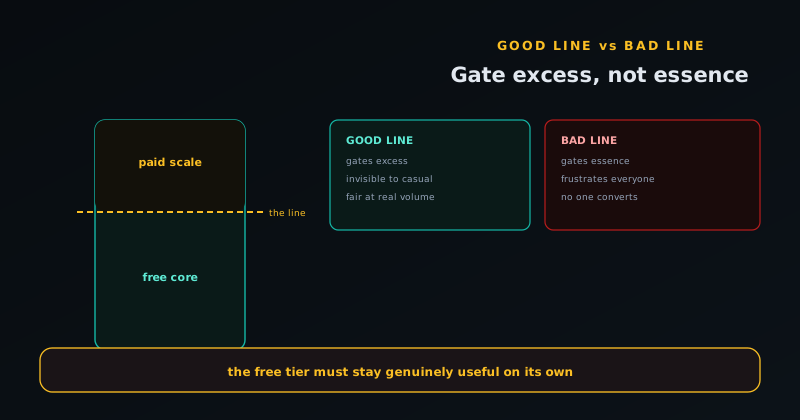
A good upgrade line gates something the free user does not need but the power user does: higher volume, advanced features, professional capabilities, scale. The free user never feels crippled because they get the full core value, and the power user hits the line naturally as their needs grow, at which point upgrading is an obvious yes. A bad upgrade line, by contrast, gates the core value itself (crippling the basic function, limiting the free tier below genuine usefulness, or holding the essential capability hostage), so the free user is frustrated rather than served, and many leave instead of upgrading. The difference is whether the line gates excess or gates essence.
The test for whether your line is good or bad is to ask what the free user experiences. If a typical free user can accomplish their real goal and walks away satisfied, the line gates excess and is well-placed; if a typical free user is blocked from their core goal and walks away frustrated, the line gates essence and is misplaced. A good line is nearly invisible to the casual user and only appears when their use grows serious; a bad line is felt immediately as a wall in the middle of the basic experience. Designing the line to be invisible to casual users and visible only at the threshold of serious use is the practical expression of gating scale rather than value.
A real example: an export-based line
A concrete example makes this clearer. Consider a creative tool where the core value is making something (editing a project, designing an asset), and the natural unit of serious output is exporting the finished result. A sensible upgrade line gates the number of exports rather than the editing itself: the free tier lets you edit fully and export a reasonable number of times per period, while heavier output requires the paid tier. The casual user who makes the occasional thing stays comfortably free and gets the full editing experience; the professional producing many finished pieces hits the export limit and upgrades, at a point where their volume genuinely justifies paying.
This export-based shape is a common one for creative tools: editing and saving stay free, while a paid tier lifts an export cap for the high-volume professional. Novus Visualizers itself takes a different route (it keeps editing, saving, and exporting all free and unmetered, funding the complete free product another way), but the export-based line remains a clean illustration of gating scale, not core value. The line sits at output volume (the point where casual creation becomes high-volume production) rather than at the core editing value, so a casual creator never feels crippled and a professional has a clear, fair reason to upgrade. The export-based line works because exporting is where casual use turns into serious output, the value to the user is highest, and the willingness to pay is clearest. It is a clean illustration of gating scale, not core value, in practice.
What you should never cripple
There are parts of a product you should never put behind the upgrade line, because crippling them undermines the free tier's ability to do its job. The core function (the thing the product is fundamentally for) should work fully in the free tier, because a free tier that cannot do the basic thing is not genuinely useful and fails as acquisition. The quality of the output should generally not be degraded in the free tier, because shipping deliberately worse results to free users damages trust and the demonstration of quality the free tier is supposed to provide. And the basic experience should not be made painful, because friction designed to force upgrades just drives people away.
The principle is that the free tier should be a genuinely good version of the product, limited in scale or advanced capability but not in essence or quality. The things you reserve for paid should be additions (more volume, more advanced features, professional extras) layered on top of a complete, high-quality free core, not subtractions that hollow out the free experience. Whenever you are tempted to cripple something to drive upgrades, ask whether you are gating excess or gating essence; if it is essence, you are weakening the free tier's real job. Protecting the core value, the output quality, and the basic experience in the free tier is what keeps it the genuine, useful thing that makes the whole model work.
Free as funnel versus free as the product
It is worth distinguishing two different free-tier philosophies, because they lead to different lines. In "free as funnel," the free tier exists primarily to convert users to paid, so the line is set to maximize conversion: useful enough to attract, limited enough to push upgrades. In "free as the product," the free tier is the main offering, genuinely complete and sustained by its own model (like ads), with paid as an optional layer for those who want more. These are different strategies, and the right line depends on which you are running, because a funnel free tier and a product free tier optimize for different things.
Confusing the two is a common mistake. A team that wants free to be the product but sets the line like a funnel ends up crippling the free tier they meant to be generous; a team that wants free as a funnel but gives away too much never converts anyone. Decide deliberately which model you are running: is the free tier the main thing, complete and self-sustaining, with paid as an extra, or is it the top of a funnel designed to convert? That decision sets where the line belongs. The Novus tools lean toward free-as-the-product (genuinely complete free tools, with any paid element as an optional layer), which is why their lines protect the core value so firmly. Knowing which philosophy you are running is what makes the line decision coherent.
Pricing the paid tier (the easier half)
Once the line is in the right place, pricing the paid tier is the comparatively easy part, because a well-placed line means the paid tier offers genuine additional value to people who genuinely need it, and such value can be priced by testing. The paid tier should be priced relative to the value it provides to the users who hit the upgrade line (the professionals and heavy users for whom the additional scale or capability is worth real money) rather than relative to the free tier. Because these users have a genuine need and are getting genuine value, there is real pricing room, and the price can be found through testing rather than agonized over in advance.
This is why the line matters more than the price: with the line in the right place, the price is a tunable parameter, while with the line in the wrong place, no price saves the model. A well-placed line creates a clear, valuable paid tier for a clear audience, and pricing that is a matter of testing what that audience will pay for the value they receive. A misplaced line creates either a paid tier no one needs (because the free tier gave everything away) or a free tier no one wants (because the line crippled it), and no amount of price tuning fixes that. Get the line right first; the price follows. The hard, decisive work is the line, and the price is the easier adjustment that comes after.
Test where the line goes
Like most pricing decisions, the right line is found partly through testing rather than pure reasoning, because where casual use turns into serious use, and what counts as a fair limit, depends on your specific users and product. You can reason your way to a sensible starting line (gate scale not value, keep the free tier genuinely useful, put the limit where casual becomes serious), but you should watch how real users experience it and adjust. If free users routinely hit the line doing normal things, it is too tight and is crippling the free tier; if almost no one ever hits it, it may be too loose to drive any upgrades. The real usage tells you whether the line is placed right.
The healthy way to test is to start generous and tighten only if needed, because a line that is too generous merely leaves some revenue uncaptured, while a line that is too tight actively damages the free tier's acquisition and trust work. Erring toward a more useful free tier is the safer error, since it protects the foundation the whole model rests on, and you can always introduce or adjust limits as you learn. Watch where real users hit the line, listen to whether they feel served or crippled, and move it deliberately. The upgrade line is the most important pricing decision you make, and treating it as something to place thoughtfully and then refine with real data (rather than guess once and forget) is how you get it right.
Frequently asked questions
Quick answers to common questions about this topic.
Where should the line between free and paid go?
Keep the core job fully free and genuinely useful, and put the upgrade where heavy users naturally hit a limit: volume, scale, collaboration, or convenience. The free tier should win users; the paid tier should reward the ones who outgrow it.
What is the risk of a too-limited free tier?
It feels like a trap and drives people away before they see value. A free tier that is too generous loses some revenue; one that is too stingy loses the audience entirely, and audience is usually the harder thing to get.
How does an ad-supported free tier change the math?
Ads can fund a fully free tier so there is no upgrade line at all, or a thin one for power features. See Free-first, ad-supported: delivering paid-tier features without a paywall.
Related troubleshooting
Was this page helpful?
Your answer stays in this browser, it is not sent anywhere and no account or cookie is involved.