2026 · Operating modelAbout 13 min readNovus Stream Solutions
Free-first, ad-supported: delivering paid-tier features without a paywall
The Novus product thesis made concrete: how the tools match or beat paid competitors while staying completely free, and why ad support fits this model better than subscriptions. Tied to real features, not abstractions.
Contents
- 1.Overview
- 2.What "paid-tier features without a paywall" means concretely
- 3.Why ads fit this model and subscriptions do not
- 4.Why "free forever" usually has an expiry date
- 5.Ads and the full product are aligned, not opposed
- 6.Three promises, one coherent design
- 7.The trust that genuinely free earns
- 8.Why this position is hard to compete away
- 9.Free as a filter on what gets built
- 10.Why this only works on top of the right architecture
Overview
The Novus product thesis is easy to state and hard to actually deliver: give people, for free, the features that competitors put behind a paywall, and make that sustainable rather than a loss leader that eventually has to be clawed back. "Free" is cheap to promise and expensive to keep, and the internet is full of tools that launched free, got popular, and then introduced the limits and paywalls that the economics always demanded. This post is about how the free-first model is made real instead of temporary: what "paid-tier features without a paywall" means concretely, why ad support fits this model where subscriptions would not, and why the whole thing rests on architecture rather than generosity.
The thesis only works because it is grounded in the cost structure, not in goodwill. A company can be as committed to "free" as it likes, but if every user costs it money to serve, the commitment is on a timer. The reason the Novus tools can credibly stay free is that they were built so that users do not cost much to serve, which turns "free forever" from an aspiration that reality eventually overrules into a position the economics actually support. Generosity is not a business model; architecture that makes generosity affordable is.
What "paid-tier features without a paywall" means concretely
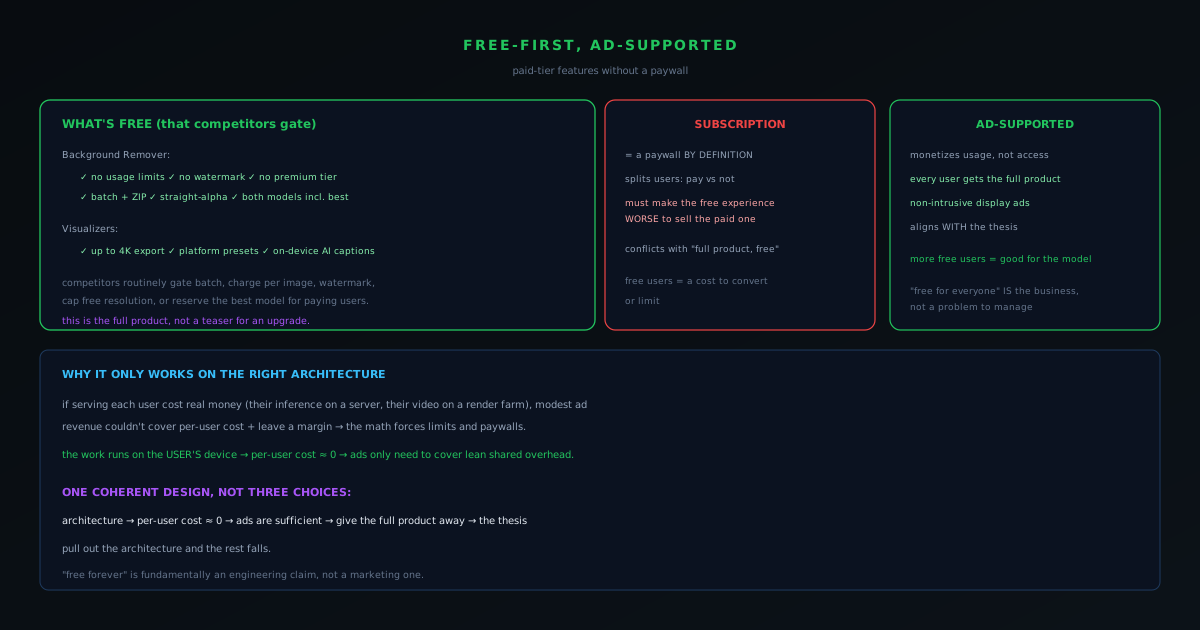
The thesis is only meaningful if it is tied to specific features, so here are real ones. The background remover (bgremover.novusstreamsolutions.com/background-remover) has no usage limits, no watermarks, and no premium tier: you can process as many images as you like, exporting true straight-alpha PNGs, with both a fast model and a higher-quality model available, all free. Competing tools routinely limit how many images you can remove for free, charge per image beyond a free allowance, watermark free output, or reserve their best model for paying users; the Novus tool gates none of that. The visualizer (visualizers.novusstreamsolutions.com/pricing) exports up to 4K, with platform presets and on-device AI captioning, free, where comparable tools often cap free export resolution, limit the number of exports, or reserve high resolution for a paid plan. These are not stripped-down free tiers designed to push you toward an upgrade; they are the full product.
The point of naming specific features rather than speaking abstractly is that "free" is meaningless without knowing what you get for free. A free tier that withholds the features people actually need is just a long advertisement for the paid tier. The Novus version of free is the opposite: the features that would be the paid tier elsewhere (no limits, full resolution, the best model, no watermark) are simply included. The product you get without paying is the product, not a teaser, and that is what "paid-tier features without a paywall" means in practice.
Why ads fit this model and subscriptions do not
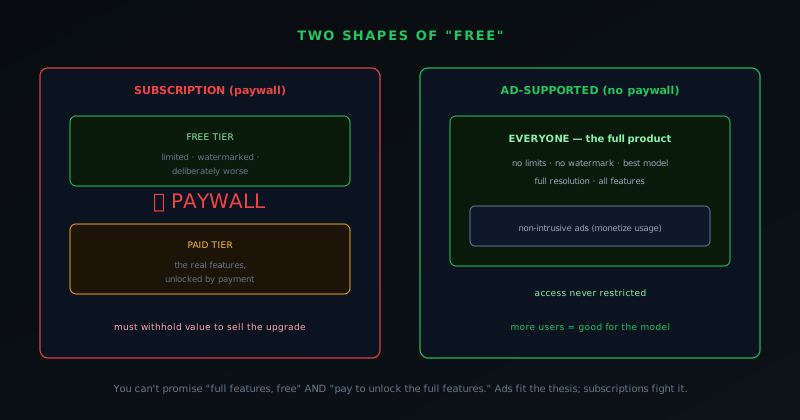
Given a free product, the monetization question is how it sustains itself, and the choice between ad support and subscriptions is not arbitrary: one fits this model and one fights it. A subscription is a paywall by definition: it divides users into those who pay and those who do not, and to make the subscription worth buying, you have to make the free experience worse than the paid one, which means deliberately withholding value from non-paying users. That is in direct conflict with a thesis whose entire point is to give the full product away. You cannot simultaneously promise "the full features, free" and "pay to unlock the full features"; the subscription model requires the paywall the thesis exists to avoid.
Ad support has the opposite shape. It monetizes usage without restricting access, which means every user gets the full product and the product sustains itself from the attention of the people using it rather than from gating features behind payment. Non-intrusive display advertising lets the tool stay completely free and completely full-featured while still generating the revenue that keeps it running. The model aligns with the thesis instead of undercutting it: more people using the free tool is good for the ad-supported model, whereas in a subscription model the free users are a cost to be converted or limited. Ads let "free for everyone" be the business rather than a problem the business has to manage.
Why "free forever" usually has an expiry date
It is worth examining why so many tools launch free and then walk it back, because understanding the failure mode clarifies what it takes to avoid it. The pattern is consistent: a tool launches free to attract users, grows popular, and discovers that serving all those users costs real money (a server bill that scales with usage) which the free model does not cover. At that point the economics demand action, and the action is always some form of taking value back: usage limits, watermarks, a paywall around the features that were free, a subscription. The free tier becomes a teaser for the paid one. This is not bad faith; it is arithmetic, the predictable result of promising free on a cost structure where free is not actually sustainable.
The lesson is that "free forever" is only credible if the cost structure makes it sustainable, not if the company is sincere about wanting it. Sincerity is irrelevant against arithmetic: a company that genuinely wants to stay free but loses money on every user will eventually have to charge, limit, or shut down, because wanting does not pay the bill. So the question to ask of any "free forever" promise is not whether the company means it but whether the economics support it: does serving a user cost them money, and if so, how is that covered. When the answer is that each user costs real money covered only by hope, the promise has an expiry date even if no one has set it yet. When the answer is that each user costs almost nothing because of how the product is built, the promise can actually hold. The difference is structural, which is why a sustainable free model is an engineering achievement before it is a business one.
Ads and the full product are aligned, not opposed
The deeper reason ad support fits the free-first thesis is that it aligns the business interest with giving away the full product, where a subscription opposes it. Under a subscription, the business needs the free experience to be worse than the paid one, because the gap between them is what people pay to close, so the business has a standing incentive to withhold value from free users, which is in direct tension with a thesis built on giving the full product away. The two cannot be reconciled: you cannot want the free product to be excellent and also need it to be deficient enough to drive upgrades. The subscription model structurally requires the product to be partly crippled for the people not paying.
Ad support has no such tension, because the business interest is simply that people use the product. More usage means more ad revenue, and the product does not need to be worse for anyone to generate it, so the incentive is to make the free product as good as possible and get as many people using it as possible, which is exactly what the thesis wants. The business goal and the user goal point the same direction: a great free product used by many people serves both. This alignment is why ads are not merely a tolerable way to fund free but the right way to fund this specific thesis, because they remove the conflict of interest that a subscription introduces between the business and its own free users. The model where everyone gets the full product and the business still thrives requires that giving away the full product be good for the business, and ad support is what makes that true.
Three promises, one coherent design
The free-first thesis, the ad-supported monetization, and the low-overhead architecture are often discussed as separate choices, but they are one coherent design, each making the others possible. The architecture drives the per-user cost to near zero; the near-zero cost makes ad revenue sufficient to sustain the tool; the sufficiency of ad revenue makes it possible to give the full product away without limits; and giving the full product away is the thesis. Remove any link and the chain breaks: expensive architecture would make ads insufficient and force a paywall, a subscription model would contradict the give-it-away thesis, and so on. The pieces are not independently chosen features but a single interlocking system.
Seeing them as one design is what explains why the model is hard to copy by adopting any single piece of it. A competitor cannot simply decide to be free-first without the cost structure that makes free sustainable, or adopt ad support while keeping an expensive architecture that ads cannot cover, or promise no limits on a per-user-cost model that will eventually force limits. The thesis works because all the pieces are present and mutually reinforcing, which is a higher bar than implementing any one of them. This is also why the model is durable: it is not resting on a single decision that could be reversed but on an integrated design where each part is held in place by the others. The coherence is the moat, and understanding the model means understanding that the free product, the ads, and the architecture are three views of one thing, not three things.
The trust that genuinely free earns
There is a benefit to being genuinely free that goes beyond the immediate value to users: it earns a kind of trust that a freemium tool cannot. Users have learned to be wary of "free," because so often it is a hook: a free tier deliberately made insufficient to push an upgrade, a tool that will introduce limits once you depend on it. A tool that is genuinely, fully free, with no watermark, no cap, no upgrade prompt lurking, behaves differently from that pattern, and users notice over time. The absence of the usual gating signals (and the fact that the promised features are actually all there) builds a trust that the tool is what it claims to be, which is rare enough to be a real differentiator.
This trust compounds into the kind of goodwill that a small operation cannot buy with marketing. A user who has experienced a tool being genuinely free, with no catch, is inclined to recommend it, return to it, and extend the benefit of the doubt to the rest of the ecosystem, because the tool has demonstrated rather than merely asserted its trustworthiness. The structural honesty of the free model (that it gives away the full product because the architecture lets it, not as a temporary loss leader) is something users come to sense, and it earns a loyalty that gated free tiers, which are always quietly working to convert their users, do not. Being genuinely free is not just generous; it is a trust-building strategy that turns users into advocates, which for a small operation relying on word of mouth is worth more than the revenue a paywall might have extracted.
Why this position is hard to compete away
The free-first position is more defensible than it might appear, because a competitor cannot easily match it without the underlying architecture that makes it sustainable. A competitor running server-side tools cannot simply decide to give away what they currently charge for, because every free user would cost them money they have no way to recover at the modest revenue of ads: the move that is sustainable for an on-device tool is financially ruinous for a server-side one. So the free-first model is not a pricing decision a competitor can copy by lowering their price; it is a consequence of an architecture they would have to rebuild their product around to match, which is a far higher bar than a price change.
This is why the architecture is the moat rather than the pricing. Anyone can announce a free tier; almost no one can sustainably give away the full, unlimited, professional-grade product, because doing so requires the per-user cost to be near zero, which requires the client-side architecture, which requires building the product a particular and harder way from the start. The competitors most likely to challenge the position are not the ones who undercut on price but the ones who adopt the same on-device approach, because they are the only ones for whom the economics of genuinely free actually work. The defensibility of the free-first model comes from the difficulty of the architecture beneath it, which means the operation's commitment to building hard, client-side tools is simultaneously what makes the product good and what makes its business model hard to compete away. The moat and the product are built from the same decision.
Free as a filter on what gets built
A consequence of the free-first commitment that is easy to miss is that it acts as a filter on what the operation builds, steering it toward products that can be delivered well for free and away from those that cannot. Because the model requires the per-user cost to be near zero, it naturally favors products whose heavy work can run on the user's device, which is the same class of products the runs-almost-free operating filter favors. The commitment to free is therefore not just a pricing stance but a product-selection principle: it rules out ideas that would require expensive per-user infrastructure and rewards ideas that fit the client-side, low-cost shape, which keeps the whole portfolio coherent.
This filtering effect is part of what gives the ecosystem its consistency. Every product in it can be free because every product was, implicitly, selected to be the kind of thing that can be free, a tool whose value can be delivered on the user's own hardware without an ongoing cost to serve. A product that could only work with heavy server-side processing would fail this filter and not get built, the same way the shelved projects that required always-on infrastructure or heavy paid APIs failed the broader operating filter. The free-first thesis and the product-selection discipline are the same principle seen from two sides: the commitment to free shapes what gets built, and what gets built makes the commitment to free sustainable. The result is a portfolio that is coherent precisely because a single constraint (must be deliverable well for free) governed both the business model and the choice of products.
Why this only works on top of the right architecture
The free-first, ad-supported model would collapse on the wrong architecture, which is why so many free tools cannot sustain it. If serving each user cost real money (a server running their inference, a render farm encoding their video) then ad revenue would have to cover that per-user cost plus leave something over, and at the modest revenue of non-intrusive ads, the math often does not close, which is exactly what pushes such tools toward limits and paywalls. The reason it closes for the Novus tools is that the expensive work runs on the user's own device, so the per-user cost to serve is near zero. Ad revenue does not have to cover a per-user processing bill because there is not one; it only has to cover the lean shared overhead, which the low-cost architecture keeps small. The model is sustainable because the cost it has to cover is small, and the cost is small because of how the tools are built.
This is the throughline connecting the whole operating model: the free-first thesis, the ad-supported monetization, and the low-overhead client-side architecture are not three separate choices but one coherent design. The architecture makes the per-user cost near zero; the near-zero cost makes ad support sufficient; ad support makes it possible to give the full product away; and giving the full product away is the thesis. Pull out the architecture and the rest falls, which is why "free forever" is, fundamentally, an engineering claim rather than a marketing one. The companion posts cover the architecture that underwrites it and the AdSense reasoning on the content side of the business.
Frequently asked questions
Quick answers to common questions about this topic.
How can a free tool offer paid-tier features?
By funding the tool with non-intrusive ads instead of subscriptions, and building on a zero-marginal-cost architecture so usage does not create cost. That combination lets the free tier carry features competitors lock behind a paywall.
Why choose ads over a paid subscription?
Ads keep the core tool open to everyone, including users who would never pay for an occasional utility.
Does free-first mean a worse product?
No. The goal is for the free version to match or beat paid alternatives on features; the funding model is separate from the quality of the tool.
Related troubleshooting
Was this page helpful?
Your answer stays in this browser, it is not sent anywhere and no account or cookie is involved.